
Poems Sneaking Through a Sieve
Riley Cavanaugh
Have a Nice Day Press
2022
Spiral-bound softcover
8.5 × 6.25 in.
66 pages
Digital printing
Edition of 500

Poems Sneaking Through a Sieve combines poems from two series, one derived from spam emails and the other from CAPTCHAs, into a single, spiral-bound compendium. Riley Cavanaugh’s visual poetry and hand-drawn annotations are accompanied by a short foreword by the publishers, Lele Buonerba and Laurel Hauge, and a longer critical essay by art historian and curator Nina Wexelblatt. The book’s high-quality digital printing conveys the low quality of the source images and renders an aggressive gamut of colors from which our spam filters typically protect us. The spam filter is the most literal meaning of the titular sieve, but that symbolism carries through more broadly in Cavanaugh’s concern with attention, boundaries, and communication.
The book’s foreword gives a brief history of spam emails and CAPTCHA authentication before explaining Cavanaugh’s motivations and process. It helps attune the reader without spoiling or speaking for the poetry that follows. In contrast, it is good that Wexelblatt’s contribution comes after the poetry. I certainly enjoyed returning to the poetry after reading Wexelblatt’s essay, but I was glad I first had the opportunity to struggle on my own toward some of the same conclusions that she makes so convincingly. Likewise, the inclusion of a mind map by Cavanaugh, also after the poetry, succinctly lays out the connections between both poetry series and Cavanaugh’s artistic lines of inquiry. Readers without the unenviable task of following Wexelblatt’s essay with their own review will no doubt appreciate her analysis as well as the opportunity to peek inside Cavanaugh’s brain.

Understanding how Cavanaugh connects ideas is especially important since connectivity itself is a central theme — connections between people but also between distinct bodies of work like the spam poems and CAPTCHA poems. The spam poems, which are written by redacting real spam emails, retain the hyperbolic vocabulary that likely triggered the spam filter. Cavanaugh excavates the desperate language of desire that drives these emails. Transformed into poetry, the trademarks of low-budget marketing (attention, urgency, calls to action) are generically erotic, even if some of the original emails were not. If each distillation of urgent desire is somewhat repellant, their accumulated effect nevertheless appeals to the reader as the book progresses.
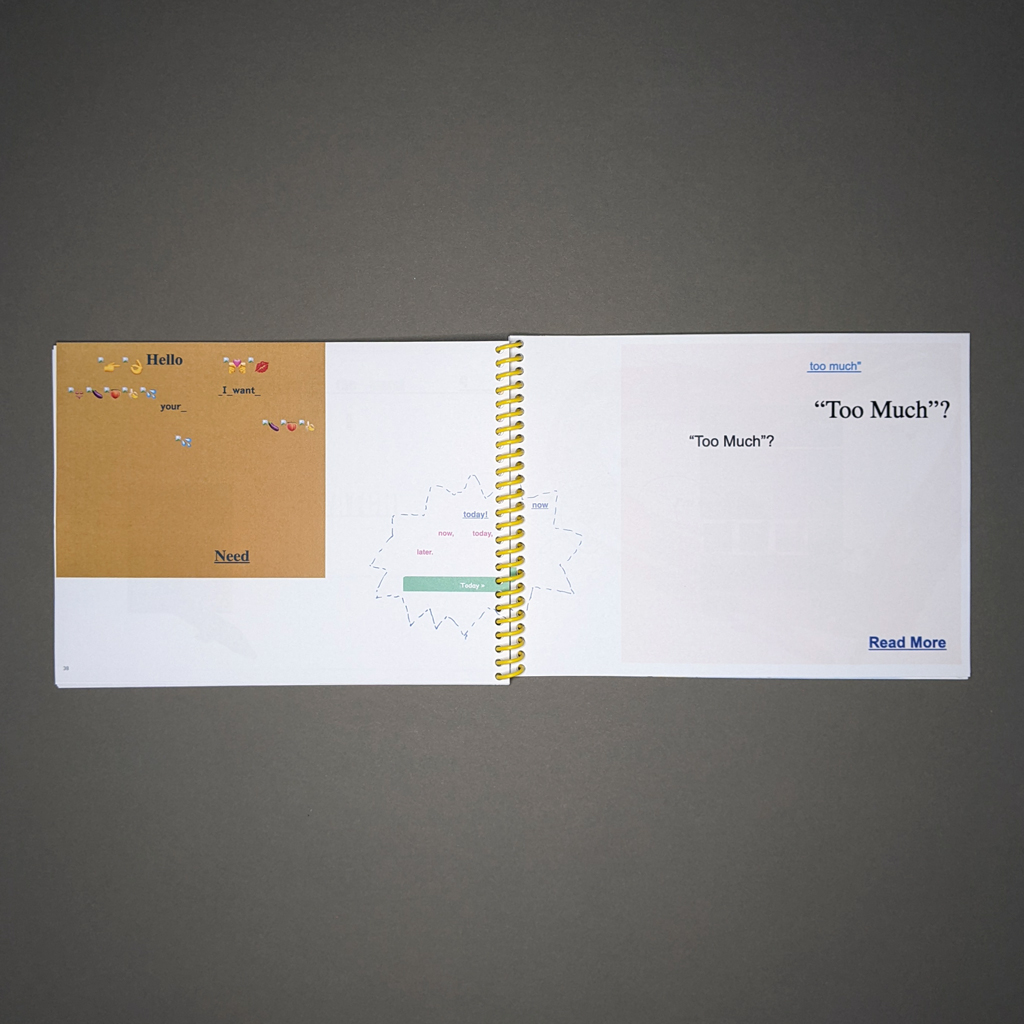
While the spam poems, with their direct address, are all about “you,” the CAPTCHA poems look inward. They reside in the pregnant pause where we question whether we are human, or at least where the seamless flow from one website to another is interrupted, and we are suddenly made aware of our own web-surfing. The earlier CAPTCHAs (distorted strings of letters) make their appearance throughout the book, but the CAPTCHA poems are based on Google’s now-ubiquitous photo CAPTCHAs, where a grid of images or a single image split into a grid asks the user to robotically identify a certain noun (e.g., “select all squares with traffic lights”). Cavanaugh responds to each CAPTCHA as if the challenge to prove one’s humanity calls for free association, word play, memory, and other acts of human creativity. Mostly, Cavanaugh adds text directly into the image grid, but they also respond with photographs of their own. For example, a CAPTCHA full of chimneys prompts a prose poem about a bird and then a photograph of two hooded crows.

Overall, the visual aesthetic is driven by the photo CAPTCHAs and spam emails. Whitespace predominates, signaling Cavanaugh’s redactions and lending a sense of movement to counteract the gridded frames of browser windows, photographs, and text fields. The space also leaves room for Cavanaugh’s playful interventions: emoji hearts float away from an email, lane lines extend a road from photograph to drawing, a fire hydrant casts a second shadow. Most importantly, the book’s negative space enacts the separation that is a precondition for Cavanaugh’s connections.

The careful attention to layout is enhanced by the book’s structure. The yellow plastic coil that binds the book is a conspicuous presence in the gutter, and even when elements cross that boundary, the spreads tend to feature two separate focal points in a dynamic relation with one another. The margins are less active than the gutter, and it is curiosity rather than any visual device that drives the reader to turn the page. The reader’s advance is evenly paced, and the book could be read rather quickly — except the whole point is to pay attention to text and imagery that is usually overlooked.
CAPTCHAs and spam are means to an end. We look and click through them on our way to a goal, whether our own or an advertiser’s. But in Poems Sneaking Through a Sieve, Cavanaugh looks at, instead of through, these communications and recovers a non-instrumental aesthetic pleasure. The book is an exercise in attention, whereas a spam filter only reduces distractions. Instead of speaking louder, it asks the reader to listen more carefully. Cavanaugh challenges binary assumptions about signal and noise, human and other, separate and connected. Between these binaries is the medium, the messy terrain where communication takes place. The sieve. The book.
As a sieve, the book also practices a certain resourcefulness, making art from the digital dustbin. Published just months before ChatGPT went mainstream, the book anticipates the need for artists to work in visual and textual economies flooded with AI-generated “content.” Cavanaugh’s prescient contribution affirms the mission of Have a Nice Day Press: to publish artists’ books informed by internet culture. It shows a deep understanding of media — print and digital, human and machine — and what happens when they collide. It also lives up to Cavanaugh’s interests in play, attention, and connection: Poems Sneaking Through a Sieve is accessible and engaging.
 Artists’ Book Reviews
Leave a comment