
Yet to Be Delivered
Sveinn Fannar Jóhannsson
2023
Multinational Enterprises
Single sheets bound with prong fastener
28 pages
8.3 × 11.7 in. closed
Ink jet
Edition of 50
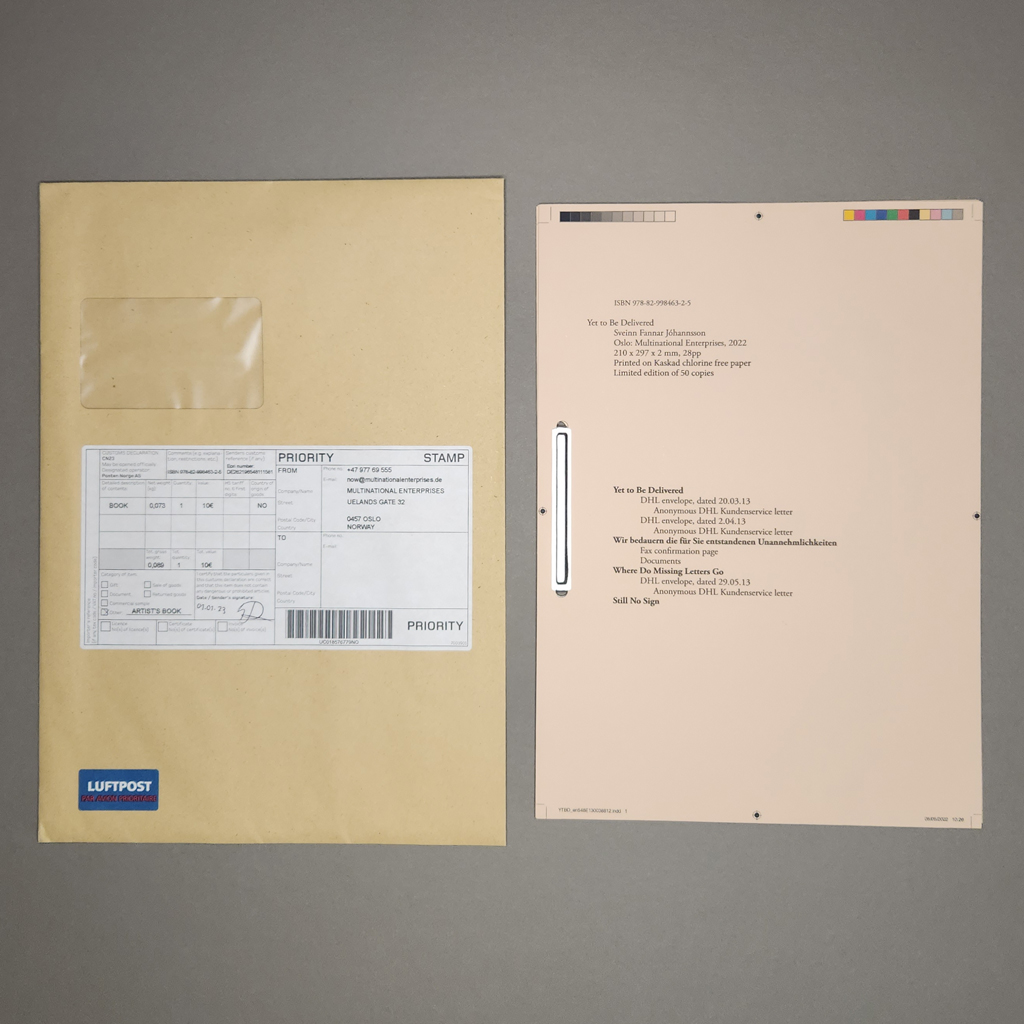
A subgenre of publishing which always entices me is the “document”—that flimsy thing which usually emerges from a very short pipeline between need and form. I worked for a short time at a business responsible for a good amount of documents—financial reports, business-to-business catalogs, investment pitches, payday loan mailers. Documents are the bulk of our postal system and the printed output of most of the industrialized world. The document has a confusing and paradoxical shelf-life—important as a record of the internal movements of governmental and corporate entities, yet concerned very little with its own material persistence. Constantly appearing in the visual language of the corporation are the “xerox”, the memo, the scanner, the extra-crunchy burned copy. Documents can be seen as a kind of id of the published world, emanations of an enduring system of administration.
Sveinn Fannar Jóhannsson’s Yet to Be Delivered begins with a cover-cum-title page-cum-colophon which reads like a shipping label, or a manifest, or a packaging insert you’d receive with an order from [Insert Online Merchant]. The book is made entirely of copies and scans of a series of letters between Jóhannsson and DHL’s customer service, printed simplex on A4 salmon Kaskad chlorine-free paper, collated with a metal prong fastener. Its margins house printer’s marks which, like its title page, elevate the conditions of book production into the paratext of the work. Perhaps fittingly, my copy has some small creases in the corners from handling, storage, and shipping.

Jóhannsson informs DHL that they have misplaced a package of 6 Daily Optik Champagne Glasses in the mail, “in their original packing case.” The story which unfolds details his attempts to determine where they are and how they were lost. Jóhannsson takes on an investigative and archival role, approaching the documentation between himself and DHL with a fastidiousness which can only be described as institutional. The aforementioned title page lists the 28-page collated publication as being specifically 2 mm thick; it contains a table of contents separated into sections, chapters in a tragicomedy of attempted interface with the bloated, hydratic bureaucracy.
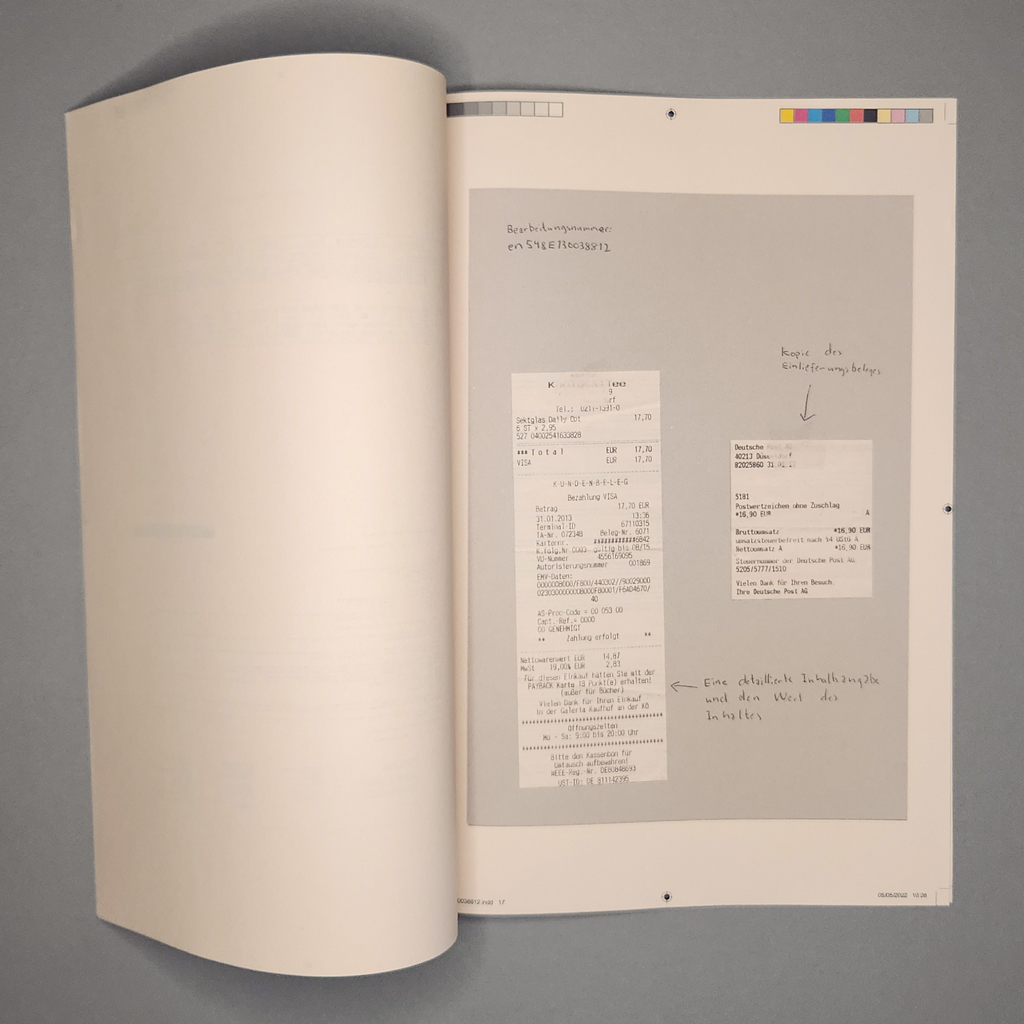
The primary conflict highlighted in Yet to Be Delivered is a corporate hollowness contrasted with the artist’s insistent humanity. The checklist-reply contrasts with the torn edge of the opened letter. Jóhannsson is speaking to this automated system with a casual and emotional looseness which is then cast in stark relief against a history of the document as a unilateral expression of power (the decree, the notice, the bill). If corporate correspondence and the technologies which facilitate it are integrated into the needs of the increasingly larger organ of administrative surveillance (as laid out in Kate Eichhorn’s book, Adjusted Margin), then Yet to Be Delivered can be seen as an act of sousveillance, subversion by Jóhannsson which seeks to uncover its humanity, point out its flaws, hold it to task.
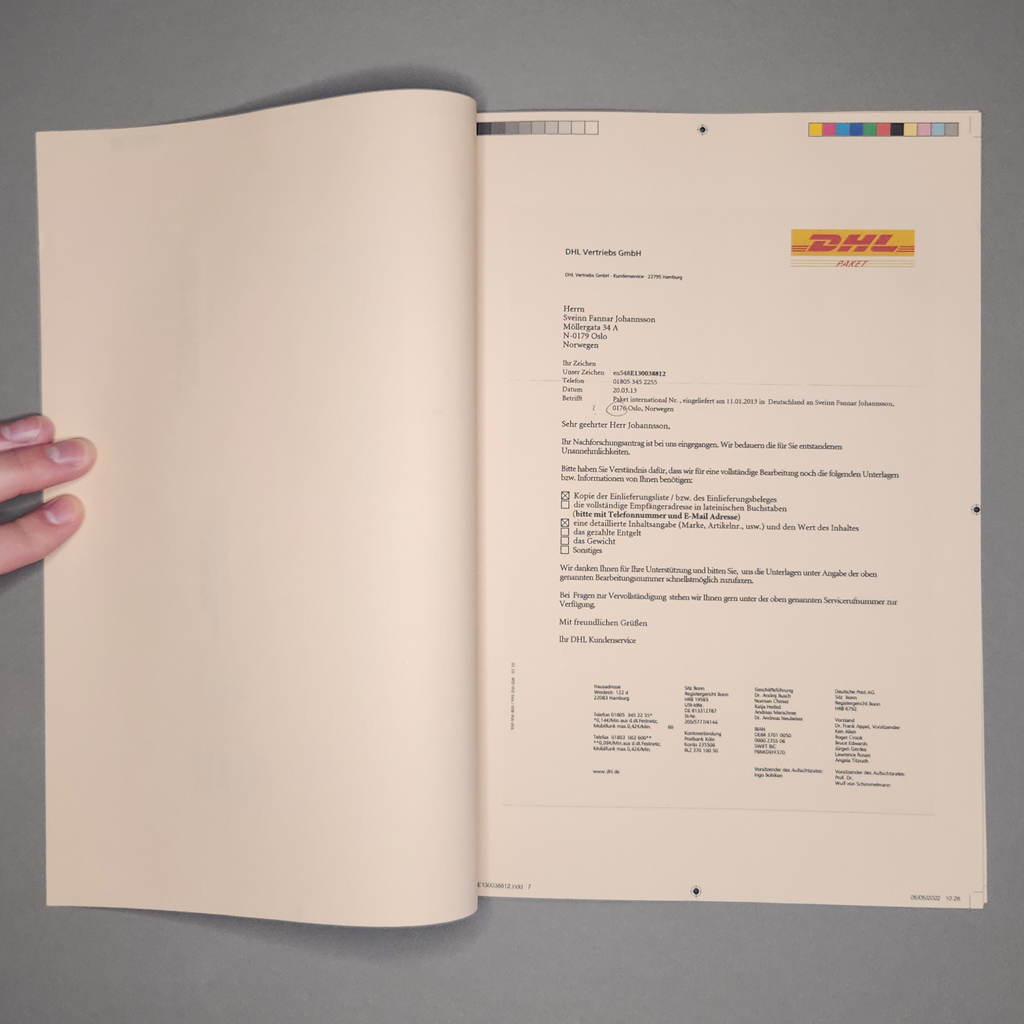
Jóhannsson’s effort, however, does not uncover the humanity of the system. It does not budge. Instead, Jóhannsson exacerbates the system’s glacial heft, its amnesia. The automatic reply and Jóhannsson’s incorrectly labeled address (circled by the artist each time it appears) reveal this exchange to be apostrophe, not correspondence. Flipping through the book, a viewer might easily lose track of their place—the identical letters are only distinguishable by their date, the paratext of the printer’s marks, and the artist’s own notations.

Yet to Be Delivered brings a familiar dizziness and discomfort. Between receiving this book and finishing this writing, the nation was, and remains, strongly divided over the assassination of Brian Thompson, the CEO of United Health, the nation’s largest health insurance conglomerate. During his tenure, profits expanded and services diminished. Meanwhile, ever more wealth trickles upward into a smaller pool of people while life expectancy—and quality— decline in the United States. Among many working class people, healthcare professionals, and activists alike, there is no love lost. While reading this book, I am reminded of the confusion I felt after being told by my own health insurance company that I may not be covered for a necessary procedure for a chronic illness (a mere two days before it was scheduled); I am reminded of the unwelcome surprise of a confusing bill for a service I was assured was covered; I am reminded of the two-year process of attempting to settle disputes between two different insurance companies (under the same umbrella company) who each insisted that they were not on the hook for an ER visit after an unfortunate incident cutting bok choy.
Yet to Be Delivered resonates deeply with me right now, a time in which it feels like institutions are receding ever further into the black box, where it feels like we can make shallower and shallower dents into their impenetrable hides. Jóhannsson carries on, circles the mistakes of “DHL”—a collective system in reality but an individual in the fictional narrative of the letters. He speaks in apostrophe, reprimands them, asks of them, as I do: “You really have no idea, do you?”
 Artists’ Book Reviews
Leave a comment