
Interruption: A List of Words and Phrases
Julie Graves Krishnaswami
Design by Megan Mangum
2022
the jenny-press
Self-covering accordion with thread loop for hanging
7.5 × 5.5 in. closed
Offset printing
Edition of 300

Interruption: A List of Words and Phrases is based on Julie Graves Krishnaswami’s 2021 Interruption Carbon Series. The original drawings, made through an elaborate process with stenciled vinyl letters and carbon paper, trade some of their material qualities for an impressive visual presence — the accordion book stretches over eight feet long — and additional context from its sharply written foreword. Since the book’s text is gathered from decontextualized fragments like “pardon me” and “may I interject,” the foreword helpfully identifies their source (proceedings at the U.S. Senate Judiciary Committee) and notes that the interrupted speakers are all women. By pairing text from the halls of power with materials evoking pink-collar clerical work, Interruption spotlights the silencing of women from all walks of life.

Krishnaswami examines the phenomenon of women being interrupted through drawing and performance, but the accordion book structure is particularly well suited for the poetics of continuity and discontinuity. That very quality can also pose problems — how to separate the text and paratext or how to treat the outside and inside covers — which designer Megan Mangum cleverly resolves. The front cover of Interruption unfolds horizontally like a typical codex. The three-page foreword is housed in this bi-fold, separating it from the “list of words and phrases,” which tumbles down vertically on lighter weight paper.
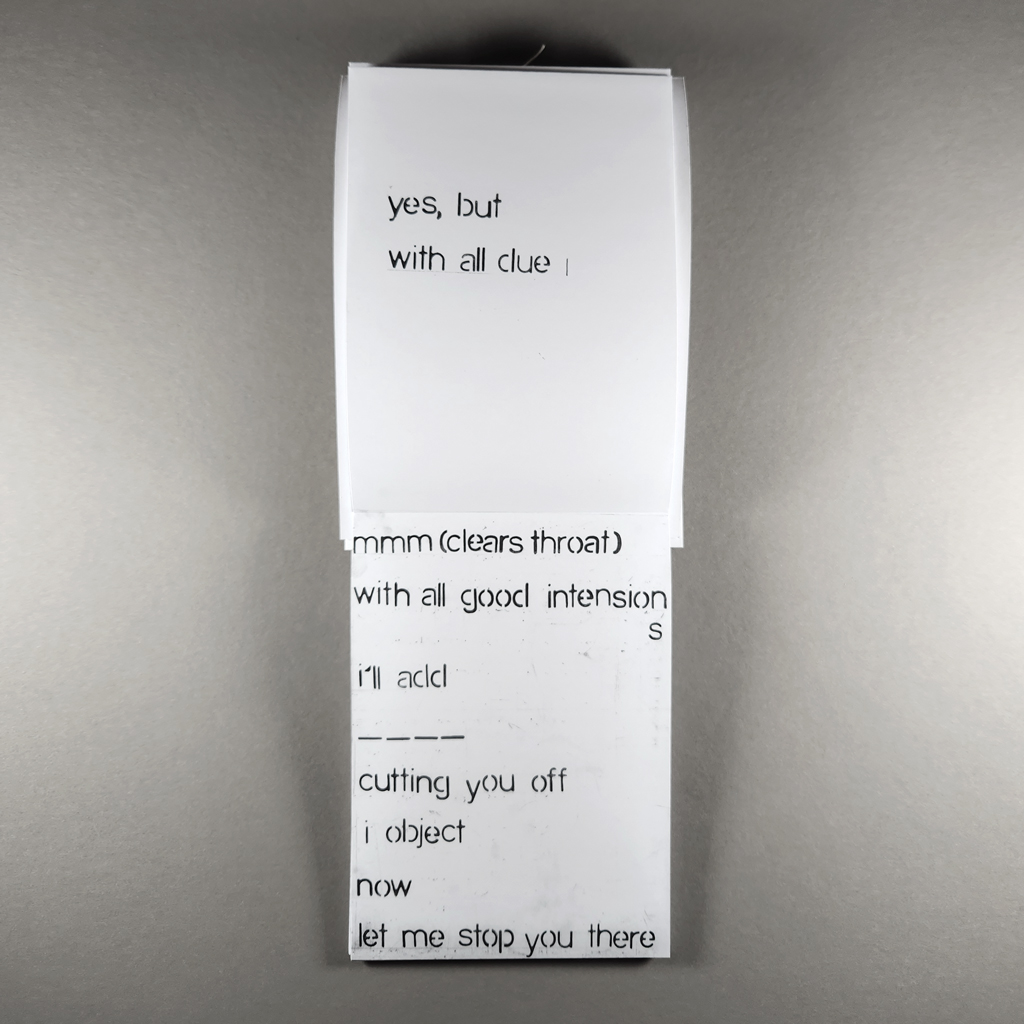
In an accordion, the folded page breaks are present but attenuated, and the book can be read page by page or seen all at once. In fact, a thread loop is sewn through the cover’s spine so the book can be hung vertically. Thus, the book stops incessantly, but the list of interruptions seems endless. The paradox of endless ending is accentuated by the page layout. A phrase like, “let me stop you there” might land just above a folded edge, but elsewhere a yawning gap follows “with all due,” marking the space where “respect” ought to be — but isn’t.
The partial page breaks of the folded panels are enough to gently organize the text. Rhythms and patterns emerge from what first appears to be a random selection of interruptions. The phrases seem to follow Krishnaswami’s train of thought rather than their order of appearance in the original Senate transcripts, and the artist’s acerbic humor comes through in her sequencing and juxtaposing. Krishnaswami’s presence, which is critical given the issues at stake, also manifests in traces of her hand — smudges and stray marks, outlines and guidelines — which the book’s offset printing convincingly transmits. (Indeed, I found myself reflexively checking my fingers for graphite despite knowing the book is printed.) Digital tools could make quick work of finding and aggregating interruptions in a Senate hearing, but Interruption foregrounds cognitive and manual labor.

The value of labor — pink collar, professional, artistic — is central to Interruption but remains provocatively unresolved. In the foreword, Krishnaswami argues that if even the most accomplished and powerful women are disrespected in the U.S. Senate, then everyday women hardly have a chance. But a Senate hearing isn’t everyday speech. Nominees and expert witnesses grandstand, stonewall, duck questions, and bloviate. One might argue that Krishnaswami’s source text differs from everyday speech by type, not merely degree. Amid all too familiar interjections, “reclaiming my time” reminds the reader of the Senate’s rules of order.
On the other hand, power plays and performance are hardly relegated to C-SPAN. If Krishnaswami said Interruption was based on a staff meeting, I would believe it. Interruption is about structure — linguistically, artistically, and politically — rather than content. The use of “I” and “you” in most of the excerpts further blurs the original context, thrusting the reader into both roles, interrupter and interrupted.
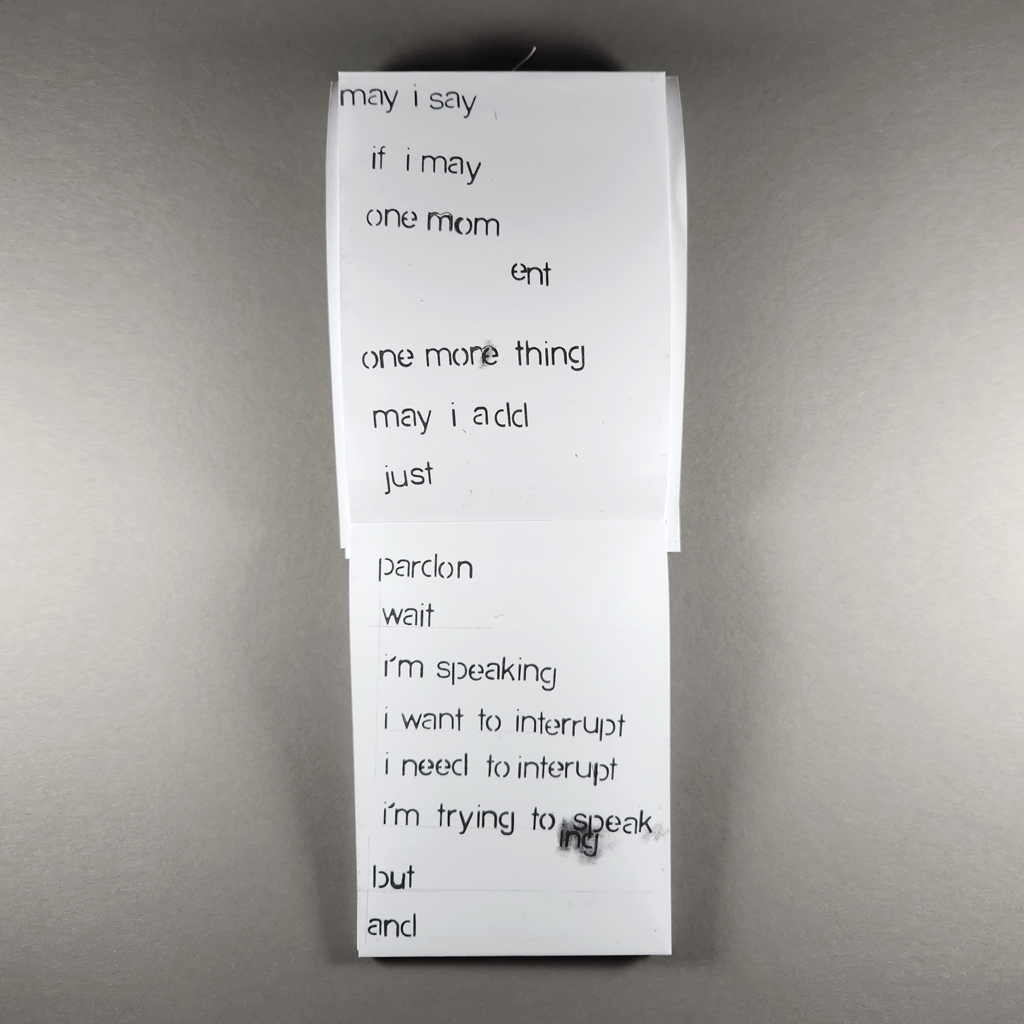
Ultimately, Interruption is, itself, an interruption. By defamiliarizing ubiquitous phrases, it calls attention not only to the larger phenomenon but to important nuances within everyday speech. Consider the escalating urgency in “I want to interrupt / I need to interrupt” or the difference between “I’m speaking” and “are you hearing me.” As an interruption, the book’s ability to hang for display is more than an afterthought. Imagine if it were hung in a boardroom or a classroom, an insistent reminder of the power behind practically invisible words and phrases. Not a panacea, to be sure; like the folded edge in an accordion, Interruption is only a pause, a moment to reflect before stopping or carrying on.
 Artists’ Book Reviews
Leave a comment