
Workshopping at WSW
Emily Larned
2025
Alder & Frankia
22 pages
4.375 × 11 in. closed
Saddle stitch with gate folds
Risograph
Edition of 500
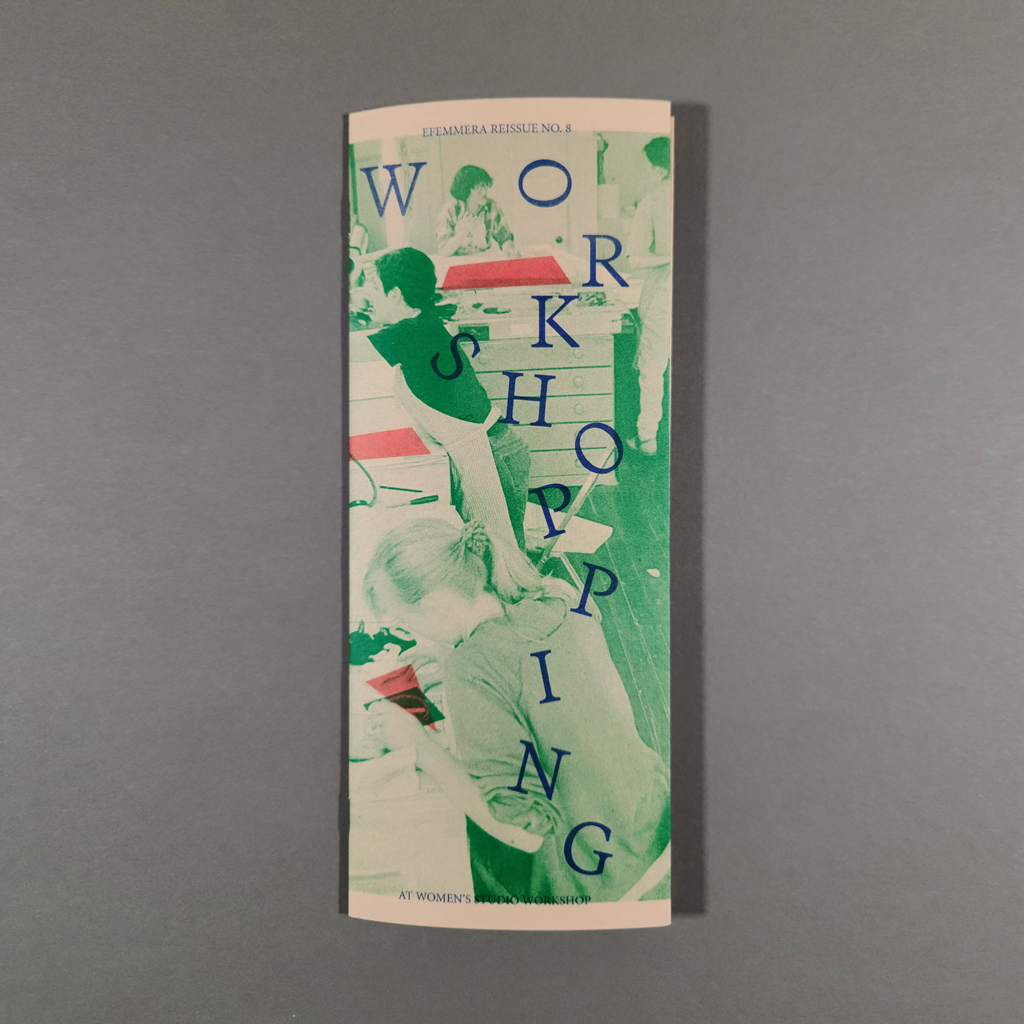
Workshopping at WSW is essentially a catalog of workshops held at the Women’s Studio Workshop in Rosendale, NY — except the workshops are from 1983–1999, and some of them never ran. The staple-bound pamphlet is part of Emily Larned’s Efemmera Reissue series, under her imprint Alder & Frankia, which is dedicated to reinterpreting and recirculating feminist ephemera. Workshopping is a charming slice of time, and the reader sees Larned’s hand making the slice. By valorizing overlooked administrative labor, Workshopping puts into practice the feminist ideals it documents.
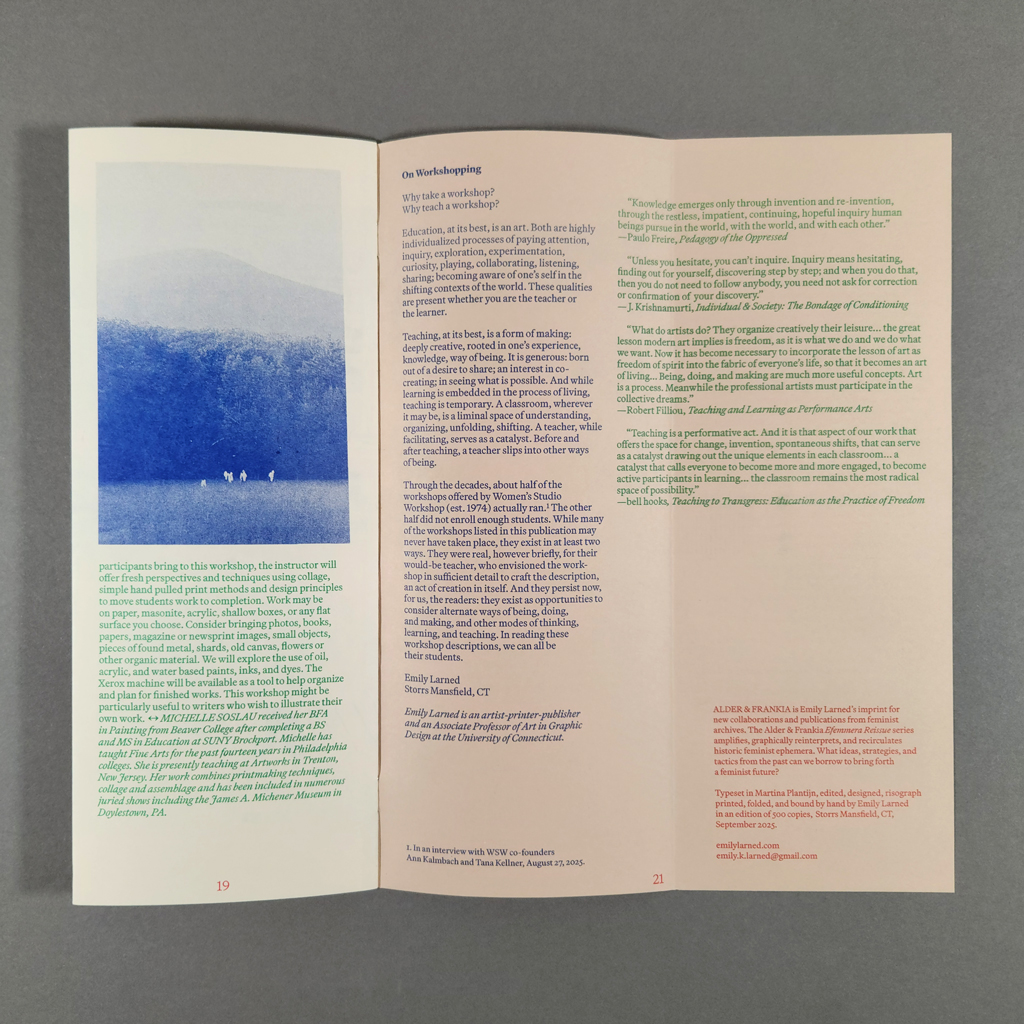
It is easy to imagine that the original WSW newsletters and catalogs looked something like Workshopping. Its narrow format, toned paper, and three-color Riso printing could pass as a conventional brochure, although its gate folds make the simple structure surprisingly interactive. The text — descriptions of workshops and brief bios of the facilitators — is reproduced verbatim. Some of the workshops feel of their moment, and others could be offered today. They index the progress made by women artists and the work that remains to be done. There are workshops on specific techniques, theories, and histories, and others that are more about empowerment and consciousness raising. Many challenge the boundary between art and the everyday, like Linda Montano’s “Learning to Pay Attention (Art for Life)” and “Circulating Energy,” in which the famed performance artist would help participants work through trauma.

The entries are organized chronologically, with the years “stamped” in red ink, forming a timeline down the right margin. Larned has added meticulous image credits and notes about missing information plus a reflective statement on teaching and learning. There are also photographs from the WSW archives, printed in blue monochrome, which give a sense of the studio but do not document the specific workshops in the text. Larned has overprinted green and red forms to accentuate details in the photographs, as one might highlight a passage of text. Tucked into the back inside cover is a self-addressed envelope. Instead of sending payment for a workshop, the enclosed form encourages readers to submit their own imagined workshop to Larned’s exhibition at WSW, also titled Workshopping, which runs from October 3, 2025–January 23, 2026.
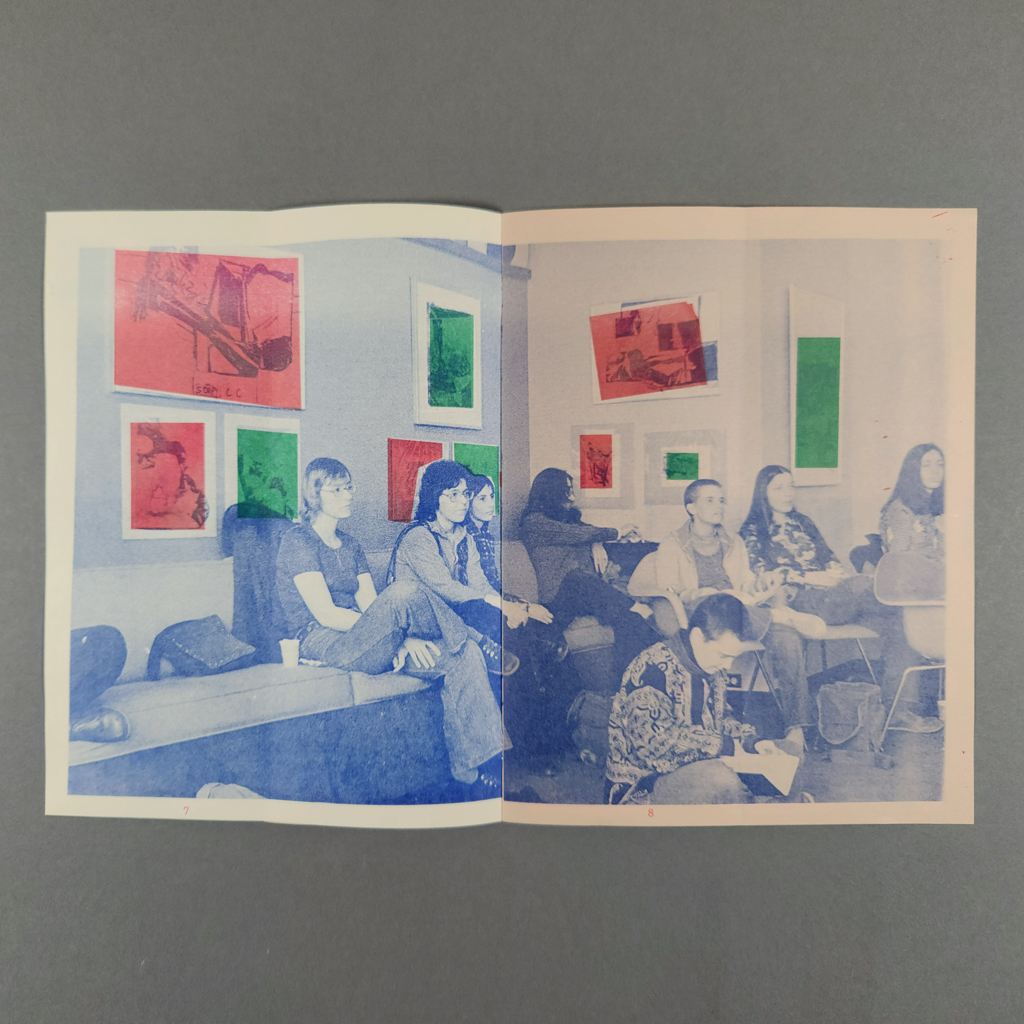
The publication is interactive in more subtle ways, too. The gate folds conceal content, inviting readers to reveal images behind the text much as Larned uncovers unfamiliar ephemera in the archive. The overprinted additions to the images remind the reader that Larned’s intervention is not neutral: she chooses what to include and exclude. What might be discounted as administrative or editorial labor — compiling a pamphlet from extant texts — is also writing, art, design, and curation. Most notably, Larned has excluded straightforward book arts workshops in favor of more experimental, cerebral, and therapeutic offerings.

The selection makes a stronger case for Larned’s argument that envisioning and proposing, much less leading, a workshop is a considerable creative undertaking. It also means that many of the workshops likely never ran. As Larned’s project statement explains, only about half of proposed workshops filled, and the ones presented in Workshopping are hardly the most practical. The descriptions represent artists imagining experiences that did not yet exist and taking calculated risks, balancing what seemed interesting and important with what would attract participants. In other words, creating a workshop isn’t so different from making art. The reader also gets to imagine the workshops into existence. Without knowing which workshops really ran, they are equally real in the mind of the reader. This is the power and peril of archival sources: so much is left to the imagination.
Larned neither romanticizes nor demonizes the archive — she uses it. The Efemmera Reissue series reanimates feminist ideas to put them into practice. In Workshopping, that mission is threefold: the workshop descriptions have ideas that remain valuable today; readers can contribute concepts of their own; and Larned models a feminist archival methodology. By inviting its readers to contribute speculative workshops, Workshopping produces another archive. Workshopping is reciprocal, not extractive, as concerned with the future as it is with the past.
 Artists’ Book Reviews
Leave a comment