
Recueil no. 1
Mélyna Dall’ara
2025
16 pages
5.5 × 8.25 in. closed
Stab binding
Digital printing with relief printed insert
Edition of 20 copies
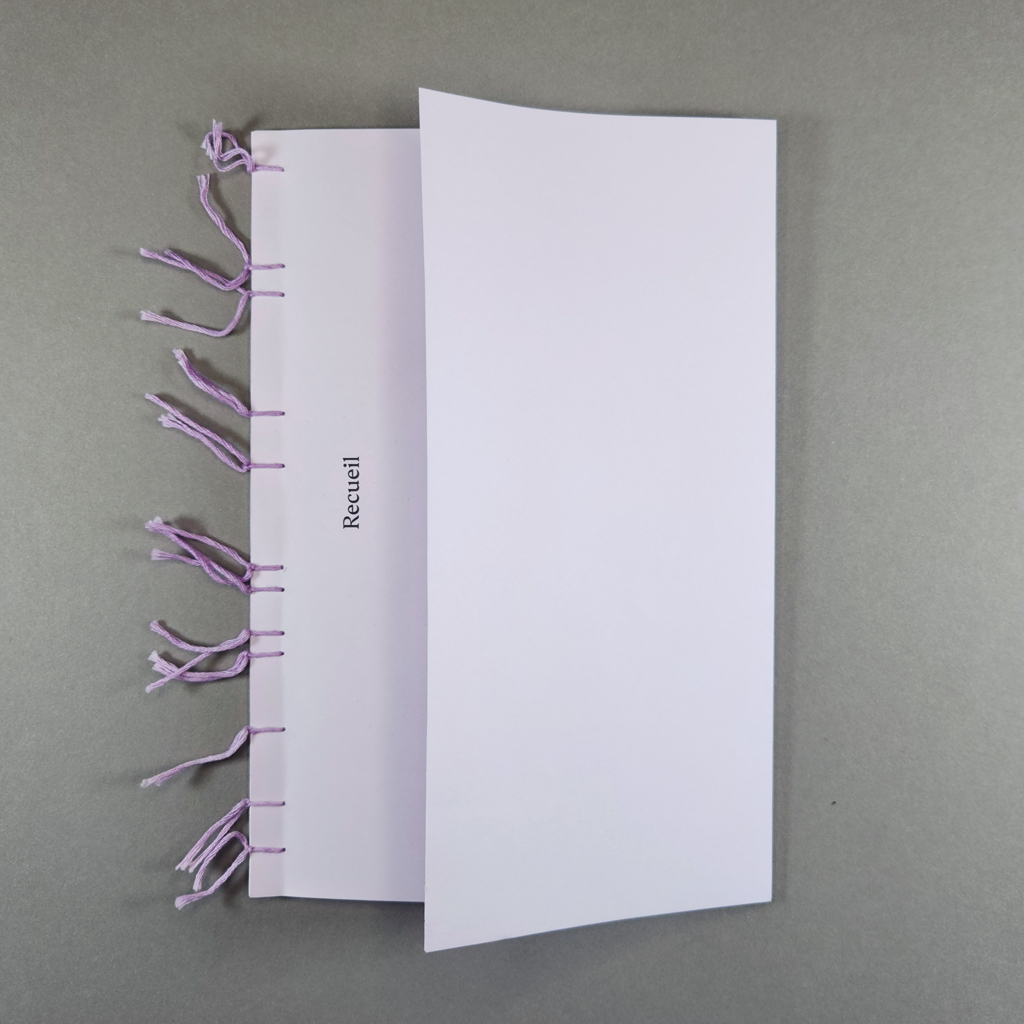
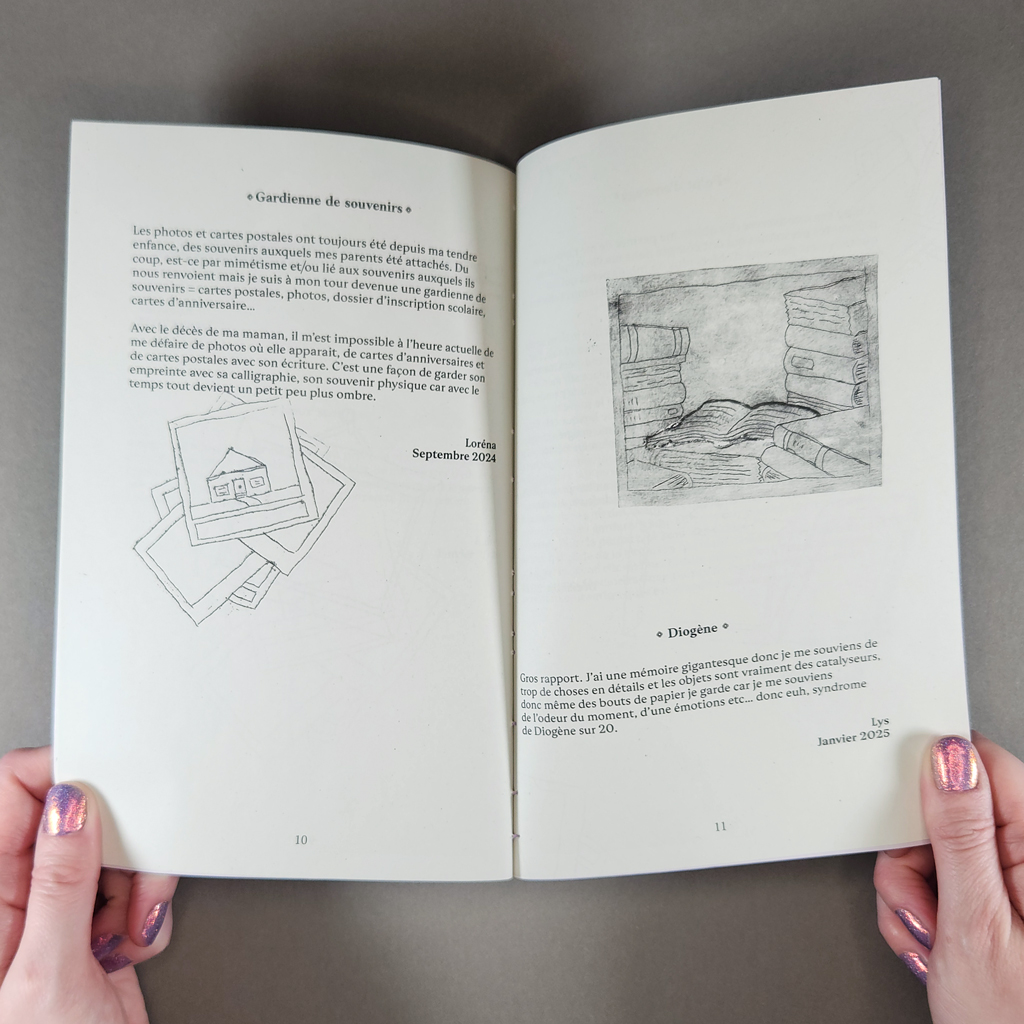
Recueil, French for collection or anthology, is a micro-magazine published by graphic designer Mélyna Dall’ara. The magazine’s mission is to spotlight ordinary people and practices. In this first issue, contributors share about a significant object they have kept. Their short testimonies are illustrated with charming Tetra Pak engravings by Dall’ara. Reproduced and digitally manipulated, the illustrations distill the issue’s underlying themes: the materialization of memory amid increasing digitization.
In both subject and style, Recueil stems from Dall’ara’s master’s research in design. As a designer, she views her role as a sort of cultural mediator. In Recueil she explores how private, individual acts can, in fact, connect people with one another. Along with ordinary people, Dall’ara is invested in ordinary materials, which provide her with generative constraints. She blends digital and analog techniques and blurs the lines between art, design, and craft. By collecting anecdotes about collecting, Dall’ara flattens the hierarchy between herself as publisher and her contributors. This sensibility will continue in the second, forthcoming, issue of Recueil, which will address cooking — another everyday creative act rarely afforded the status of art.
The magazine’s low price (only €3) further democratizes the project. Dall’ara was able to give a copy to any contributor who wanted one and hopes to increase the edition size for future issues. Surely both the distribution and the price will need to increase to sustain the project, but the reciprocity between the contributors and the publisher reflects Recueil’s values. Though the contributors are identified only by first name or remain anonymous altogether, sharing such personal stories — death and loss are, unsurprisingly, common themes — is a vulnerable experience. In exchange, Dall’ara expresses care through craftsmanship.
This care is evident immediately, thanks to Recueil’s unconventional stab binding and folded front cover. Instead of using a single thread and knot, each of the twelve asymmetrically spaced sewing stations is tied off individually. The ends of the soft, lavender floss are left as decorative tassels that mark the time and attention that went into the binding. The front cover, also lavender, is folded back to create a flap that conceals a printed foreword and a keepsake: a relief-printed title card with hand-scalloped edges.
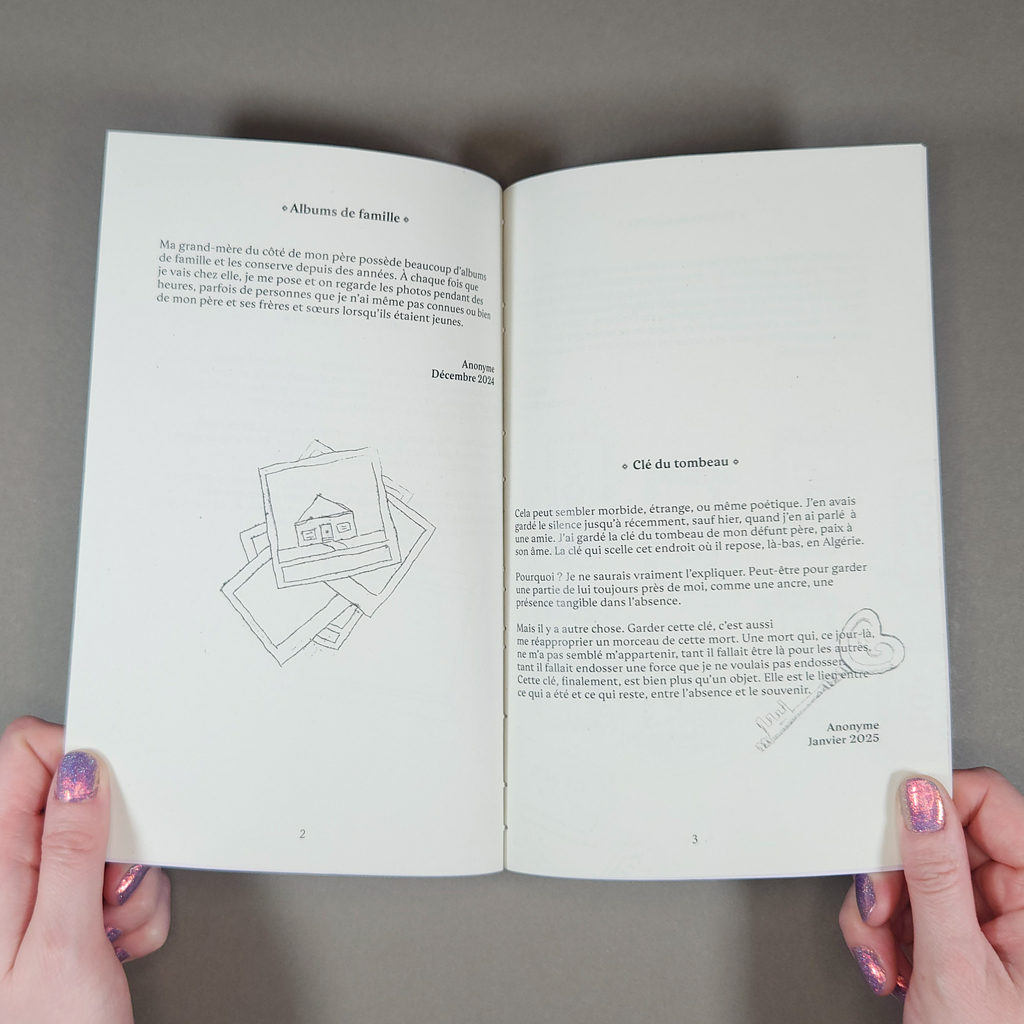
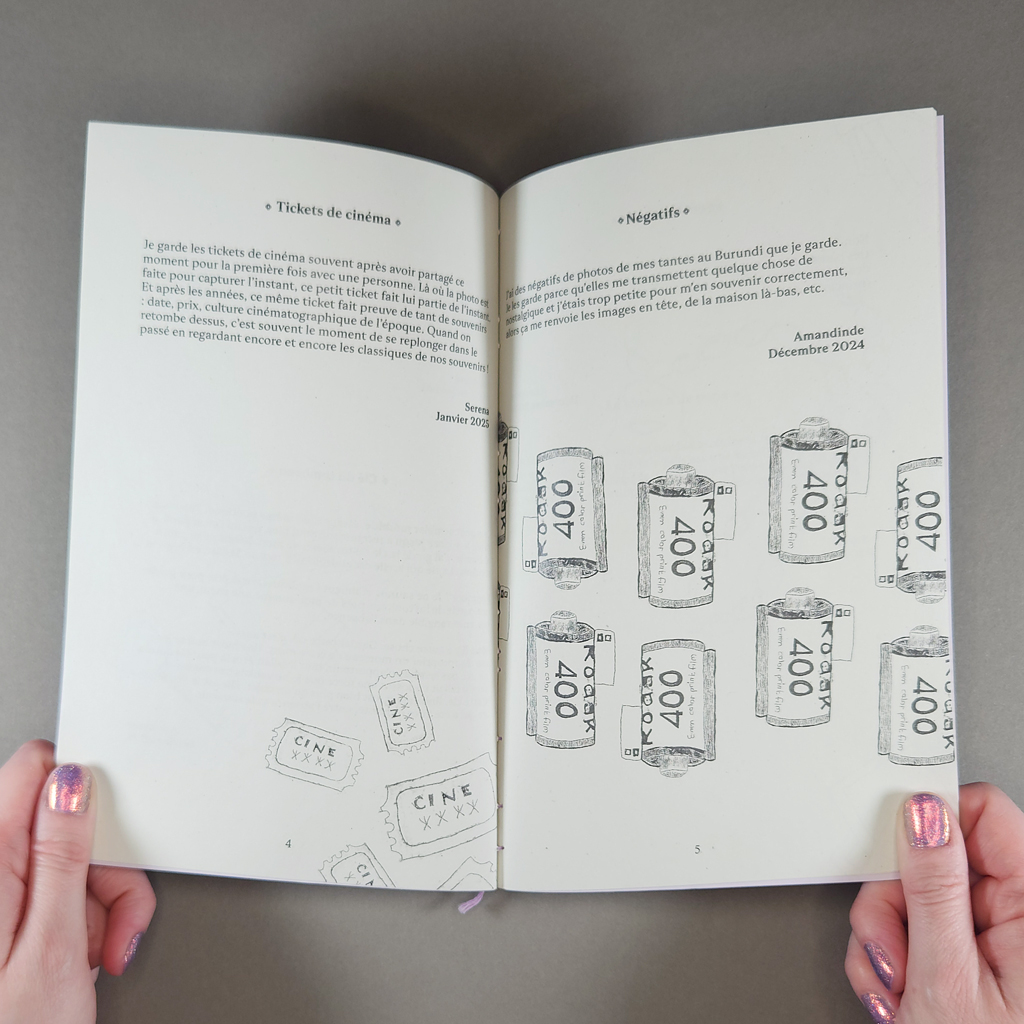
Inside, the design is just as thoughtful. The typography is restrained; the only embellishments are the fleuron’s surrounding each contribution’s title. The texts range from one to three short paragraphs. None occupies more than half a page. Some of the objects described are predictable: baby clothes, photo albums, and movie tickets. Others are more surprising: an anonymous contributor has kept the key to their father’s tomb in Algeria. Yet the contributors describe the same impulses and share their stories with a similar tone, a combination of puzzlement, reverence, and confession. We get glimpses of biography but hardly enough to distinguish the writers — or to prejudge them before empathizing. Dall’ara successfully focuses on commonalities rather than differences.
Many of the objects kept form bodily connections, not unlike religious relics. A necklace from a father, a grandfather’s shaving kit, postcards that preserve a mother’s “imprint” and “physical memory” through her handwriting. Many of these relations have passed away, but death is not the only displacement; travel and migration also recur.
The imagery is more playful than the typography. The line quality resembles a stick-and-poke tattoo, but Dall’ara created the original engravings on Tetra Pak instead of a metal plate. (The layered material — paperboard, plastic, and aluminum — lends itself to intaglio printing. It is easy to engrave, and its smooth surface can be wiped clean, leaving ink only in the incised areas.) Dall’ara then digitized the prints, allowing her to rotate, repeat, crop, and otherwise manipulate the imagery throughout the magazine. Some of the images appear more than once, but they are never completely identical. These repeated images — a stack of photos, a picture frame — serve as icons, categorizing as well as illustrating the anecdotes they accompany.
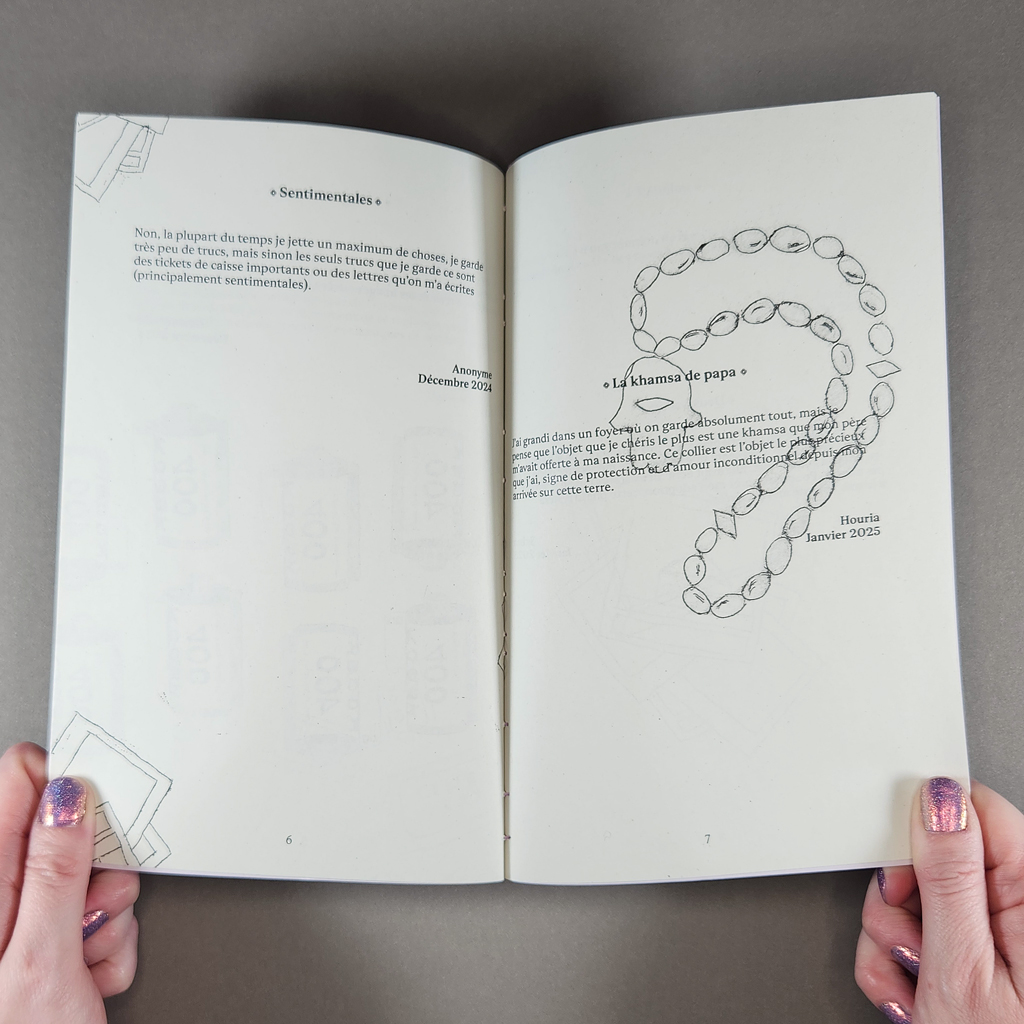
The Tetra Pak engravings exemplify Dall’ara’s approach to everyday materials, but they also resonate thematically. Just as a mother’s handwriting retains a physical trace, the engraving process functions as a material metaphor for memory. An absence — a cut — is filled with ink, then pressed into presence. The recycled packaging, inscribed with meaning, echoes the movie tickets and receipts saved by Recueil’s contributors.
In turn, the publication enlists the reader in the duty to keep and make meaningful. The serial format, the promise of future issues, underlines the reader’s responsibility to safely store the delicate volume for some time. It has become cliché to discuss the printed book (or magazine) in an era of digital publishing. Recueil reminds the reader that other material culture is also threatened, not just photographs and letters but movie tickets and metal keys. What do we throw away — or delete — today that future generations will wish we kept? By celebrating vernacular practices like collecting and cooking, Recueil will record what might otherwise be forgotten.
 Artists’ Book Reviews
Leave a comment