
8.5 × 11.5 in. closed
70 pages with several 4 × 6 in. photographs inserted
3-ring binding with acrylic covers
Ink jet
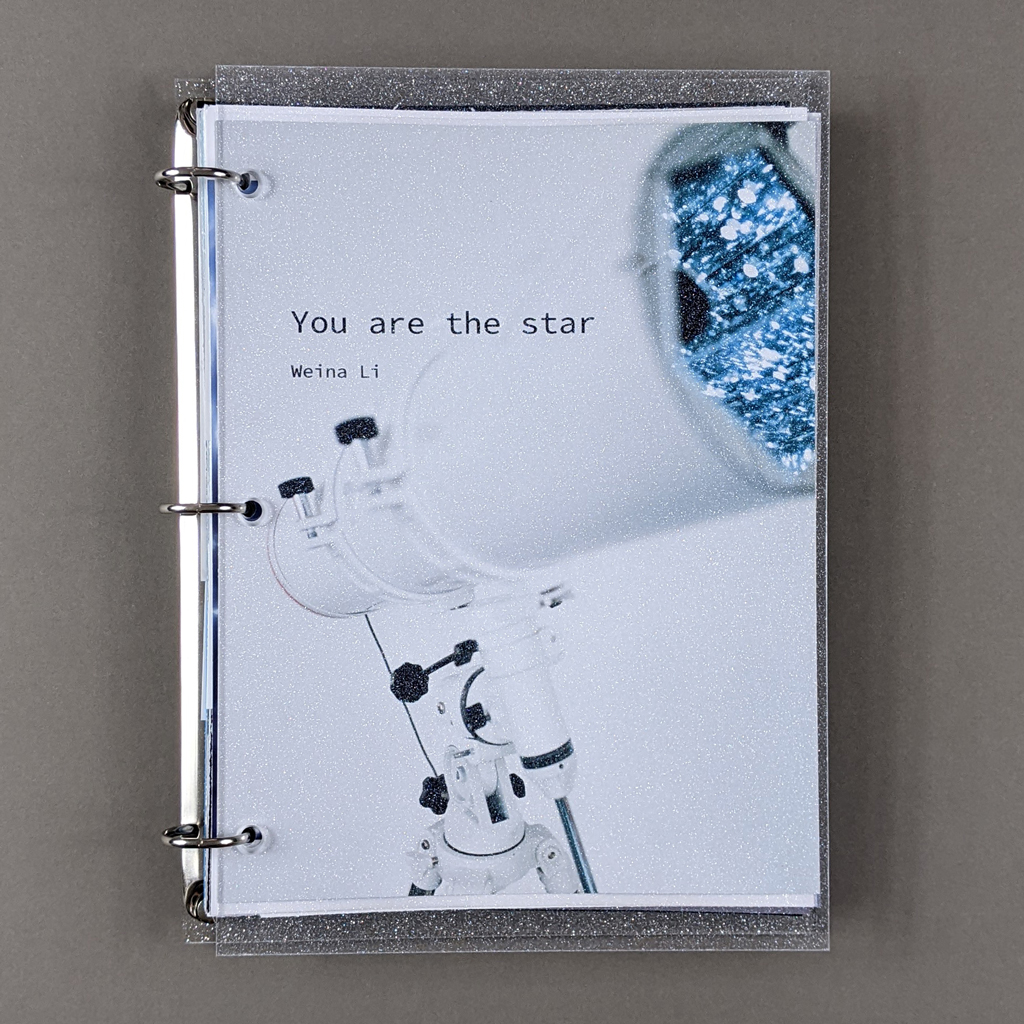
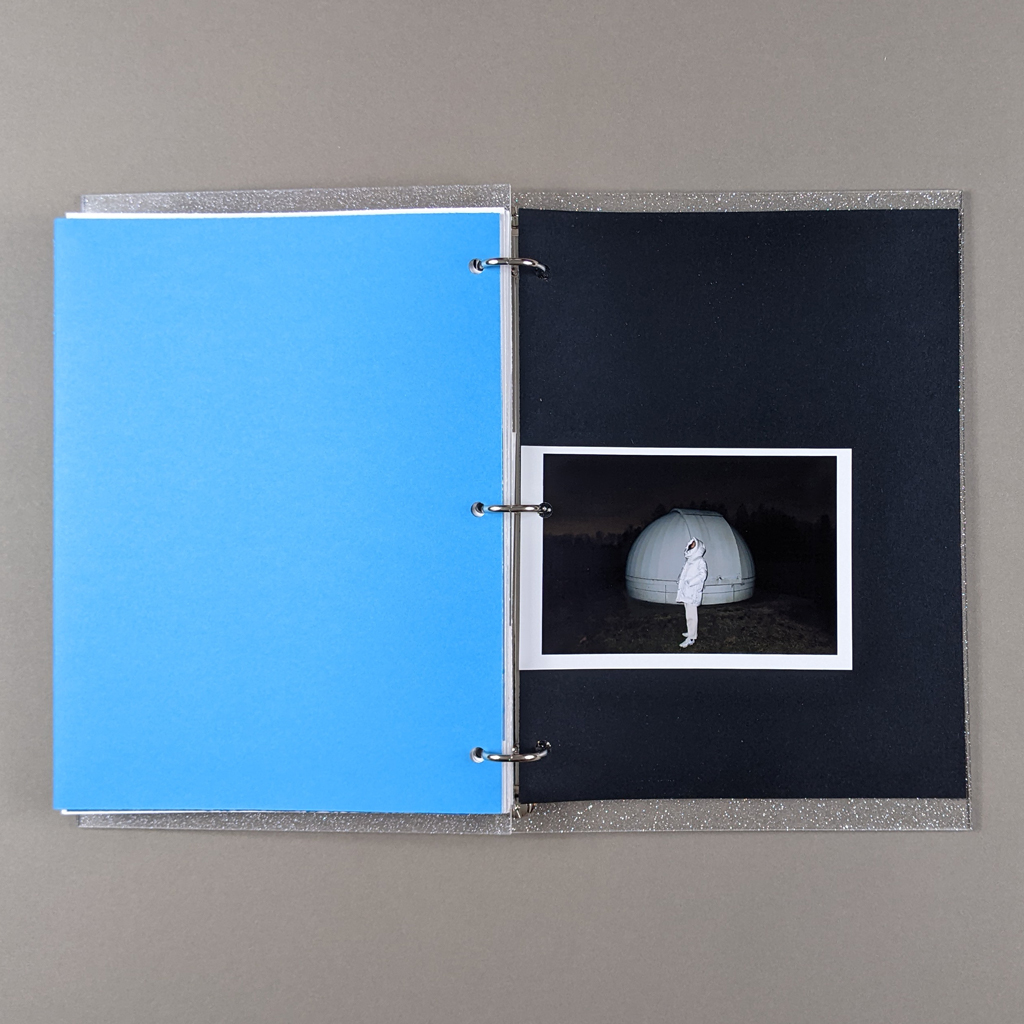
You are the star presents Weina Li’s art practice, but it is more than a portfolio; it is a work of art in its own right. The book is bound with a three-ring binder mechanism and clear acrylic covers impregnated with glitter. Inside a variety of coated and uncoated photo papers, colored cardstock, and transparent mylar support inkjet-printed text and image. A number of 4 × 6 in. photographs are interspersed, each hanging tenuously from a single binder ring. These snapshots slow the reader down, as do longer sheets with folded fore-edges. The sheer variety of materials also slows the reader, who must adjust to the weight, texture, and drape of each page. By thoughtfully crafting an elaborate, engaging experience, Li conveys to the reader the heart of her installations. That means You are the star grapples with big, existential questions.
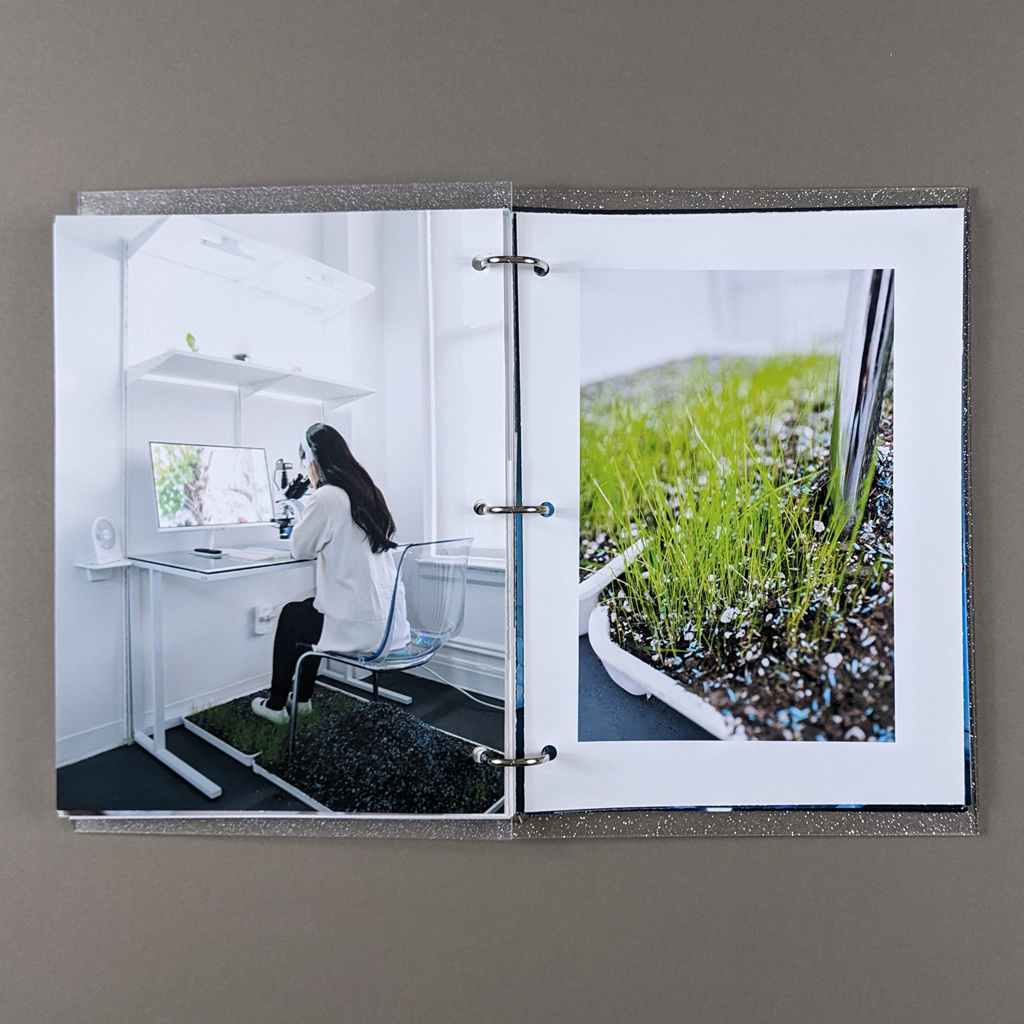
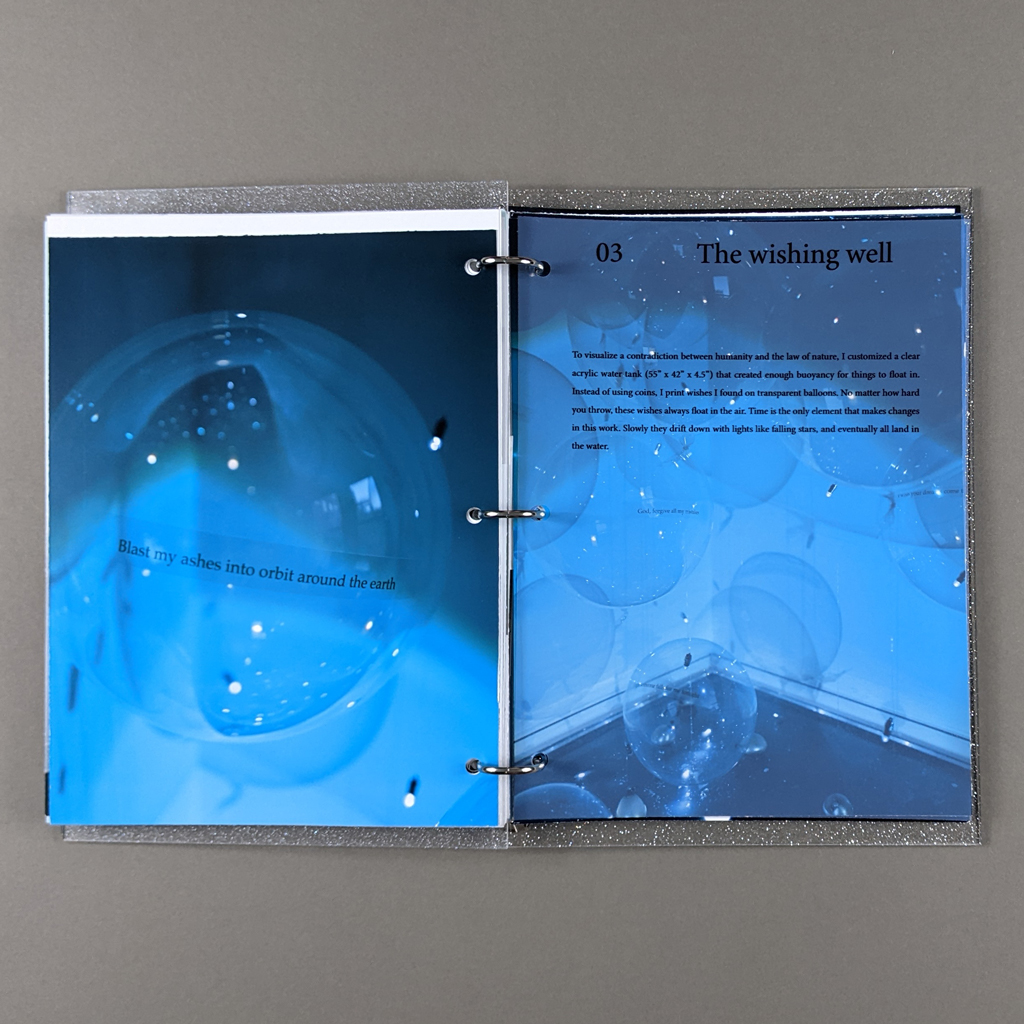
The book is divided into three roughly equal sections based on three recent bodies of work: You are the star/distance between us; Glorious my eyes have seen; and The Wishing Well. Each section retains the distinct look and feel of these projects, but the book lends further cohesion to Li’s consistent visual vocabulary. In You are the star/distance between us, Li contemplates her place in the cosmos via stargazing. Facing the vast unknowability of the universe, she paradoxically finds a universal connection with others in the radical aloneness of the human experience. Poetic, personal reflections mix with descriptions of the eponymous installation, in which participants gaze at one another through a kaleidoscopic, two-way telescope with pinpoint fiber optic lights. Glorious my eyes have seen instead employs a microscope, allowing participants to scrutinize tiny fragments of Emily Dickinson’s poetry. Li questions how language limits our understanding of the world. The Wishing Well addresses the age-old desire to change the world with language. Li borrows wishes from online, virtual wishing wells and floats the text on translucent balloons in a tank of water.
These brief descriptions are incomplete and inadequate, but that is the point. Li shows that language, whether visual or verbal, cannot communicate completely. But where ordinary language, even — or perhaps especially — scientific language, falls short, poetry can get closer. So, Li examines mediation itself: mirrors and lenses, projectors and screens. You are the star does the same with its transparent, reflective pages, and further deconstructs the medium of the book with its clear covers and conspicuous binding.
The book-as-mirror helps Li cast the reader into her existentialist introspection (the reader, after all, is the “you” in the title). Already self-aware thanks to the haptic reading experience, the reader is quite literally reflected in the glossy pages of the book. Seeing my white, male face projected over Li’s raised questions about identity and positionality that the book leaves unanswered — but what more would the reader expect when Li writes “You see, this story isn’t about me … You are the one participating in this unsolved mystery — The character of this story.”?
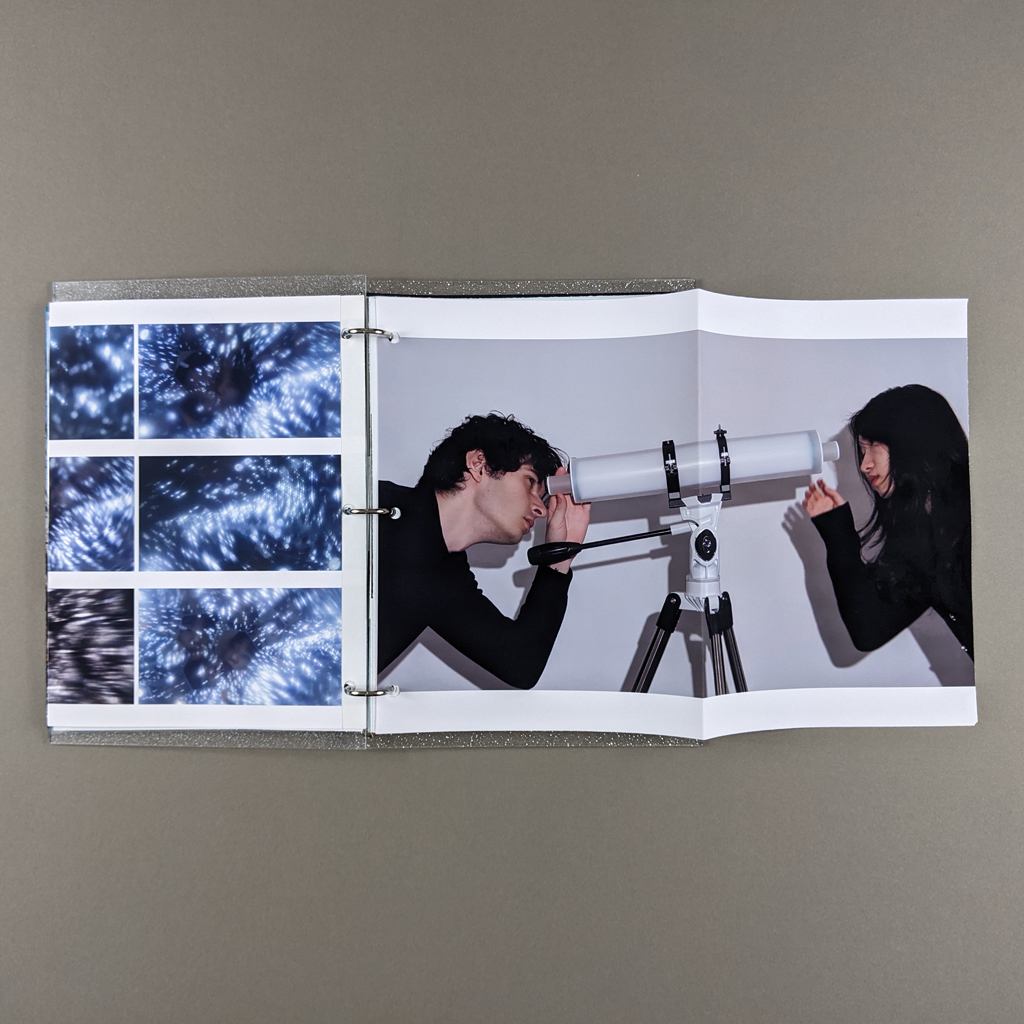
This process of discovery asks more of the reader than the passive projection of their gaze. Most obviously, features like the interspersed snapshots and longer folded sheets require increased attention. The folded sheets could simply be turned from recto to verso, but the curious reader who unfolds these pages is rewarded by their clever design. In one, a photograph of Li’s two-way telescope is folded down the middle, separating the figure on the left from the figure in the right. By opening the page, the reader joins the two people together. Another fold separates an image of Li looking through a microscope from a close-up of what she sees. Unfolding the sheet reveals a single scene: the close-up is a computer screen on the same table as the microscope.
Such moments are part of a broader strategy to remix existing artworks into new statements. Many of Li’s installations include text, and she deftly weaves together writing from the installations with writing about them. In some cases, Li uses the book form to frame a single word or passage. Across from a blank white verso, a close-up of a single balloon from The Wishing Well is all the more effective: “God, forgive all my mistakes.” Elsewhere, the book offers more holistic access to Li’s installations. These overviews could risk merely documenting existing work, but You are the star is more of a manifesto than an artist’s statement. It helps that Li’s descriptive writing is rarely didactic. Instead, she leaves absurd gaps between what she does and why, comically combining philosophical and technical language: “To visualize a contradiction between humanity and the law of nature, I customized a clear acrylic water tank (55” x 42” x 4.5”) that created enough buoyancy for things to float in.” The book remains a unified expression that transcends the projects within it.
Perhaps the book triumphs because, even when it comes to presenting her own art practice, Li seems skeptical of direct communication. You are the star mirrors, magnifies, and distorts her installations just as her installations mediate the natural world. If each reader receives a different message, however, it is not only a matter of mediation. Uncertainty lies in the message as well as the medium. Li’s art is about discovery and experimentation rather than settled conclusions. The questions are big, and the answers are few. Despite its careful sequencing and high-quality printing, You are the star retains the vitality of an artist gathering her thoughts in a binder.
If Li remains uncertain about our ability to understand the universe or connect with one another, You are the star leaves me more optimistic. The book’s exploration of existential loneliness is undeniably affective, paradoxically proving art’s potential to connect people. It is because we are unable to perfectly communicate our thoughts and feelings with ordinary language that art is necessary, or indeed possible. You are the star shares a good deal about Li’s art, but more importantly, it conveys her uncertainty, curiosity, longing, and hope.
 Artists’ Book Reviews
Leave a comment