
how to build a ____.
Madeleine Aguilar
2023
bench press
Issues:
1. Madeleine Aguilar
2. Ray Madrigal
3. Jane Ferry
4. Bex Ya Yolk
24 pages
7 × 8 in. closed
Saddle stitch
Risograph printing
Editions of 250

Madeleine Aguilar calls how to build a ____. “a series of artists’ responses to organizing their creative practice in 20 steps.” I wouldn’t usually begin a review by quoting from an artist’s statement, but the challenges — and risks — of distilling one’s practice are central to this project. Fortunately, Aguilar is particularly good at explaining herself and her imprint, bench press. She writes, “bench press is a risograph press based on friendship, play & collaboration. books are remnants of generative conversations & mutual exchange between artist + publisher.” The series may blur generic boundaries (zine, pamphlet, manifesto), but one thing is clear: this is not about bookmaking, it is publishing as artistic practice.

Bench press prefers books that do something (guidebooks, workbooks, instruction manuals). How to build a ____. falls into this category, even if the guidance is sometimes more poetic than practical. Each pamphlet is printed in two colors on legal-size paper in classic office colors (mint, goldenrod, lavender). Along with the Risograph printing, itself an office technology, the paper choice amplifies the contrast between practical instruction, with its implied hierarchy (expert and novice, manager and employee), and the horizontal dialogue in each issue of how to build a ____. To date, these collaborations feature Jane Ferry, Ray Madrigal, Bex Ya Yolk, and Yutian Liu (although Liu’s issue came out in 2025, after I received my review copies). Aguilar also created an issue of her own.

Aguilar’s design unifies the variety provided by her collaborators. The main text, the twenty numbered steps each artist takes to organize their practice, is set in bold, black type at the top of each page. The imagery, which sometimes includes handwriting, is printed in a second color. The contrast ensures that the main text is legible even when unruly images fill an entire page. These are not neat, finished pieces. We see how the artists plan and reflect on their work, through sketching, writing, photography, and collecting. The images seem to challenge or complicate the text as often as they illustrate it.
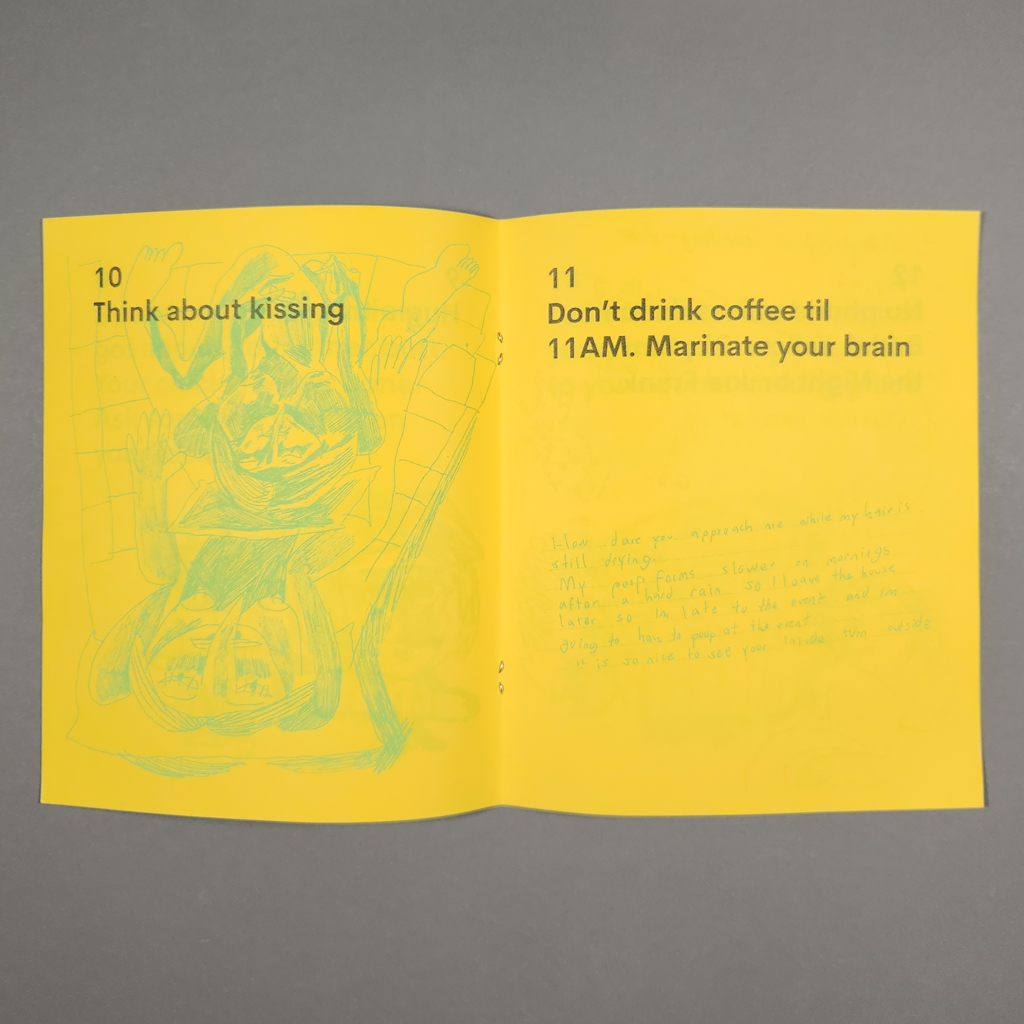
Each artist has a distinct practice, which comes through in their pamphlet, but there are also common threads among the artists — hardly a surprise since they have a mutual friend in Aguilar. Attention and mindfulness are one such connection. The mix of practical and poetic advice is another similarity. These features connect how to build a ____. to a tradition stretching back to conceptual art and Fluxus works of the 1960s and ‘70s. Yet there are clear differences, and how to build a ____. feels thoroughly contemporary. The artists’ politics are more explicit, their identities are more important, and their bodies are more present. If artists in the sixties read eastern philosophy and did drugs, artists today read queer theory and do therapy.

Another difference is how the interest in process manifests. How to build a ____. is not a renunciation of authorship in favor of the reader. True, the reader may follow the instructions offered, but the process behind the pamphlet is just as important. No matter what the reader does, the collaboration between the artist and publisher happened; it was more than a thought experiment. Aguilar takes advantage of the immediacy of the Risograph process to introduce new artists to bookmaking and publishing. The result feels like a dialogue between artist, publisher, and machine, unfolding in real time.
It might be too much to claim that how to build a ____. inaugurates a new genre, but the series fills a void where other forms fall short. The pamphlets are more interesting than most artist’s statements. They are less presumptuous than most manifestos. They are more imaginative than most websites and more substantial than most social media posts. Each of these has its place, and they are not mutually exclusive. I was glad that the inside back cover of each issue features the artist’s bio, and I eagerly looked up their websites. Still, how to build a ____. strikes a satisfying balance between process and product, creation and reflection, thinking aloud and dialogue.
 Artists’ Book Reviews
Leave a comment