
Serpents
Philip Zimmermann
2025
Spaceheater Editions
2 volumes, 40 pages and 60 pages
10.325 × 8.5 × 0.75 in. together in slipcase
Pamphlet and double-pamphlet stitched softcovers with wrappers
HP indigo printing inside with foil-stamped covers and blind-embossed slipcase
Edition of 60 copies
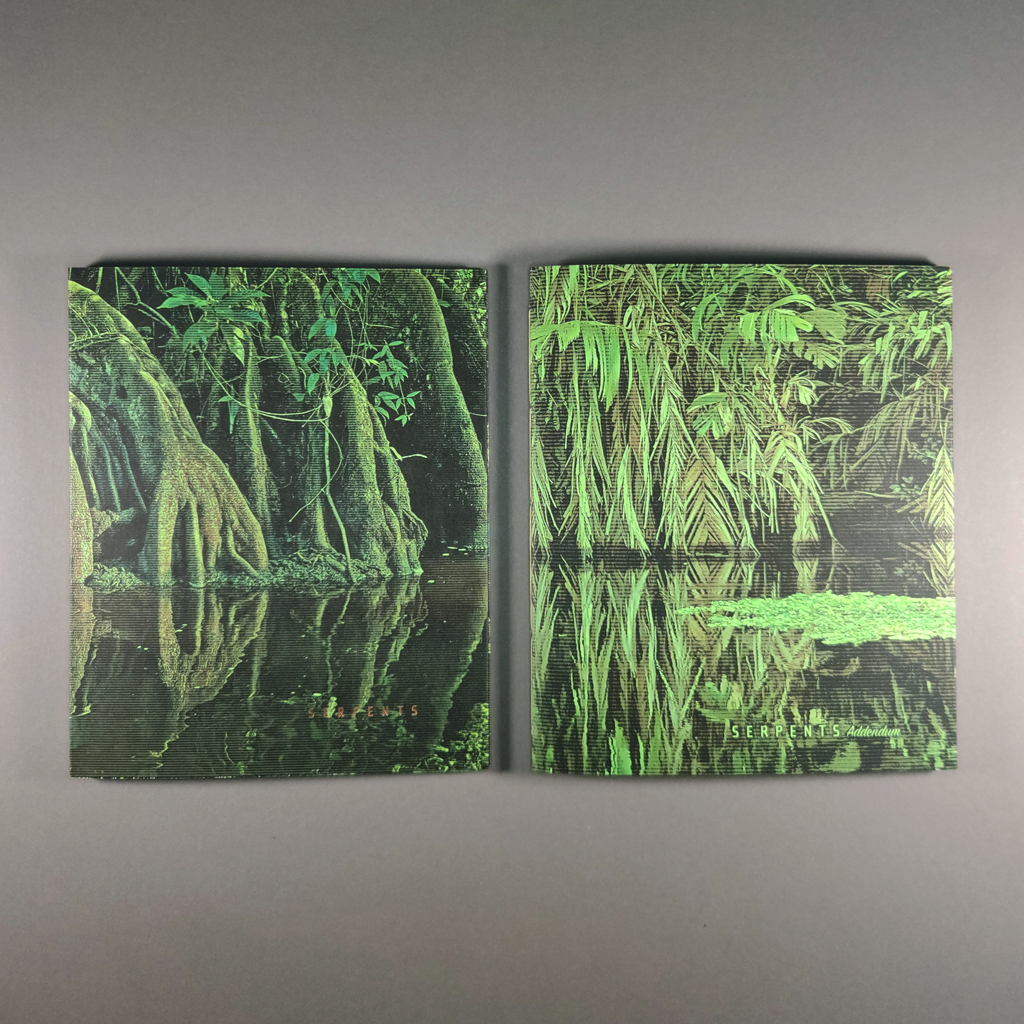
Philip Zimmermann calls Serpents a “visual and poetic rant” about 2025, the Year of the Snake. Having survived 2025, it came as no surprise that the book is two volumes. The first volume is a posthumous collaboration with Bern Porter, whose poem “The Last Acts of Saint Fuckyou” forms the main text: an apocalyptic, alphabetized litany of ethical and epistemological ills. The second volume reprises Zimmermann’s 2020 Swamp Monsters, an unflattering rogue’s gallery of politicians, oligarchs, and influencers responsible for all this turmoil. If the first volume suggests that things have always been this way, the second volume counters that it doesn’t have to be; we know who to blame. Serpents offers consolation but not complacency.
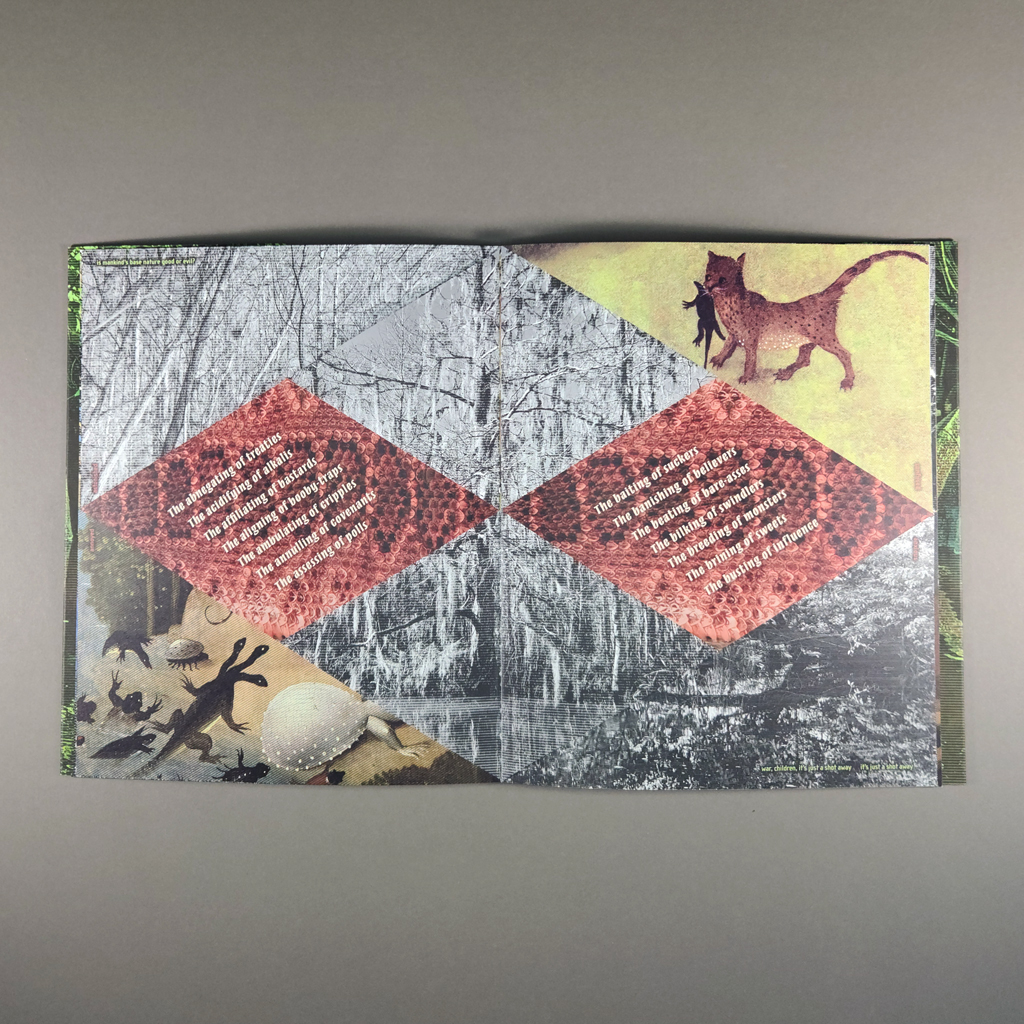
While the second volume of Serpents is a sequel to Swamp Monsters, the first volume is more reminiscent of Zimmermann’s landmark High Tension. The pages are cut diagonally, forming a diamond of smaller diamonds in the center of each spread. Porter’s poem is set, atop a snakeskin background, in the center diamond on both verso and recto. The red-toned scales give the entire diamond motif a reptilian aspect, although it also resembles the “hazard identification diamond.” In any case, the sharp angles, busy patterns, and diagonal text provoke feelings of anxiety. Having fractured the spread into diamonds and triangles, Zimmermann quilts together images from different sources and adds additional text along the margins.
The central text, Porter’s poem, was first published in 1975, but it feels fitting for this moment. Or perhaps it is timeless, a result of its quasi-biblical delivery and utter strangeness. For each letter of the alphabet, Porter lists seven acts: “The abnegating of treaties / The acidifying of alkalis / The affiliating of bastards…” Porter mixes serious and silly, obvious and obscure. His saint sews chaos and contradiction: “The breeding of monsters / The brining of sweets / The busting of influence…”
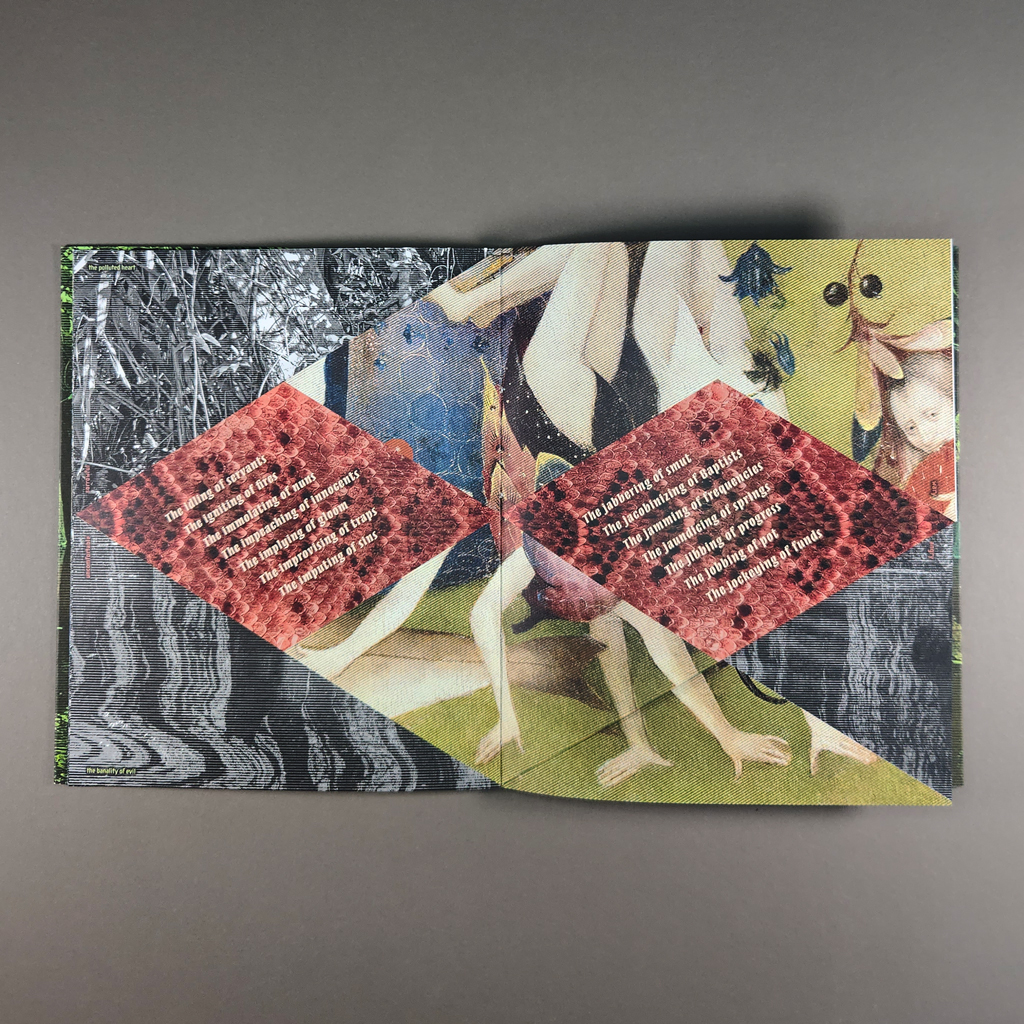
Surrounding Porter’s poem, Zimmermann quotes from other sources. Song lyrics, ranging from the Rolling Stones’ “Gimme Shelter” to Childish Gambino’s “This is America” cohabitate with Dante and Hobbes. A clever couplet places Elon Musk in 1984, showing just how Orwellian his vision is: “Ignorance is strength / empathy is weakness.” Paired words set parallel to the fore-edge seem to record one’s psychic response to this dystopian state of affairs. The diagonally cut pages split the pairs, creating new phrases with every turn. “Frightened / serious” turns into “wary / serious,” then into “wary / angry.”
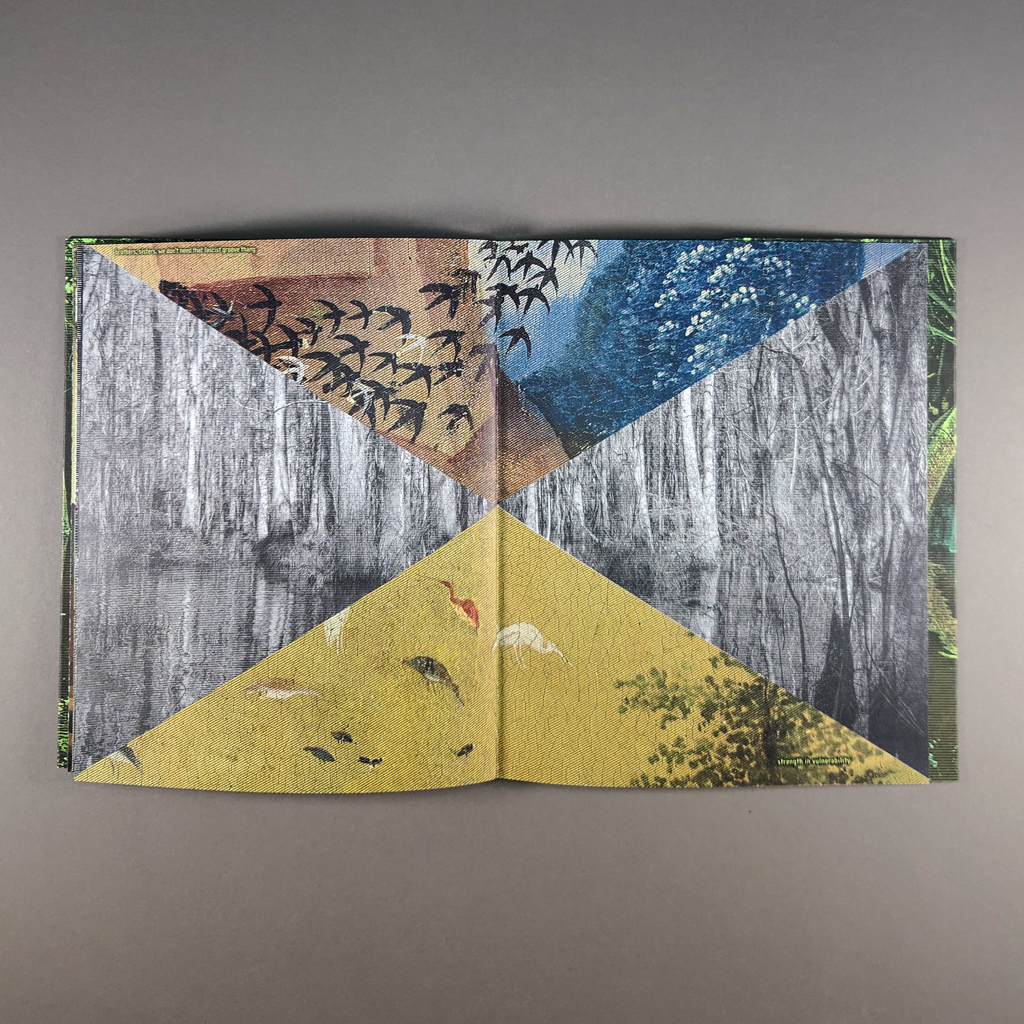
In addition to the text, Zimmermann borrows some of the imagery. Scenes from The Garden of Earthly Delights by Hieronymus Bosch populate most pages. Zimmermann takes advantage of the triptych’s narrative arc from paradise to hell, but he tells his own story. Porter’s poem gives way to the fires and explosions of Bosch’s hellscape, then an eerie spread with nothing but birds. No humans remain, not even to be tormented by demons. All of this is patterned together with Zimmermann’s own photographic imagery, desaturated and heavily half-toned snapshots from the swamps of Louisiana and jungles of Costa Rica. Screened with horizontal lines rather than Ben-Day dots, the swampy reflections of Cypress trees look as though they could be tuned with an antenna. (Incidentally, Bern Porter, a physicist as well as a poet, helped develop the cathode ray tube.)
In the second volume, an addendum of “alphabetically arranged swamp scum,” the visual effects are more B-movie than CRT television. Each spread is a close-up of a latter-day demon, one eye on each side of the gutter. The faces are tinted green, and the eyes are red. Aside from Donald Trump’s mugshot-turned-merchandising-opportunity and Mark Zuckerberg’s iconic soulless stare, many of these powerful people are hard to identify. Zimmermann provides a visual index on the dust jacket flaps, but the faces are equally effective as interchangeable avatars of evil. The aesthetic is undeniably campy, yet the images still produce a queasy, anxious feeling in the reader.
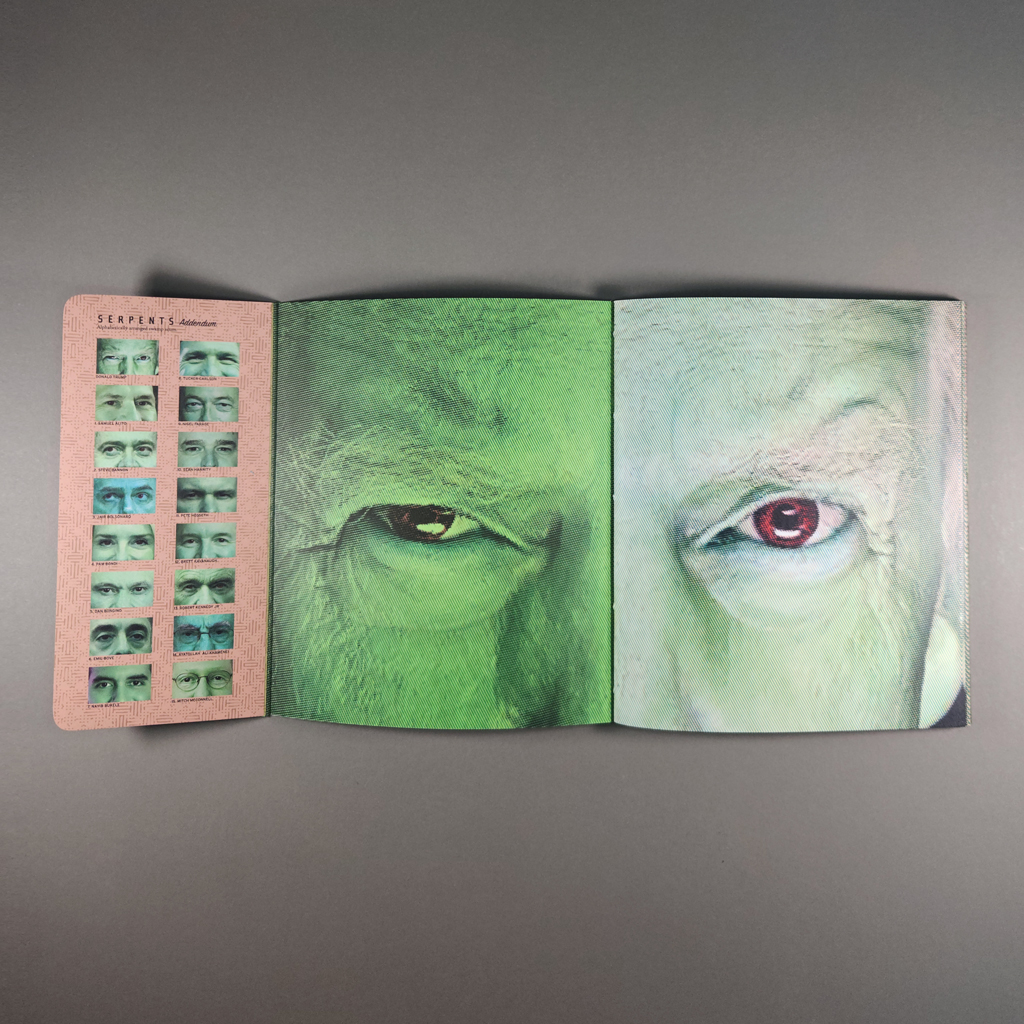
Zimmermann has long been interested in human nature, good and evil, and cycles of violence. Perhaps these issues are so timely because they are timeless. Evil has been with us since the beginning, Bosch reminds us — even in paradise a serpent coils around a tree in the distance behind Eve. Yet, Zimmermann’s serpents suggest a particularly contemporary vision of hell, one in which the acolytes of Steve Bannon (number two in the addendum) continue to “flood the zone with shit.” Bosch and Porter admirably anticipated the experience of doom-scrolling through the twenty-first century. More than horror or suffering, they convey chaos and corruption (in the full sense of the word).
Like so much of Zimmermann’s work, Serpents pairs politics with personal experience. The second volume, with its righteous indignation, is only an addendum; the uncertainty and anxiety in the first volume is the heart of the project. If we entertain the biblical allegory, then Serpents leaves open the possibility of resisting the temptations of greed, vanity, and power. Yet, it seems the world is a swamp, not a garden. By rendering the likes of Steve Bannon and Tucker Carlson as movie monsters, by reveling in the absurd inventions of Bosch and Porter, Serpents shows, in contrast, that real evil is both murky and banal.
 Artists’ Book Reviews
Leave a comment