
Pamphlets
Andrew Shaw
June 2019–March 2020
The Silent Academy
11 × 8.5 in. open
1 sheet each (12 total)
Trifold cardstock pamphlets

In his 2019–2020 series of twelve pamphlets, Andrew Shaw conceals extravagantly magical ideas in a plain package.
Simultaneously evocative and mystifying titles like Items of Inconsequential Dysfunction & Beauty or Items of Color & Reach appear in black Times New Roman on a cream cardstock only slightly richer in color than ordinary printer paper. The interior of each pamphlet and its accompanying “artifact detail,” a small sheet briefly explaining its contents, are similarly unobtrusive and understated.
At first the form may not feel significantly different from the default settings in a word processing program, but it is an intentional and vital part of the reading experience. Shaw’s design choices take the minimalist aesthetic of much of the silent academy’s work to its greatest extreme, forgoing the perfect binding of the press’s books or the hand-stitching and illustrations of their field guides. More than that, it consciously reflects the history of the medium, drawing on the simple aesthetic of both the philosophical or political pamphlets of past centuries and zines produced in the recent past and present day.

The publisher’s description of Items of Gentle Revolt, first in the series, specifically references this historical context: “Pamphlets have played a part in overthrowing dictatorships. Helped tourists understand the most elegant route through an art museum. Codified noodles into a number 42. This pamphlet does none of those things.”
As much as they participate in the history of the pamphlet, then, they also stand outside it. Rather than trying to disrupt a political or cultural system directly, the texts in Shaw’s series are more concerned with changing individual thought patterns. This is not to say they are apolitical, only that they are more concerned with inner change than outer, choosing to address the apathy and casual selfishness that capitalism creates, and is created by, rather than capitalism itself.
To this end, the text consists of strange, wonderful instructions. “Instructions” is an inadequate descriptor, but the only word I’ve found that covers the breadth of experiences on offer.

Many are literal directions for producing a work of poetry or art (some similar to those Shaw created in his other works, couplets and questions). Others feel more like ethical or metaphysical musings in verse, which we could perhaps call instructions for living. Still others take the reader on a much less literal and concrete journey into the surreal — but while the destinations are unexpected, the trip is very much guided.
Shaw might ask the reader to “call a friend you’ve not spoken with in forever” (as in Items of Joy and Unrest) or to imagine impossibilities like wrapping arms around the moon to pull it down from the sky — a sky that sometimes contains a gargantuan floating whale.
Each pamphlet is divided into four sections: four sets of “instructions” for four different projects. Each of these can be appreciated individually, but they complement one another in various ways; images recur, the same themes are explored from slightly different perspectives. This double existence as single pieces and parts of a larger project extends throughout the series. The individual pamphlets were produced in four batches, each created in a particular season and reflecting that season’s aesthetic and emotional associations. The same image or idea (such as the aforementioned flying whale) often occurs in multiple contexts throughout the “year” represented by the twelve pamphlets.

The straightforward, colloquial language Shaw uses to explore these heady, conceptual experiences is a natural complement to the pamphlets’ physical plainness, and a part of the project’s intentional accessibility. Pamphlets is a series intended for everyone, not exclusively those with formal academic or artistic training.
Shaw instructs readers to do things virtually anyone could do easily enough (“Scribble a list of every lie, / untruth, and manipulation / that you can remember telling”) or things almost no one could (“Go to the mountains. / Sit motionless for three days. / Move only to drink, eat, shit & piss. … Walk twelve hours a day for ten days”). Rather than being taken literally, the latter are experiences meant to be had internally: what would it be like to do this impossible thing, and how would it affect me?
Many of the projects also seek an audience beyond the individual reader, encouraging and guiding encounters with others through small bursts of public art or conversations with friends and strangers.
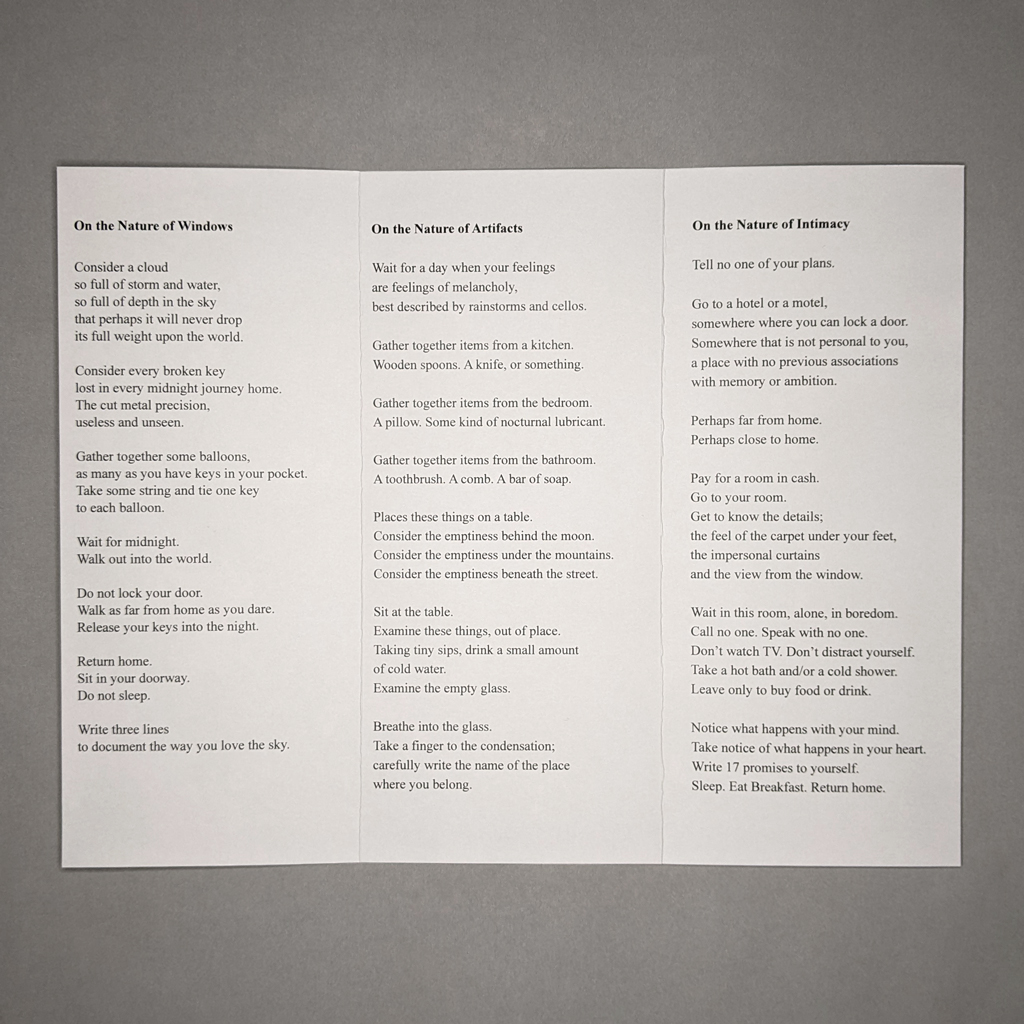
The series’ accessible and public nature further reflects the history of the pamphlet. Just as early mass literacy allowed for various forms of political change and enhanced the common understanding of science and philosophy, Shaw’s pamphlets hope to foster greater understanding of oneself and other people. However much they reflect his personal ideas and understanding of the world, they are necessarily and consciously dialogic.
Like the history and ideas it explores, Pamphlets is neither static nor conclusive. After a considerable break, the series has continued, with new author Brittany V Wilder taking over in March 2022. Exploring a changed world through a new perspective seems a natural extension of the series so far, both a throwback to and evolution of the idea of the pamphlet itself. The project as a whole reflects the focus on collaboration so vital to its text, the dialogue it creates continuing to expand.
 Artists’ Book Reviews
Leave a comment