
O meu coração bate sem mim
Alexandra Agostinho
Design by Rita Oliveira and production by Isabel Baraona
2019
23.25 × 6 in. open
Single sheet (6 accordion-folded pages)
4.3125 × 6.25 in. bi-fold paper enclosure with ribbon tie
Digital offset printing
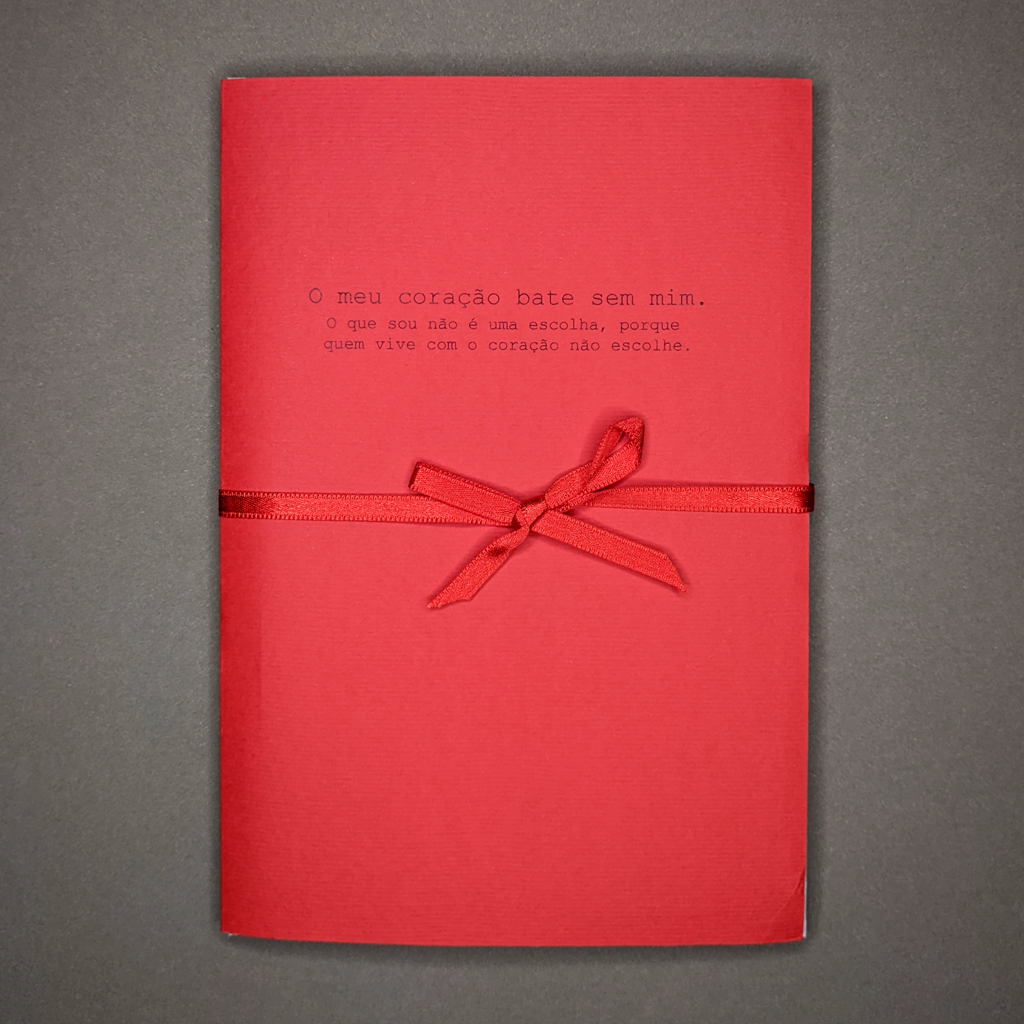
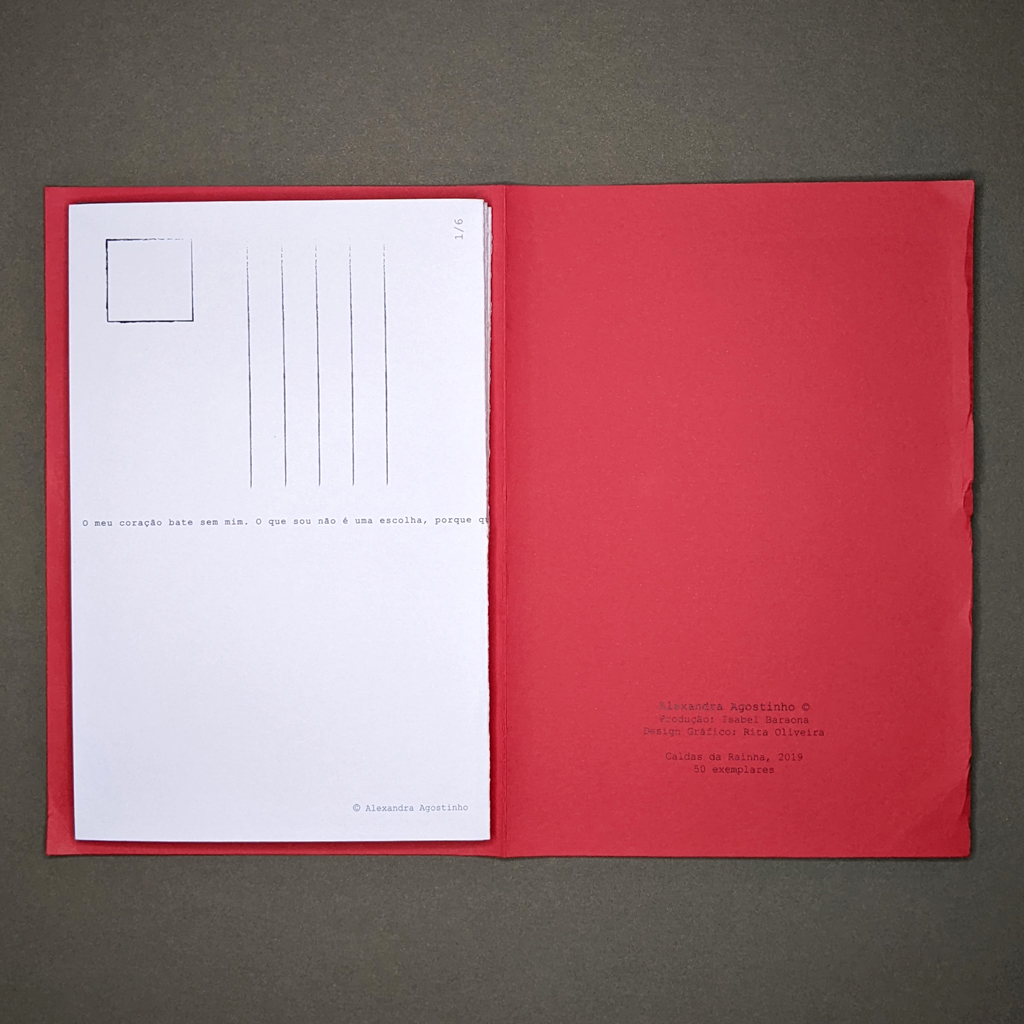
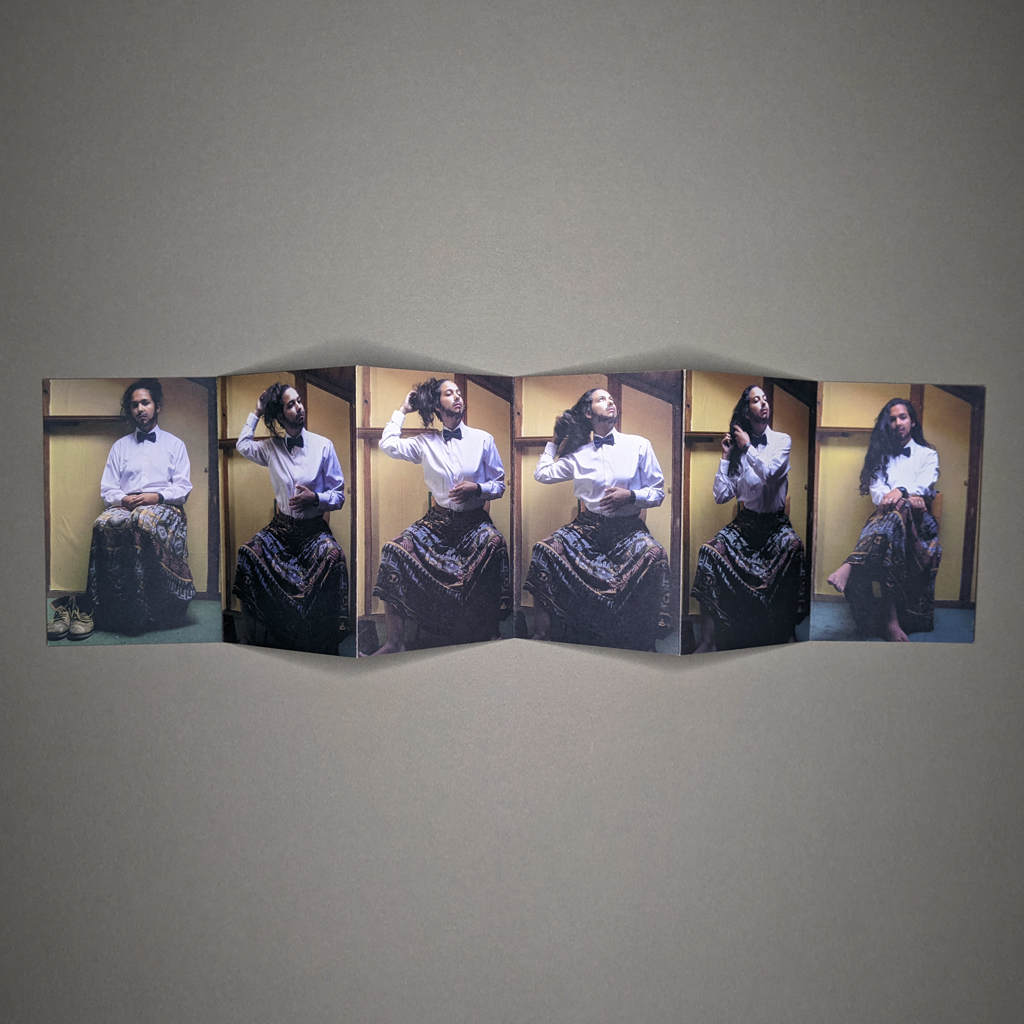
Alexandra Agostinho’s O meu coração bate sem mim is an instance of genderqueer expression that makes gender both a performance and an innate aspect of the person. The book is presented as a wrapped gift, complete with a bright red bow with matching paper as the cover, and the words (translated from the Portuguese), “My heart beats without me. What I am is not a choice, because who lives with the heart does not choose.” Inside the covers is a set of accordion-folded postcards with a series of six photographs of the artist, Alexandra Agostinho, taking their hair out of a bun and letting it settle on their shoulder while staring defiantly into the camera. Unlike other books of postcards, these have no perforation to separate them, and taking them apart would not only disrupt the order of the action in the images, but it would also tear apart the text that runs across the back of them, which is a repetition of the title.
When I first opened this book, already excited by the joyful and passionate red of the cover, I audibly gasped. What I saw was a fellow gender non-conforming artist, complete with long hair and a colorful skirt, and with eyes locked into the camera, they also saw me. Using the common LGBTQ+ pronouncement that love is not a choice, Agostinho takes it further: their entire being, skirt and facial hair and all, is not a chosen mode of expression, but a natural occurrence of letting their heart beat. At a time when queer bodies are heavily politicized and even demonized, O meu coração bate sem mim is a powerful statement of self that refuses to back down.
For a time, I sat with this book trying to impose a performance vs. internal reality dichotomy onto it. Is this performed gender? Is this innate gender? Is it both or neither? I reached out to Agostinho for some background information that would help me read and talk about this work. They were inspired by a work by Ana Mendieta while taking a class about self-representation. During a staged photography session, this series of photos “happened” and they knew they “had to do something with them.” In Agostinho’s words, “The ‘self’ represented is an extent of a ‘self’ I know that exists within me, but I’m not acquainted with yet.” I was surprised that Agostinho expressed any uncertainty about this represented self, as the confidence exuded by their stance stood out to me immediately. Perhaps it’s the eye contact, or maybe the put-togetherness of the bow tie and crisp shirt juxtaposed against the well-loved shoes and bold skirt. I can’t help but read a knowledge of, and comfort with, the self in this book. That may be a deliberate performance, but the statement that the series “happened” implies that this is instead a captured moment of the heart beating without Agostinho’s control.
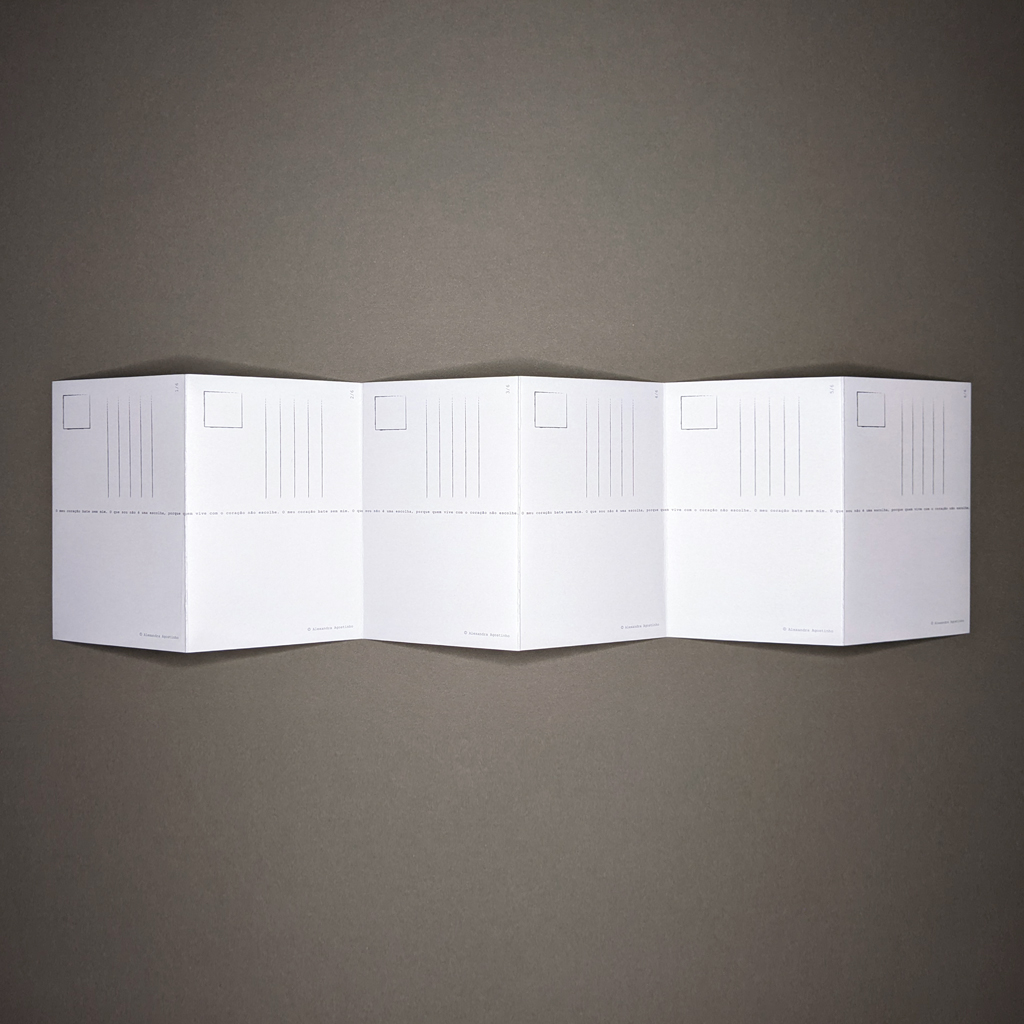
But in trying to impose the question of performance vs. internal reality that I too struggle against onto this book, I think I’d missed the point. Almost every aspect of this book is non-binary. As an artists’ book in postcards, it is neither in book nor postcard form. The text (which is also the title) along the back doesn’t fit into the boundaries imposed by the postcard setting. Because this series was taken during a planned photoshoot with planned feminine- and masculine-coded aspects, there is necessarily an aspect of performance on top of the natural expression of self. The masculine and the feminine are used together in the photographs in order to render each detail “none of both,” and the change we witness in Agostinho occurs in a single fluid motion.
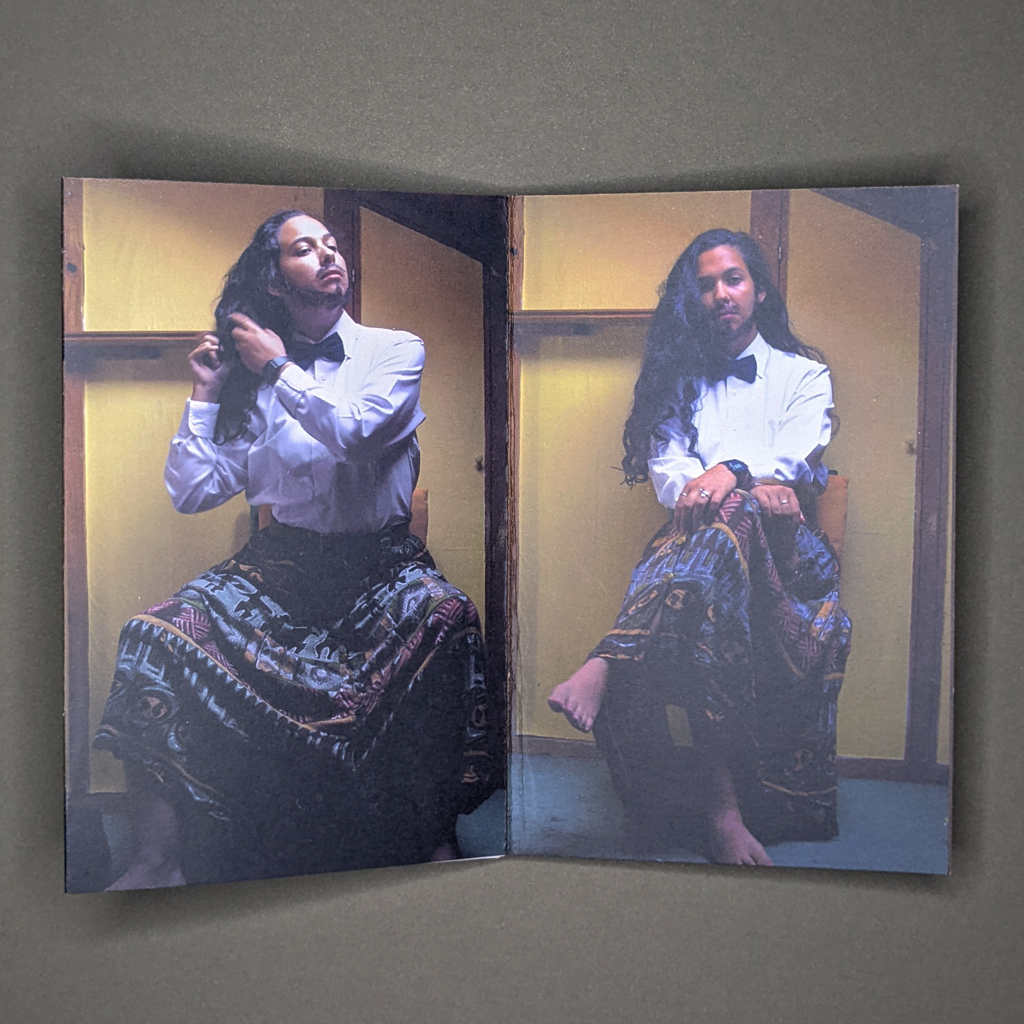
This fluidity of the self is reflected in Agostinho’s thoughts on gender, which stuck with me as a direct reflection of my own experience: “Gender is a concept I can’t quite wrap my head around. I’m a being that goes through womanhood and is [supposed] to ‘be’ one and is seen as one, but that’s not how I see myself. But I’m still figuring that part out.” As readers, we are also left figuring things out. With very few words and even fewer images, Agostinho has created a nesting doll of themself. Upon opening and removing layers, we are met with that aspect of Agostinho that even they aren’t familiar with. What keeps me returning to this book is not just that feeling of learning a secret about someone or witnessing their vulnerabilities. I am drawn to reopen O meu coração bate sem mim to both see and be seen.
 Artists’ Book Reviews
Leave a comment