
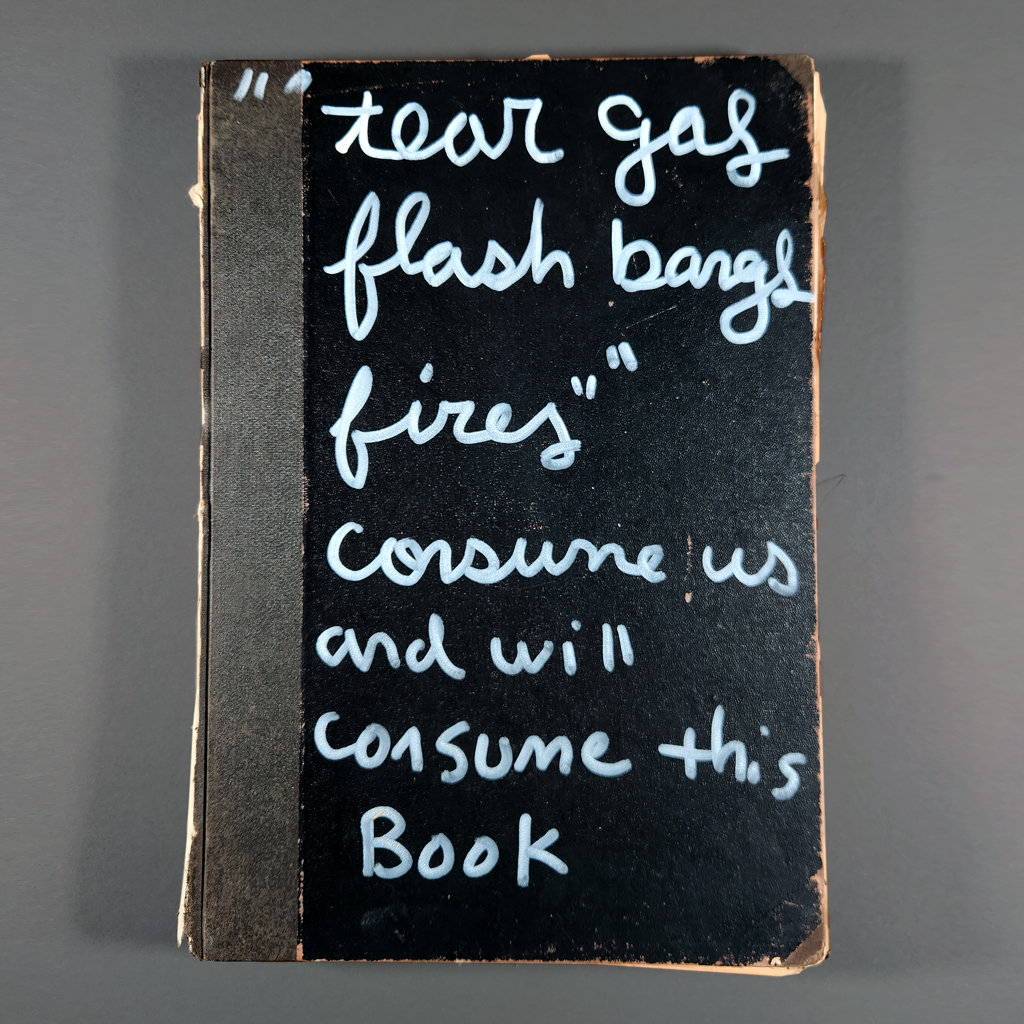
“Tear Gas Flash Bangs Fires” Consume Us and Will Consume this Book
Paul Valadez
2026
286 pages
9.5 × 13.75 in. closed
Unbound altered book
Ink lettering on cover with graphite and watercolor inside
Unique (1 copy)
Most of the books I review have been donated to Artists’ Book Reviews — an exchange of artistic and critical labor. If anything, it is this reciprocity that is new for Paul Valadez. The Texas-based artist gives his work away, no strings attached. Inspired by indigenous potlatch practices, Valadez’s lifelong “Potlatch Project” amounts to a conceptual artwork that frames his prolific painting, drawing, and collage. Among these works are altered books, like “Tear Gas Flash Bangs Fires” Consume Us and Will Consume this Book.
The book’s title is scrawled on the front cover in a casual mix of cursive and print, white paint marker on fading black board. On the back cover, the same hand declares: “Original Unique Drawing on ACID FULL Book.” Indeed, the book is falling apart. The covers are detached, spineless, with roughly 280 loose pages stacked between them. I am reminded that, in addition to gift-giving, a potlatch may involve the ritual destruction of valuable goods.
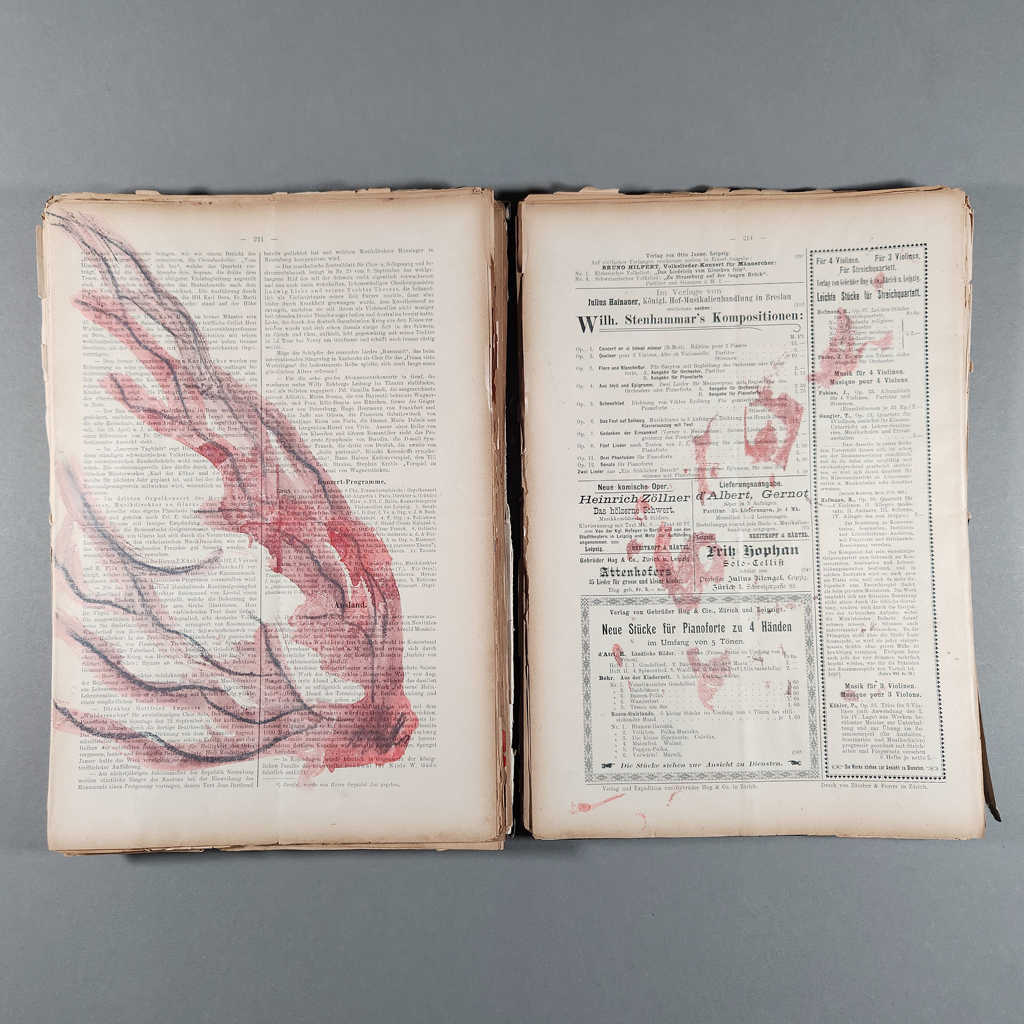
In this case, the original book is of questionable value. It is, or rather, was a bound volume of the periodical Schweizerische Musikzeitung und Sängerblatt (Swiss Music Journal and Choral Gazette) from 1897. The German-language journal was letterpress printed on thin paper, now yellowed and brittle. The sheets are faintly creased from being folded horizontally before being bound, and now unbound, in their current form.
The relatively large (9.5 × 13.75 in.) pages, busy with printing, provide an ideal surface for Valadez’s gestural, semi-abstract drawings of fires. Every verso in the book has a drawing, rendered in graphite with red watercolor on top. The watercolor tends to bleed through to the recto, where the fingers of flames suggest a bloody handprint. The drawings are varied enough to propel the reader, despite their restricted visual vocabulary. Some of the fires contain crosses, and others are surrounded by a scalloped mandorla of what might be smoke, perhaps hinting at the Catholic iconography common in Chicano art. Still other drawings are more abstract, like lightning branching across the page. This is a new direction for Valadez, whose paintings and drawings are usually figurative and often contain text.
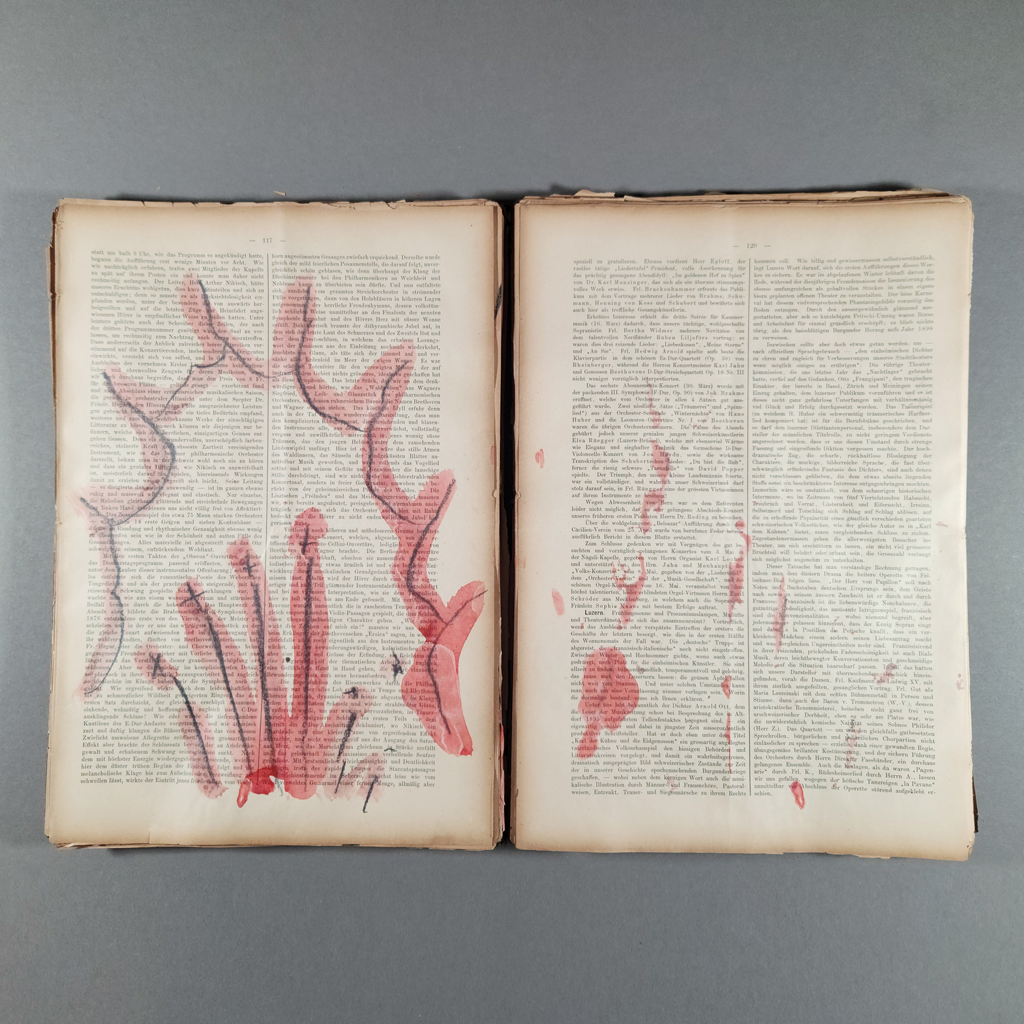
Of course, there is text in the book, and it is more significant than it first appears. Like many Mexican-Americans, Valadez was never taught Spanish. Instead, as he grew up listening to older relatives talk in Spanish, he associated the language with the forbidden knowledge of adults. Unable to converse with half his family, Valadez spent much of his time reading, no doubt informing his interest in collage (and visual communication, more broadly). If this was a happy outcome, Valadez also found himself marginalized among some of his Chicano peers for not speaking Spanish. Thus, the inability to read the text — albeit, in this case, German — signifies the troubles of the adult world, the generational loss of colonization and assimilation, and the marginal perspective of an outsider.
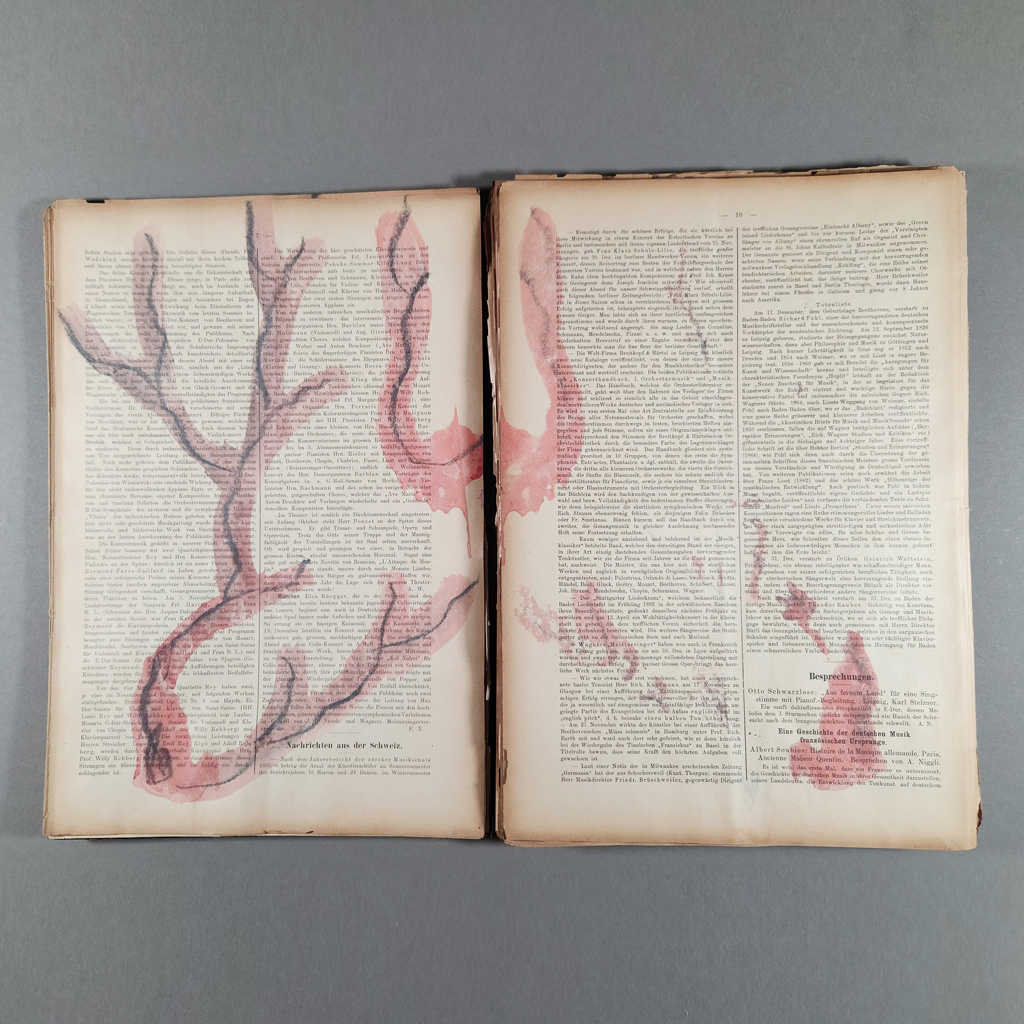
The book’s music also matters. Beginning with his sprawling collage series, The Great Mexican-American Songbook, Valadez has played with the idea of the “Great American Songbook.” He is interested in both Americanness and greatness. For an artist who feels marginalized within mainstream American culture as well as the art world, the Great American Songbook represents the canon of great art. This is what he has set alight, via the Swiss Music Journal and Choral Gazette in “Tear Gas Flash Bangs Fires” Consume Us and Will Consume this Book.
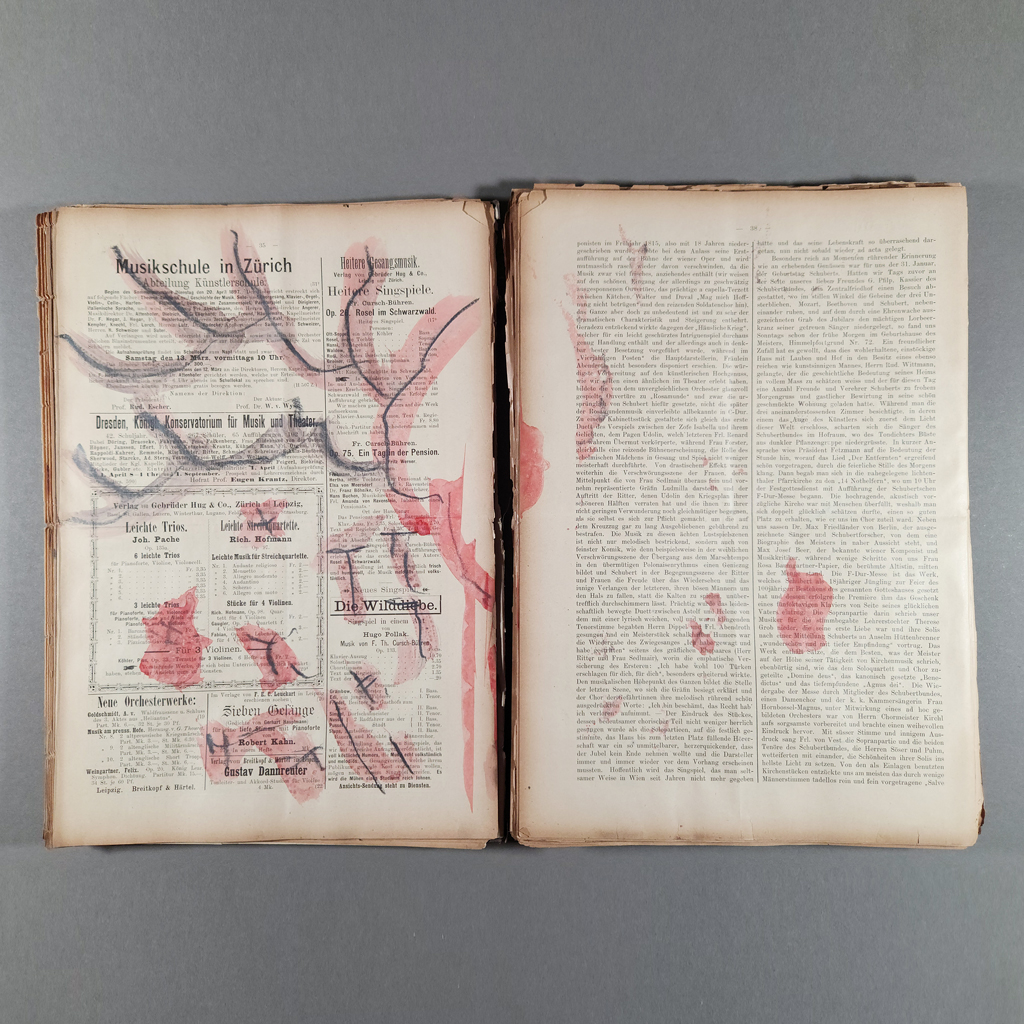
So, we return to the book’s promise of self-destruction. Is this to be mourned or celebrated? The inscription on the back cover, “original unique drawing,” raises a related question: is this a single work or more than a hundred? The singular “drawing” — not drawings — could be a verb, in which case the book documents the performance of drawing. In fact, Valadez does make drawings in public and give them away to spectators. The question is not whether this is an artists’ book, but rather what the reader must do with the drawings. Are they meant to be kept or given away? Am I obliged to preserve this brittle book for posterity, or to multiply Valadez’s generosity by distributing the drawings and destroying the book?
Fire is imbued with such questions and contradictions. It symbolizes violence but also transformation and enlightenment. No doubt the titular tear gas and flash bangs have something to say about current events, which hardly seem enlightened. Yet destruction and renewal are inseparable. The canon crumbles, making room for artists like Valadez. Finally, fire is something we can share without losing — a fitting metaphor for Valadez’s radical generosity.
 Artists’ Book Reviews
Leave a comment