Skip to content
Artists’ Book Reviews

Artists’ Book Reviews

Monthly reviews and occasional interviews

  • Reviews
  • Interviews
  • Submissions
    • Subsidized Submissions
  • About
    • FAQ
  • Contact
  • Email Newsletter
  • Browse Books
    • Title
    • Author / Contributor
    • Editor
    • Date Published
    • Publisher
    • Publication Format
      • Monograph
      • Periodical
    • Genre
    • Print / Production
    • Medium
    • Binding
    • Container
      • Belly Band
      • Envelope
      • Slipcase
      • Tube
    • Structure
  • Notes from Byzantium

    Notes from Byzantium
    Shelly Taylor and Eben Goff, ed. AB Gorham
    2019
    Black Rock Press
    www.unr.edu/art/black-rock-press

    7 × 9 × .25 in.
    60 pages
    Binding: Softcover codex with sewn signatures
    Foil cover and HP Indigo inside

    Notes from Byzantium, cover

    The combination of poetry by Shelly Taylor and art by Eben Goff is not an obvious choice, but then, the best books are often surprising. Both text and image benefit from this unlikely marriage in Notes from Byzantium, edited by AB Gorham of Black Rock Press. The two remain on their respective pages, integrated through juxtaposition and rhythm. Depending on the spread, text or image occupy either recto or verso or both. The unpredictable pattern influences the reader’s pace, though the effect only gradually becomes apparent. This dynamic reading experience, combined with the book’s size and materiality, make artists’ books a good framework for approaching the hybrid publication. Though the text is divided into discrete, titled poems, Notes from Byzantium is neither a typical poetry chapbook nor a fine press edition.

    The book, as a physical object, is unusual. It feels simultaneously modest and luxurious in the reader’s hands. It is covered in a coral pink book cloth, which is folded over paper rather than board to create a pillowy, flexible codex. The text block is sewn in five slim signatures of three sheets each, so it lays flat with little resistance. Even the full-page images lose nothing in the gutter. The mechanics of the book afford it a sensuality that would be lacking had it been perfect bound or pamphlet-stitched. The relatively thick paper still drapes nicely as the page turns, thanks to the book’s nearly square proportion. Even the texture and opacity of the paper contribute to a deluxe feeling that is especially well suited to Goff’s photography.

    The series of photos depict the artist’s own oil engravings in wax panels. However, they are not mere documentation or facsimile. As the book advances, the photographs progress from decontextualized close-ups of stratigraphic imagery to compositions that hint at the objects’ scale and materiality. The pieces appear as though thread was somehow embedded in marble. The restrained color palette and limited mark-making vocabulary heighten the impact of subtle changes. When the horizontal rows of filament give way to vertical columns, the relationship between text and image is radically reconfigured. Likewise, the switch back and forth between full-page photos-as-image and cropped photos-of-image repositions the reader in relation to the book’s themes of memory, time and place.

    There is no literal, illustrative connection between the text and image. With their geological appearance, Goff’s images seem to speak to memory and environment. The oil engravings exude temporality and process – the slow deposit of sedimentary layers, or perhaps their erosion. This makes them ideal for reflecting on Taylor’s words, which are very much about place. Though her lexicon evokes the American South, and she references the desert southwest, each poem seems to transcend one region. They convey what it feels like to have a sense of place, where ever it may be rooted. Taylor establishes setting with only a few details, the way one might recall their childhood home. The reading experience is not unlike memory; what begin as grounded narratives accelerate into fragments of language. One gets the impression of Taylor’s hometown, but it’s glimpsed through the passenger window of a too-fast truck.

    This momentum makes the pairing of text and image especially welcome. Once the poem begins, there is no place to pause. One must simply keep up with Taylor as she jumps between ideas until the theme emerges. “Every hinge gap apple please you,” for example, is a seventeen-line poem with a single period. The beautiful, intricate images provide an ideal place to reflect on the preceding poem. They are endlessly interpretable, receptive to the reader’s projections and associations. Both Goff and Taylor forge a pleasing gestalt from elements that are, upon closer examination, surprisingly rough. The tension between these fragments and the pieces they constitute remains compelling throughout the book.

    Women are another important through line in the book – women and girls and the distance traveled between (in both directions, growing up and reminiscing). Taylor’s poems touch on the unspoken things women pass down, for better or worse, through the generations. It’s not that men, or more often boys, are absent. Rather, what is striking is how they are mediated through an intimate, intersubjective narration, a secret or a memory shared between sisters. Contributing to the momentum of Taylor’s writing, the women of Notes from Byzantium seem restless, in transition even as they shape the sense of place.

    You moved all your stuff across town for love
    hands in lap passenger seat shy shoulders
    soot for later when the fires came through
    we found new homes.

    The speed, instability and fragmentation of the text all benefit from the book’s type treatment. With incredible economy, small changes in justification and word-spacing effectively alter the expression of each poem. A number of poems successfully use an unusual technique: the text is fully justified, with the word spacing selectively (not evenly) distributed throughout each line. Neither fully random, as with prose, nor predetermined as with verse, the line breaks and word spacing in poems like “Straight to the jawline bloody Igor” are the combined result of chance and choice. There is a resourcefulness, an ambivalence, in this approach that seems appropriate for the text. The impact of this design decision is demonstrated in contrast to poems that similarly use selective word spacing, but with a ragged right edge that leaves the line break to the poet’s discretion. Further variations, all with the same typeface, point size, and leading, show the power of typography. Even the titles benefit from the subtle handling.

    Notes from Byzantium offers a nuanced presentation of challenging, rewarding text and imagery. In a digital world, it is fair to question whether a book warrants a printed existence. Notes from Byzantium will invite readers back again and again. The book’s engaging materiality and excellent print quality create the right reading experience for such potent content. That it achieves this elegance while celebrating the grounded, unfussy quality of Taylor and Goff’s work is an impressive achievement.

    Levi Sherman

    May 27, 2019
    Review
    2019, AB Gorham, art, art and writing, artists’ book, book art, Eben Goff, Foil Stamp, HP Indigo, hybrid publication, Link Stitch, Monograph, oil engraving, Photography, Poetry, publishing, Shelly Taylor, Softcover, Text, wax
  • The Job

    The Job
    Woody Leslie
    2019
    Large Home Tiny Idea
    woodyleslie.com

    4 × 5 in.
    32 pages
    Binding: 5-hole pamphlet stitch
    Ink jet cover and laser inside

    The Job, front cover

    The Job is the second book in Woody Leslie’s “Tiny Ideas” chapbook series. Through his imprint, Large Home Tiny Idea, Leslie harnesses the authority of the book form in order to examine everyday phenomena, often through the lens of language. The Job achieves this by reflecting on Leslie’s experience working in restaurants, and the familiar struggle to balance work with one’s outside interests. Tellingly, that tension never resolves. The workplace that inspires the book is, in Leslie’s words, “no place for creative writing.”

    The Job, inside spread 1

    Though it touches on political issues, The Job remains resolutely personal. The writing expresses a common sense solidarity with fellow food service workers (and a visceral resentment of those who profit off their work) that is more sympathetic than an ideological label. Even when Leslie uses insider slang, the specificity is relatable rather than exclusive. Many readers will have shared the experience of starting a new job and finding something funny or confusing, only to accept it and forget how weird it is until they quit or another new employee joins. In fact, the similarities among jobs – whether the author’s or the reader’s – is another powerful political point made implicitly through the observations in The Job.

    Fans of Leslie’s work will find plenty of continuity with previous pieces. Considered alongside his 2011 comic, The Adventures of Super Cafe Douche Bag Man, The Job shows the evolution of Leslie’s work-inspired art. Words and Vegetables (2017) shares its highly detailed introspective style. The organization of ideas, not quite stream of consciousness, is similar to Some Definitions of Vegetables (2019) and Parsely (2016), with which it also shares an emphasis on the visual arrangement of text on the page.

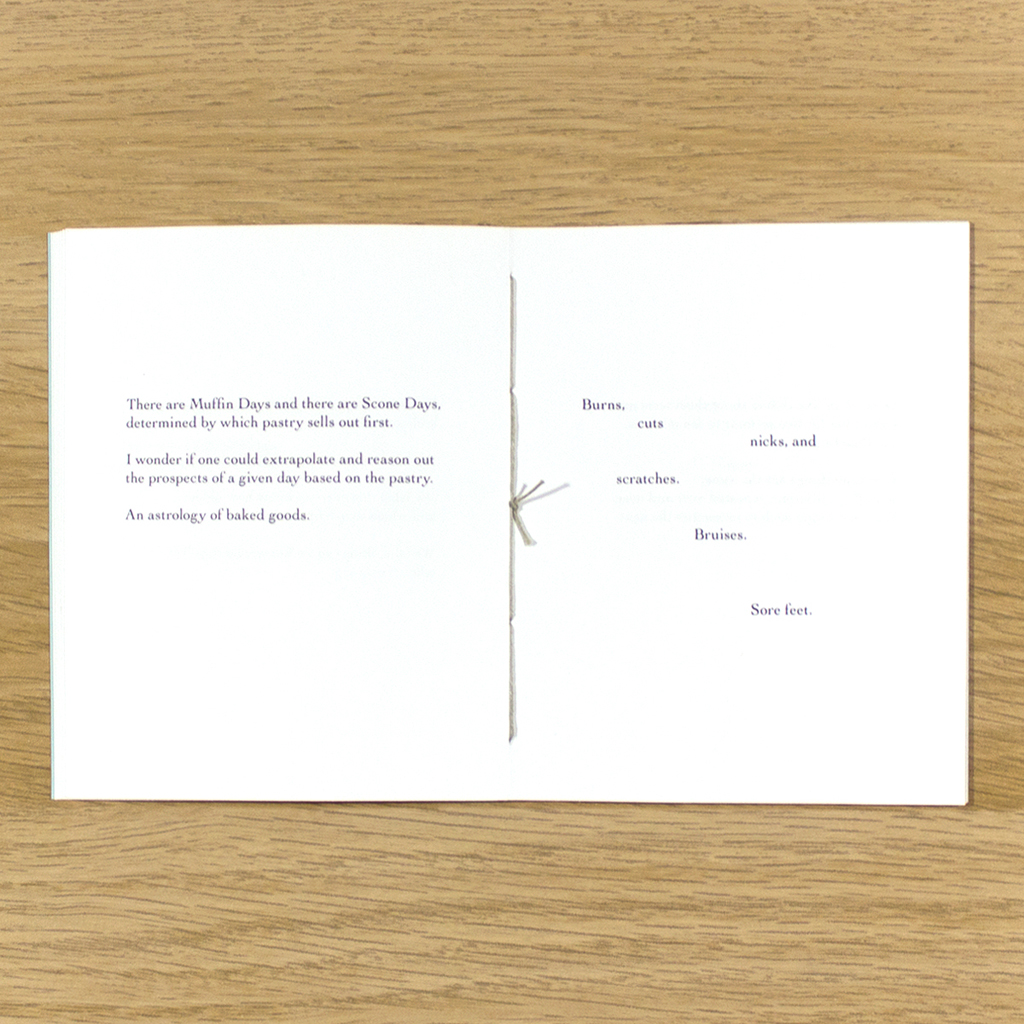
    The visual treatment of text in The Job is subtle, but it is enough to put this work of nonfiction into dialogue with visual poetry. In some passages, the text is treated as prose. Elsewhere, enjambment gives a more poetic feel to the few lines on a page. The conversation with visual poetry begins in earnest on the fourth spread, where a map of Leslie’s workplace is rendered on the recto. Interestingly, it’s not clear if the representation is spacial or temporal, or some psychogeographic mixture. This uncertainty is later complexified when the same layout is used to visualize Leslie’s body, mapping the aches and pains of restaurant work.

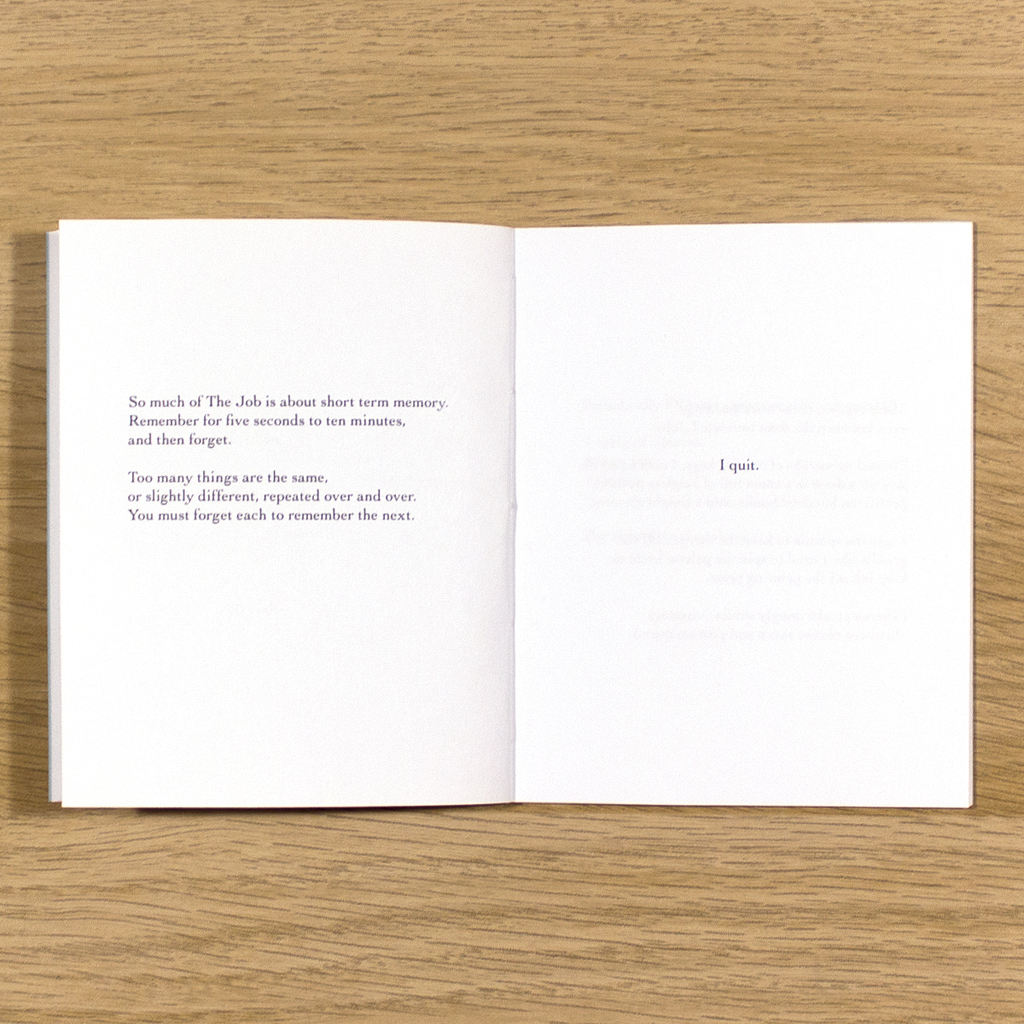
    As a text in the book form, The Job does more than visual poetry alone. On a basic level, layout on a page or a spread within a codex is different than, say, a broadside. For example, a recto that says only, “Waste.” has a different meaning than the same word with the same amount of white space around it on a broadside. The page is a unit, and the word uses (or perhaps wastes) the entire unit. A similarly sparse page bearing the phrase “I quit.” highlights other features of the codex. Has the author quit writing; are the subsequent pages blank? The way the turn of a page conceals and reveals adds to the impact of The Job – it would be a different piece outside the book form.

    Leslie also engages the codex as a mnemonic device. In the first half of the book, he writes:

    So much of The Job is about short term memory.
    Remember for five seconds to ten minutes,
    and then forget.
    Too many things are the same,
    or slightly different, repeated over and over.
    You must forget each to remember the next.

    The same text, with identical formatting, repeats in the second half of the book. The self-reflexive relationship between form and content tempts the reader to flip back to the first instance. Is the phrase the same or slightly different? The codex is ideal for this sort of non-linear access.

    Even with this short text, Leslie takes full advantage of these affordances to play with linear and cyclical progression throughout the book. The page as a temporal unit is disrupted to convey a quintessential experience of an unsatisfying job: the days are long, but the years are short. The opening page features the repeated phrase, “We set up the blocks, they knock them over.” Time crawls by, and the page ends with “Day after day.” Later in the book, Leslie ruminates on mopping:

    Leaves.
    Slush and salt.
    Mud.
    Grass.

    A whole year flies by, just like that. The stakes are raised as the pamphlet’s bulk shifts from the reader’s right hand to the left hand. Will the author escape The Job and focus on his creative work? Or will an earlier phrase repeat and place the reader back into the cyclical existence of wage labor? The suspense of each progressive revelation is heightened in the user-determined, time-based medium of the book.

    In fact, The Job’s successful marriage of form and content points to the historical role of the chapbook as a democratic form. Leslie is subverting the authority of the book to assert the importance of the personal and quotidian, but he is doing so within a long tradition. The Job is noteworthy for the ease with which book art, visual poetry and non-fiction meet and make meaning in a humble pamphlet. Perhaps it is a large idea in a tiny home.

    Levi Sherman

    April 15, 2019
    Review
    2019, Ink Jet, Large Home Tiny Idea, Laser, Memoir, non-fiction, Pamphlet, Pamphlet Stitch, Periodical, Poetry, Text, The Job, visual poetry, Woody Leslie
  • Welcome

    Below you’ll find the most recent artists’ book reviews and interviews. See the submissions page to find out how your book can be featured.

    Artists’ Book Reviews

    April 13, 2019
    Uncategorized
←Previous Page
1 … 9 10 11

    • Instagram
    • Mail

    Loading Comments...

      • Subscribe Subscribed
        • Artists’ Book Reviews
        • Join 78 other subscribers
        • Already have a WordPress.com account? Log in now.
        • Artists’ Book Reviews
        • Subscribe Subscribed
        • Sign up
        • Log in
        • Report this content
        • View site in Reader
        • Manage subscriptions
        • Collapse this bar