
4 × 6 in. closed
124 pages
Perfect-bound softcover
Digital printing
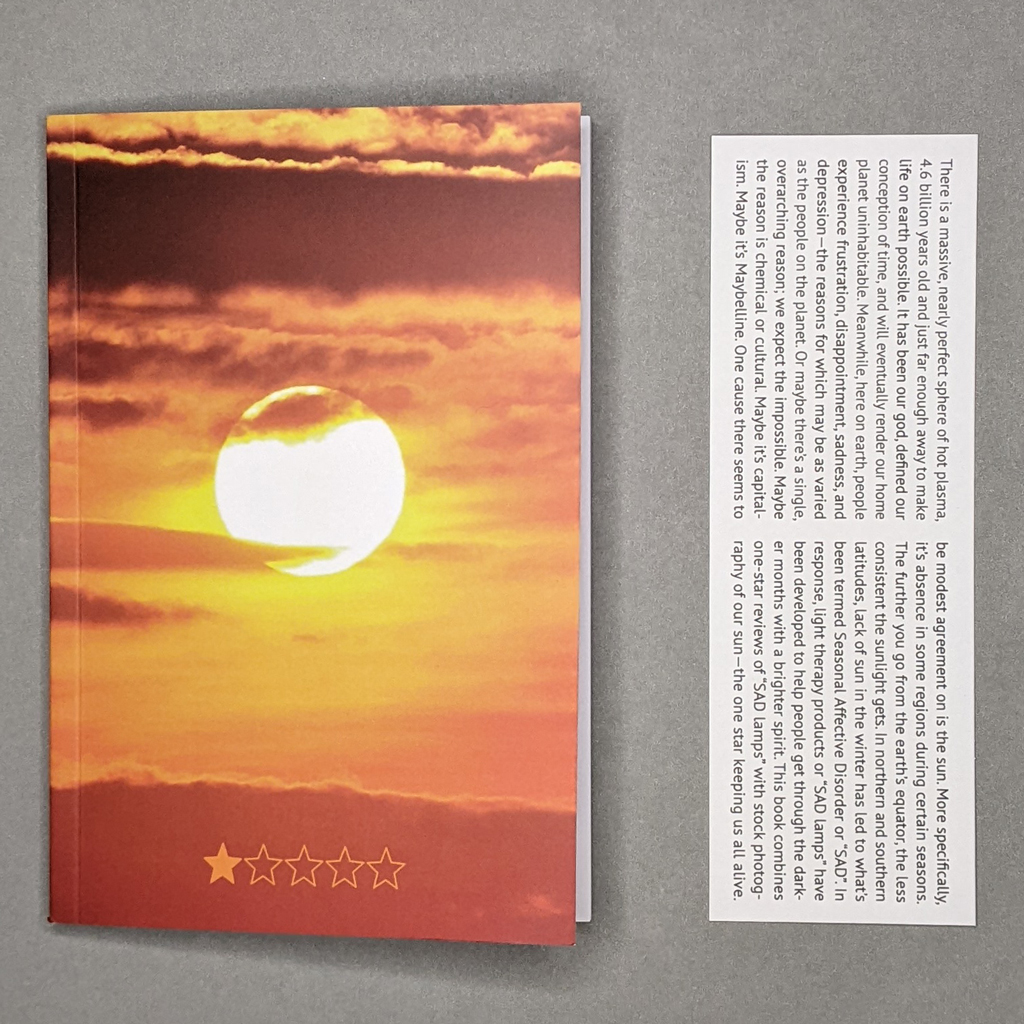
Zak Jensen’s self-published book One Star collects one-star customer reviews of seasonal affective disorder lamps interspersed with stock photographs of the Sun. A bookmark accompanies the book; on one side: the title, edition size, artist’s name, and date of publication; on the other: a preface.
The preface, which attempts to cover a lot of ground on a small surface, functions as an axiom, an interpretive key to reading the book. And since there’s nothing in the book to inform the reader about what’s about to happen, it’s helpful in providing a certain kind of orientation. The last sentence, for instance, clearly states One Star’s contents. Yet, even though the bookmark can be separated from the book, these prefatory remarks may have been better left unstated altogether. As if we may have forgotten, Jensen reminds us that the Sun exists, and that its presence and finiteness mark some of the contingencies informing human life on Earth. His cavalier etiology of depression strikes an overweening tone that undermines the found text in the accompanying book.
![One Star inside spread. Verso is a grayscale stock photo of the sun above a cloud. Recto reads: “Just regular light. / Amazon Customer”]](https://artistsbookreviews.com/wp-content/uploads/2023/11/pxl_20231126_180106942-square-1024px.jpg?w=1023)
However, there is a book within the book that Jensen has made that deserves attention. Without the bookmark, Jensen’s book becomes a critical act, ironically mobilizing tropes in ways that are at once destructive and moving, turning the world, for a brief moment in time, on its head. That book, on its face, would have appeared to be the same book that Jensen published (and it is): its orange, sherbety cover ablaze with an image of the Sun, setting or rising depending on your perspective, captioned by Amazon’s five-star rating system. The book’s title and Jensen’s name appears on the back cover, a move that generates intrigue when initially encountering the book (an intrigue that is prevented if the bookmark is read first).
What is this One Star? Who would dare review the Sun — and so negatively?
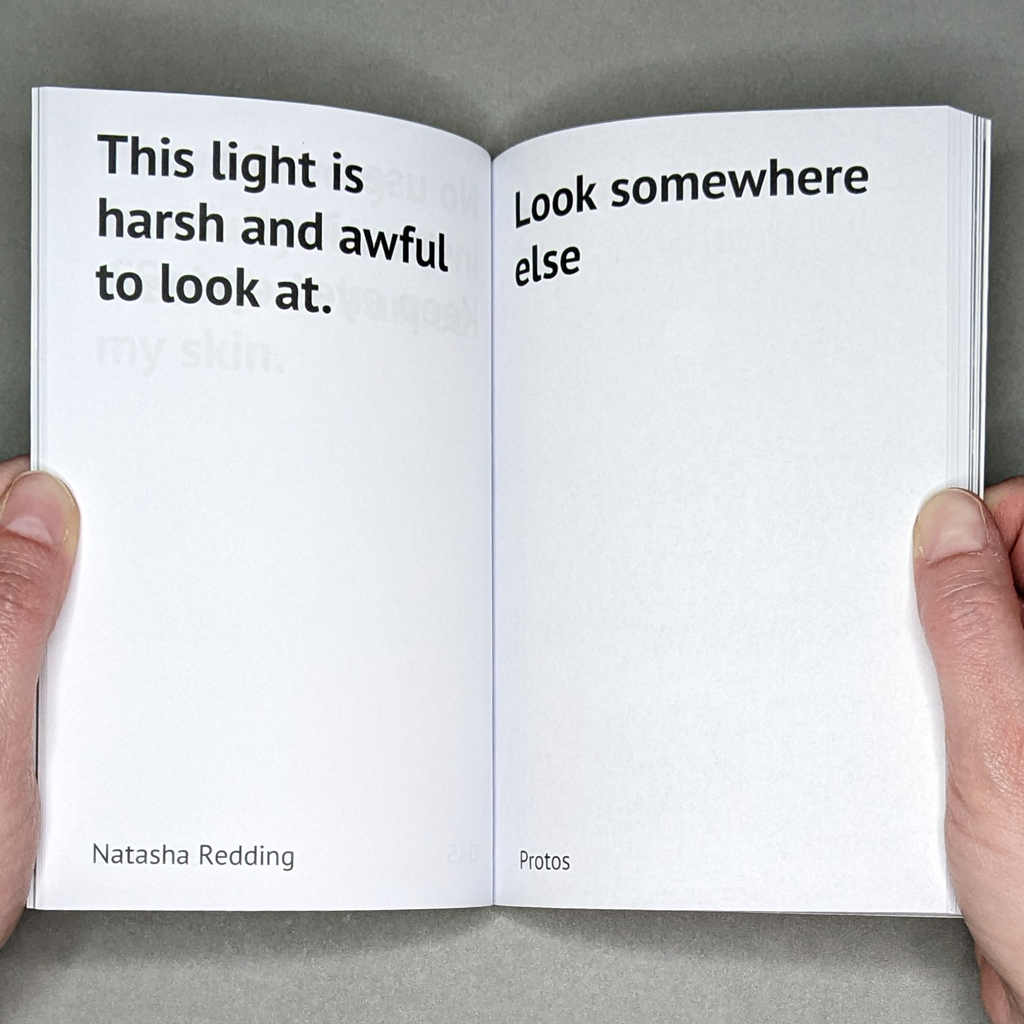
It wouldn’t take long for readers to discover that they’re reading one-star reviews of an object that emits light (the word “lamp” is absent from most of the reviews, but even when it appears, especially in conjunction with images of the Sun, it takes on a more tropological significance). The reviews quickly become jarring and mournful, especially when pictures of the Sun — very typical pictures of it — begin to emerge. It’s as if a taking stock were put in motion, a reminder of all that we have. Whether read as a joke or a eulogy, it would take merely a click, a search, to find the Sun, posted on the world’s largest marketplace by a hundred different sellers, some reputable, some not, and listed on sale for a limited time, sold in pieces, with free delivery, implicitly demonstrating that even as humanity hurtles piecemeal towards extinction the market remains unvanquished.
![One Star inside spread with text on both pages. Verso reads: “Not only does this piece of junk cycle through brightness modes and turn off by itself when you’re using it, but it turns ON by itself! / Laura”. Recto reads: “Stopped Working / It apparently has some kind of short. / Ann Wortham”]](https://artistsbookreviews.com/wp-content/uploads/2023/11/pxl_20231126_180329964-square-1024px.jpg?w=1024)
However, Jensen’s One Star takes a different approach. The Sun is not for sale on Amazon. The book and its bookmark stand beside one another, as near equals. Jensen’s one-star customer reviews remain more literal than figurative, but he uses the Sun as a second (subordinate) object to create a kind of strobe effect that engenders ambiguous interpretations, allowing the reader to apply the reviews to both objects. When a review explicitly refers to a SAD lamp, or when the reviewer blames Chinese manufacturers for a defective product, touting its inferiority, the ambiguity disappears. The best reviews — the most ambiguous — are those which neither name nor blame.
One Star is in conversation with a brief history of books that collect and reframe writing from consumer comments sections. The book would fit squarely, shelved alongside books such as Stephanie Barber’s Night Moves, Cory Arcangel’s Working on My Novel, and Vanessa Place’s You Had To Be There: Rape Jokes (Barber’s Night Moves collects YouTube comments of Bob Seger’s song Night Moves; Arcangel’s Working on My Novel is a Twitter feed that re-tweeted the best posts featuring the phrase “working on my novel”; and Place’s You Had To Be There: Rape Jokes is mostly culled from Reddit). Likewise, One Star uses found writing and reframes it in book form. One Star doesn’t challenge conventional book design, but it is easy to imagine certain reviews (e.g., “DO NOT PURCHASE”; “Trash./Does nothing.”; “Underwhelming”) coupled with an image of the Sun becoming posters for the walls of today’s nihilists.
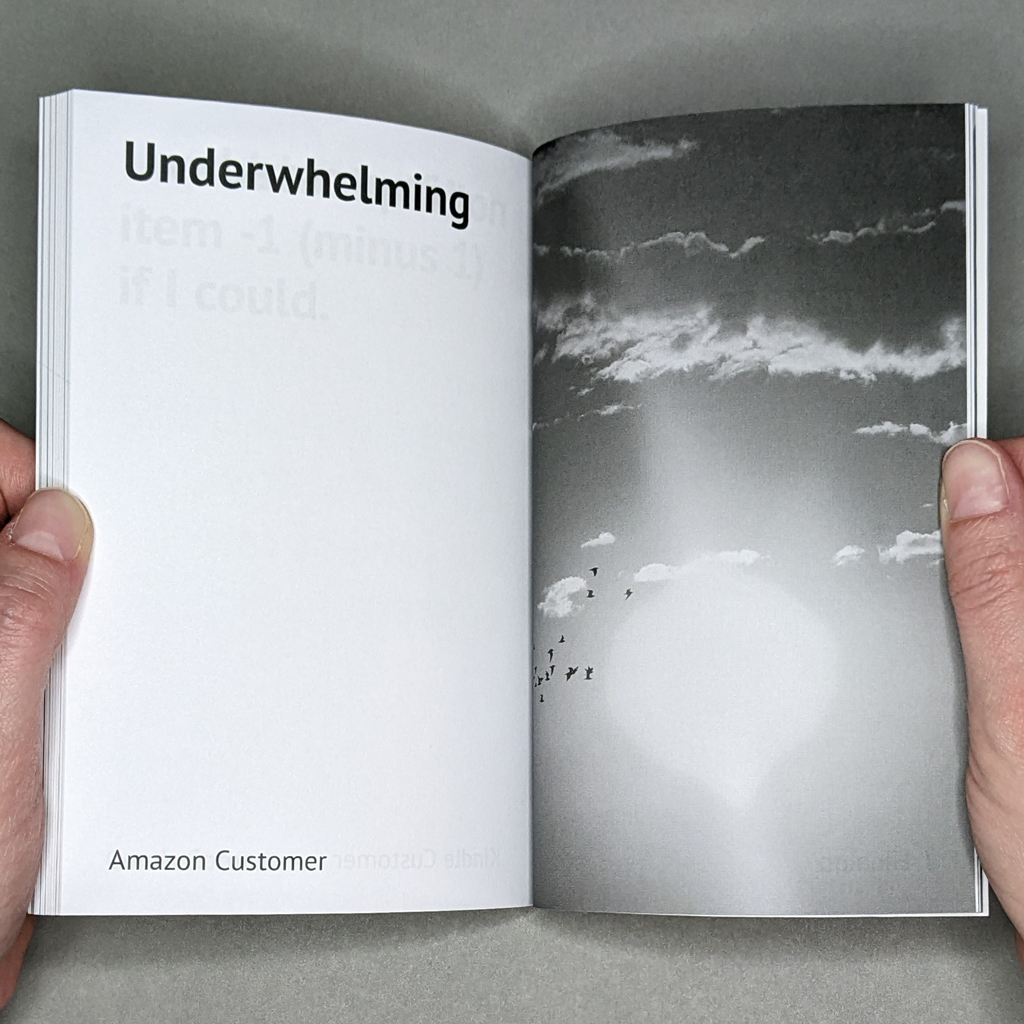
Jensen’s method of juxtaposing two abject elements — product reviews and stock photographs — to create a new ensemble echoes the situationist tactic of détournement. But One Star seems less interested in interrogating relations of power or in constructing new situations opposed to capital’s spectacle than it is in reproducing those relations to maintain a status quo: the artbook as product.
Jensen risks reproducing the exploitative model of social media platforms, where users produce free content for corporations to sell. Placing the reviewer’s name on the back cover alongside Jensen’s and giving them a cut of the sales of the book they unknowingly helped create could have dispelled one of capitalism’s chief operating metaphors: that people are valuable insofar as they are useful.
One Star is timely. However, it’s impossible to discern the exact time frame during which Jensen gathered these reviews. Dates could help locate the book in history, providing the reader with a sense of where they were — like 9/11 — when the customer complaints were posted. One Star succeeds in recording and documenting the ephemeral existence of people who bought a product, commented on it, and then disappeared.
 Artists’ Book Reviews
Leave a comment