
Tender to Empress
Maureen Alsop
Wet Cement Press
2022
8 × 8 in. closed
114 pages
Perfect-bound hardcover
Ink jet

Tender to Empress is a collection of visual poems by poet, artist, and psychologist, Maureen Alsop. These digital collage-poems began as a gallery installation, but the book has its own dynamics, thoughtfully pairing pages into spreads and sequencing the poems toward something like a climax. Something like, because Alsop’s écriture féminine is not so linear or goal directed. It is better to say the book’s layers of meaning accumulate, amplifying and feeding back on one another as the reader progresses. If écriture féminine is meant to escape masculinist literary traditions, Alsop has chosen a challenging subject — Tender to Empress arose from a longer manuscript on warfare, from the crusades to the second world war. But the topic is hardly obvious, and there is rarely only one topic in Alsop’s poetry. Part of the pleasure of Tender to Empress is re-reading to see how meanings change through new juxtapositions and associations, a reading experience that is well supported by the book’s pacing, design, and mix of text and image. Returning and remaking meaning gives the reader a taste of Alsop’s process, in which words become visual art and even interactive objects, which then inspire new writing.

The book is separated into sections by numbered prose poems, which are conventionally typeset across a single spread without illustration. The visual poems that follow each of these spreads borrow fragments from that longer text or otherwise build off it. Each page is a self-contained collage-poem surrounded by a white margin, but the verso and recto visually relate to one another, often with coordinated colors. Likewise, each set of collages between the numbered prose poems seem to form a coherent movement with related colors and motifs. This coherence may simply result from the recursive repetition of themes as layers of meaning accumulate. Regardless, as the book progresses, the visual movements between numbered prose poems are shorter, quickening the overall pace.
The short texts flow from one page to the next and thus propel the reader more than the imagery. At that speed, the images offer impressions and set the tone more than they illustrate the text. Visual motifs repeat and sink in slowly, as if arising from the reader’s subconscious. Yet each collage is imaginative and well designed, warranting a closer look upon subsequent readings. Alsop also uses design tactics to slow the reader, like setting grids of vertical text or turning elements so the book must be rotated. However, even when the reader is challenged, the text remains readable.
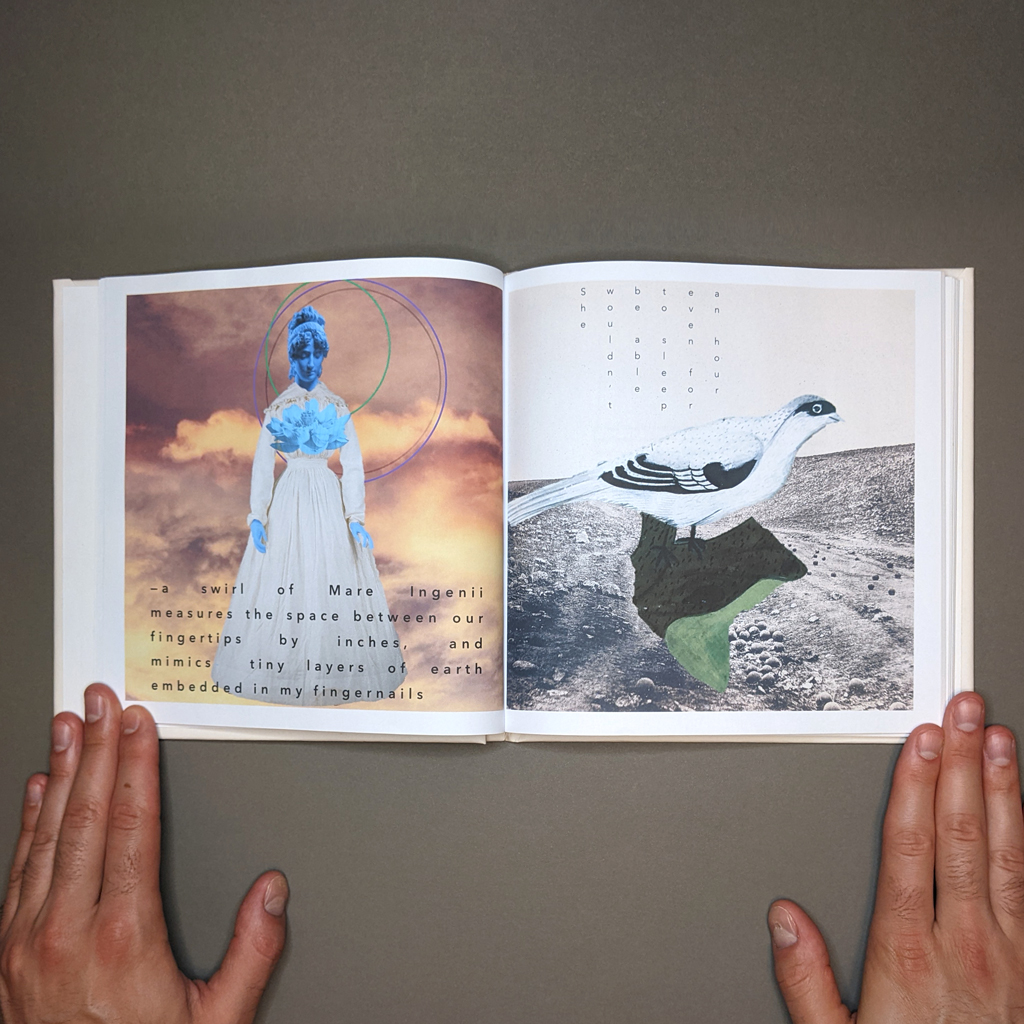
If the reader returns to the collages, they will find that the text also merits repeated reading. Alsop’s poetry is perfectly polished at the sentence level, and some collages have only a single sentence or phrase. At the same time, the paragraphs are richly textured and unpredictable. The poetry’s refinement, and the depth and strangeness of its vocabulary, are at odds with its immediacy and momentum, but in a way that is surprising, not unconvincing. Plant species roll off Alsop’s tongue, conjuring specific geographic and cultural associations — or the exotic absence of such associations — as if they come up in daily conversation: pin-oak, glasswort, hyssop, alder. If, intellectually, the reader understands the steps Alsop must take between drafting the text, rendering it in collage, and editing it into a book, the overall effect is nevertheless spontaneous. Moments of introspection feel like real revelations.
If the topic, or topics, are never entirely clear, it is not because Alsop’s language is vague. It is, in fact, precise. Alsop is, however, interested in signification and encoding, in the erotics and ethics of communication and miscommunication. This doesn’t preclude the drive for self-understanding that is central to écriture féminine; in Tender to Empress, the self and the other cannot be disentangled. Interiors and exteriors, of people and environments alike, merge and interpenetrate.
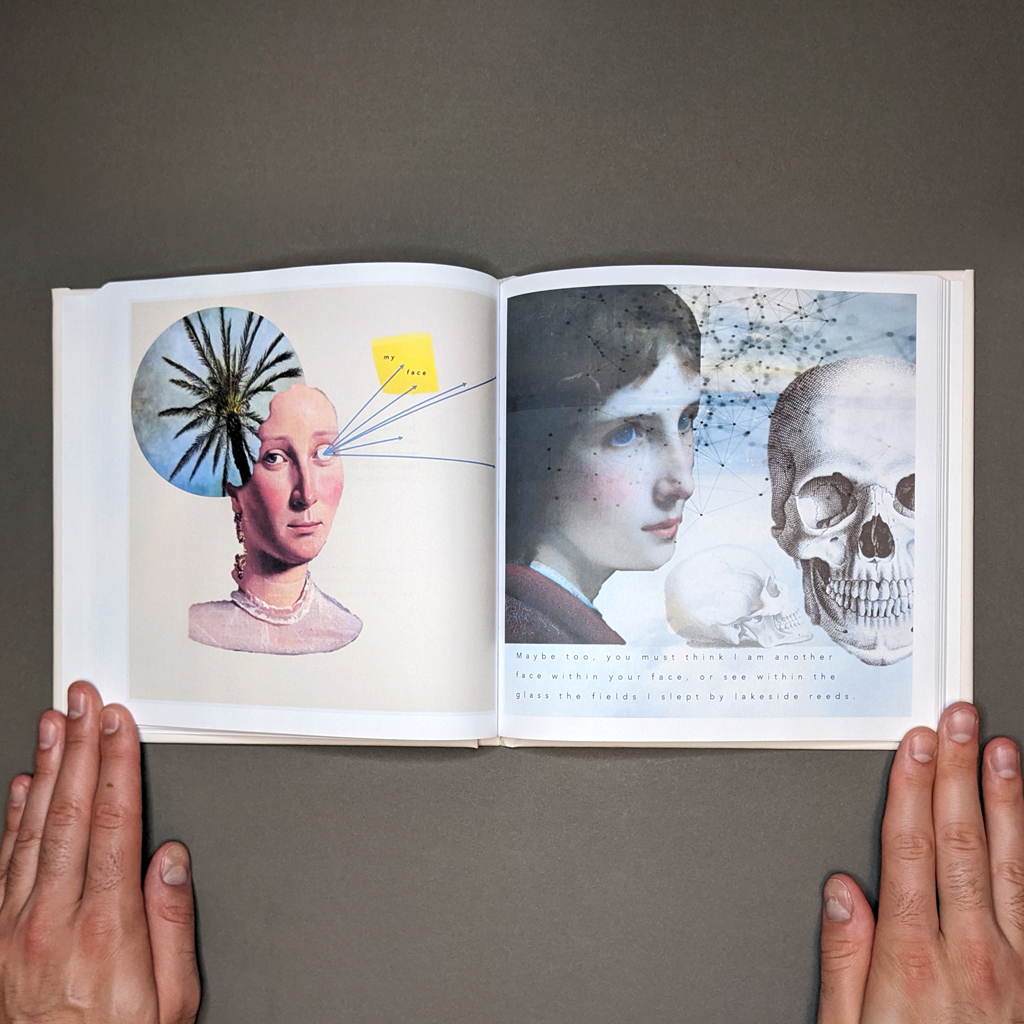
Collage is the perfect medium for entanglement and shapeshifting; things are constantly becoming other things, or at least combining with them. These strange combinations contrast with the familiarity of their source images, a mix of eighteenth- and nineteenth-century art, scientific diagrams, and vernacular visual culture — familiar but rarely recognizable. Alsop’s collages belong to a lineage stretching from surrealism to net.art. They are unapologetically digital without being about software or the internet. Like the visual culture Alsop appropriates, the recognizable traces of digital tools speak to the limits of signification and communication. Familiarity helps the reader access the work, but it also comes freighted with history. Therefore, collage is Alsop’s medium in a second sense: it calls forth ghosts from the hall of battles, where her writing project began.

The weight of history, of war and trauma, seems to grow more explicit as the book progresses, although, again, this awareness may just result from accumulation. What first passes as metaphor becomes, slowly but insistently, history. After all, we are quick to use the language of war in other contexts, and Alsop, in turn, says a great deal about other topics. Or perhaps she says little but mediates effectively. Each reader brings their own ghosts, and Alsop trusts the reader a great deal. Which is not to say Tender to Empress is a blank screen for projection. On the contrary, Alsop provides a richly detailed, endlessly surprising environment in which to immerse oneself. This invitation to the reader doubles the achievement of Alsop’s écriture féminine on a prototypically masculine subject — she convincingly works toward a less alienated self and enables the reader to do the same.
 Artists’ Book Reviews
Leave a comment