
Bibliographic Performances & Surrogate Readings
Janelle Rebel
2024
The Everyday Press
Perfect-bound softcover with French folds
353 pages
5.25 × 7.75 in. closed
Letterpress cover, offset inside

Bibliographic Performances & Surrogate Readings is a bibliography of bibliographies. Not just any bibliographies, though — author Janelle Rebel is both an artist and a librarian, and the collected bibliographies reside at that same intersection. The roughly fifty projects are prefaced by two essays addressing bibliographies and contemporary art. From there, the bibliographies are presented in alphabetical order. Rebel succinctly describes and illustrates, and sometimes evaluates, these projects, usually in around five pages. Given the book’s subject, it is no surprise that an alphabetized “catalogue of bibliographies” and index are also included. At once a work of scholarly interpretation and creative expression, Bibliographic Performances & Surrogate Readings does important interdisciplinary work that ought to interest anyone in the field of artists’ books — and many related areas.
The first essay, “Bibliographic Performances and Surrogate Readings,” places Rebel’s work amid related debates. In literature, there is handwringing over “distant reading.” In digital humanities, contention over what constitutes interpretation. In art history, concerns about the canon. Rebel makes her position clear: “The labor of the bibliographer is one that includes many micro-acts of interpretation and judgement, effectively engaging in a form of critical editing at the level of subject construction.” In other words, bibliographies are interpretive, creative, and powerful, and therefore worth examining critically. Artists are well suited for such an examination because, as Rebel reminds us, surrogates — such as catalog records — are representations.
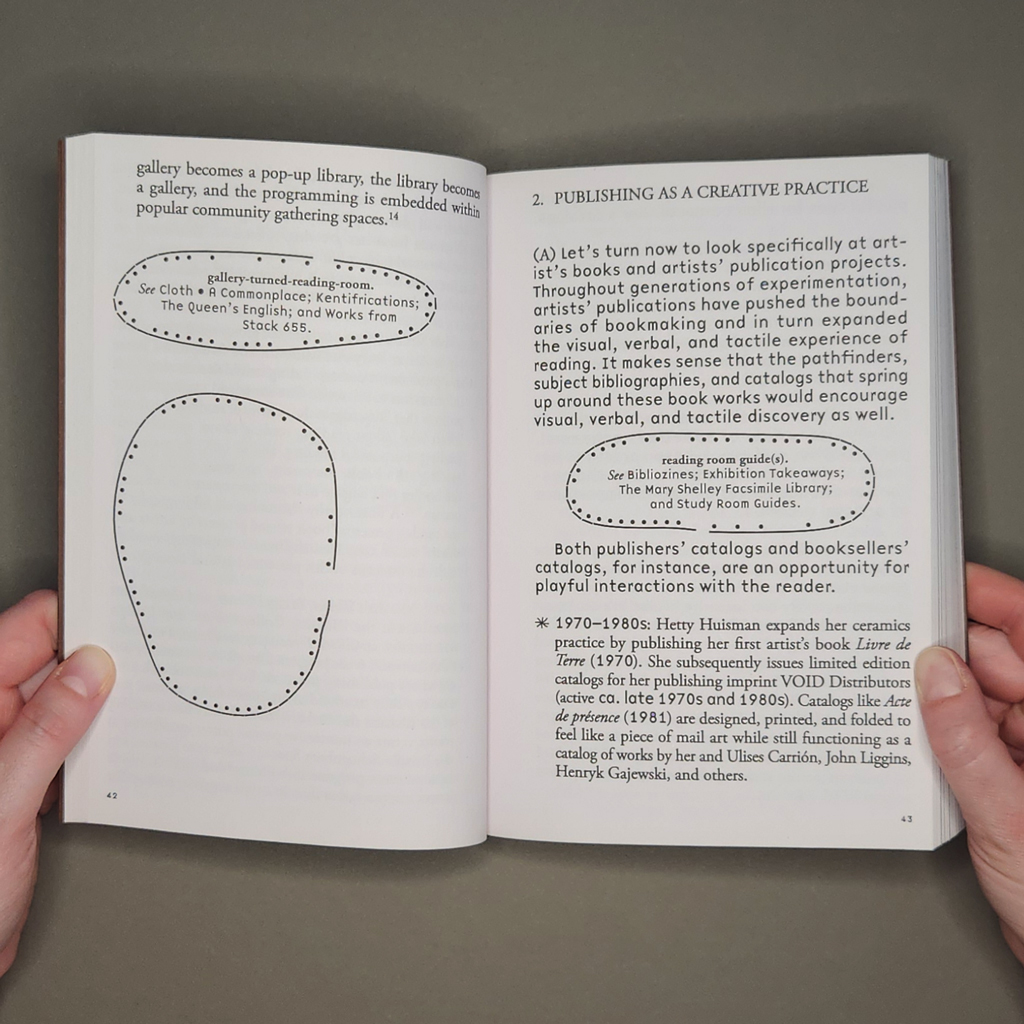
The second essay, “The Visio-Bibliographic Turn in Art and Design” relates more directly to art and art history. Sections include “The Dematerialization of Art,” “Publishing as a Creative Practice,” and “Experiments in Arranging the Library.” Though a substantial piece of scholarship, the essay is essentially an annotated bibliography, a roughly even mix of theoretical arguments and case studies. Rebel also illustrates certain ideas by cross-referencing examples from the collected bibliographies that follow. (The challenge of integrating these cross-references with the main argument and its annotations showcases the book’s excellent graphic design, done by Margherita Sabbioneda.) Rebel blurs the boundaries of the essay’s thematic sections and stretches the geographic and temporal scope far beyond contemporary art and design. There are, for example, multiple references to works from the sixteenth century that remain not just relevant but provocative.
The essays provide useful context, but the collected bibliographies can be enjoyed without them. I eagerly read the book cover to cover (in part because it overlaps with my dissertation research), but many readers may find it more fun to sample the bibliographies at random. The provocative thought experiments are sure to inspire even more creative bibliographies, and Rebel provides thorough documentation for readers to dig deeper into projects that particularly interest them. Each entry begins with a conventional citation, but the rest of the surrogate adapts to the original project, which range from books and databases to sculptures and installations. Some projects can be grasped through a single photograph while others require substantial verbal explanations.

Readers familiar with artists’ books will likely recognize some of the bibliographies, most obviously those in book form, such as David Maroto’s The Artist’s Novel (previously reviewed for ABR by Eric Morris-Pusey), Triin Tamm’s Bookcatalogtest, Craig Dworkin’s A Perverse Library, and Kenyatta A.C. Hinkle’s Kentifrications, to name just a few. Yet I am certain that every reader will discover something new. Furthermore, the opportunity to reconsider something familiar can be even more exciting. For example, I gained a new appreciation for the creative and interpretive aspects of Mindy Seu’s Cyberfeminism Index and Dworkin’s “Further Listening,” a chapter in his otherwise scholarly book, No Medium.
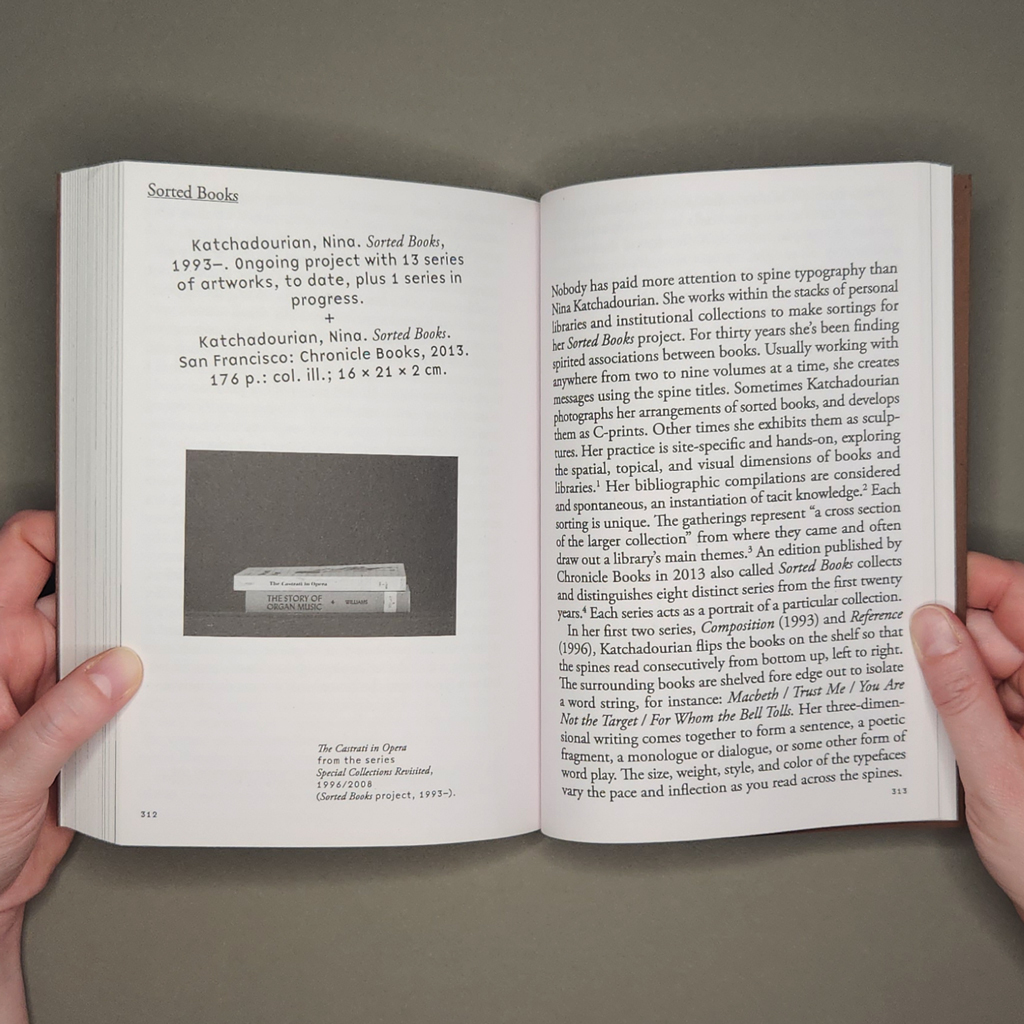
In other words, the scope of Bibliographic Performances & Surrogate Readings is capacious but convincing. Rebel’s definitions seemed strained most by platforms that facilitate bibliography but are not themselves bibliographies. For example, Printed Matter’s website allows users to curate and share their own virtual “tables.” Similarly, Sitterwerk uses RFID technology to turn actual tables of books into digital bibliographies. In other cases, a different analytical framework might fit more easily, but the friction that may accompany Rebel’s bibliographic framing is, in part, what makes the book so generative. Besides, such frameworks are not mutually exclusive — Nina Katchadourian’s Sorted Books can be bibliographies and poems and portraits. In every case, the bibliographies Rebel has collected benefit from being considered alongside one another and against the backdrop of the preceding essays.
Rebel provides ample evidence that there is indeed a bibliographic turn in art. Her study is therefore a valuable map of this new artistic territory. However, critical questions remain. Rebel correctly identifies a move toward “diversifying the list and Black bibliography” and notes the potential of such projects to deconstruct the canon, but what are the results? If we acknowledge that bibliographies can be art, then is there a chance that all the online reading lists and syllabi that circulated during the so-called racial reckoning of 2020 were more like art than activism?

More generally, can creative bibliographies maintain enough critical distance from the conditions that drive the bibliographic turn? Certainly, bibliography is part of a broader “curationism” that arose from the glut of content available online. One manifestation has been the longlists and shortlists that exert such a powerful influence on photobooks (though not yet artists’ books to the same degree). Might we mistake this commercial canonization for criticism or even art? Despite these risks, the solution is not to continue ignoring creative and interpretive labor, especially work pioneered by women and others whose artistic and scholarly contributions have long been undervalued. Instead, we should follow Rebel’s lead and continue to develop a critical framework to appreciate such work for what it is.
 Artists’ Book Reviews
Leave a comment