
One More Day: A Collection of Collections
Sonny Meno-Gutierrez
2026
72 pages
8.5 × 8.5 in. closed
Perfect binding
Digital printing
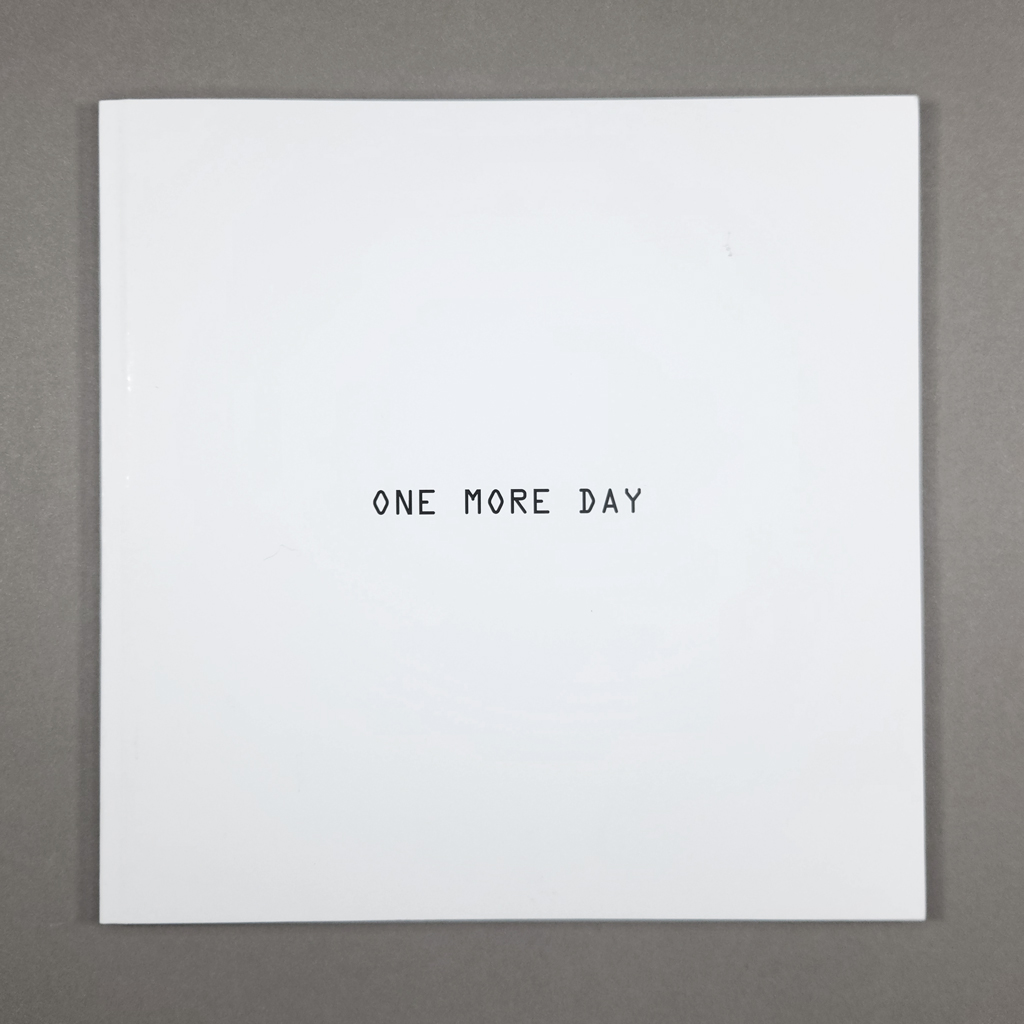
One More Day is an omnibus edition of photo series by Sonny Meno-Gutierrez. Some of the projects already exist as separate photobooks, but they function differently within One More Day. The book is, as the subtitle puts it, “a collection of collections.” Some of the photo series are obviously collections, but in other cases the collecting framework accentuates features that might otherwise be overlooked. Like any good collection, One More Day broadens and deepens the meaning of the works that comprise it.
Much of the photography has a deadpan aesthetic, and Meno-Gutierrez is clearly influenced by the likes of Bernd and Hilla Becher and Sol Lewitt. The series 29 Mattress Firms was previously published as an homage to Ed Ruscha’s Twenty Six Gasoline Stations, and the title One and Four Sons nods to Joseph Kosuth, while the series itself echoes Douglas Huebler. For a more contemporary reference, One More Day looks like something from Joachim Schmid’s 96-volume series Other People’s Photographs. Except, importantly, Meno-Gutierrez makes his own photographs, even when they look like found snapshots. What makes Meno-Gutierrez’s work particularly interesting is that he harnesses the aesthetics of photoconceptualism to different ends. Unlike the largely white canon of conceptual art, Meno-Gutierrez is a third culture kid, CHamoru and Chicano, who was born in Guam and moved around in a military family. By collecting pieces of place and time, Meno-Gutierrez locates himself, wherever he is.
Like LeWitt’s PhotoGrids, One More Day is a square softcover with black title text set in the center of the bright white cover. The OCR-A typeface recalls the Quartz Date timestamps that appear in some of the photographs (Meno-Gutierrez shoots on film). Similar title pages identify each series inside, but there are no page numbers or headers that might distract from the images. The photographs, scanned from prints, reproduce well on the coated stock. Which is not to say that these are technically ‘good’ photographs. Some are, but others look more like crime scene snapshots than conceptual deadpan. Meno-Gutierrez is not interested in the decisive moment so much as the aftermath.
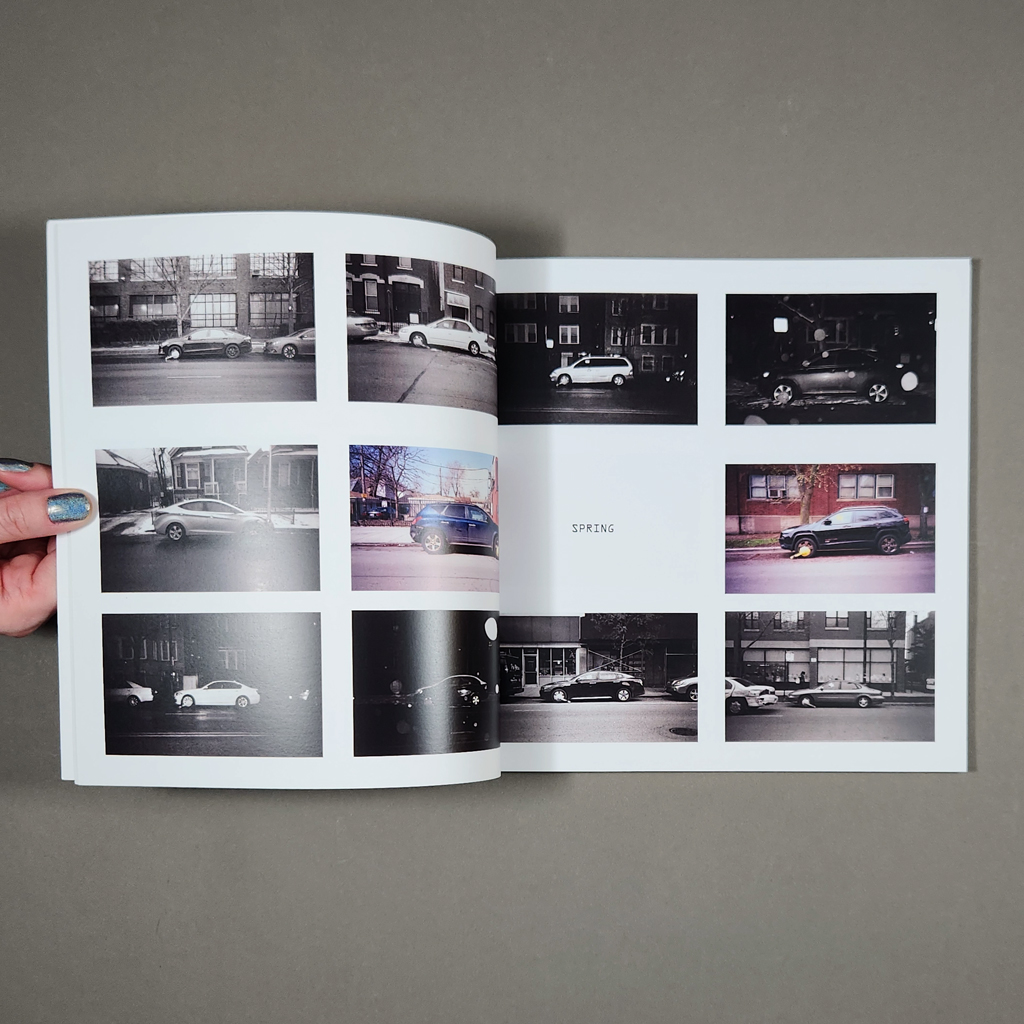
Boot Season exemplifies Meno-Gutierrez’s preference for duration. The boots referenced in the title are, in fact, those put on parked cars. Unfortunately for the drivers of Chicago, boot season never ends: the photographs are arranged into fall, winter, spring, and summer. Each page has two columns of three horizontal photographs, some color and some black and white. Even as the time of day and weather change, the compositions are quite consistent. The booted car is centered, shot in profile from across the street. The array is impressive, but the individual photographs reward close looking. The state of the car and its surroundings tell a story.
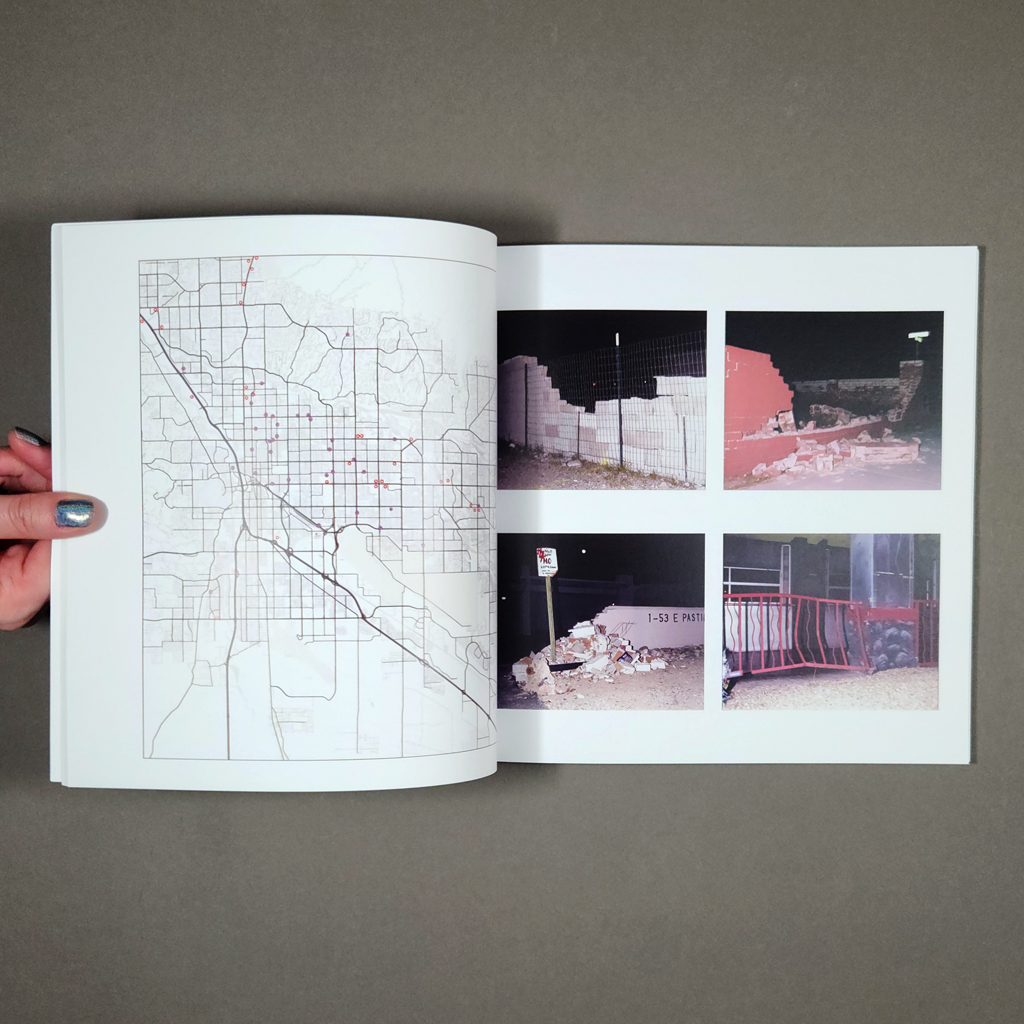
College Town Consequences is another collection of motorist misfortune: a grid of broken fences, walls, signposts, and anything else that stood in the way of an errant driver. The scenes are photographed at night, illuminated by headlights or camera flash, lending them the look of a tabloid magazine, if not a police file. They are visually reminiscent of Andy Warhol’s Death and Disaster Series, except for the critical fact that the cars are missing. Again, Meno-Gutierrez focuses not on the moment of impact, or even the immediate aftermath, but on a longer duration. A crumpled bus shelter has been cordoned off with caution tape. A cartoonishly bent wrought iron fence has been patched with chain link. If these provisional repairs suggest healing or resilience, there are also wounded trees whose survival is less certain. Collected over several years, the thirty-five photographs take a longer view of disaster and its impact on a single community.
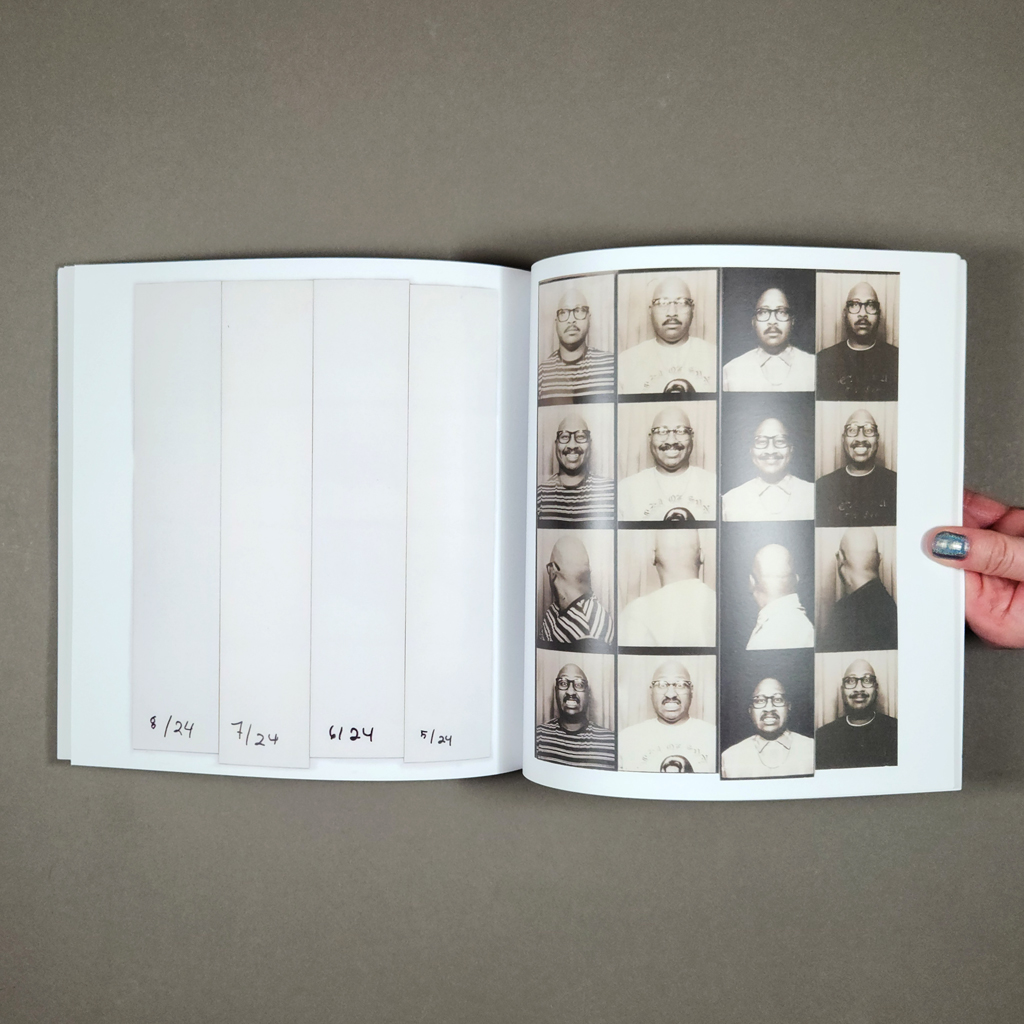
One and Four Sons is just a procedural as Boot Season or College Town Consequences, but the result is more personal. It is a collection of self-portraits, made in a photo booth, each month from January 2024 to December 2025. Dates are hand-written onto the backs of the photo strips, which are revealed with a turn of the page. Each strip has four images, and each one follows the same formula: the artist is deadpan, he smiles, he turns his head, and he grimaces. The order occasionally changes, probably by accident, but the four faces are as consistent as Meno-Gutierrez’s appearance: glasses, mustache, shaved head. Glimpses of personality come through in dress and undress, but the most authentic thing captured may be the artist’s commitment to the process. By using a photo booth, which is both a place and a camera, One and Four Sons distills the way Meno-Gutierrez constructs and performs identity through place and time.
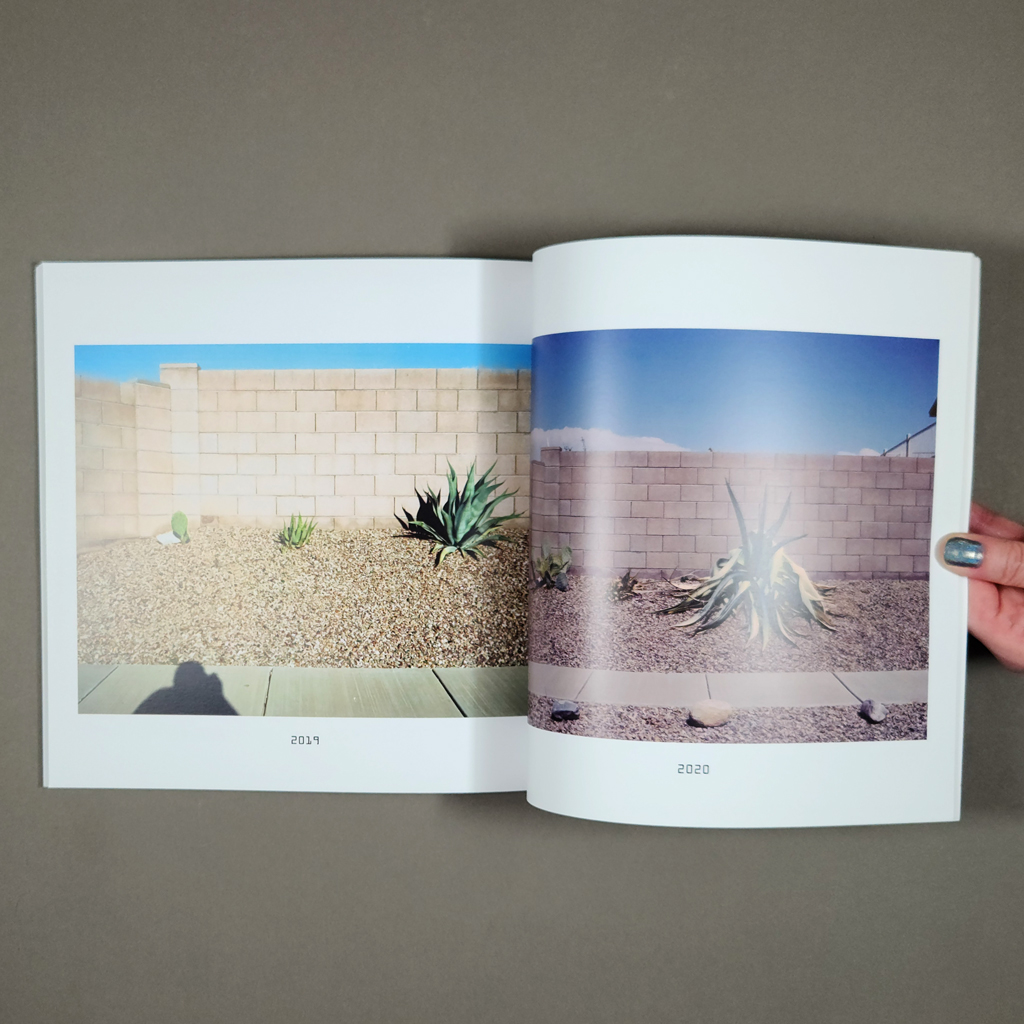
One More Day concludes with Existential Check-In, a series spanning 2019–2026. The photographer is back behind the camera, but the work seems even more personal than One and Four Sons. The subjects are three succulents: a prickly pear, an agave, and a larger agave of a different species. Over eight pages, each with a single photo and a caption with the year, we see the plants struggle, wither, and grow. (It is hard to say whether one or two may have died and been replanted.) The style is, again, deadpan. The plants have been dropped into a desolate strip of gravel between a sidewalk and a block wall, which serves as a neutral backdrop. Above the wall, a strip of desert sky adds a shock of color. Meno-Gutierrez casts a shadow into the first image, identifying himself with the subjects he will return to over the next seven years. Like Meno-Gutierrez’s monthly visits to the photo booth, it seems more like we are checking in on the photographer than on the plants — especially as the project covers the COVID-19 pandemic. Perhaps because of this identification, it is surprisingly gratifying to see the plants flourishing by the end of the sequence.
One collection that does not appear in One More Day — but could — instead comprises Meno-Gutierrez’s zine After Words. The zine pairs portraits of (mainly hardcore) musicians, taken after their set, with their hand-written response to the question, “what’s a lyric that you like to perform?” Yet again, Meno-Gutierrez focuses on the aftermath instead of the main event, although he does include some action shots, which account for the musicians’ bedraggled appearances. I mention After Words, and the challenge of photographing music, because it typifies Meno-Gutierrez’s larger attempt to reorient photography away from instantaneity and toward duration, where the medium confronts its limitations in interesting ways. The difference between a linear progression, like the growth of a plant, and a collection of separate instances, like car accidents, is only apparent. Zoom out far enough, and a line becomes a point. Zoom in close enough, and the point reveals a story.
 Artists’ Book Reviews
Leave a comment