
The Collected Poems of Donald J. Trump
Brad Freeman
2024
5.75 × 6.5 in. closed
Single-signature clothbound hardcover
40 pages
Laser printing
Edition of 50
I Have Nothing to Say, and I am Saying It
Landry Butler
2024
6.25 × 9.25 in. closed
Perfect-bound hardcover
200 pages
Digital printing

This month’s review departs from my usual format, just as November 2024 has been an unusual month. I am reviewing two books together, and the books are, not entirely coincidently, the two I’ve received most recently.
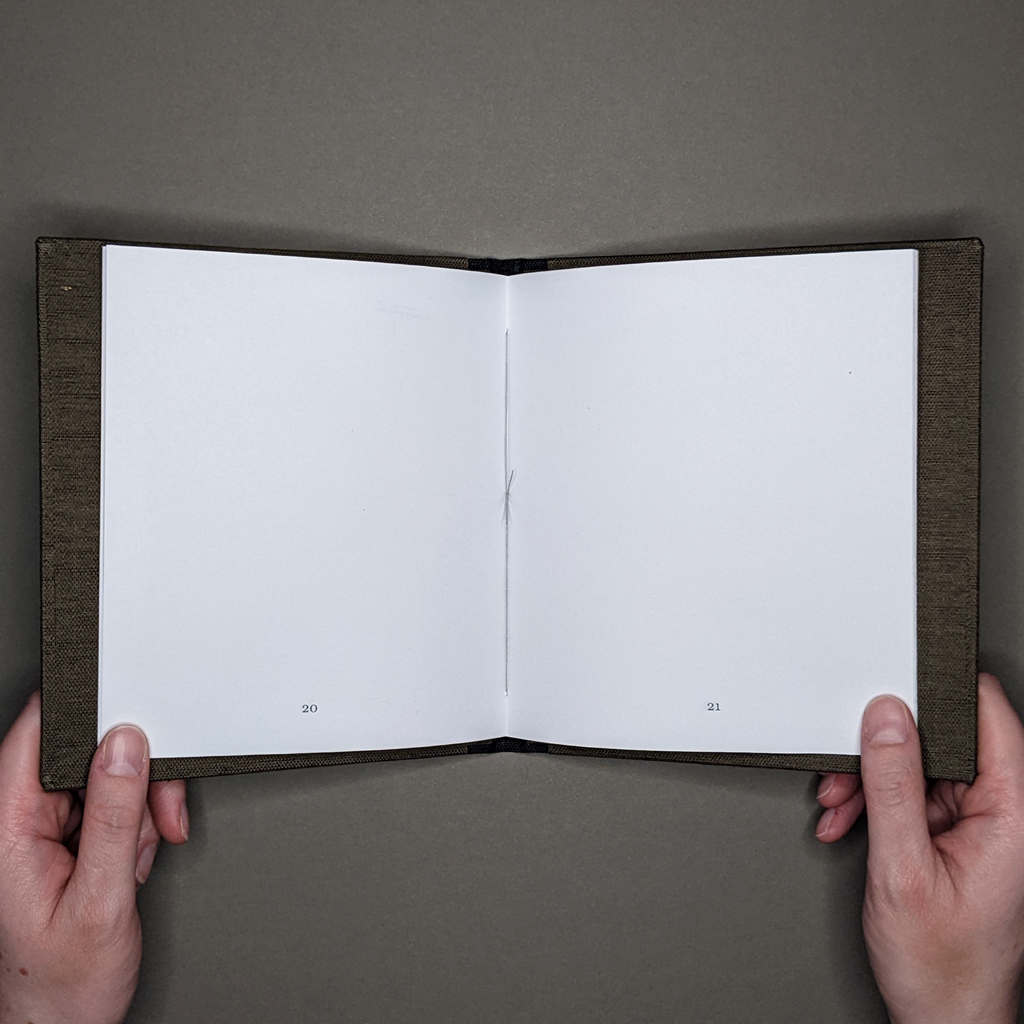
Brad Freeman’s The Collected Poems of Donald J. Trump arrived on election day, November 5. The title is set in a script typeface that looks elegant the way Mar-a-Lago looks elegant. If the concept strikes the reader as implausible, consider the Trump Bible (officially titled God Bless The USA Bible). Its slim proportions do hint at a dearth of poetry; inside the clothbound hard covers is a single sewn pamphlet.

The forty pages are numbered but otherwise blank. There is no poetry.
The page numbers focus the reader’s eye as they thumb through the stark white pages. They also mark the passage of time and — at the risk of projecting onto the book’s blankness — remind the reader of its finitude. Trump’s presidency will come to an end.
Trump’s first term in office spawned an entire sub-genre of artists’ books. With over 25,000 tweets during his presidency, Trump gave artists plenty of content to work with. For example, Richard Kraft’s five-volume, 1,622-page artists’ book It Is What It Is: All the Cards Issued to Donald Trump January 2017–January 2021 annotates nearly 10,000 of Trump tweets, issuing a color-coded penalty card, like a soccer referee.
For those sick of reading what Trump has to say, Freeman’s book has the advantage of silence. Trump and his allies “flood the zone with shit” to keep us distracted with every new outrage. Instead, Freeman quietly, materially demonstrates how little Trump has to offer.
We often say “there are no words…” as we cope with shock or sorrow. No doubt many Americans felt this way in the days following the election, even as pundits breathlessly filled the airwaves and editorial sections with lessons learned (or not). The phrase also appears on the cover of Landry Butler’s I Have Nothing to Say, and I am Saying It.

Like Freeman’s book, I Have Nothing to Say is blank except for page numbers. And like The Collected Poems of Donald J. Trump, the book’s title determines its interpretation. Further distinguishing the two blank books, I Have Nothing to Say has ruled pages, inviting the reader to use it as a journal. The back cover also features a blurb, which explains the book’s dual purpose. The reader may choose to use it as a journal, but for Butler the book is an existentialist reflection on empty platitudes and meaninglessness more generally.
Whereas Freeman’s book is handbound in an edition of fifty, I Have Nothing to Say is available on-demand through Amazon. This puts the book in dialogue with the proliferation of semi-customized self-help journals pumped out by online gig workers and side-hustlers. So-called “low-content publishing” has been largely unexamined by book artists, so Butler’s blank journal is a welcome contribution. The grandiosity of his questions — what is lost when thoughts become words? what would a better world look like? — strikes an absurd contrast with the vehicle, a humble 200-page hardcover. Purchasing it from Amazon only sharpens that contrast.

Artists have long experimented with blank books as vehicles for meaning, and Butler’s existentialism has parallels in 1960s experiments by John Cage, Robert Rauschenberg, and others. The Collected Poems of Donald J. Trump grapples with existential absurdity and the meaninglessness of words in its own way. Both books contribute to this tradition of silence in contemporary art even as they respond to today’s internet culture, from political discourse to the commodification of self-care.
In their own ways, Freeman and Butler empower their readers. Butler invites the reader to share their thoughts, and Freeman silences one of the world’s most powerful people. Taken as critiques of authoritarian politics and cynical profiteering, these blank books demonstrate the difference between being speechless and having nothing to say.
 Artists’ Book Reviews
Leave a comment