
Tears Are Everywhere
Kira Lynn Cain and
Ellen Robinette
2026
Buckman Publishing
36 pages
8.25 × 10.25 in. closed
Perfect-bound hardcover
Print-on-demand ink jet

From its front cover, where the hand-lettered title merges playfully with line illustrations that give way to an explosion of watercolor, Tears Are Everywhere might be mistaken for a children’s book. The format inside is similar, too. The book’s short text unfolds one phrase at a time across the illustrated spreads. Except, the text is not narrative. It may be a poem, but it doesn’t rhyme or follow a meter. And children like won’t recognize the epigraphs from Virgil’s Aeneid and Beckett’s Waiting for Godot. Still, Tears Are Everywhere does have a message — it’s right there in the title. The book is subtle and exploratory yet insistent. It is a call for empathy, to better understand others and oneself.
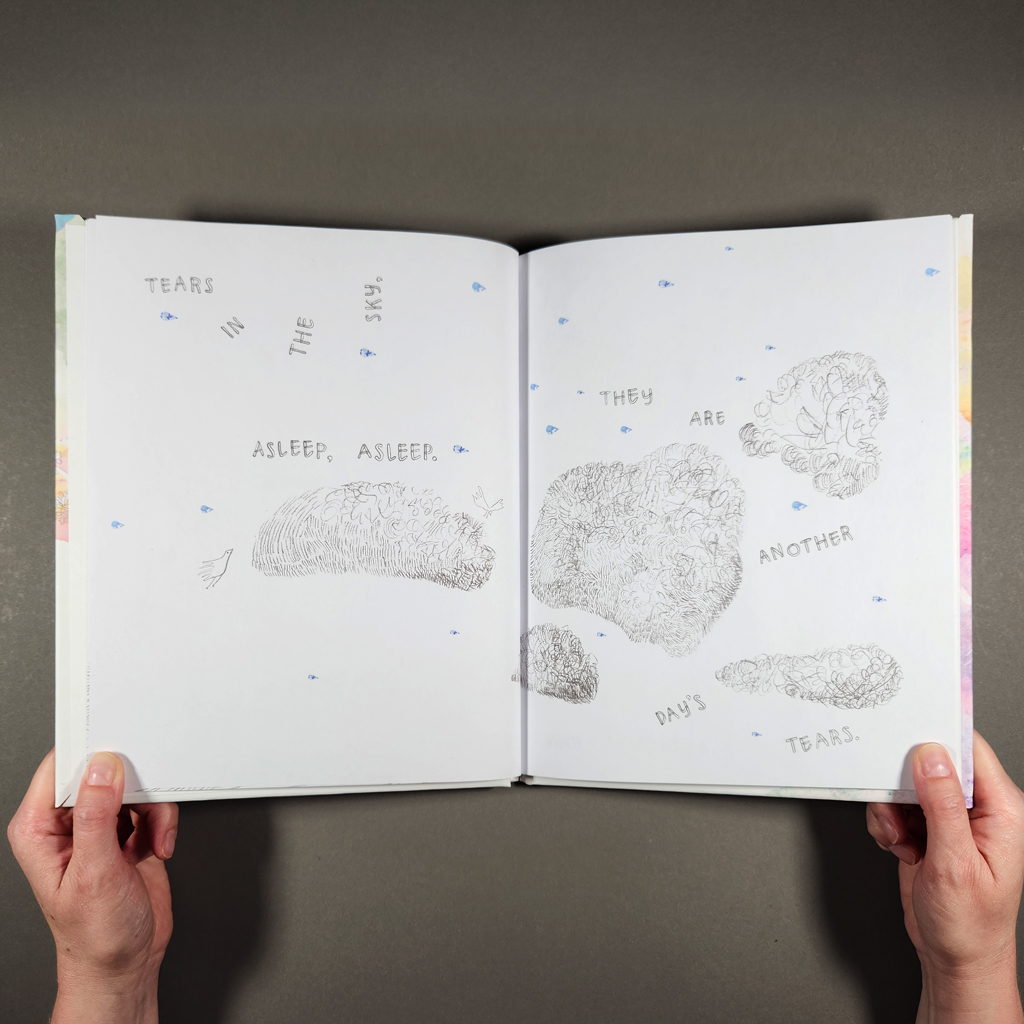
Rather than consign Tears Are Everywhere to a genre or audience, Buckman Publishing recommends the book to those who like “Edward Gorey, Yoko Ono, crying at museums.” To that list I would add Niki de Saint Phalle’s 1971 artists’ book My Love. Tears Are Everywhere has a soft but not saccharine sensibility. It can be read in one sitting, but it also lends itself to a more impressionistic flipping-through. The message does develop sequentially, but the spreads are self-contained. The contemplative reading experience is enhanced by the original soundtrack Cain recorded to accompany her book (copies from the deluxe edition include a 7-inch record, but the recordings can also be streamed online). This is fitting since the text asks the reader to both look and listen.
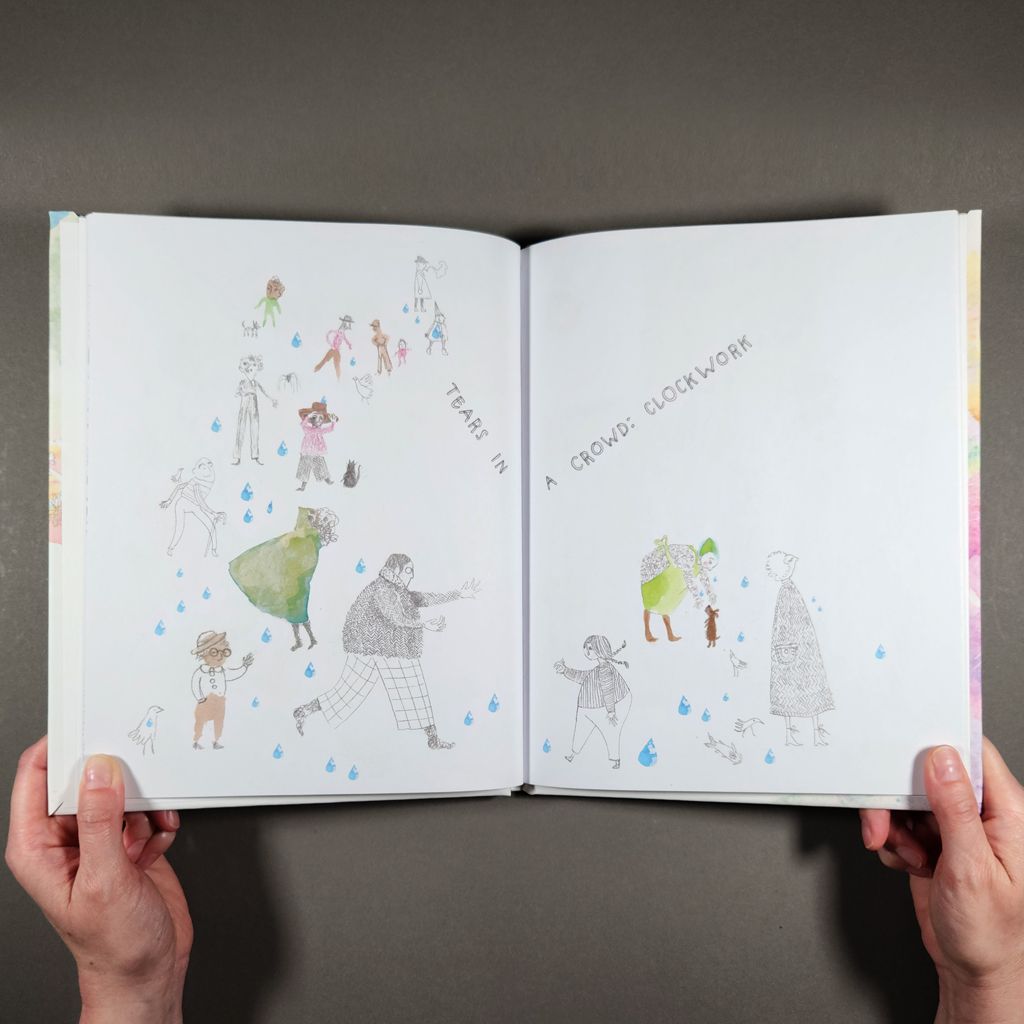
In fact, the book’s first line is: “Look. Tears are everywhere. You see them secretly.” From there, it is essentially a catalogue poem, listing different types of tears. There are, for example, tears in the sea and tears in the sky, alone tears and tears in a crowd. Most of these tears are paired with another line, forming a couplet that breaks up the rhythm of the list and introduces surprising associations. Consider the difference between “Alone tears / They are for your eyes” and “Tears in / a crowd: clockwork.” When instead a line is left single, the accompanying illustration seems to finish the couplet. This leap from text to image is eased by the harmony between the hand lettering and line drawings.

Cain’s illustrations foreground mark-making, especially hatching. Rather than seeming busy, this softens the visual impact with white space and introduces a sense of time that slows the reader down. Having bought this time, Cain is adept at moving the reader’s eye around the composition. Since each couplet resolves across a single spread, the reader is propelled around each composition more than they are from page to page. However, where it counts most, Cain pulls the reader into and out of the book with careful attention to sequence. As on the cover, the controlled hatching of the line art is complemented by loose, colorful watercolor. Cain also uses watercolor to render the most important visual element: the tears. Curiously, the tears are mostly digitally duplicated throughout the book. The effect, which I initially found distracting, reminds me of early Flash animation. There is a certain earnestness that seems fitting, and perhaps one could stretch to say that the repetition of a single tear illustrates Cain’s concluding thought: “To know tears. Know them everywhere.”
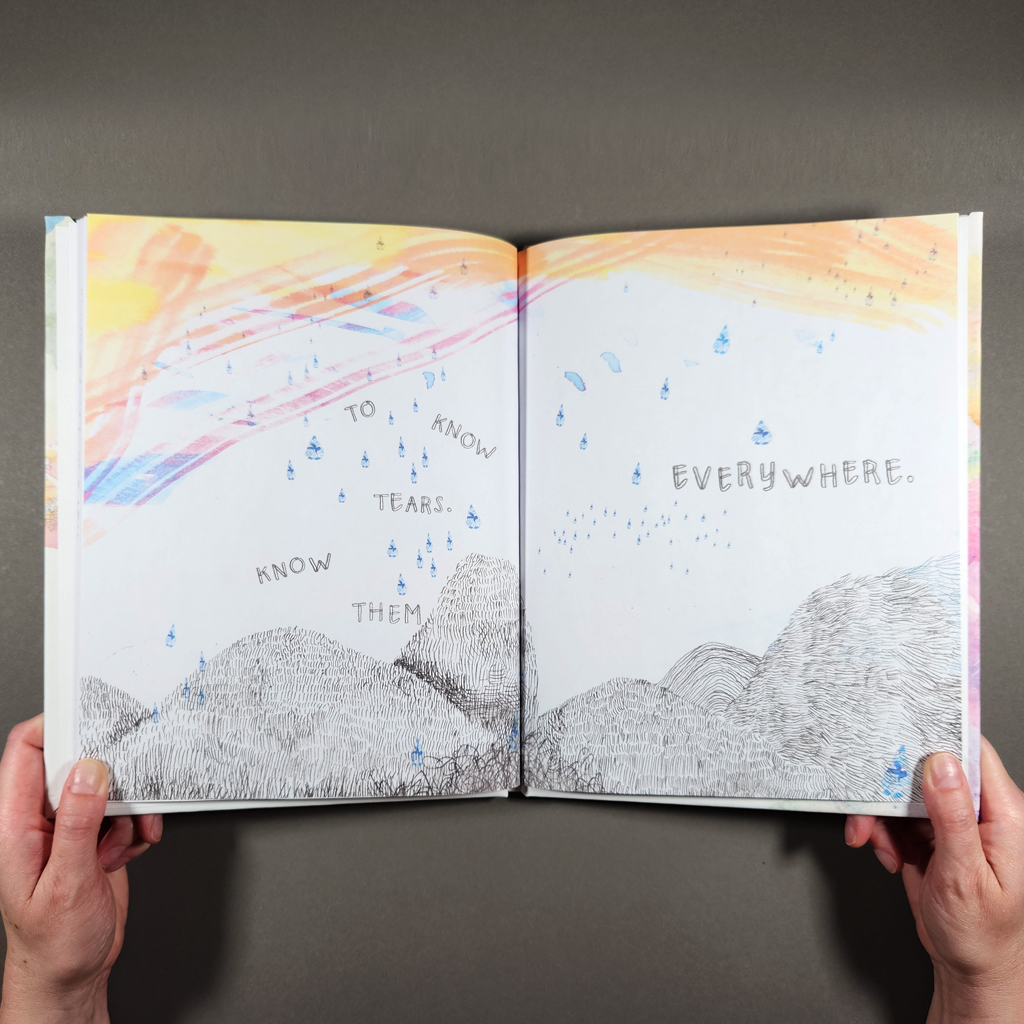
I interpret that with a comma, rather than a period. Which is to say, in order to understand feelings, even our own, we must understand one another. The point is not just that tears are everywhere, but that tears everywhere — in pockets, on hands, or singing on the stairs — share the same human condition. As a guidebook of sorts, Tears Are Everywhere attunes the reader to emotions without replacing introspection or communication. After all, as Cain writes, “Tears in pages…do not talk.” On the other hand, an artists’ book has certain affordances: “Tears in pictures…do not leave.” Therefore, the book mirrors the phenomenon it addresses. It is both personal and relational. The reading experience is intimate, but the message can circulate widely. Because Cain understands the strengths and limitations of her medium, Tears Are Everywhere is whimsical and allusive, even as it carries a strong message.


Leave a Reply