
John Cage’s 640 numbers between 1 and 4: An assisted self-portrait
Josh Hockensmith
Blue Bluer Books
2025
24 pages
5.25 × 8.25 in. closed
Saddle-stitched softcover with inserted photocopy
Digital print-on-demand
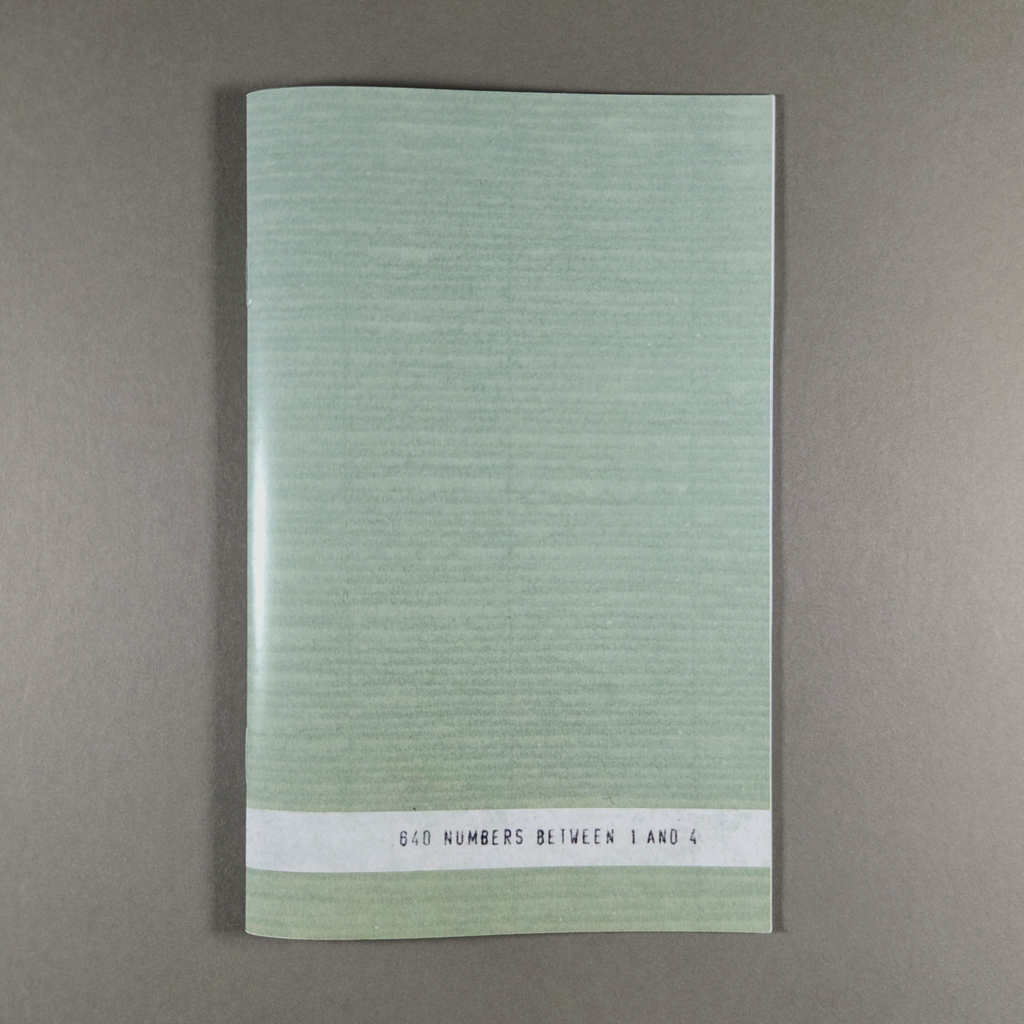
John Cage’s 640 numbers between 1 and 4 is exactly that: Josh Hockensmith’s interpretation of one of Cage’s computer-generated numerical sequences. Unlike Cage’s unadorned grids of numbers — there are numerous variations with numbers 1–5, 1–16, 1–21, and so on — Hockensmith’s book is a visually rich experience. The original book is also very tactile, a quality that is transmitted surprisingly well in the saddle-stitched, print-on-demand facsimile edition reviewed here. Having worked as a book repair technician, Hockensmith revels in altered books and unique objects with cut, collaged, sewn, and burned pages. His facsimile editions are a worthy compromise to enable democratic distribution, and the use of print-on-demand is perhaps more measured than Cage’s own embrace of computers, which might seem naively technophilic at the present moment. 640 numbers certainly feels more contemporary, even as it shows that Cage’s scores and systems remain generative after sixty years.
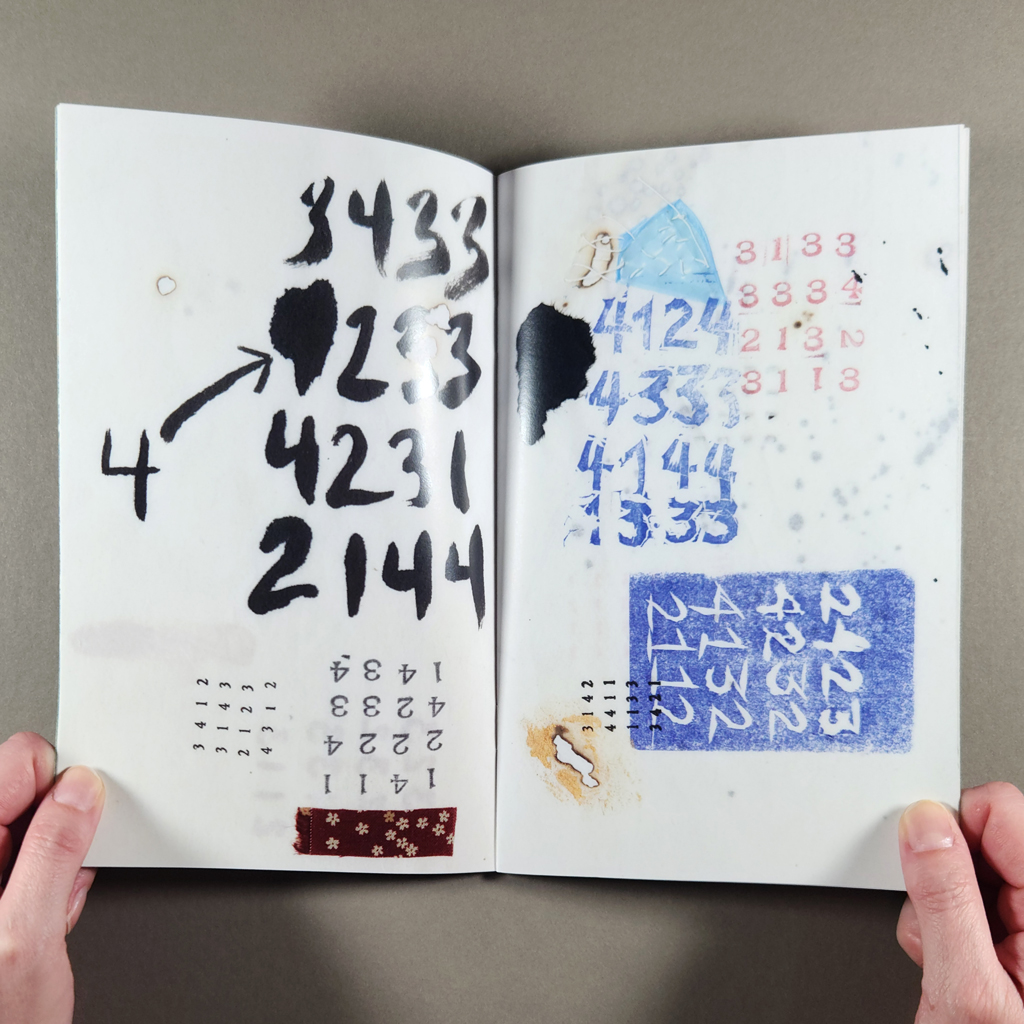
In this case, I mean generative literally. To determine the materials, the page layout, the numbers of elements (and therefore the total number of pages), Hockensmith relied on chance operations using the sequence of numbers 1 through 4. An element might be made with one of four processes, for example, or be placed in one of four quadrants on the page. Hence the book’s subtitle, “an assisted self-portrait”: Hockensmith helps the number sequence articulate itself in book form. By his calculations, it took 631 queries to render all 640 numbers, across fifteen pages. To rein in the resulting permutations, the numbers are always grouped in a 4-by-4-digit grid.
Hockensmith’s process (and the inspiration behind it) are explained in an afterword titled, “Um, what…?” Following this, a folded photocopy of John Cage’s original piece is inserted. The neatly ordered list, originally produced with a dot matrix printer, is annotated with checkmarks and artifacts from years of photocopying, reminding the reader it is a score, not a finished work. However minimal, this materiality draws an important connection between Cage’s original and Hockensmith’s version.
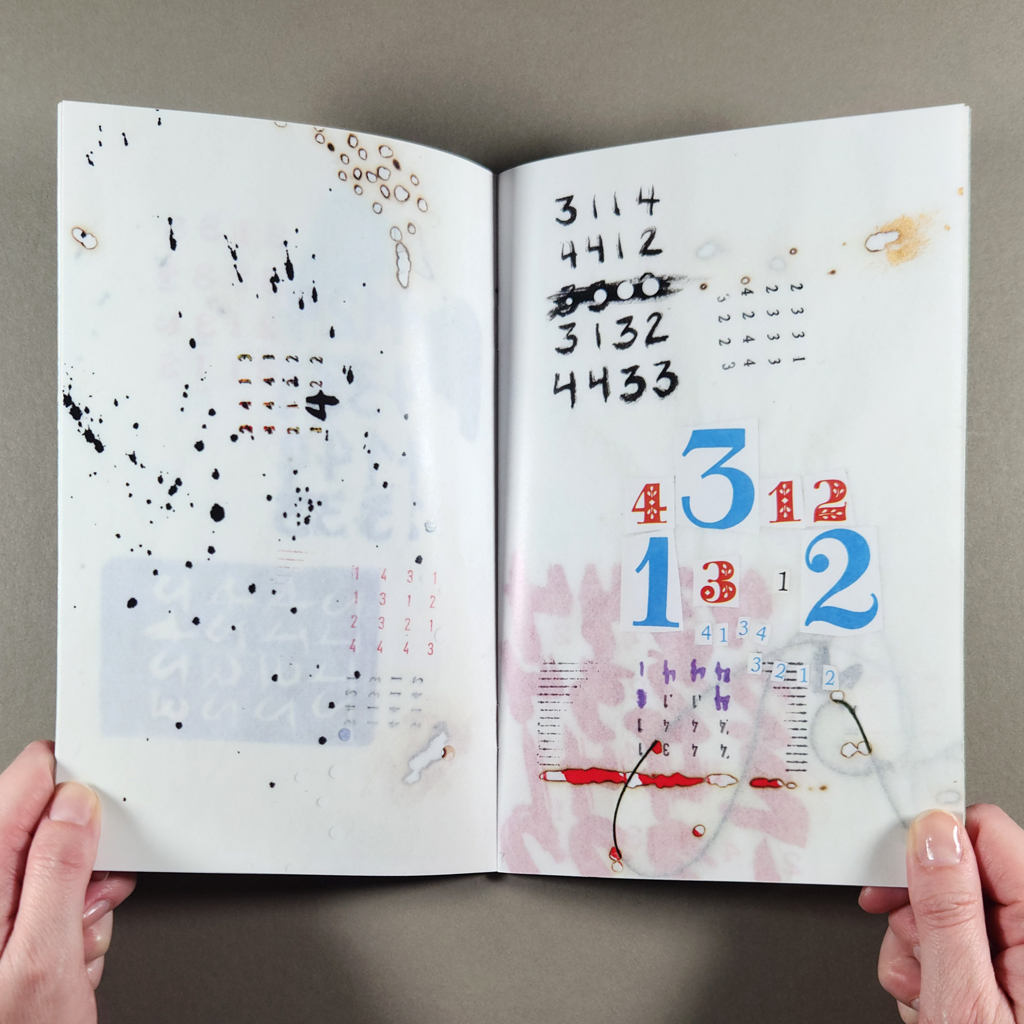
In the latter, numbers are rendered with brush and ink, rubber stamp, and collage. Fragments of decorative paper, fabric, and what might be discarded plastic are also included. Thread is sewn through the pages, sometimes through scorched holes — another homage to Cage, who created burned, branded, and smoked works on paper. Splatters of ink echo the uneven edges of the burned holes. The book’s palette is restricted to primary colors (and near neighbors, including a metallic gold pigment). There is a coherent visual vocabulary, both within the book and Hockensmith’s oeuvre, but the book is never boring. The pages may be split into quadrants, but they lack the rigid grid of Cage’s original. The compositions are lively and unpredictable, though the content is nothing but numbers. In fact, the content recedes to the point that the book is nearly, but not quite, abstract or asemic.
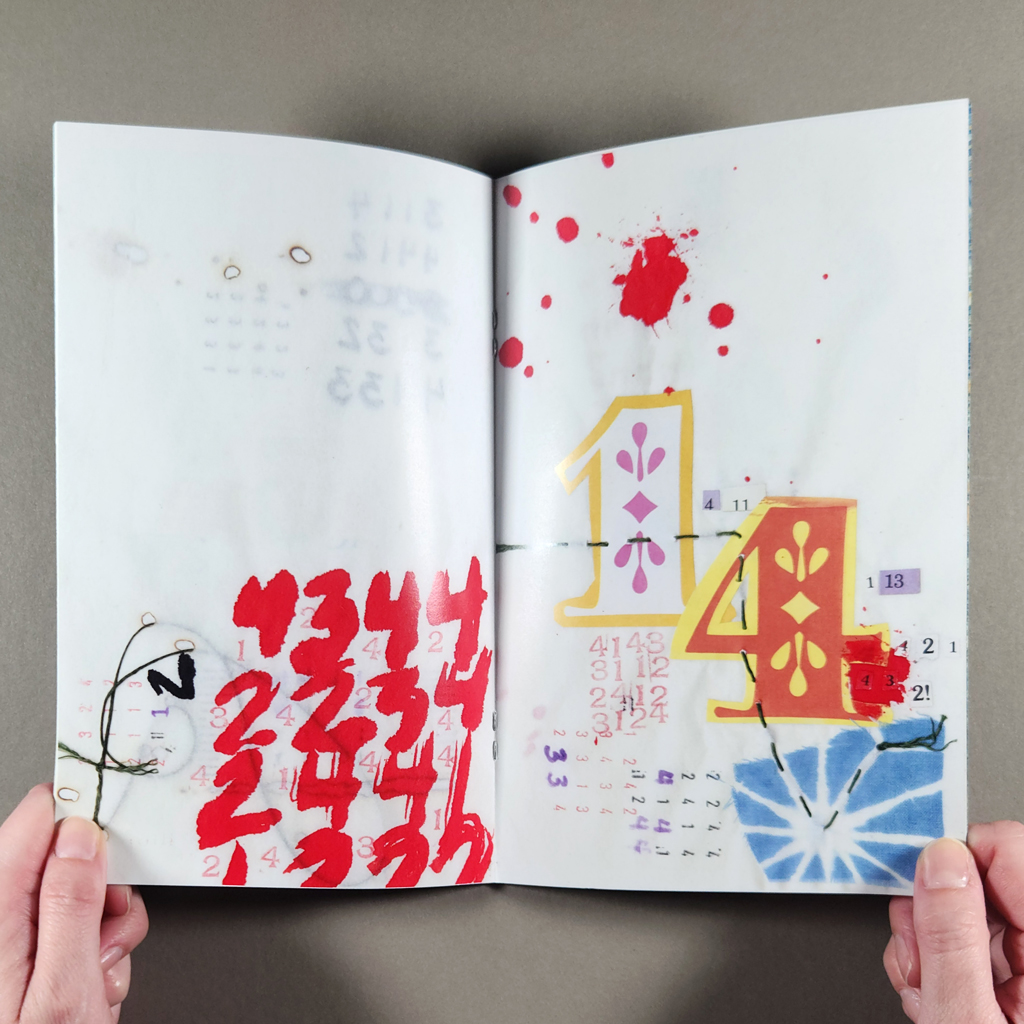
Perhaps remarkably, for a book with no narrative or linguistic content, 640 numbers invites repeated reading. Because there is an underlying system, the compositions can be reverse engineered. The reader can try to derive the rules that produced the book, to see how the artist made choices within a system of constraints. If the reader is left thinking “I could do that,” so much the better. The results would no doubt be different. (Indeed, a series or exhibition of different versions would be quite interesting.) Arguably, then, the book is about how we interpret rules, how we make decisions when our options are constrained. If so, it is timely. There are those who would redefine creativity as writing prompts to be executed by a computer. Instead, Hockensmith shows room for creativity in following prompts generated by a computer. If this seems like a limited form of freedom, consider how many design decisions are already made by default. By composing his pages through chance, Hockensmith ignores, or reconsiders, compositional canons like the golden ratio or the rule of thirds, which have long spared artists from making conscious decisions about every aspect of a design.
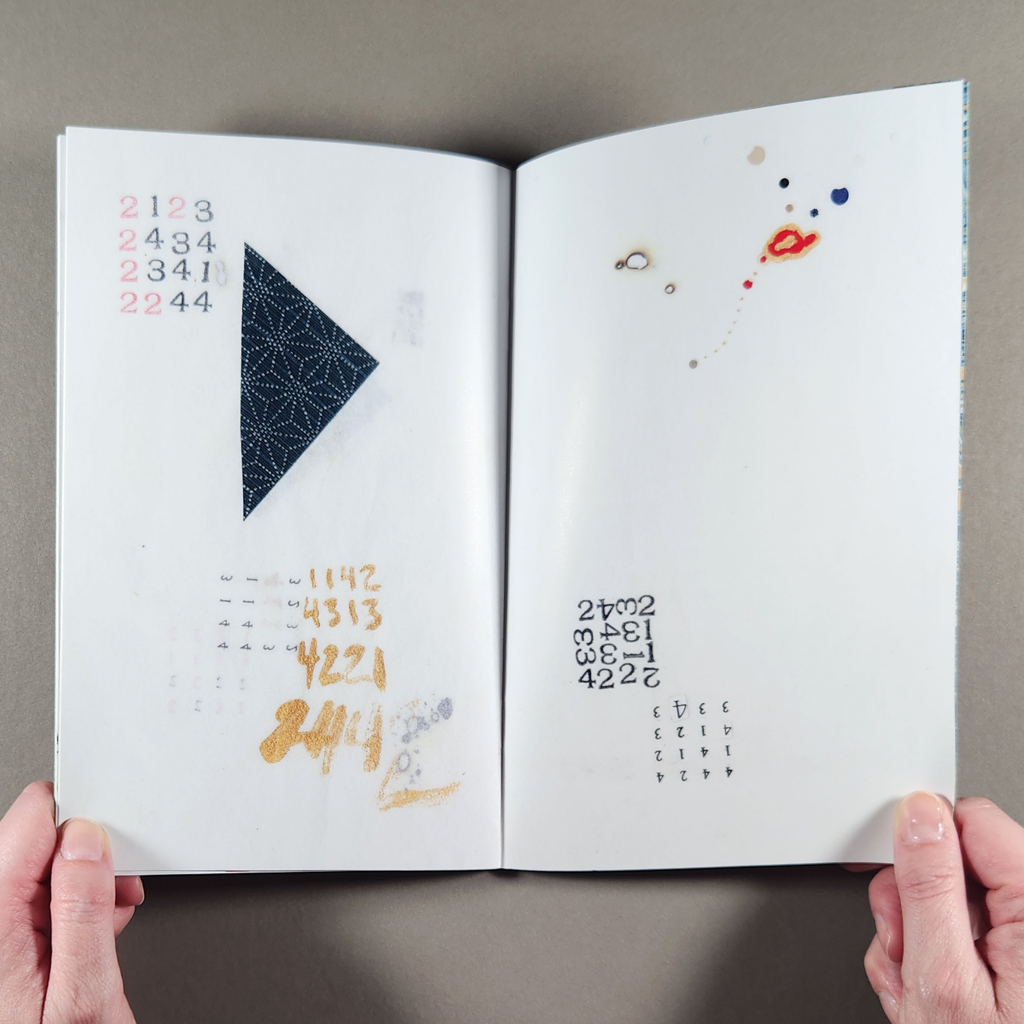
Thus, 640 numbers may be read, counterintuitively, as a celebration of artistic decision-making. Let us return to the book’s subtitle, an assisted self-portrait. What if, in addition to Hockensmith helping the book create itself, the book is assisting Hockensmith? What if we read 640 numbers as a portrait of the artist? Hockensmith’s overriding interest is how material and form alter the meaning of language, and the afterword hints at what sort of meanings are layered within this book: “Some of the collaged numbers are in my beloved late father’s handwriting, and some were cut out of a Sesame Street book I learned to count from as a child.” He credits his late collaborator, Stephen Addiss, and, of course, there is the influence of John Cage. Hockensmith’s appreciation for Eastern philosophy and literature, shared by Cage, comes through in the brushed ink, mulberry paper, and scraps of silk book cloth — though he seems as interested in the pitfalls of appropriation and translation as he is in Zen, divination, and haiku. As a portrait of the artist, 640 numbers shows that procedural art resonates beyond the 1960s and speaks to yet another moment when creativity confronts computing.


Leave a comment