
As One: An Experiment in Visual Meaning
Danny O’ Donoghue
Low Light Publications
2025
450 pages
8.5 × 11.25 × 1.25 in. closed
Perfect-bound hardcover
Digital print on demand
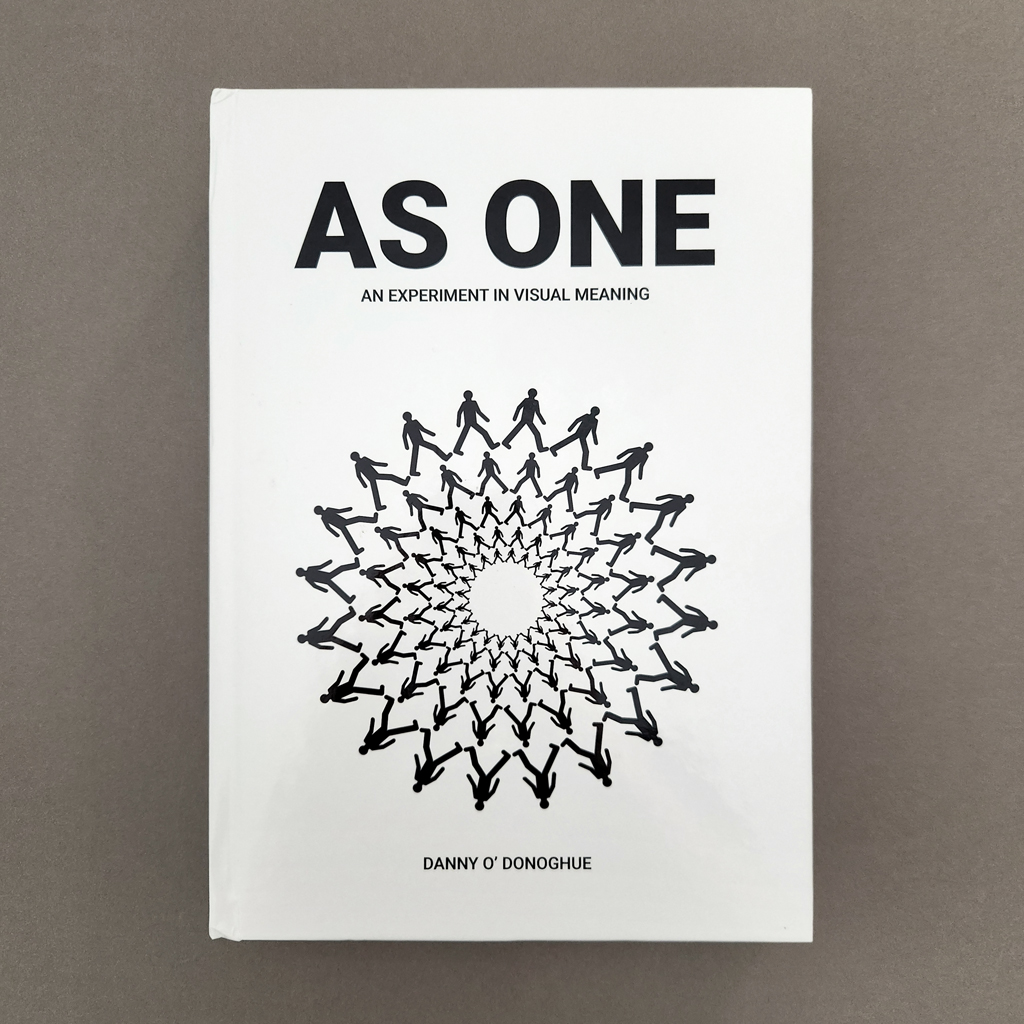
As One: An Experiment in Visual Meaning is a departure from Danny O’ Donoghue’s usual practice. Inspired by Dada and Surrealism, his sculptural work incorporates ordinary objects in surprising, clever, and sometimes unsettling, ways. In contrast, As One is a book of digital illustrations rendered in a style so spare it feels as though one has entered the parallel world where stick figures must live when they aren’t working in crosswalk signals. The book’s introduction helps explain O’ Donoghue’s drastic change in style. He began the work in 2015, during a period of unemployment after studying graphic design — and amid the divisiveness of Brexit and the first Trump campaign. So, As One is a true experiment, a new direction without a clear destination. Nevertheless, there are also continuities with O’ Donoghue’s other work. Above all, the work hits on two levels: first, an emotional reaction, then the intellectual work of interpretation. By radically reducing his visual vocabulary, O’ Donoghue explores the utopian promise of universal communication. Ultimately, though, it seems what people share is the capacity to interpret the same thing in different ways.
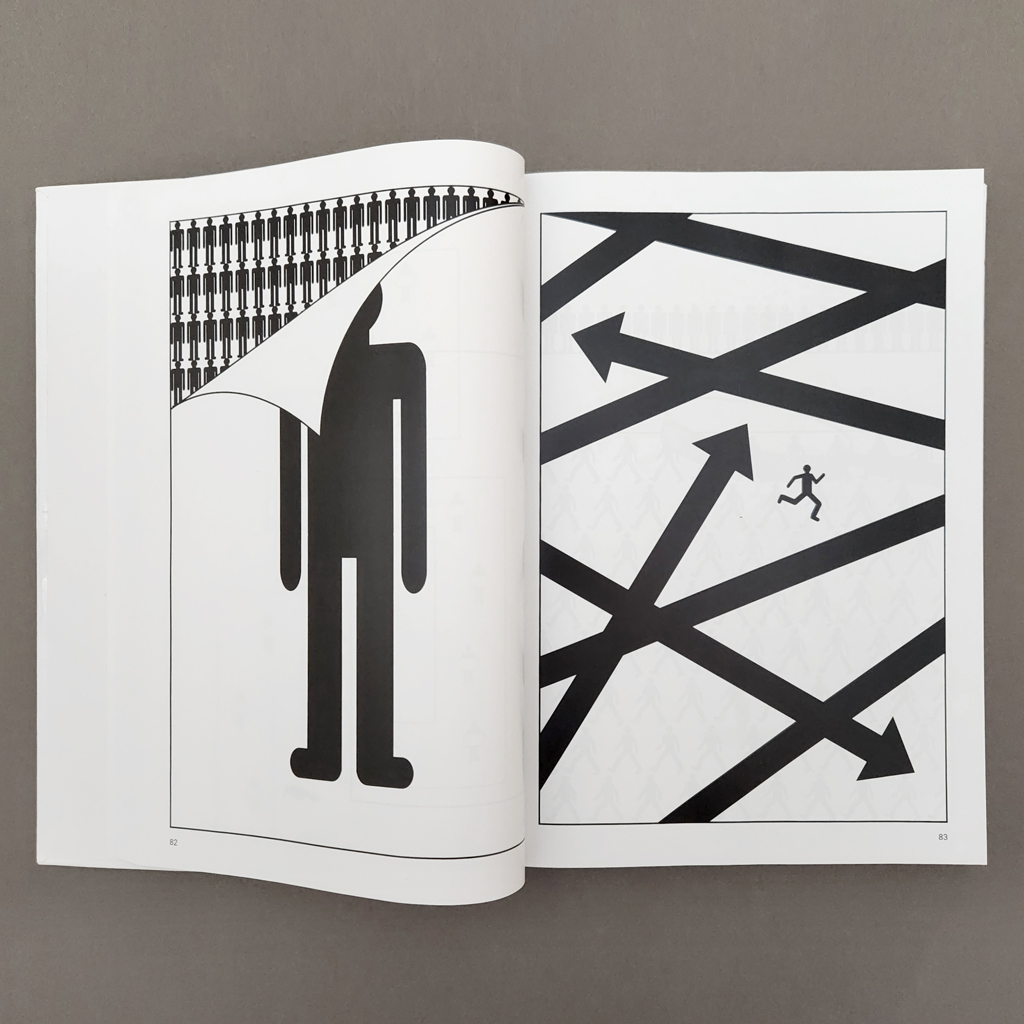
The book contains four hundred wordless illustrations and makes part of its argument through sheer heft. Some occupy a single page, and others spread across the gutter. They are not quite comics and not quite editorial illustrations, though they have a strong sense of narrative and metaphor. It is as if someone asked O’ Donoghue to explain life’s big questions using only signs found in an airport. Some compositions would hold up on their own, but O’ Donoghue is more interested in pushing the limits of his restricted lexicon than in creating perfectly resolved images. Even his stick figures, already stripped of identity, perform only a limited number of actions. They stand and kneel, walk and run, fall and collapse. These archetypes — it seems a stretch to call them characters, though they begin to feel that way — reappear throughout the book. Many compositions are variations on a theme, and their interpretations change, sometimes incrementally and sometimes drastically, from one instance to the next. Thus, even without a sustained narrative, the book’s sequencing is crucial.
We see, in O’ Donoghue’s return to certain themes or tropes, that rather than exhausting the possibilities of a limited lexicon, each illustration generated new ideas. With the rendering of figures and environments restricted, meaning is conveyed through composition. What remains are the relationships between figures, making the illustrations a matter of ethics. By removing distinguishing features from these figures, O’ Donoghue shows the contingent nature of the ethical relations. What makes a leader different from their followers? What accounts for the separation between two apparently identical people?
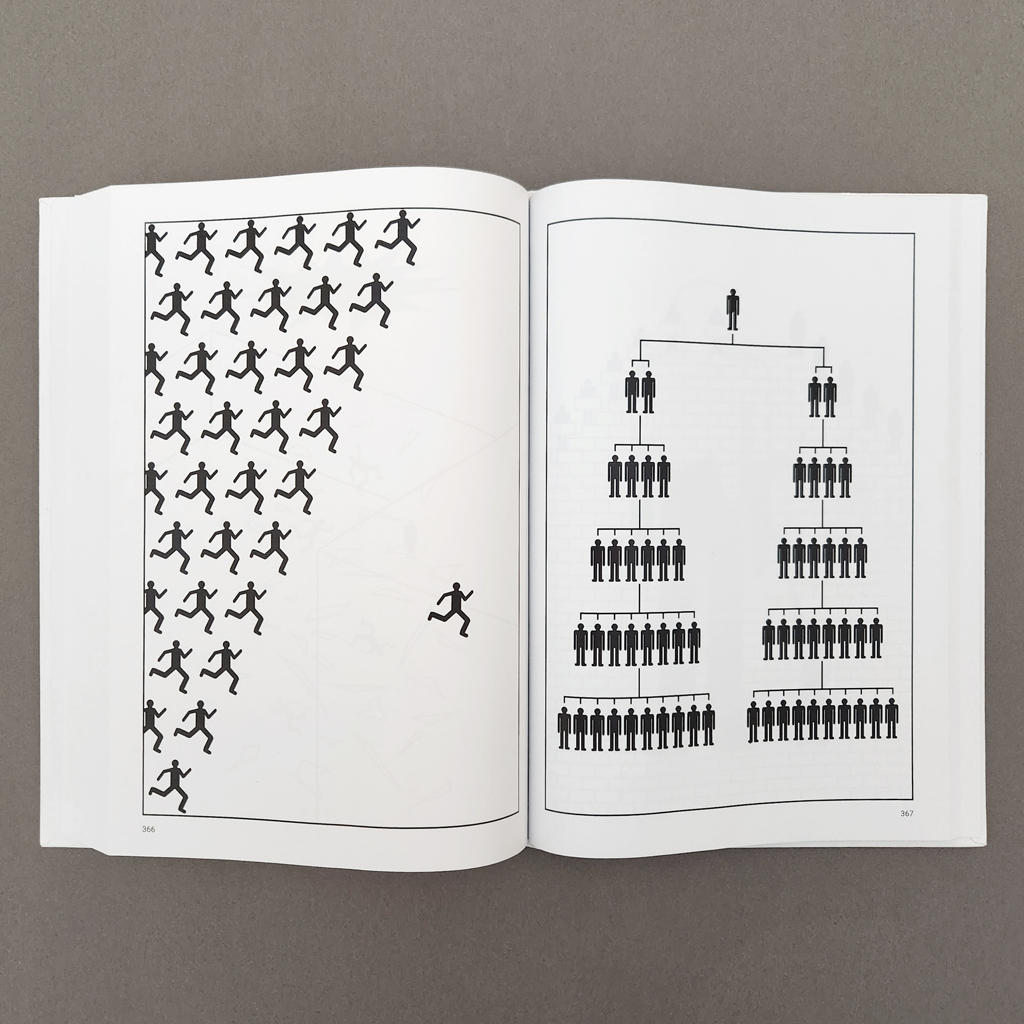
In many cases, even the relationships among figures are open to interpretation. In one image, a figure runs ahead of a mass of similar running figures. Are they leading the group or being chased? Is this a mob or a marathon? In another image, a figure walks by in the foreground while four others watch from behind barred windows in the background. I first read the background figures as incarcerated, while the figure walking in the foreground is free. Yet, there is nothing in the minimal illustration to preclude the opposite reading — the foreground figure is walking inside and being observed by free figures outside. Perhaps everybody is incarcerated, in their cells and in a prison yard, respectively. Or maybe everybody is free, and their windows just happen to have security bars. Or are they merely vertical blinds? The way the composition positions the viewer remains the same, but its meaning is radically unstable.
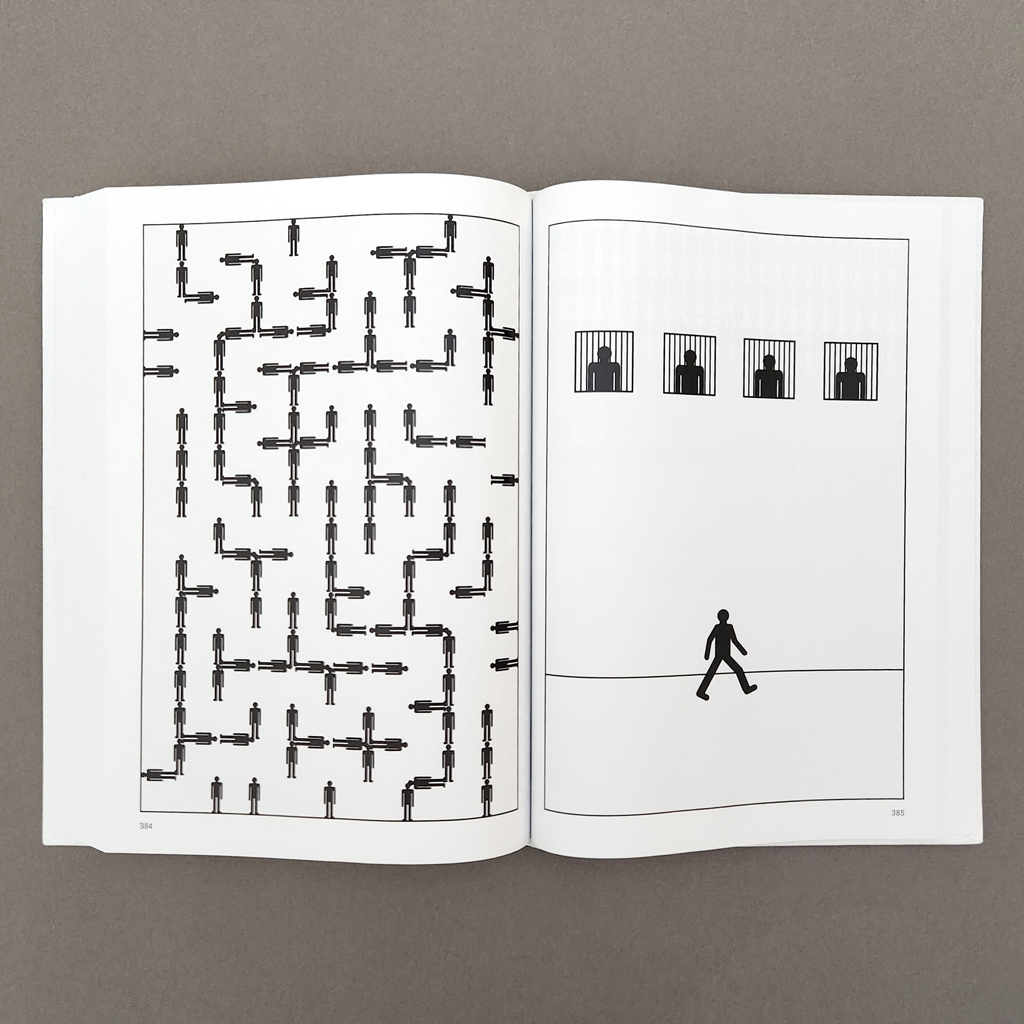
To a greater or lesser degree, each image in As One supports the constructive, interpretive process sketched out above. They challenge the reader to play a mental game, to see how many stories they can read into a single image. Despite their visual simplicity, they reward slow and repeated looking. Yet they also hit the reader quickly. I happened to interpret the running figure mentioned above as though they were being chased by a mob. Another reader’s first impression might well be different. In either case, however, the contrast between the lone figure and the group is perceived immediately and viscerally, before the reader can begin to tell themselves a story about it. This almost subliminal effect compounds as the impressions from previous images begin to color subsequent ones. The result is that the book can be surprisingly affecting even when flipped through quickly.
With As One, O’ Donoghue takes part in a long quest for universal visual communication. In particular, I am reminded of Isotype, the International System of Typographic Picture Education, developed by Otto Neurath and Gerd Arntz. Beyond the stylistic similarities, which are striking, there is the historical context. Isotype was developed between World War I and World War II, precisely when Dada and Surrealism emerged, largely in reaction to the First World War. Whereas Dada rejected meaning and reason in the face of an irrational, industrial war, Isotype was meant to enable rational, scientific cooperation among nations. With his turn from surreal, Neo-Dada assemblages to graphic messages, O’ Donoghue explores the same issues that vexed artists in the interwar period. It is not hard to imagine how 2015–2025, the decade during which the Ireland-based artist completed the project, raised similar questions.
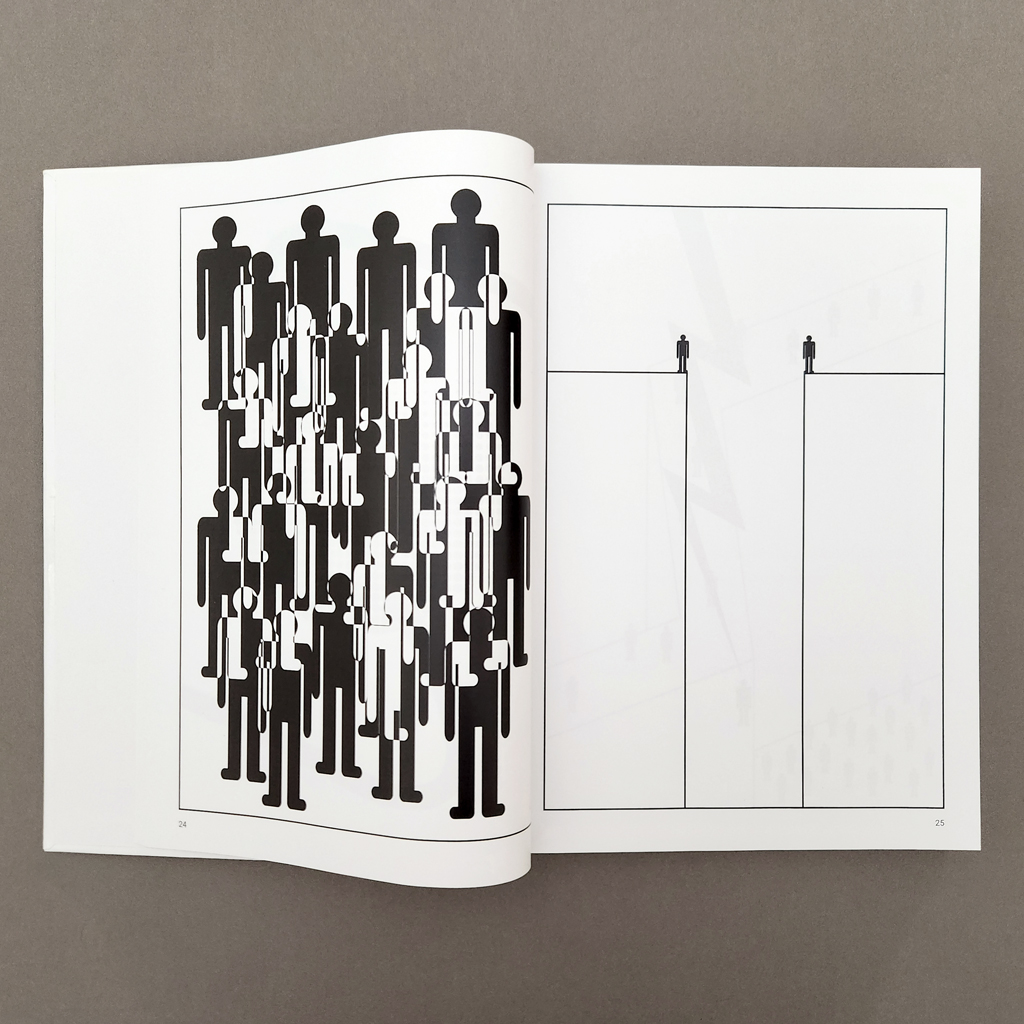
Perhaps O’ Donoghue learned from the unfulfilled promises of projects like Isotype, but As One is neither cynical nor naïve. Stripped of so much context, the images are both widely accessible and deeply ambiguous. The compositions supply the archetypal elements of a narrative, but the reader assigns roles to the characters and plots the action. Ironically, then, uncertainty is the most universal aspect of the book. This seems good enough for O’ Donoghue, who embraces the reader as a co-producer of meaning. In daily life, uncertainty and disagreements are sources of anxiety and conflict. As One provides a safe space, where ambiguity is interesting, even pleasurable. It is more than an escape from anxiety and conflict; it is a guidebook for better communication. It won’t teach readers to speak universally, but it might help them appreciate why others see things differently.


Leave a Reply