Artists’ Book Reviews

Artists’ Book Reviews

Monthly reviews and occasional interviews

  • Reviews
  • Interviews
  • Submissions
    • Subsidized Submissions
  • About
    • FAQ
  • Contact
  • Email Newsletter
  • Browse Books
    • Title
    • Author / Contributor
    • Editor
    • Date Published
    • Publisher
    • Publication Format
      • Monograph
      • Periodical
    • Genre
    • Print / Production
    • Medium
    • Binding
    • Container
      • Belly Band
      • Envelope
      • Slipcase
      • Tube
    • Structure
  • Bibliographic Performances & Surrogate Readings

    Bibliographic Performances & Surrogate Readings
    Janelle Rebel
    2024
    The Everyday Press

    Perfect-bound softcover with French folds
    353 pages
    5.25 × 7.75 in. closed
    Letterpress cover, offset inside

    Cover of Bibliographic Performances & Surrogate Readings. The title text is arranged in a rough spiral, printed in magenta ink on brown cover paper. The author's name, Janelle Rebel, is printed smaller, also pink, in the lower right corner.

    Bibliographic Performances & Surrogate Readings is a bibliography of bibliographies. Not just any bibliographies, though — author Janelle Rebel is both an artist and a librarian, and the collected bibliographies reside at that same intersection. The roughly fifty projects are prefaced by two essays addressing bibliographies and contemporary art. From there, the bibliographies are presented in alphabetical order. Rebel succinctly describes and illustrates, and sometimes evaluates, these projects, usually in around five pages. Given the book’s subject, it is no surprise that an alphabetized “catalogue of bibliographies” and index are also included. At once a work of scholarly interpretation and creative expression, Bibliographic Performances & Surrogate Readings does important interdisciplinary work that ought to interest anyone in the field of artists’ books — and many related areas.

    The first essay, “Bibliographic Performances and Surrogate Readings,” places Rebel’s work amid related debates. In literature, there is handwringing over “distant reading.” In digital humanities, contention over what constitutes interpretation. In art history, concerns about the canon. Rebel makes her position clear: “The labor of the bibliographer is one that includes many micro-acts of interpretation and judgement, effectively engaging in a form of critical editing at the level of subject construction.” In other words, bibliographies are interpretive, creative, and powerful, and therefore worth examining critically. Artists are well suited for such an examination because, as Rebel reminds us, surrogates — such as catalog records — are representations.

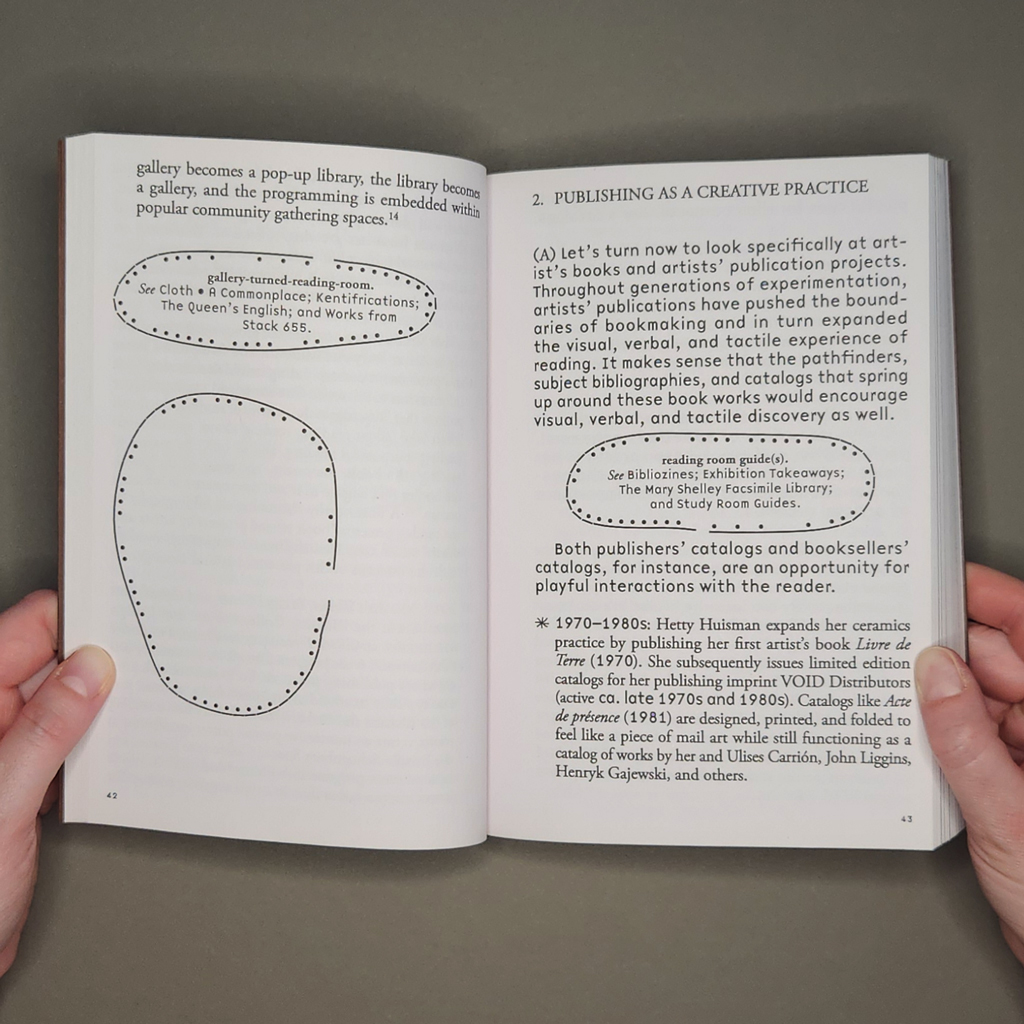
    Bibliographic Performances & Surrogate Readings, pp. 42-43. The titular essay is open to a subheading "Publishing as a Creative Practice". The design is unconventional, with decorative borders around cross-referenced works of art.

    The second essay, “The Visio-Bibliographic Turn in Art and Design” relates more directly to art and art history. Sections include “The Dematerialization of Art,” “Publishing as a Creative Practice,” and “Experiments in Arranging the Library.” Though a substantial piece of scholarship, the essay is essentially an annotated bibliography, a roughly even mix of theoretical arguments and case studies. Rebel also illustrates certain ideas by cross-referencing examples from the collected bibliographies that follow. (The challenge of integrating these cross-references with the main argument and its annotations showcases the book’s excellent graphic design, done by Margherita Sabbioneda.) Rebel blurs the boundaries of the essay’s thematic sections and stretches the geographic and temporal scope far beyond contemporary art and design. There are, for example, multiple references to works from the sixteenth century that remain not just relevant but provocative.
    The essays provide useful context, but the collected bibliographies can be enjoyed without them. I eagerly read the book cover to cover (in part because it overlaps with my dissertation research), but many readers may find it more fun to sample the bibliographies at random. The provocative thought experiments are sure to inspire even more creative bibliographies, and Rebel provides thorough documentation for readers to dig deeper into projects that particularly interest them. Each entry begins with a conventional citation, but the rest of the surrogate adapts to the original project, which range from books and databases to sculptures and installations. Some projects can be grasped through a single photograph while others require substantial verbal explanations.

    Bibliographic Performances & Surrogate Readings, pp. 242-243. Opening spread of the entry for "Kentifrications: Convergent Truth(s) and Realities" by Kenyatta A.C. Hinkle. On the verso, bibliographic citations are set above a black and white photograph of the art installation. On the recto, descriptive text is set in conventional paragraphs.
    Readers familiar with artists’ books will likely recognize some of the bibliographies, most obviously those in book form, such as David Maroto’s The Artist’s Novel (previously reviewed for ABR by Eric Morris-Pusey), Triin Tamm’s Bookcatalogtest, Craig Dworkin’s A Perverse Library, and Kenyatta A.C. Hinkle’s Kentifrications, to name just a few. Yet I am certain that every reader will discover something new. Furthermore, the opportunity to reconsider something familiar can be even more exciting. For example, I gained a new appreciation for the creative and interpretive aspects of Mindy Seu’s Cyberfeminism Index and Dworkin’s “Further Listening,” a chapter in his otherwise scholarly book, No Medium.

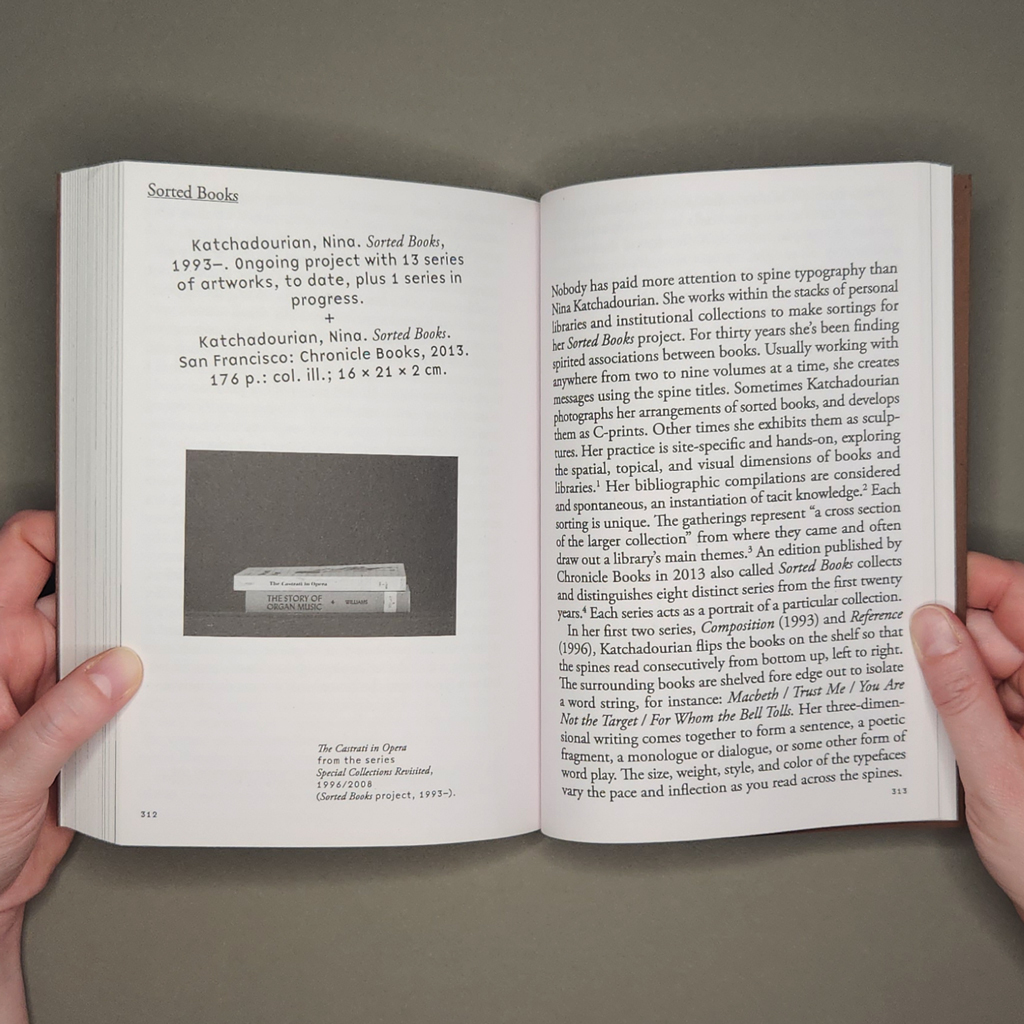
    Bibliographic Performances & Surrogate Readings, pp. 212-213. Opening spread of the entry for "Sorted Books" by Nina Katchadourian. On the verso, bibliographic citations are set above a black and white photograph of the art. On the recto, descriptive text is set in conventional paragraphs.

    In other words, the scope of Bibliographic Performances & Surrogate Readings is capacious but convincing. Rebel’s definitions seemed strained most by platforms that facilitate bibliography but are not themselves bibliographies. For example, Printed Matter’s website allows users to curate and share their own virtual “tables.” Similarly, Sitterwerk uses RFID technology to turn actual tables of books into digital bibliographies. In other cases, a different analytical framework might fit more easily, but the friction that may accompany Rebel’s bibliographic framing is, in part, what makes the book so generative. Besides, such frameworks are not mutually exclusive — Nina Katchadourian’s Sorted Books can be bibliographies and poems and portraits. In every case, the bibliographies Rebel has collected benefit from being considered alongside one another and against the backdrop of the preceding essays.

    Rebel provides ample evidence that there is indeed a bibliographic turn in art. Her study is therefore a valuable map of this new artistic territory.  However, critical questions remain. Rebel correctly identifies a move toward “diversifying the list and Black bibliography” and notes the potential of such projects to deconstruct the canon, but what are the results? If we acknowledge that bibliographies can be art, then is there a chance that all the online reading lists and syllabi that circulated during the so-called racial reckoning of 2020 were more like art than activism?

    Bibliographic Performances & Surrogate Readings, pp. 224-227. Opening page of the entry for "An Ideal Syllabus" by Jerry Saltz. On the verso is the end of the previous entry, including endnotes. On the recto, a captioned black and white photograph of the piece floats above its bibliographical citations.

    More generally, can creative bibliographies maintain enough critical distance from the conditions that drive the bibliographic turn? Certainly, bibliography is part of a broader “curationism” that arose from the glut of content available online. One manifestation has been the longlists and shortlists that exert such a powerful influence on photobooks (though not yet artists’ books to the same degree). Might we mistake this commercial canonization for criticism or even art? Despite these risks, the solution is not to continue ignoring creative and interpretive labor, especially work pioneered by women and others whose artistic and scholarly contributions have long been undervalued. Instead, we should follow Rebel’s lead and continue to develop a critical framework to appreciate such work for what it is.

    Levi Sherman

    February 24, 2025
    Review
    2024, Anthology, Essay, Janelle Rebel, Letterpress, Monograph, Offset Lithography, Perfect / Double-Fan Adhesive, The Everyday Press
  • Yet to Be Delivered

    Yet to Be Delivered
    Sveinn Fannar Jóhannsson
    2023
    Multinational Enterprises

    Single sheets bound with prong fastener
    28 pages
    8.3 × 11.7 in. closed
    Ink jet
    Edition of 50

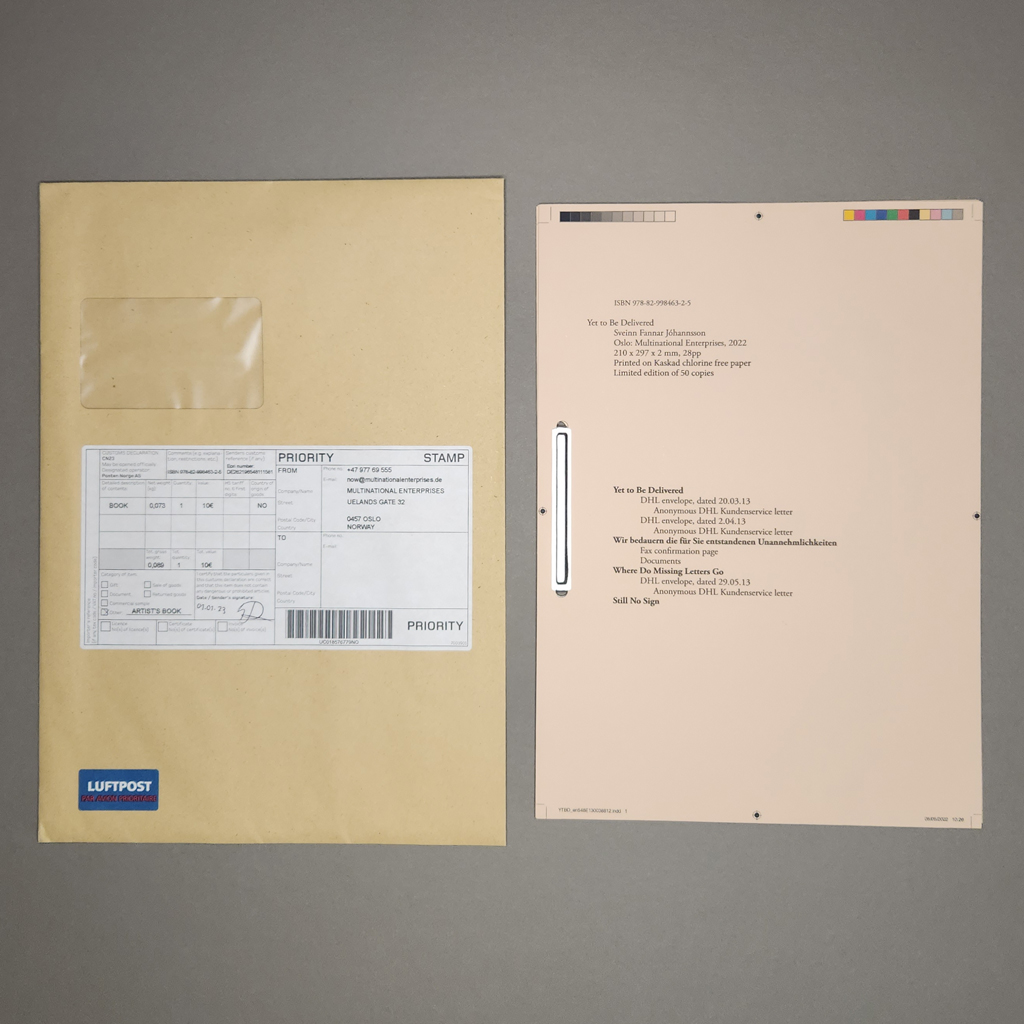
    Yet to Be Delivered beside its containing envelope, which has a faux shipping label. The metal prong binding is visible on the first page which is also the front cover, title page, and colophon.

    A subgenre of publishing which always entices me is the “document”—that flimsy thing which usually emerges from a very short pipeline between need and form. I worked for a short time at a business responsible for a good amount of documents—financial reports, business-to-business catalogs, investment pitches, payday loan mailers. Documents are the bulk of our postal system and the printed output of most of the industrialized world. The document has a confusing and paradoxical shelf-life—important as a record of the internal movements of governmental and corporate entities, yet concerned very little with its own material persistence. Constantly appearing in the visual language of the corporation are the “xerox”, the memo, the scanner, the extra-crunchy burned copy. Documents can be seen as a kind of id of the published world, emanations of an enduring system of administration.

    Sveinn Fannar Jóhannsson’s Yet to Be Delivered begins with a cover-cum-title page-cum-colophon which reads like a shipping label, or a manifest, or a packaging insert you’d receive with an order from [Insert Online Merchant]. The book is made entirely of copies and scans of a series of letters between Jóhannsson and DHL’s customer service, printed simplex on A4 salmon Kaskad chlorine-free paper, collated with a metal prong fastener. Its margins house printer’s marks which, like its title page, elevate the conditions of book production into the paratext of the work. Perhaps fittingly, my copy has some small creases in the corners from handling, storage, and shipping.

    Yet to Be Delivered, inside spread: a full-color scan of an empty DHL envelope.

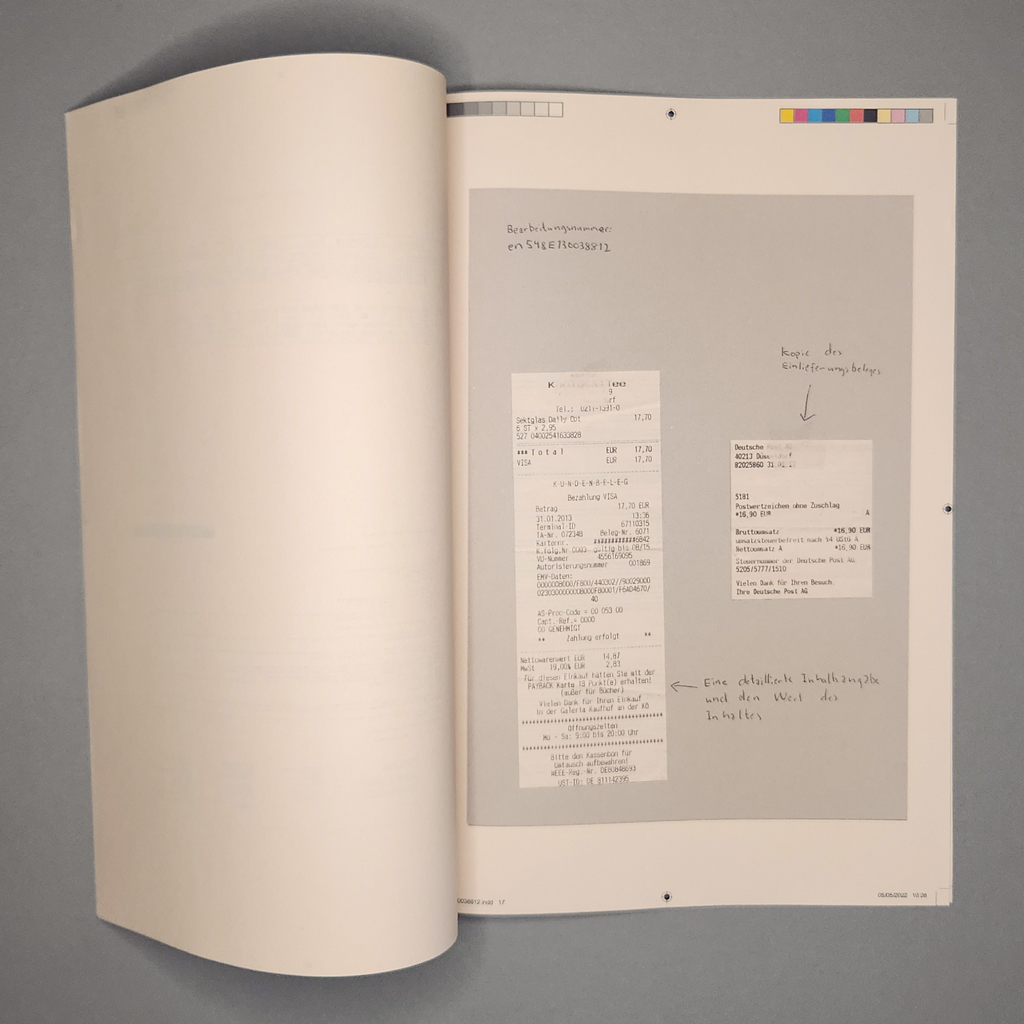
    Jóhannsson informs DHL that they have misplaced a package of 6 Daily Optik Champagne Glasses in the mail, “in their original packing case.” The story which unfolds details his attempts to determine where they are and how they were lost. Jóhannsson takes on an investigative and archival role, approaching the documentation between himself and DHL with a fastidiousness which can only be described as institutional. The aforementioned title page lists the 28-page collated publication as being specifically 2 mm thick; it contains a table of contents separated into sections, chapters in a tragicomedy of attempted interface with the bloated, hydratic bureaucracy.

    Yet to Be Delivered, inside spread: grayscale scans of receipts with hand-written annotations by the artist.

    The primary conflict highlighted in Yet to Be Delivered is a corporate hollowness contrasted with the artist’s insistent humanity. The checklist-reply contrasts with the torn edge of the opened letter. Jóhannsson is speaking to this automated system with a casual and emotional looseness which is then cast in stark relief against a history of the document as a unilateral expression of power (the decree, the notice, the bill). If corporate correspondence and the technologies which facilitate it are integrated into the needs of the increasingly larger organ of administrative surveillance (as laid out in Kate Eichhorn’s book, Adjusted Margin), then Yet to Be Delivered can be seen as an act of sousveillance, subversion by Jóhannsson which seeks to uncover its humanity, point out its flaws, hold it to task.

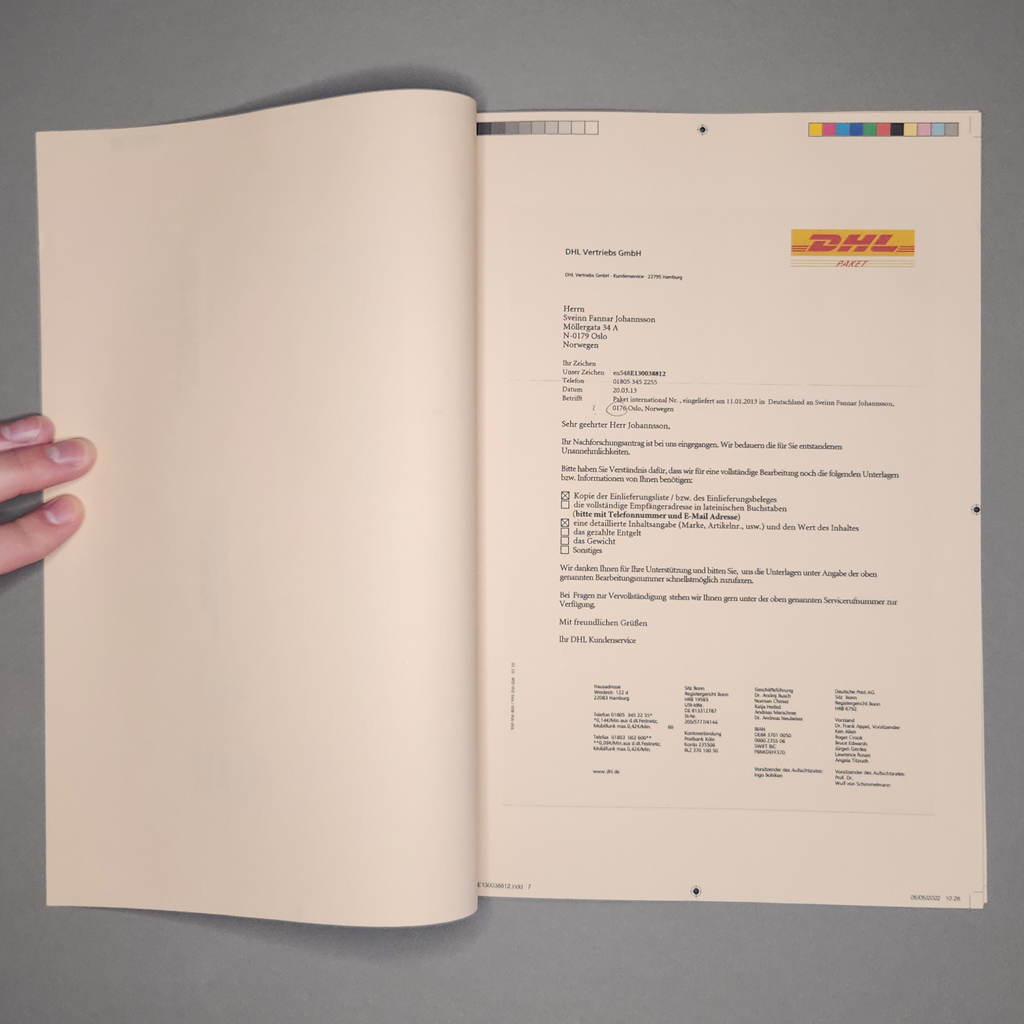
    Yet to Be Delivered, inside spread: a full-color scan of a letter from DHL customer service.

    Jóhannsson’s effort, however, does not uncover the humanity of the system. It does not budge. Instead, Jóhannsson exacerbates the system’s glacial heft, its amnesia. The automatic reply and Jóhannsson’s incorrectly labeled address (circled by the artist each time it appears) reveal this exchange to be apostrophe, not correspondence. Flipping through the book, a viewer might easily lose track of their place—the identical letters are only distinguishable by their date, the paratext of the printer’s marks, and the artist’s own notations.

    Yet to Be Delivered, inside spread: a full-color scan of an identical letter from DHL customer service, distinguishable only by metadata in the page margin.

    Yet to Be Delivered brings a familiar dizziness and discomfort. Between receiving this book and finishing this writing, the nation was, and remains, strongly divided over the assassination of Brian Thompson, the CEO of United Health, the nation’s largest health insurance conglomerate. During his tenure, profits expanded and services diminished. Meanwhile, ever more wealth trickles upward into a smaller pool of people while life expectancy—and quality— decline in the United States. Among many working class people, healthcare professionals, and activists alike, there is no love lost. While reading this book, I am reminded of the confusion I felt after being told by my own health insurance company that I may not be covered for a necessary procedure for a chronic illness (a mere two days before it was scheduled); I am reminded of the unwelcome surprise of a confusing bill for a service I was assured was covered; I am reminded of the two-year process of attempting to settle disputes between two different insurance companies (under the same umbrella company) who each insisted that they were not on the hook for an ER visit after an unfortunate incident cutting bok choy.

    Yet to Be Delivered resonates deeply with me right now, a time in which it feels like institutions are receding ever further into the black box, where it feels like we can make shallower and shallower dents into their impenetrable hides. Jóhannsson carries on, circles the mistakes of “DHL”—a collective system in reality but an individual in the fictional narrative of the letters. He speaks in apostrophe, reprimands them, asks of them, as I do: “You really have no idea, do you?”

    Connor Frew

    January 27, 2025
    Review
    Fastener, Multinational Enterprises, Sveinn Fannar Jóhannsson
  • NEW YORK POST Flag Profile

    NEW YORK POST Flag Profile
    Michalis Pichler
    2017
    Co-published by COLLAGE and “greatest hits,” distributed by Buchhandlung Walther König

    Folded, unbound newsprint
    88 pages
    11 × 14 in. closed
    Offset
    Edition of 5,000

    Front cover of NEW YORK POST Flag Profile: the original cover of the New York Post "Lest We Forget" special issue appears to be taped onto the margin of the newsprint page.

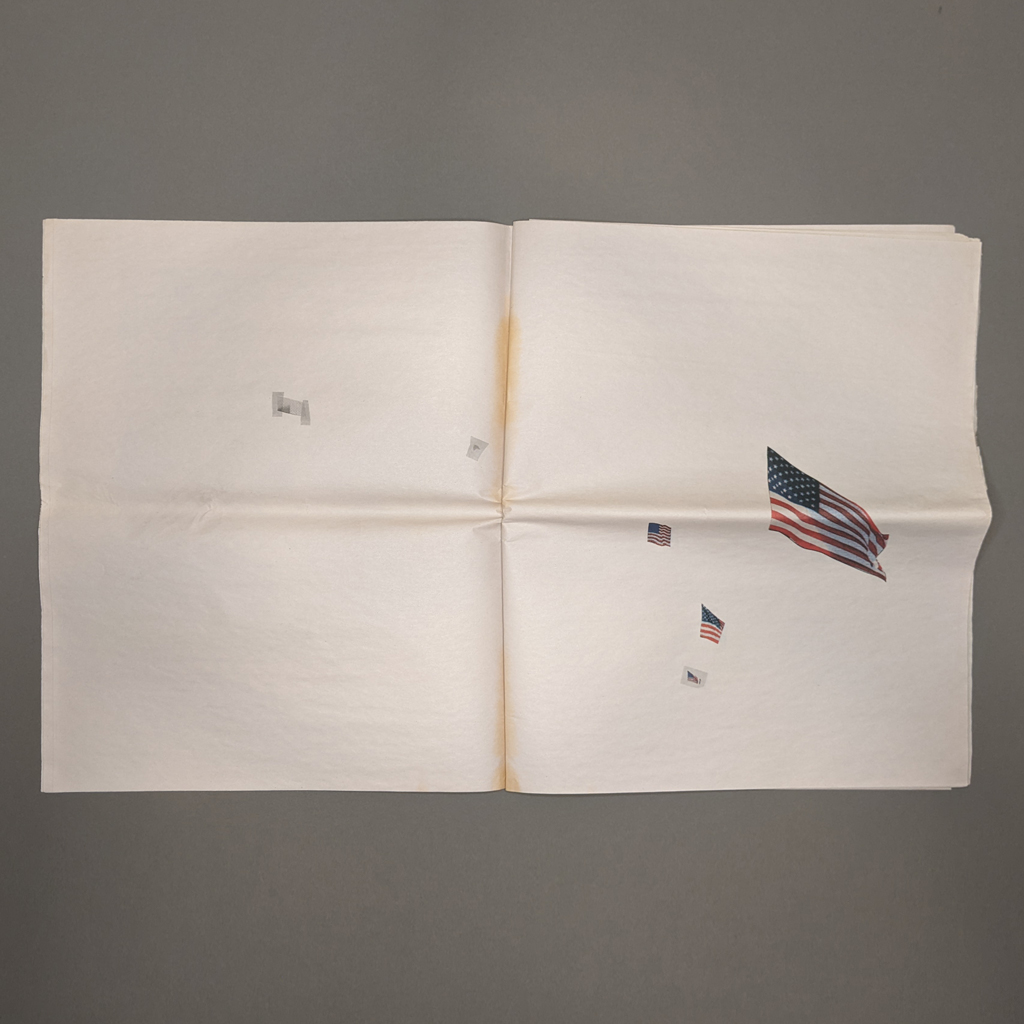
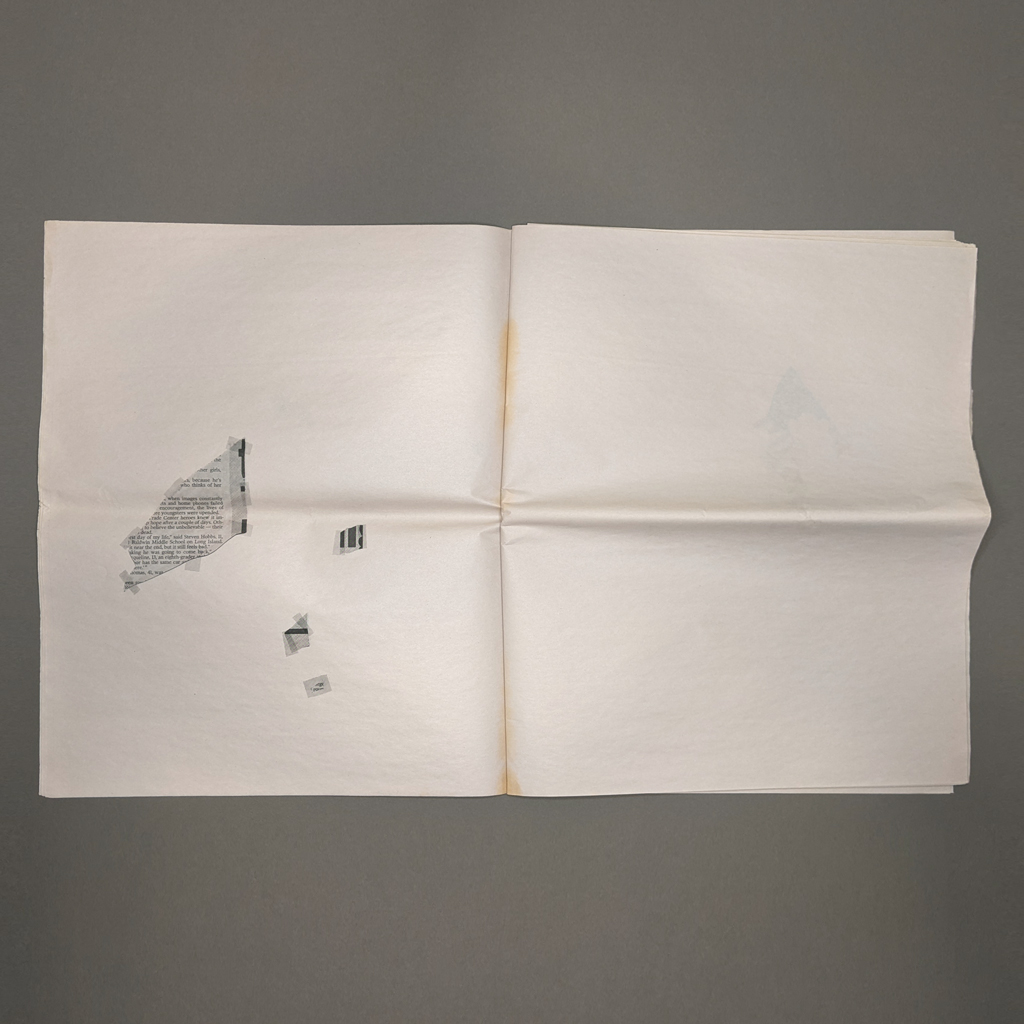
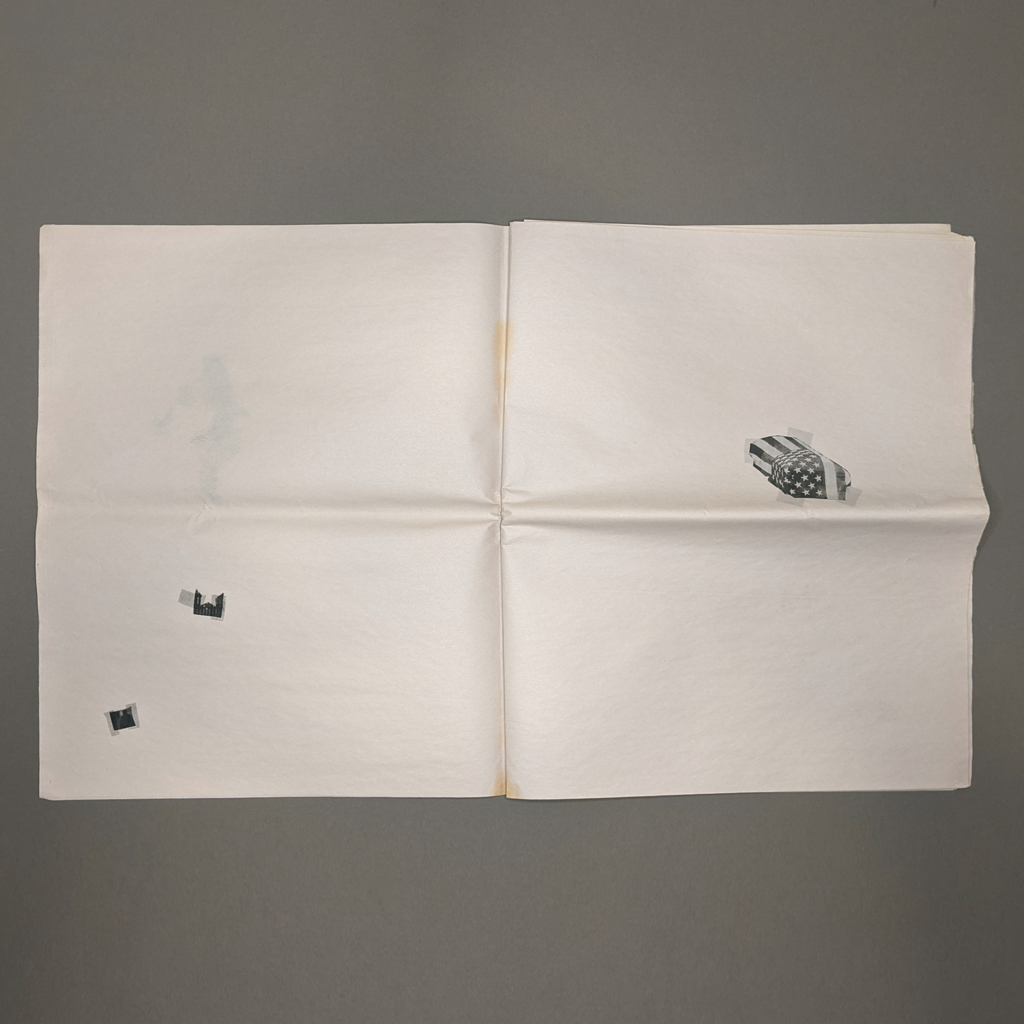
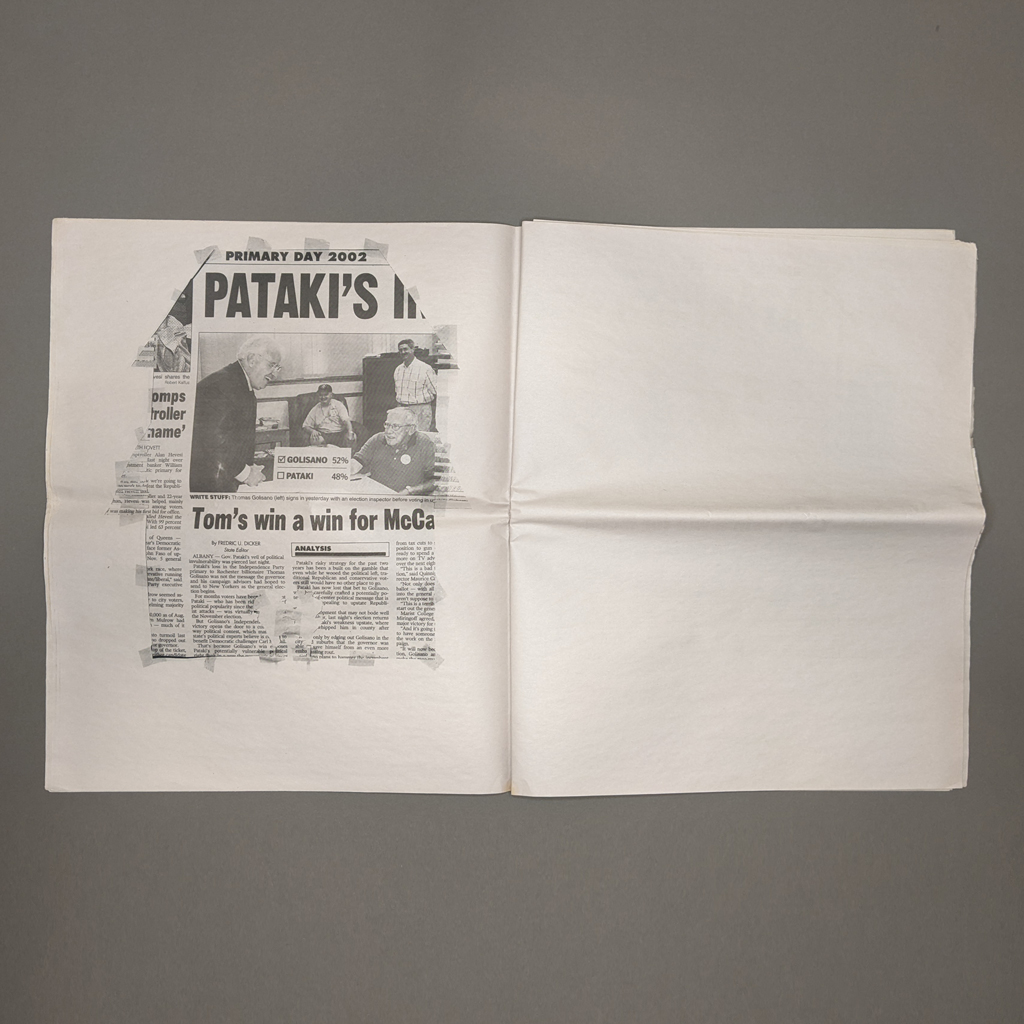
    NEW YORK POST Flag Profile is a redacted version of a special edition of the New York Post issued on the first anniversary of the September 11 terror attacks. Specifically, Michalis Pichler has cut out all the American flags from the original issue and essentially pasted, or rather taped, them into a blank newspaper, preserving their precise location and orientation on the page. I say essentially, because there is a pre-press trick: whatever is on the backside of the excised flag is also pasted back into the newspaper in its corresponding position. The result is a new version of the special issue featuring nothing but American flags and whatever happened to be printed behind them. Given the potent symbolism of erasure in the context of loss, of silence in the context of remembrance, and of American flags in the post-9/11 era, NEW YORK POST Flag Profile is a high-stakes exploration of longstanding concerns for artists’ books: how context informs content and how the physical space of the page produces meaning.

    NEW YORK POST Flag Profile, inside spread: on the recto, four cut-out American flags, printed in color, float on the white page. On the verso, two small, black-and-white fragments of newsprint are taped onto the page.


    The presence of entirely blank pages among NEW YORK POST Flag Profile’s eighty-eight pages suggest that Pichler has faithfully followed the original special issue, except for the centerfold and subsequent page, which serve as a colophon and project statement. The newspaper format enhances the impact of the blank pages, because a reader cannot quickly flip through or skip over them as one might with a book. It also allows for the relatively large edition size of 5,000. The project seems well suited for wide distribution. It can be appreciated at many levels, but its impact is practically immediate, and its construction is largely self-explanatory.

    NEW YORK POST Flag Profile, inside spread: the recto is blank. On the verso, the backside of the flags in the previous recto are taped to the page. The silhouette of the flag is visible but filled with fragments of text and imagery.

    One reason NEW YORK POST Flag Profile succeeds at multiple levels is that it illustrates the importance of context in both concrete and abstract ways. Separated from the surrounding text and image, it is difficult to tell whether the flags belonged to a news story, a commemoration, or an advertisement. The images run the gamut from flag-draped coffins to generic backgrounds behind text that Pichler has painstakingly cut out. Beyond the page, the context of the publication matters, too. Consider the difference between the New York Post, a conservative tabloid, and the New York Times, which Pichler first treated with the same approach in his 2003 New York Times Flag Profile. Furthermore, the meaning of the American flag continued to change between 2002 and 2017. Just as the flag took on new meaning, and ubiquity, after 9/11, so too did it change during the MAGA era of Donald Trump’s first presidency.

    Perhaps even on September 11, 2002, when the original newspaper was published and when the United States had invaded Afghanistan but not yet Iraq, the flag meant something different than it would by Pichler’s 2003 publication. NEW YORK POST Flag Profile is not about 9/11 per se but about its commemoration a year later. Pichler retains the original cover and title of the Post’s special issue: “Lest we forget.” The largely empty pages might be seen as a moment of silence, whether out of respect or at a loss for words. Moreover, their creation through erasure might invoke the loss suffered in New York and elsewhere. But Pichler’s erasure is ambivalent; it seems to enact the very forgetting that the Post wants to prevent. Do the flags paper over a more complex discourse with facile patriotism? Does the erasure interrupt the then-inescapable images of airplanes, fireballs, survivors, and victims? The latter phenomenon, the incessant repetition of the same event, was an anomaly for the news media. “Lest we forget,” proclaims the Post, but daily newspapers are in the business of forgetting. History doesn’t sell like novelty, and the new is rarely as outrageous when viewed in context.

    NEW YORK POST Flag Profile, inside spread: on the recto is a black-and-white image of a flag-draped coffin, taped to the page. On the verso, two small, black-and-white rectangles with unidentifiable content are taped to the page.

    Newspapers’ bias towards the present is visible in their ephemerality, and Pichler retains this quality. The yellowing and creasing of my own review copy is a testament, but even a pristine copy bears the marks of Pichler’s paste-up production, most notably the adhesive tape still visible around the edges of many images. By emphasizing the materiality of the page, the tape helps activate the white space that dominates most spreads. This is a major concern for Pichler, who has produced numerous projects related to Stéphane Mallarmé’s Un coup de dés jamais n’abolira le hasard, which is seen as a watershed moment in poetry’s recognition of the page. Newspapermen understood this before poets, though, and Pichler interrupts his publication with a four-column tally of square inches dedicated to the stars and stripes in New York Newsday, New York Post, New York Times, and Village Voice anniversary editions.

    In newspapers, column inches are a measurement of monetary and cultural value — the space given to a story, a journalist, or an advertiser informs the message as surely as Mallarmé’s typography guides his reader. Important stories go above the fold, and advertisers can pay for premium placement. If Mallarmé reminds us that the page is a presence, not an absence, Pichler reveals the page to be as ideological as it is material. The incidental information that is retained because it is printed on the backside of a flag might be subject to chance, but it is not random. Far from “all the news that’s fit to print,” each page reflects decisions made by editors, publishers, and ad reps.

    NEW YORK POST Flag Profile, inside spread: the recto is blank. The verso contains most of a page from the original newspaper, including headlines, text columns, and images. The silhouette is irregular, and the cut-out is taped to the page.

    The importance of editorial choices may be most obvious in Pichler’s quantitative comparison of four very different New York newspapers, but the entire publication resensitizes the reader to the newspaper format, which is so familiar it risks becoming transparent. As a critique of politics and mass media, NEW YORK POST Flag Profile has obvious parallels with tactical media projects like the Yes Men’s New York Times Special Edition (2008), which launched a week after Obama’s first election, full of hopeful yet implausible alternative headlines. However, Pichler looks deeper than content. By thinking with artists’ books, he deconstructs the newspaper format and the politics of commemoration by attending the interplay between materiality, structure, content, and context. With a print run of 5,000, accessible subject matter, and familiar format, NEW YORK POST Flag Profile introduces these considerations for readers not already steeped in artists’ books. For readers who already think in the language of artists’ books, there is plenty to enjoy in the publication’s visual surprises, semiotic play, and poignancy.

    Levi Sherman

    December 24, 2024
    Review
    2017, Collage, Folded, Michalis Pichler, Offset Lithography, Unbound, Visual
  • Two Blank Books

    The Collected Poems of Donald J. Trump
    Brad Freeman
    2024
    5.75 × 6.5 in. closed
    Single-signature clothbound hardcover
    40 pages
    Ink jet
    Edition of 50

    I Have Nothing to Say, and I am Saying It
    Landry Butler
    2024
    6.25 × 9.25 in. closed
    Perfect-bound hardcover
    200 pages
    Digital printing

    Two books side by side. On the left is "I Have Nothing to Say, and I am Saying" which has a violet cover and light green title text. On the right is "The Collected Poems of Donald J. Trump," which has brown bookcloth and an inlaid printed title.

    This month’s review departs from my usual format, just as November 2024 has been an unusual month. I am reviewing two books together, and the books are, not entirely coincidently, the two I’ve received most recently.


    Brad Freeman’s The Collected Poems of Donald J. Trump arrived on election day, November 5. The title is set in a script typeface that looks elegant the way Mar-a-Lago looks elegant. If the concept strikes the reader as implausible, consider the Trump Bible (officially titled God Bless The USA Bible). Its slim proportions do hint at a dearth of poetry; inside the clothbound hard covers is a single sewn pamphlet.

    Title page of and front inside cover of "The Collected Poems of Donald J. Trump". The title text is set in a fancy script face.

    The forty pages are numbered but otherwise blank. There is no poetry.

    The page numbers focus the reader’s eye as they thumb through the stark white pages. They also mark the passage of time and — at the risk of projecting onto the book’s blankness — remind the reader of its finitude. Trump’s presidency will come to an end.

    Center spread of "The Collected Poems of Donald J. Trump". A pamphlet stitch is visible in the gutter between two otherwise blank pages with page numbers, 20 and 21.

    Trump’s first term in office spawned an entire sub-genre of artists’ books. With over 25,000 tweets during his presidency, Trump gave artists plenty of content to work with. For example, Richard Kraft’s five-volume, 1,622-page artists’ book It Is What It Is: All the Cards Issued to Donald Trump January 2017–January 2021 annotates nearly 10,000 of Trump tweets, issuing a color-coded penalty card, like a soccer referee.

    For those sick of reading what Trump has to say, Freeman’s book has the advantage of silence. Trump and his allies “flood the zone with shit” to keep us distracted with every new outrage. Instead, Freeman quietly, materially demonstrates how little Trump has to offer.


    We often say “there are no words…” as we cope with shock or sorrow. No doubt many Americans felt this way in the days following the election, even as pundits breathlessly filled the airwaves and editorial sections with lessons learned (or not). The phrase also appears on the cover of Landry Butler’s I Have Nothing to Say, and I am Saying It.

    Inside spread of "I Have Nothing to Say, and I am Saying It". The pages are numbered and ruled but otherwise blank.

    Like Freeman’s book, I Have Nothing to Say is blank except for page numbers. And like The Collected Poems of Donald J. Trump, the book’s title determines its interpretation. Further distinguishing the two blank books, I Have Nothing to Say has ruled pages, inviting the reader to use it as a journal. The back cover also features a blurb, which explains the book’s dual purpose. The reader may choose to use it as a journal, but for Butler the book is an existentialist reflection on empty platitudes and meaninglessness more generally.

    Whereas Freeman’s book is handbound in an edition of fifty, I Have Nothing to Say is available on-demand through Amazon. This puts the book in dialogue with the proliferation of semi-customized self-help journals pumped out by online gig workers and side-hustlers. So-called “low-content publishing” has been largely unexamined by book artists, so Butler’s blank journal is a welcome contribution. The grandiosity of his questions — what is lost when thoughts become words? what would a better world look like? — strikes an absurd contrast with the vehicle, a humble 200-page hardcover. Purchasing it from Amazon only sharpens that contrast.

    Final spread of "I Have Nothing to Say, and I am Saying It". A Barcode and date stamp indicate when the on-demand book was produced.

    Artists have long experimented with blank books as vehicles for meaning, and Butler’s existentialism has parallels in 1960s experiments by John Cage, Robert Rauschenberg, and others. The Collected Poems of Donald J. Trump grapples with existential absurdity and the meaninglessness of words in its own way. Both books contribute to this tradition of silence in contemporary art even as they respond to today’s internet culture, from political discourse to the commodification of self-care.

    In their own ways, Freeman and Butler empower their readers. Butler invites the reader to share their thoughts, and Freeman silences one of the world’s most powerful people. Taken as critiques of authoritarian politics and cynical profiteering, these blank books demonstrate the difference between being speechless and having nothing to say. 

    Artists’ Book Reviews

    November 13, 2024
    Review
    2024, Brad Freeman, Hardcover, I Have Nothing to Say and I am Saying It, Landry Butler, Monograph, Pamphlet Stitch, Perfect / Double-Fan Adhesive, Poetry, Text, The Collected Poems of Donald J. Trump, Visual
  • Senza Titolo (Untitled)

    Senza Titolo (Untitled)
    Angelo Ricciardi
    2021

    Unbound; one folded and gathered signature
    6 × 8.25 in. closed
    48 pages
    Ink jet
    Edition of 10

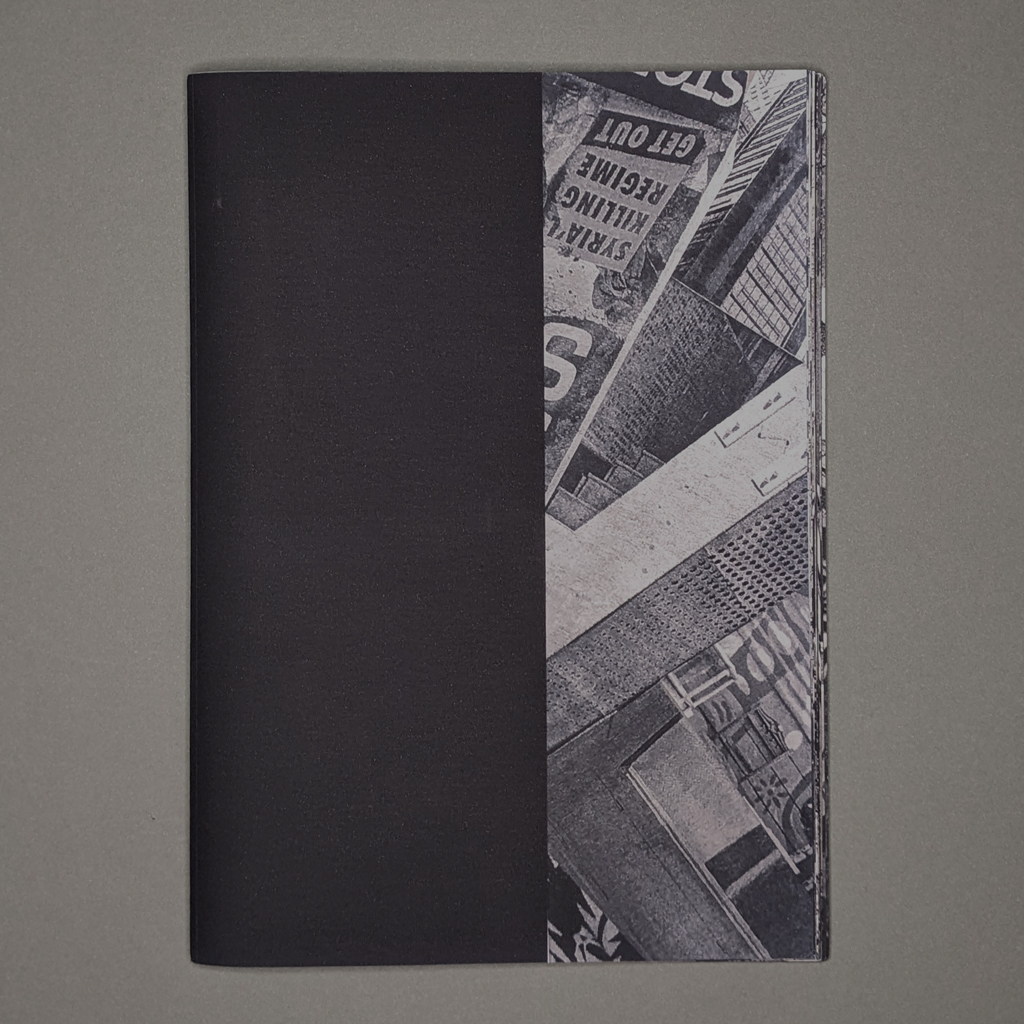
    Front cover of Senza Titolo. The cover is divided vertically: the left half is solid black, the right half is a grayscale collage with fragments of text. There is no title text.

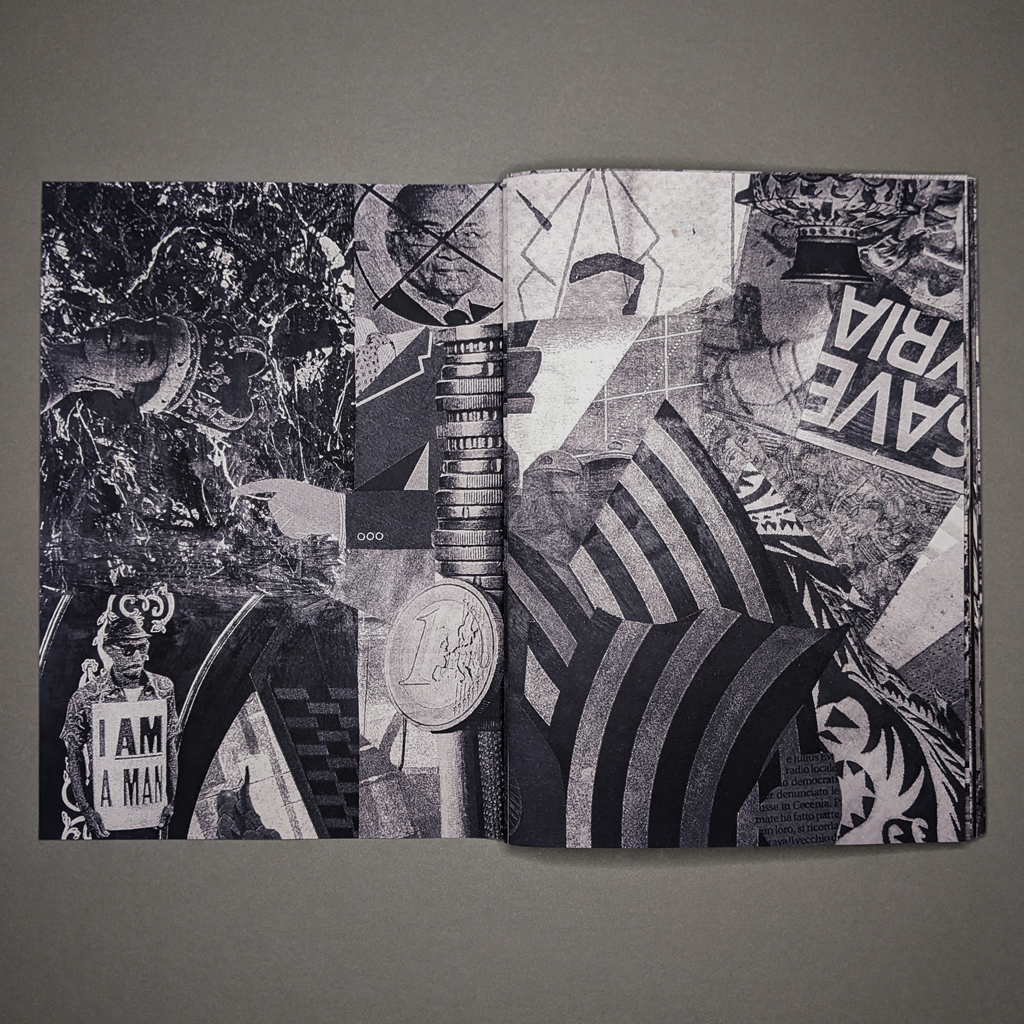
    Angelo Ricciardi’s Senza Titolo (Untitled) is a busy book of fragmented collages, printed full-bleed in black and white. The whites are toned down to a light gray, lending the book the appearance of newsprint. And, like a newspaper, the book’s 48 pages are folded and gathered but left unbound. Ricciardi shares his longstanding interest in newspapers with many collage artists, and Senza Titolo recalls avant-garde movements of the early twentieth century: Cubism, Dada, and Futurism. The collages teem with images but also contain text, and it seems another of Ricciardi’s interests is the interaction of text and image. In Senza Titolo, text and image clash as often as they concur. Amid controlled chaos, the reader must make their own meaning.

    Senza Titolo, inside spread. The verso collage contains a photo from the Memphis Sanitation Workers strike in 1968 with the slogan "I am a Man". The recto collage contains a fragment of a "Save Syria" sign.

    The imagery speaks to both tasks: controlling chaos and making meaning. There are police and protestors, old master artworks and cartoon characters. The grayscale rendering helps unify these incongruous images, itself a trade-off between information and order. Furthermore, the relatively low contrast — few bright whites and a full spectrum of grays — slows the reader down as they parse the boundaries of fragmented objects. Their values may be subtle, but the forms are expertly assembled; each page has a strong composition. Ricciardi guides the reader’s eye, and the mind hurries to catch up.

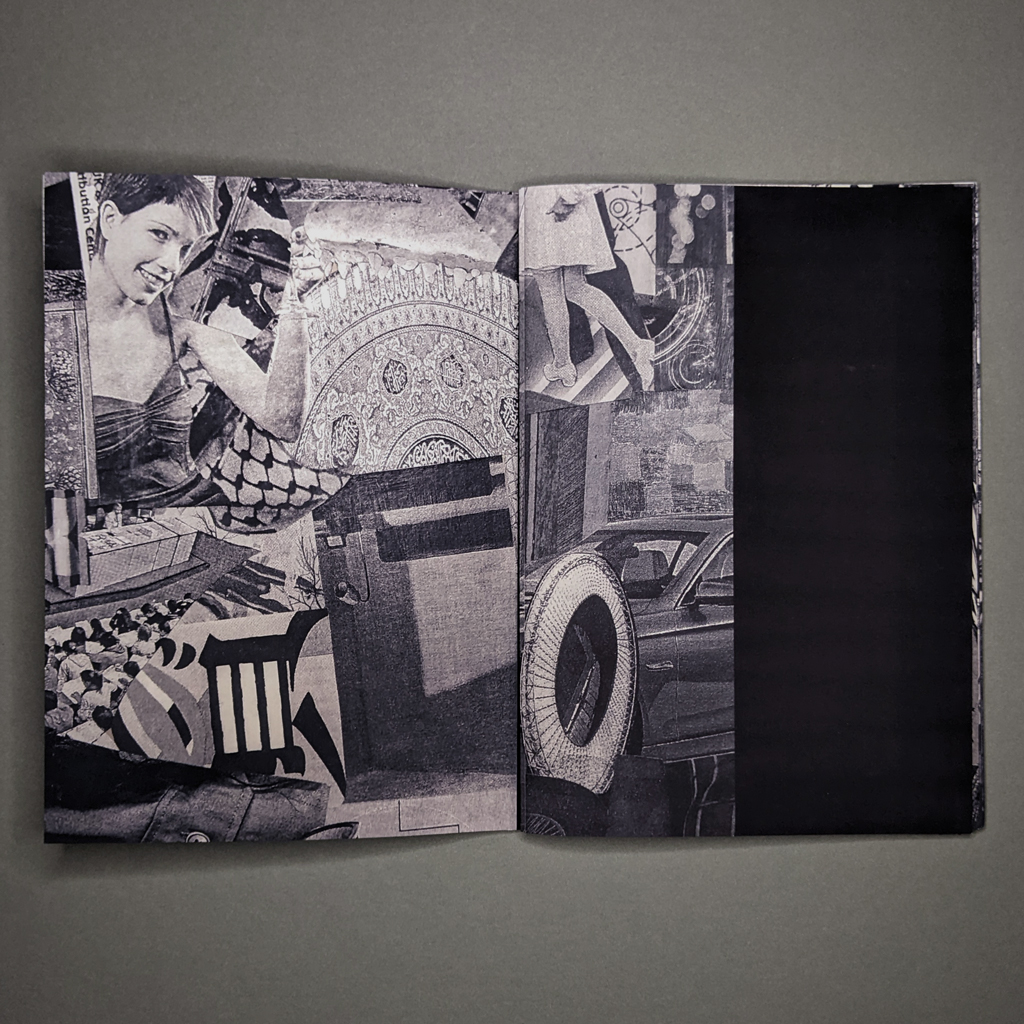
    Composition also reveals the structural complexity of Senza Titolo. Each folded sheet has a complete college on each side, but these are only visible if the sheets are removed from the gathered signature. When gathered into a pamphlet, the verso and recto are from different collages. Despite the chaos, the pairings are not entirely random; Ricciardi uses visual devices to call across the gutter. Portraits of people are especially effective in this regard, but the echo of a geometric form is all it takes to connect the composition of the two-page spread. (If, in fact, the paired pages are random, it goes to show how naturally readers seek patterns and construct meaning.) In an unbound book — read as pages, spreads, and sheets — possible meanings multiply, and then multiply further as they accumulate in what is ultimately a time-based experience.

    Senza Titolo, inside spread. A vertical band of solid black splits the recto roughly in half.

    In some ways, composition and time are in conflict. The immersive, all-over design of each collage pulls the reader inward instead of propelling them to turn the page. Fortunately, this is balanced by the book’s game-like quality, which invites readers to recognize references and decode symbols. Ricciardi introduces a sense of rhythm and pacing by interspersing vertical bands of solid black, which cover half a page and split the book into several sections. Even without obvious themes or through lines, these sections break the book into manageable units for the reader and offer signposts in the absence of page numbers.

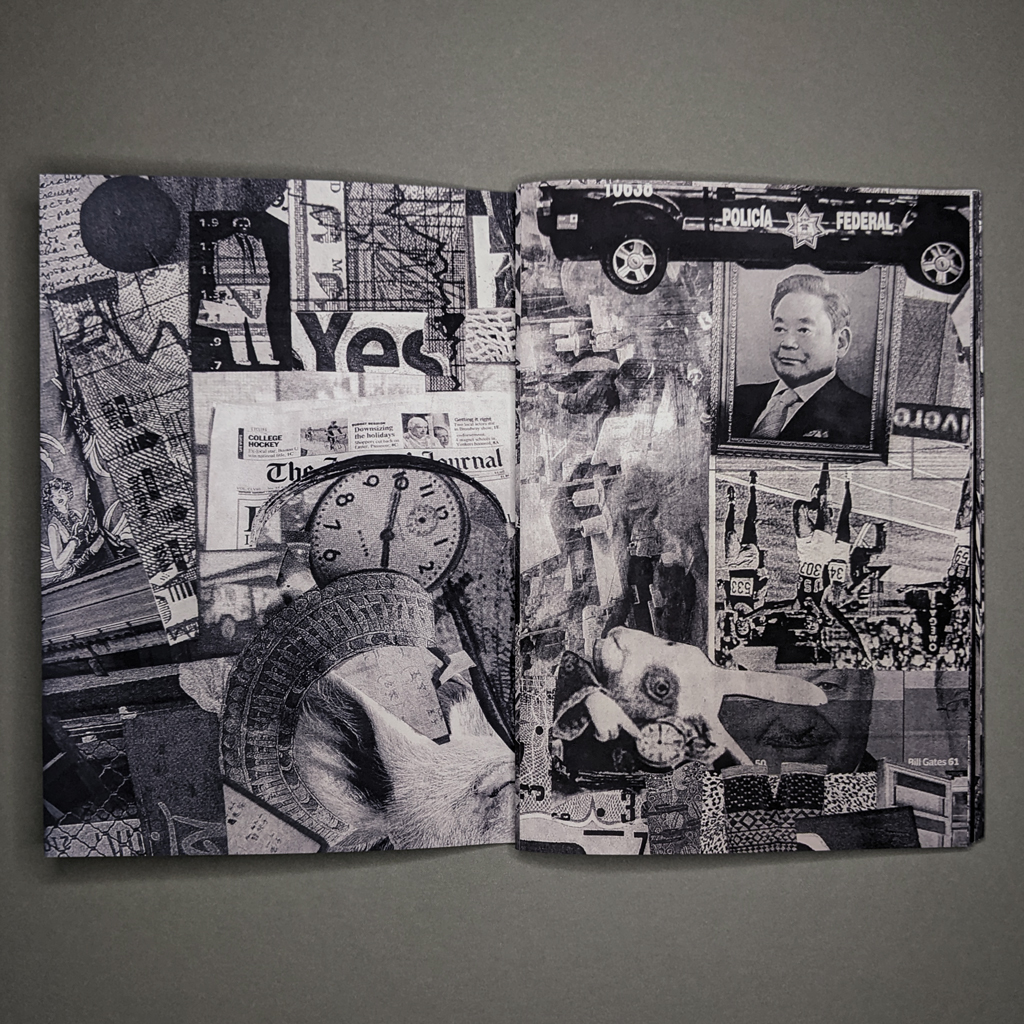
    Senza Titolo, inside spread. Watch dials appear on both recto and verso.

    The passage — and stoppage — of time is not just a feature of the book’s reading experience but also its content. Clocks and watches appear throughout, and the mash-up of historical references and recent events is another form of temporal play. But while the source images span centuries, Ricciardi’s visual strategies are of a particular moment. There are elements of Dada, particularly Hannah Höch’s political commentary, which is in no way random or resigned. The fragmentation of space and perspective, of course echoes Cubism, which is credited with first incorporating newspaper into art. And there is an overall sense of a decadent present burdened by history, which features in Futurism. In other words, Senza Titolo seems like a work from the turn of the twentieth century. So why does it still succeed?

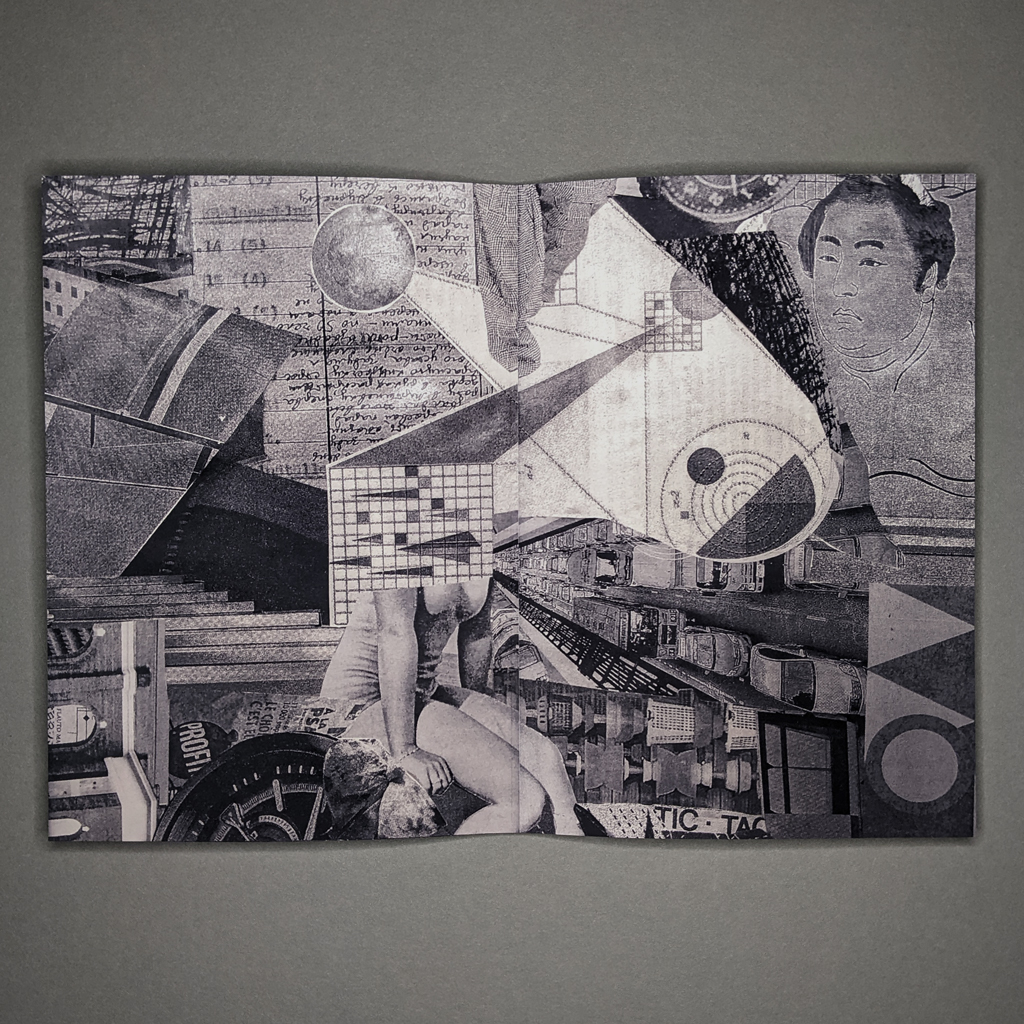
    A single, ungathered sheet from Senza Titolo. Images continue across the folded gutter.

    If the political stakes of collage, montage, and fragmentation have changed since Walter Benjamin theorized them in the 1920s, Ricciardi uses the structure of the book, as well as its content, to reach today’s reader. The unbound book makes tangible the battle between chaos and control: one must physically disorder the book by ungathering its pages to gain visual mastery of the complete compositions. Today’s reader may be less shocked by collage, but order and chaos are as salient now as a hundred years ago, and so is the related search for meaning and purpose. Senza Titolo’s absurd juxtapositions carry on a legacy of nonsense and relativism that stretches from Dada to postmodernism and beyond. And like these precedents, Ricciardi’s message is anything but meaningless.

    Levi Sherman

    October 29, 2024
    Review
    2021, Angelo Ricciardi, Collage, Folded, Ink Jet, Monograph, Unbound, Visual
  • Poems Sneaking Through a Sieve

    Poems Sneaking Through a Sieve
    Riley Cavanaugh
    Have a Nice Day Press
    2022

    Spiral-bound softcover
    8.5 × 6.25 in.
    66 pages
    Digital printing
    Edition of 500

    Front cover of "Poems Sneaking Through a Sieve" — white title text on a blue background, part of a full-bleed, hand-drawn, abstract illustration. The binding is a bright yellow plastic coil.

    Poems Sneaking Through a Sieve combines poems from two series, one derived from spam emails and the other from CAPTCHAs, into a single, spiral-bound compendium. Riley Cavanaugh’s visual poetry and hand-drawn annotations are accompanied by a short foreword by the publishers, Lele Buonerba and Laurel Hauge, and a longer critical essay by art historian and curator Nina Wexelblatt. The book’s high-quality digital printing conveys the low quality of the source images and renders an aggressive gamut of colors from which our spam filters typically protect us. The spam filter is the most literal meaning of the titular sieve, but that symbolism carries through more broadly in Cavanaugh’s concern with attention, boundaries, and communication.

    The book’s foreword gives a brief history of spam emails and CAPTCHA authentication before explaining Cavanaugh’s motivations and process. It helps attune the reader without spoiling or speaking for the poetry that follows. In contrast, it is good that Wexelblatt’s contribution comes after the poetry. I certainly enjoyed returning to the poetry after reading Wexelblatt’s essay, but I was glad I first had the opportunity to struggle on my own toward some of the same conclusions that she makes so convincingly. Likewise, the inclusion of a mind map by Cavanaugh, also after the poetry, succinctly lays out the connections between both poetry series and Cavanaugh’s artistic lines of inquiry. Readers without the unenviable task of following Wexelblatt’s essay with their own review will no doubt appreciate her analysis as well as the opportunity to peek inside Cavanaugh’s brain.

    Poems Sneaking Through a Sieve, inside spread: verso is a hand-drawn, color-coded mind map of Cavanaugh's poetic and artistic interests. Recto is the first page of Wexelblatt’s essay, conventionally typeset.

    Understanding how Cavanaugh connects ideas is especially important since connectivity itself is a central theme — connections between people but also between distinct bodies of work like the spam poems and CAPTCHA poems. The spam poems, which are written by redacting real spam emails, retain the hyperbolic vocabulary that likely triggered the spam filter. Cavanaugh excavates the desperate language of desire that drives these emails. Transformed into poetry, the trademarks of low-budget marketing (attention, urgency, calls to action) are generically erotic, even if some of the original emails were not. If each distillation of urgent desire is somewhat repellant, their accumulated effect nevertheless appeals to the reader as the book progresses.

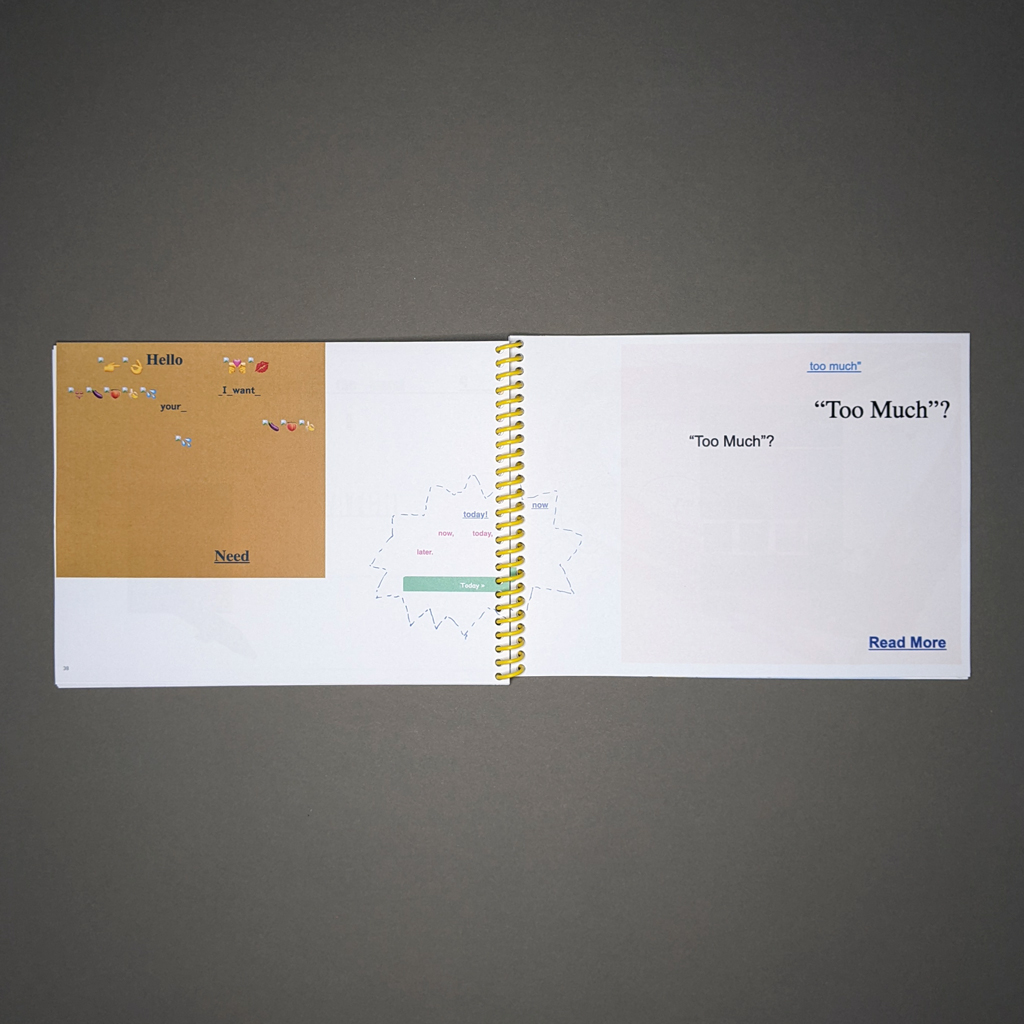
    Poems Sneaking Through a Sieve, inside spread. Verso reads: "Hello I want your Need" with suggestive emoji. Recto reads: "too much / Too Much? / Too Much? / Read More". In the gutter, a star-shaped textbox reads: "now / today! / now today / later / Today"

    While the spam poems, with their direct address, are all about “you,” the CAPTCHA poems look inward. They reside in the pregnant pause where we question whether we are human, or at least where the seamless flow from one website to another is interrupted, and we are suddenly made aware of our own web-surfing. The earlier CAPTCHAs (distorted strings of letters) make their appearance throughout the book, but the CAPTCHA poems are based on Google’s now-ubiquitous photo CAPTCHAs, where a grid of images or a single image split into a grid asks the user to robotically identify a certain noun (e.g., “select all squares with traffic lights”). Cavanaugh responds to each CAPTCHA as if the challenge to prove one’s humanity calls for free association, word play, memory, and other acts of human creativity. Mostly, Cavanaugh adds text directly into the image grid, but they also respond with photographs of their own. For example, a CAPTCHA full of chimneys prompts a prose poem about a bird and then a photograph of two hooded crows.

    Poems Sneaking Through a Sieve, inside spread. Verso has a photo Captcha and recto has a spam email redaction poem. In the gutter is a photo of crows surrounded by hand-drawn, cartoon-style grass.

    Overall, the visual aesthetic is driven by the photo CAPTCHAs and spam emails. Whitespace predominates, signaling Cavanaugh’s redactions and lending a sense of movement to counteract the gridded frames of browser windows, photographs, and text fields. The space also leaves room for Cavanaugh’s playful interventions: emoji hearts float away from an email, lane lines extend a road from photograph to drawing, a fire hydrant casts a second shadow. Most importantly, the book’s negative space enacts the separation that is a precondition for Cavanaugh’s connections.

    Poems Sneaking Through a Sieve, inside spread. Verso has a photo of a dented car. Recto has a spam email redaction poem: "please / I WANNA SEE THAT / please / I WANNA SEE THAT". In the gutter is a white lane line on asphalt, split by the book's yellow coil binding.

    The careful attention to layout is enhanced by the book’s structure. The yellow plastic coil that binds the book is a conspicuous presence in the gutter, and even when elements cross that boundary, the spreads tend to feature two separate focal points in a dynamic relation with one another. The margins are less active than the gutter, and it is curiosity rather than any visual device that drives the reader to turn the page. The reader’s advance is evenly paced, and the book could be read rather quickly — except the whole point is to pay attention to text and imagery that is usually overlooked.

    CAPTCHAs and spam are means to an end. We look and click through them on our way to a goal, whether our own or an advertiser’s. But in Poems Sneaking Through a Sieve, Cavanaugh looks at, instead of through, these communications and recovers a non-instrumental aesthetic pleasure. The book is an exercise in attention, whereas a spam filter only reduces distractions. Instead of speaking louder, it asks the reader to listen more carefully. Cavanaugh challenges binary assumptions about signal and noise, human and other, separate and connected. Between these binaries is the medium, the messy terrain where communication takes place. The sieve. The book.

    As a sieve, the book also practices a certain resourcefulness, making art from the digital dustbin. Published just months before ChatGPT went mainstream, the book anticipates the need for artists to work in visual and textual economies flooded with AI-generated “content.” Cavanaugh’s prescient contribution affirms the mission of Have a Nice Day Press: to publish artists’ books informed by internet culture. It shows a deep understanding of media — print and digital, human and machine — and what happens when they collide. It also lives up to Cavanaugh’s interests in play, attention, and connection: Poems Sneaking Through a Sieve is accessible and engaging.

    Artists’ Book Reviews

    September 23, 2024
    Review
    2022, Drawing, Have a Nice Day Press, Laser, Monograph, Photography, Poetry, Riley Cavanaugh, Softcover, Spiral, Text
  • Been Magic * Been Real

    Been Magic * Been Real: A Guide for an Everyday Revolution
    Helina Metaferia
    Center for Book Arts
    2024

    7 × 65 in. open
    Paper scroll in cardstock enclosure with leather strap
    Risograph
    Edition of 250

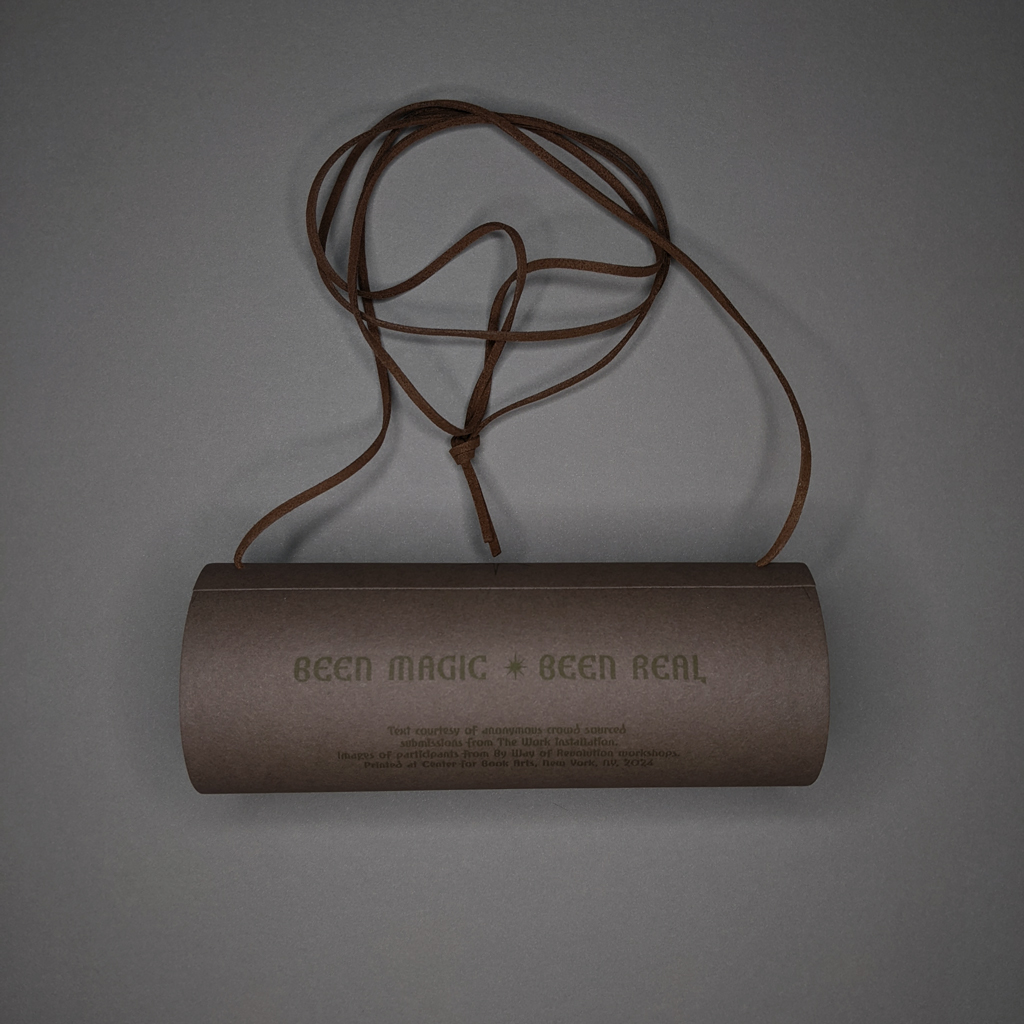
    Been Magic * Been Real enclosed in a brown paper tube with title text and leather cord.

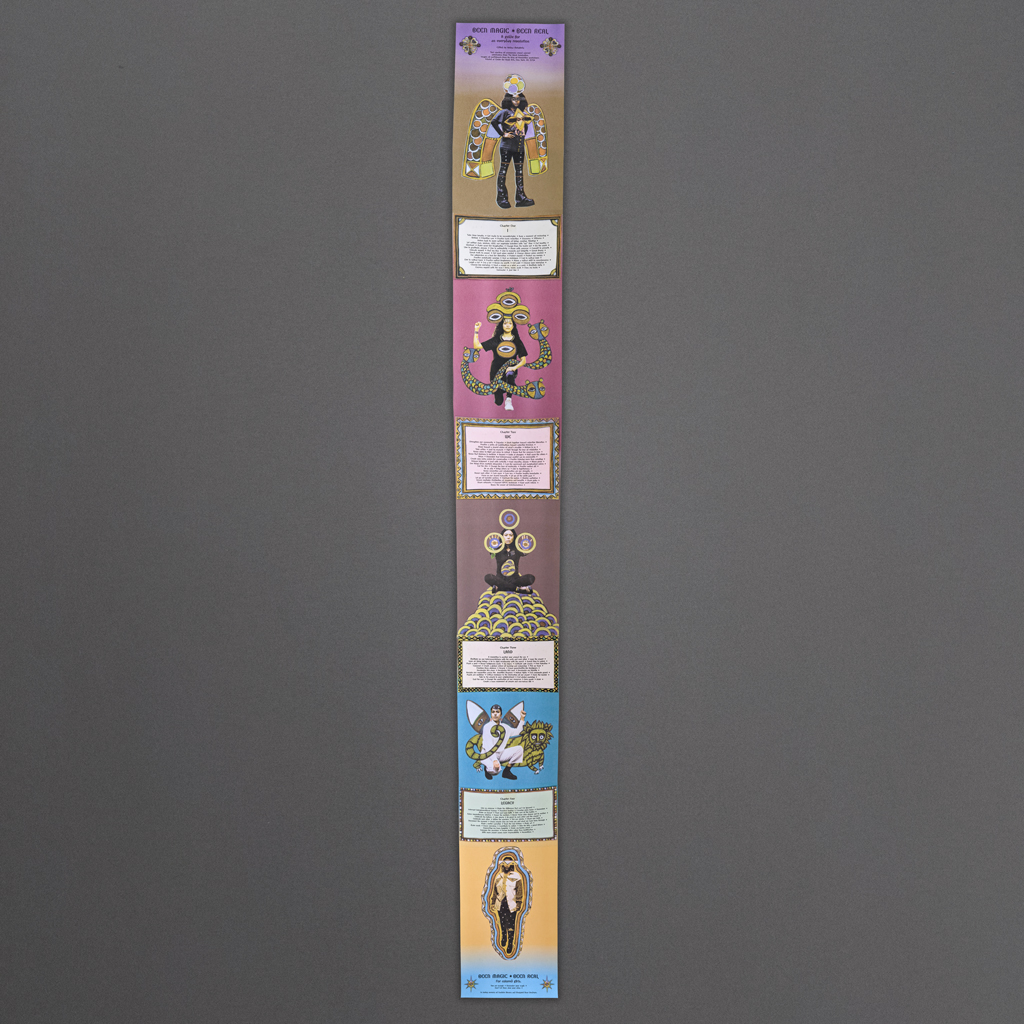
    Been Magic * Been Real: A Guide for an Everyday Revolution is inspired by centuries-old Ethiopian healing scrolls. The 65-inch, vertical scroll combines text and image, the latter which cleverly updates traditional iconography through vibrant photo-collages. Drawing on African art and culture is central to Ethiopian-American artist Helina Metaferia’s practice, but Been Magic * Been Real is not about her; it is a record of collaboration and community. The text comes from Metaferia’s interactive installations and social practice projects, and the images are portraits of BIPOC women who participate in her workshop, The Meeting Place. If Been Magic * Been Real is “visual medicine,” it may be the process and not the final publication that has the power to heal.

    Been Magic * Been Real: a colorful vertical scroll fully open with 5 images and 4 blocks of text

    The scroll is enclosed in an open paper tube with a printed title and a leather cord. (Traditionally, healing scrolls were carried or worn on the body, and many that survive have a leather cord.) The scroll is easily removed from, and returned to, the tube, but readers who don’t plan to hang their scroll may want a rectangular box for long-term storage. At seven inches wide, the scroll itself can be managed on a lap or tabletop. It has four blocks of text divided by five images, and a reader can comfortably keep these pairs of text and image open together. To see the entire scroll at once, a reader needs a partner, a paperweight, or some way to display it on a wall.

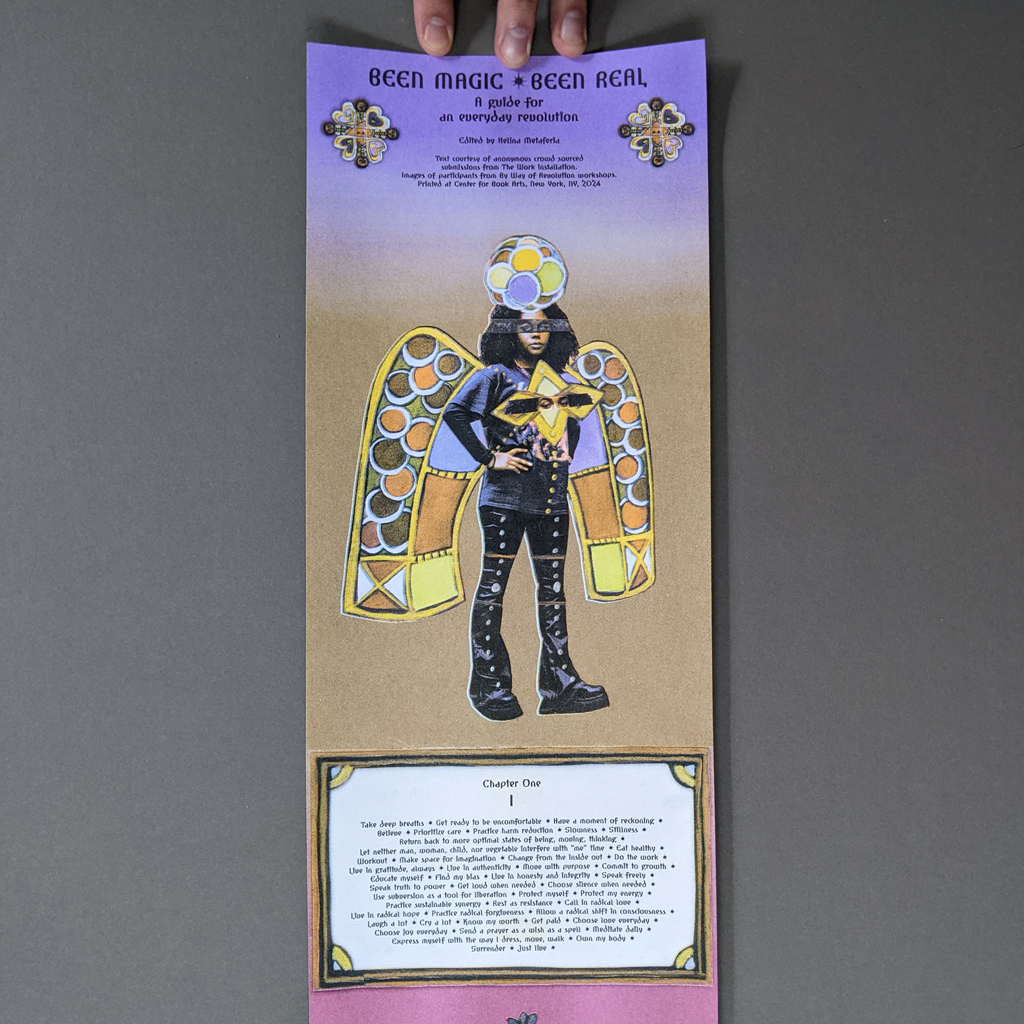
    Been Magic * Been Real, chapter 2: A photo-collage illustration of a woman with angel wings above a framed text box titled "I"

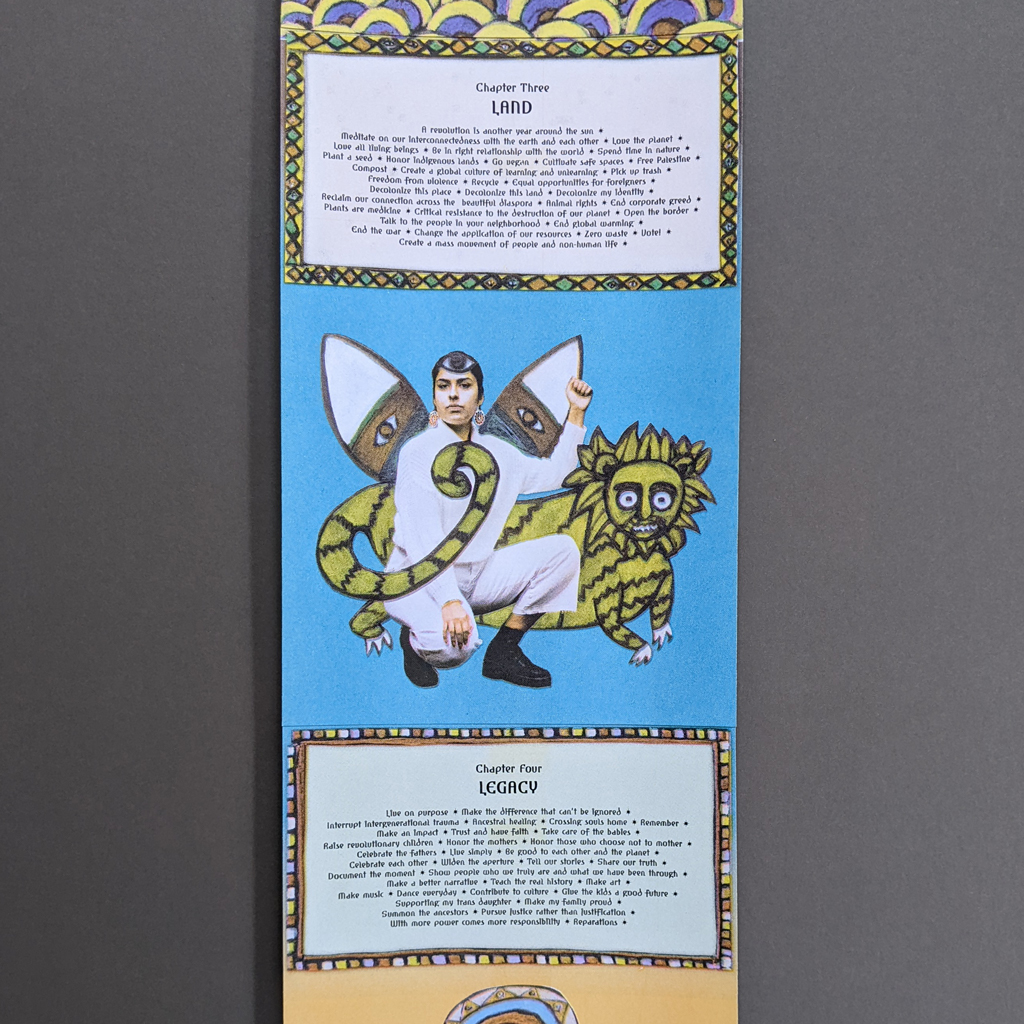
    Each block of text is a separate chapter — I, We, Land, and Legacy — and contains a litany of short phrases offered in response to the question “What is your everyday revolution?” These range from pithy sayings you might find on Instagram (activist slogans, self-help affirmations, and so on) to more individual expressions. The phrases are sequenced with an ear for rhythm and variety, giving the overall effect of a poem or a prayer rather than a word cloud at a team-building retreat. If the most meme-ready responses elicit a shrug or an eye roll, others contextualize, supplement, or even contradict these. The point is that each participant has their own revolutionary practices, and there is no one right way. This multiplicity is baked into the syntax of the first two chapters, where the titular pronoun can be appended to the beginning of each phrase: “I…prepare to be uncomfortable” or “we…work together toward collective liberation.” Instead of telling the reader what to do, the scroll offers dozens of examples that people already practice, some concrete and others more abstract.

    Been Magic * Been Real Chapter 2: A photo-collage portrait of a woman, kneeling and raising a fist, with eye and serpent motifs above a text box titled "We"

    Just as the text is stitched together from many sources, the imagery is digitally collaged. The iconography hews closely to traditional healing scrolls: eye motifs abound, and the boxes of text are framed by geometric patterns. However, instead of angels or saints, the portraits are of ordinary people posed like heroic, revolutionary figures. And, instead of a limited color palette, often only black and red, Metaferia’s scroll is Risograph printed in ten colors, enabling an aesthetic somewhere between vernacular religious posters and internet art. The images are detailed enough to be read alongside the text but retain a graphic quality that works well as wall art. Likewise, each chapter has a distinct color scheme and visual vocabulary, but they coalesce into an attractive overall design when the scroll is fully opened.

    Been Magic * Been Real Chapters 3-4: A photo-collage portrait of a winged woman, kneeling and raising a fist, with eye motifs and a lion between text boxes labelled "land" and "legacy"

    If I am projecting an internet art aesthetic onto the illustrations (and social media sloganeering onto the text), it is because the vertical scroll format now invokes the internet as much as any ancient tradition, and I think it is worth exploring, even stretching, these parallels. On one hand, social media is emblematic of the gaze that Metaferia seeks to counter: the heteropatriarchal male gaze, the colonial gaze, the glazed over, disengaged doomscrolling of the attention economy. Let’s call this the evil eye. The eye motif, which traditional talismanic scrolls use to return the gaze of the reader and banish the demon that has afflicted them, is found throughout Metaferia’s version. So, on the other hand, there is the reciprocal gaze, the healing power of being seen. Social media too often falls short of this, but it is the sort of mutual recognition that Metaferia’s workshops aim for, and which resounds in the book’s portraits.

    To continue the comparison, just as traditional healing scrolls relied on ritual, Been Magic * Been Real is incomplete without its social context. It is an interesting artists’ book in its own right, but its power comes from the trust and hope that motivate Metaferia’s interlocutors. Even as the text’s direct address absorbs the reader in their individual experience, the portraits make present the contributors who collaborated on the text. This dialectic of I and we, of consciousness-raising and collective action, is just one of the tensions sustained throughout the book, showing the complexity of healing and revolution. Is it time for reflection or action? Do we act locally or globally? Do we listen or lead? Been Magic * Been Real doesn’t offer answers; it invites the reader to look, and it looks back. Its gaze affirms, encourages, and obligates the reader.

    Artists’ Book Reviews

    August 19, 2024
    Uncategorized
    2024, Center for Book Arts, Collage, Documentary, Helina Metaferia, Monograph, Poetry, Risograph, Scroll, Tube
  • The Usual Arteries

    The Usual Arteries
    Erin Dorney
    Illuminated Press
    2024

    4.25 × 4.25 in. folded
    Single cut and folded sheet in a paper slipcase
    Ink jet inside with letterpress and screen printed slipcase
    Edition of 250

    The Usual Arteries (right) next to its slipcase (left). The slipcase is made of neon green paper. The book is white with black text and green and magenta imagery.

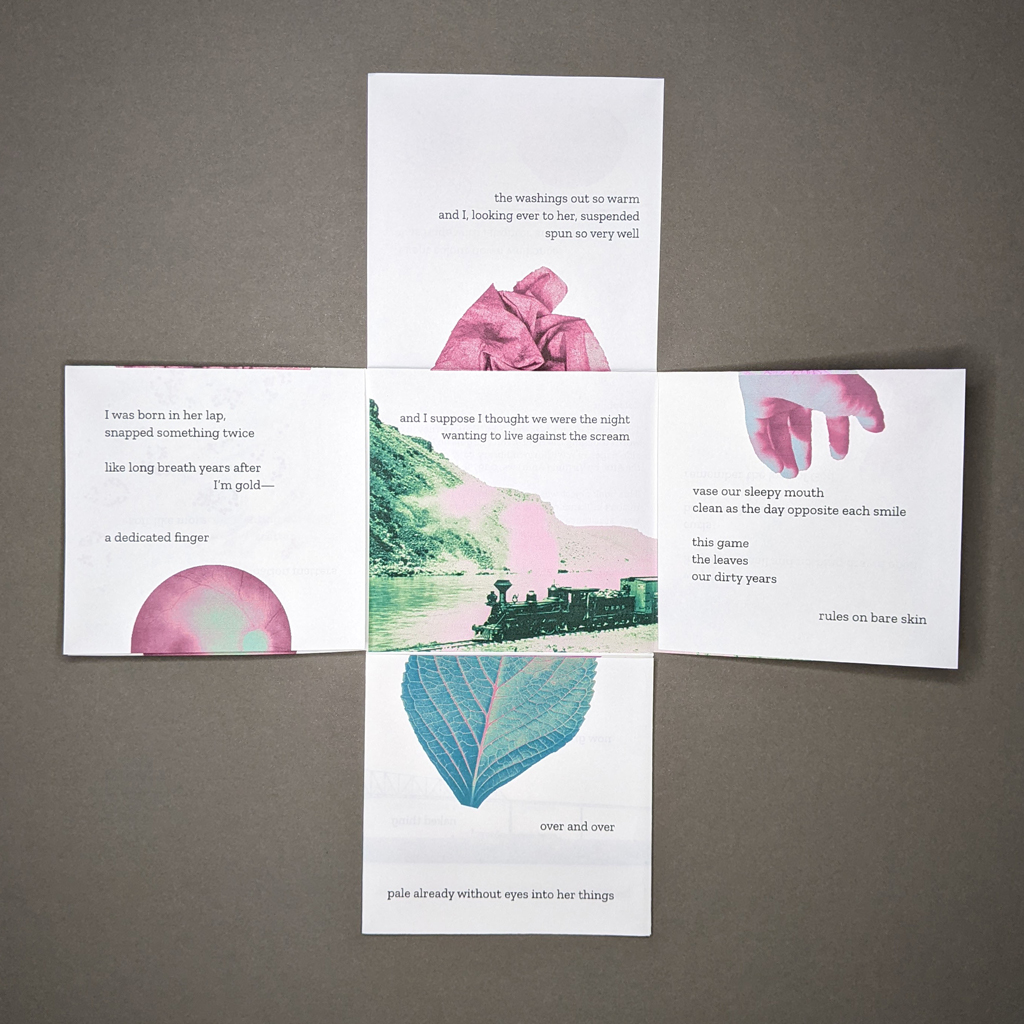
    The Usual Arteries is a single illustrated poem on a single sheet of paper that nevertheless unfolds into a captivating reading experience that thoughtfully engages the book as a physical object and cultural touchstone. Dorney, both a poet and visual artist, draws the text exclusively from words set against the right-hand margins of a copy of Flowers in the Attic by V. C. Andrews, a controversial but wildly popular gothic novel first published in 1979. This interest in the physical space of the page extends to The Usual Arteries, whose eighteen square pages (the book is a two-sided, three-by-three grid with cuts that separate the pages but leave the sheet intact) allow the text to be read in more than one order. Without page numbers, the reader’s unfolding and refolding are guided by the book’s duotone illustrations, which are split across pages and can thus be matched up to form complete images. Because unfolding and refolding take concentration, and because the full poem is never visible all at once, the book would warrant repeated readings even without the multiple horizontal and vertical sequences permitted by its grid format. 

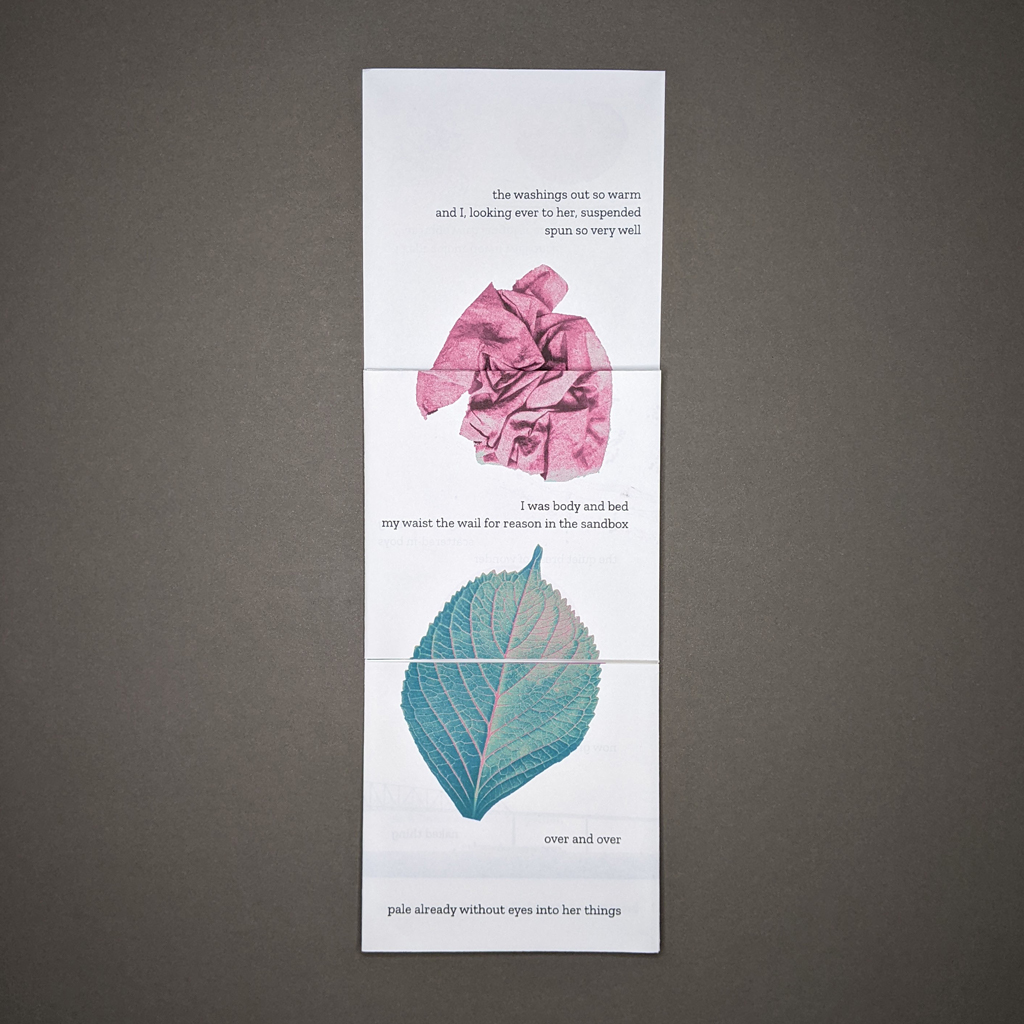
    The Usual Arteries, second opening: 3 pages are visible, stacked vertically.  Duotone images of a garment and a leaf cross the cut edges of the pages. Each page has black text, flush right.

    Readers won’t need to have read Flowers in the Attic to enjoy The Usual Arteries. I haven’t read Flowers in the Attic, but a summary of the plot makes me think readers familiar with it will have a different experience with The Usual Arteries. (In fact, I’m glad I read The Usual Arteries a few times before investigating the source text.) The salacious story of incest, inheritance, and murder seems to stick with people. For her part, Dorney retains the original text’s first-person perspective and oblique references to a few characters, but these breadcrumbs in no way overdetermine the poem. If a certain darkness lingers beneath the surface, the credit must go to Dorney, not Andrews. The mood is fitting but not dependent on the original. Dorney alludes to past events without offering the clarity of narrative, unsettling but not upsetting the reader. Dorney has a knack for choosing words that are loaded but still open to recontextualization, and the way The Usual Arteries unfolds — sequential and combinatorial — allows for those changes in meaning no matter what background knowledge the reader brings with them.

    The Usual Arteries, fourth opening: 5 pages are visible, forming a cross.  The duotone images are fragmented, cut off by page edges. Each page has black text.

    The book’s photographic imagery adds another layer of open-ended associations, and while the text sometimes anticipates the imagery, the former is more than a caption, and the latter is more than an illustration. The images begin as single objects against the white background: a garment, a leaf, a flower. As the book progresses, larger images are collaged together, filling the page with lurid magenta-mint duotones that further the psychedelic effect of the content. Or perhaps the surrealist game exquisite corpse is a better comparison for the grid of interrupted images where a hand rises from a mountain amid the fragments of previous pages: the top of a garment, the bottom of a leaf. This interactive, ludic quality, where text-image relationships are activated by the reader, is central to The Usual Arteries’ achievement.

    The Usual Arteries, sixth opening: 7 pages are visible, 2 rows of 3 and 1 page on the bottom. Some of the fragmented duotone images connect to form new continuous images, including a picture of a train in a canyon. Each page has black text.

    In this regard, the book’s production value is well matched to its form and content. The format maintains a connection between the artist’s process and the reader’s action, which is essentially unfolding the book back into a press sheet. This playful informality does not come at the expense of craftsmanship. The cut pages seem subtly tapered to fold without catching, and the book is easily retrieved from its simple but sturdy slipcase. Despite this manual labor, Illuminated Press has managed 250 copies and kept the price low enough (a sliding scale from $10–15) to compete with conventional chapbooks and zines, offering a model for accessible opuscula that might expand the readership of artists’ books.

    The Usual Arteries, eighth opening: 9 pages are visible, 3 rows of 3. The bottom row has a continuous image of a bridge. Each page has black text.

    The Usual Arteries is also a successful synthesis of Dorney’s visual and literary practices. Her erasure of Flowers in the Attic may be especially apt given the book’s themes of concealing, revealing, loss, and constraint, but it is not Dorney’s first; her previous books include a redacted treatment of Stephen King’s Pet Sematary and another taken from interviews with Shia LaBeouf. At the same time, The Usual Arteries draws on Dorney’s understanding of materiality and interactivity, which is more evident in her installation art and experimental videos. All erasure poetry blurs the line between reading and writing, but The Usual Arteries makes the reader especially aware of their role in co-producing the experience. As a multidisciplinary artist, Dorney is an accomplished bookmaker who also knows when a project is better suited to a different medium; she only makes books that need to be books. And The Usual Arteries, with its economy of text and image, fine-tuned pacing, and balance of simplicity and interactivity, also shows how much Dorney has learned from those other allied arts.

    Artists’ Book Reviews

    July 22, 2024
    Uncategorized
    2024, Erin Dorney, Illuminated Press, Ink Jet, Letterpress, Monograph, Photography, Poetry, Screen Print, Single Sheet, Slipcase
  • Tender to Empress

    Tender to Empress
    Maureen Alsop
    Wet Cement Press
    2022

    8 × 8 in. closed
    114 pages
    Perfect-bound hardcover
    Ink jet

    Front cover of Tender to Empress by Maureen Alsop. A collage featuring a bird is centered in the square cover below the title text. The background is off-white.

    Tender to Empress is a collection of visual poems by poet, artist, and psychologist, Maureen Alsop. These digital collage-poems began as a gallery installation, but the book has its own dynamics, thoughtfully pairing pages into spreads and sequencing the poems toward something like a climax. Something like, because Alsop’s écriture féminine is not so linear or goal directed. It is better to say the book’s layers of meaning accumulate, amplifying and feeding back on one another as the reader progresses. If écriture féminine is meant to escape masculinist literary traditions, Alsop has chosen a challenging subject — Tender to Empress arose from a longer manuscript on warfare, from the crusades to the second world war. But the topic is hardly obvious, and there is rarely only one topic in Alsop’s poetry. Part of the pleasure of Tender to Empress is re-reading to see how meanings change through new juxtapositions and associations, a reading experience that is well supported by the book’s pacing, design, and mix of text and image. Returning and remaking meaning gives the reader a taste of Alsop’s process, in which words become visual art and even interactive objects, which then inspire new writing.

    Tender to Empress, inside spread. A prose poem is conventionally typeset against a white background, one paragraph on the verso and one on the recto.

    The book is separated into sections by numbered prose poems, which are conventionally typeset across a single spread without illustration. The visual poems that follow each of these spreads borrow fragments from that longer text or otherwise build off it. Each page is a self-contained collage-poem surrounded by a white margin, but the verso and recto visually relate to one another, often with coordinated colors. Likewise, each set of collages between the numbered prose poems seem to form a coherent movement with related colors and motifs. This coherence may simply result from the recursive repetition of themes as layers of meaning accumulate. Regardless, as the book progresses, the visual movements between numbered prose poems are shorter, quickening the overall pace.

    The short texts flow from one page to the next and thus propel the reader more than the imagery. At that speed, the images offer impressions and set the tone more than they illustrate the text. Visual motifs repeat and sink in slowly, as if arising from the reader’s subconscious. Yet each collage is imaginative and well designed, warranting a closer look upon subsequent readings. Alsop also uses design tactics to slow the reader, like setting grids of vertical text or turning elements so the book must be rotated. However, even when the reader is challenged, the text remains readable.

    Tender to Empress, inside spread. Text and digital collage on verso and recto. On the verso, the primary figure is a woman, and on the recto, a bird.

    If the reader returns to the collages, they will find that the text also merits repeated reading. Alsop’s poetry is perfectly polished at the sentence level, and some collages have only a single sentence or phrase. At the same time, the paragraphs are richly textured and unpredictable. The poetry’s refinement, and the depth and strangeness of its vocabulary, are at odds with its immediacy and momentum, but in a way that is surprising, not unconvincing. Plant species roll off Alsop’s tongue, conjuring specific geographic and cultural associations — or the exotic absence of such associations — as if they come up in daily conversation: pin-oak, glasswort, hyssop, alder. If, intellectually, the reader understands the steps Alsop must take between drafting the text, rendering it in collage, and editing it into a book, the overall effect is nevertheless spontaneous. Moments of introspection feel like real revelations.

    If the topic, or topics, are never entirely clear, it is not because Alsop’s language is vague. It is, in fact, precise. Alsop is, however, interested in signification and encoding, in the erotics and ethics of communication and miscommunication. This doesn’t preclude the drive for self-understanding that is central to écriture féminine; in Tender to Empress, the self and the other cannot be disentangled. Interiors and exteriors, of people and environments alike, merge and interpenetrate.

    Tender to Empress, inside spread. Text and digital collage on verso and recto. On the verso, a palm tree seems to grow out of a woman’s head while arrows and text spring from her eye. On the recto, a portrait and two skulls float in a network diagram.

    Collage is the perfect medium for entanglement and shapeshifting; things are constantly becoming other things, or at least combining with them. These strange combinations contrast with the familiarity of their source images, a mix of eighteenth- and nineteenth-century art, scientific diagrams, and vernacular visual culture — familiar but rarely recognizable. Alsop’s collages belong to a lineage stretching from surrealism to net.art. They are unapologetically digital without being about software or the internet. Like the visual culture Alsop appropriates, the recognizable traces of digital tools speak to the limits of signification and communication. Familiarity helps the reader access the work, but it also comes freighted with history. Therefore, collage is Alsop’s medium in a second sense: it calls forth ghosts from the hall of battles, where her writing project began.

    Tender to Empress, inside spread. Text and digital collage on verso and recto. Images include battleships and explosions but also a portrait of a woman. The text references war but also personal themes.

    The weight of history, of war and trauma, seems to grow more explicit as the book progresses, although, again, this awareness may just result from accumulation. What first passes as metaphor becomes, slowly but insistently, history. After all, we are quick to use the language of war in other contexts, and Alsop, in turn, says a great deal about other topics. Or perhaps she says little but mediates effectively. Each reader brings their own ghosts, and Alsop trusts the reader a great deal. Which is not to say Tender to Empress is a blank screen for projection. On the contrary, Alsop provides a richly detailed, endlessly surprising environment in which to immerse oneself. This invitation to the reader doubles the achievement of Alsop’s écriture féminine on a prototypically masculine subject — she convincingly works toward a less alienated self and enables the reader to do the same.

    Levi Sherman

    June 24, 2024
    Review
    2022, Collage, Hardcover, Ink Jet, Maureen Alsop, Monograph, Perfect / Double-Fan Adhesive, Poetry, Text, Wet Cement Press
  • Jericho’s Daughter

    Jericho’s Daughter
    Warren Lehrer and Sharon Horvath
    EarSay
    2024

    6.75 × 9 in. closed
    50 pages
    Softcover dos-á-dos with wraparound cover and string and button enclosure
    HP Indigo

    Front cover of Jericho’s Daughter: on a background of coarse, brown fabric texture, white title text in a typewriter face reads: “an alternative telling of the biblical tale of Rahab, the ‘harlot’ who lived inside the wall of Jericho”. There is a cardboard button and string enclosure on toward the book’s right edge.

    Jericho’s Daughter reimagines the biblical story of Jericho, this time told from the perspective of Rahab, the Canaanite prostitute who is spared by Joshua when the Israelites raze Jericho and who, having converted and married an Israelite, becomes an important Jewish matriarch. As a work of visual literature, Jericho’s Daughter epitomizes Warren Lehrer’s style, which is partly to say it generously accommodates the aesthetic of his collaborator, Sharon Horvath, whose mixed-media collages and assemblages contribute much of the book’s visual appeal. The book’s structure is a dos-á-dos, which compartmentalizes two storytelling strategies. The first side is a linear, narrative retelling of the usual story in a wry voice. The second side imagines what came next through “found” fragments: excerpts from Rahab’s diary (by Lehrer) and Horvath’s unclassifiable art (simultaneously image and object, figurative and abstract). Jericho’s Daughter is not a facsimile of Rahab’s diary, but with its string and button closure, the slim paperback feels more like reading a diary than a bible.

    Though the book can be read in one sitting, the experience is surprisingly immersive. Instead of sequestering the publication’s technical details to a colophon or insert, Lehrer integrates the front matter into a filmic sequence of title pages that ease the reader into the visual environment. Furthering the immersive quality, the first side of the book slips seamlessly between narrative and dialogue without character names or even quotation marks. The book is not a script; it is a complete work of visual literature, and the reading is the performance. Each character is identified by typeface, the size and style of which also express qualities of their speech, but the typography is understated compared to other works by Lehrer, especially his visualizations of poetry.

    Jericho’s Daughter pp. 14–15: Fragments of colorful collage form three vertical strips: in the gutter and bleeding off on each margin. Verso and recto are mostly black text on a white background, with different typefaces to distinguish dialogue among three characters.

    The toned-down typography makes the book’s imagery even more vibrant. Fortunately, the high-quality HP Indigo printing conveys much of the texture in Horvath’s work, which mixes materials like sand and ash with paint and ceramic. The materiality of the images, which literally frame the written dialogue, brings to life the setting where much of the narrative plays out — Rahab’s home, which the narrator tells us is lined with colorful fabrics and permeated with incense. Or perhaps the setting is Rahab’s mind, where the vivid but fragmented imagery evokes memory.

    Some of Horvath’s works are presented in full, but many pages are adorned with fragmented close-ups. Like the book itself then, the imagery is both archival (pieced together from fragments) and narrative. Horvath’s sculptural works, cut out and arrayed in the white space of the margins, look like archaeological finds in a museum case or catalogue. Her collages, though also assembled from separate objects, have a more integrated, narrative quality. In an interesting chiasmus, the continuous collages predominate in the book’s diary section, where the text is fragmentary and archival, whereas the individuated, archaeological objects are mostly in the book’s more linear, narrative section. Text and image reinforce one another through complementary strategies.

    Jericho’s Daughter, Catalogue of Artifacts pp. 14–15: Verso is a cropped image of a monochrome assemblage of orange-gold images and objects beneath the sub-title text “Home Economics”. Recto is divided into three rectangular modules, one with a typeset diary fragment and two with portions of a pink collage.

    Lehrer’s handling of the narrator and protagonist also helps ease the reader into the narrative. With plainspoken prose in short sentences and plenty of dialogue, the voice recalls a children’s bible (Haggadah, etc.) even as the text offers frank descriptions of Rahab’s life as a sex worker. The narrator also blurs biblical time with the present day, as though the story could be contemporary. References to pants cuffs mingle with tunics and sudras, and “red alert” with candles and papyrus. The temporalities never completely collapse, but the book strains their separation.

    The blurred time periods help Jericho’s Daughter operate allegorically. In Lehrer’s revision, the biblical matriarch is all too relatable. Rahab is inundated with misinformation and fearmongering by elites and disenfranchised from politics. Her dreams of running a textile business are put on hold while she scrapes by with dangerous, demeaning work. She is street-smart, but her horizons are limited. The two Israelite scouts she saves are even less worldly, boys not men, who might nevertheless fit in at the front lines of any armed conflict today.

    If the narrative blurs biblical and contemporary time, the dos-á-dos book structure would seem to sharpen such divides. The conventional telling of Rahab’s story indeed follows a two-part structure: before and after conversion, before and after marriage. But the critical revision in Jericho’s Daughter is to refuse such binaries. The book separates the accepted biblical story (side one) from the speculative addition of Rahab’s diary (side two) only to attenuate the difference. In a motif repeated throughout the first side of the book, the narrative text is framed — or forced to the spread’s margins — by Horvath’s organic, ovular forms. Echoing the archived objects that accompany Rahab’s diary in the book’s second half, these forms act as portals or windows that connect the accepted narrative with the revision. The window, of course, plays a key role in the narrative (Rahab saves the Israelite scouts by letting them escape through her window) and is central to a feminist reading of Rahab as a redeemable character whose agency influences the story. It complicates a recurring biblical motif, the “woman in the window,” a liminal, transformational space where women connected to powerful men watch the world but hardly act in it.

    Jericho’s Daughter pp. 10–11: In the center of the spread is an uneven oval with a decorative frame and collage/assemblage inside it. Against a white background, black text is arranged in a half circle on either side of the oval, like an open parenthesis on the verso and a closed parenthesis on the recto.

    As a feminist revision, Jericho’s Daughter goes even further. It is not enough for Rahab’s agency to catalyze her transformation from whore to mother. Rather, the binary itself must be deconstructed. Instead of symbolizing faithful conversion, Rahab’s diary reveals the ambivalence, grief, and trauma — as well as resilience and hope — that one might expect from someone whose entire community was annihilated and who survived by joining the perpetrators. The scenario is unimaginable, yet this revision is more plausible than the biblical version. Jericho’s Daughter therefore complicates the usual truth claims of narrative and archive by pitting the authority of the primary source (Rahab’s fictionalized diary) against the authority of the biblical text (perhaps no less fictional, and endlessly open to interpretation).

    Rahab’s plight may be unimaginable, but it is still an effective allegory. After all, war is unimaginable, even if it continues to occur. Incidentally, Jericho’s Daughter was begun before the most recent bloodshed in Israel and Gaza. It deals with millennia-long metanarratives and cycles of violence. That Horvath’s artworks seem simultaneously contemporary and archaic speaks to the universal themes she and Lehrer address.

    Jericho’s Daughter, Catalogue of Artifacts pp. 4–5: The spread is sub-titled “Transformation”. Verso has a rectangular module with a typeset diary fragment, a rectangular cropping of a collage, and a shaped collage/assemblage cut out against the white background. The recto has another shaped collage/assemblage cut-out and a rectangular mixed-media collage-painting.

    One of those universal themes, perhaps what resonated most with me, is the unknowability of our parents’ lives. Only Rahab’s diary betrays her true feelings. Outwardly she is the very picture of conversion, marriage, and motherhood. She masks and manipulates with the skills she honed as a “harlot.” But her children are faithful Jews whose offspring include the prophets Jeremiah and Ezekiel. How could they possibly understand what she went through? No child knows their parents as they were before parenthood, but the generational divide is especially poignant for Jews of Lehrer’s generation. Marianne Hirsch coined the term postmemory to describe the experience of the generation whose parents survived a cultural trauma, such as the Holocaust — an experience characterized by memory, but a memory of projection and imagination rather than recollection.

    Just as no child can truly understand what their parents went through, no parent can fully protect their child from its effects. By revising the story of Joshua, Jericho’s Daughter offers a better understanding of intergenerational trauma. The surreal juxtapositions and glimpses of narrative that haunt Horvath’s visuals — and rupture the firewall between archive and narrative, memory and history — give lie to the tidy two-part narrative we have inherited. This improved model of trauma is badly needed in a world with so much conflict. Would there be fewer wars if the story of Jericho had been told from Rahab’s perspective instead of Joshua’s? Perhaps that is wishful thinking, but surely we can treat survivors and refugees and disenfranchised people everywhere with greater empathy.

    Levi Sherman

    May 25, 2024
    Review
    2024, Collage, Dos-a-Dos, EarSay, Fiction, HP Indigo, Monograph, Paint, Pamphlet, Sharon Horvath, Softcover, Text, typography, Warren Lehrer
←Previous Page
1 2 3 4 … 10
Next Page→

    • Instagram
    • Mail
     

    Loading Comments...
     

      • Subscribe Subscribed
        • Artists’ Book Reviews
        • Join 78 other subscribers
        • Already have a WordPress.com account? Log in now.
        • Artists’ Book Reviews
        • Subscribe Subscribed
        • Sign up
        • Log in
        • Report this content
        • View site in Reader
        • Manage subscriptions
        • Collapse this bar