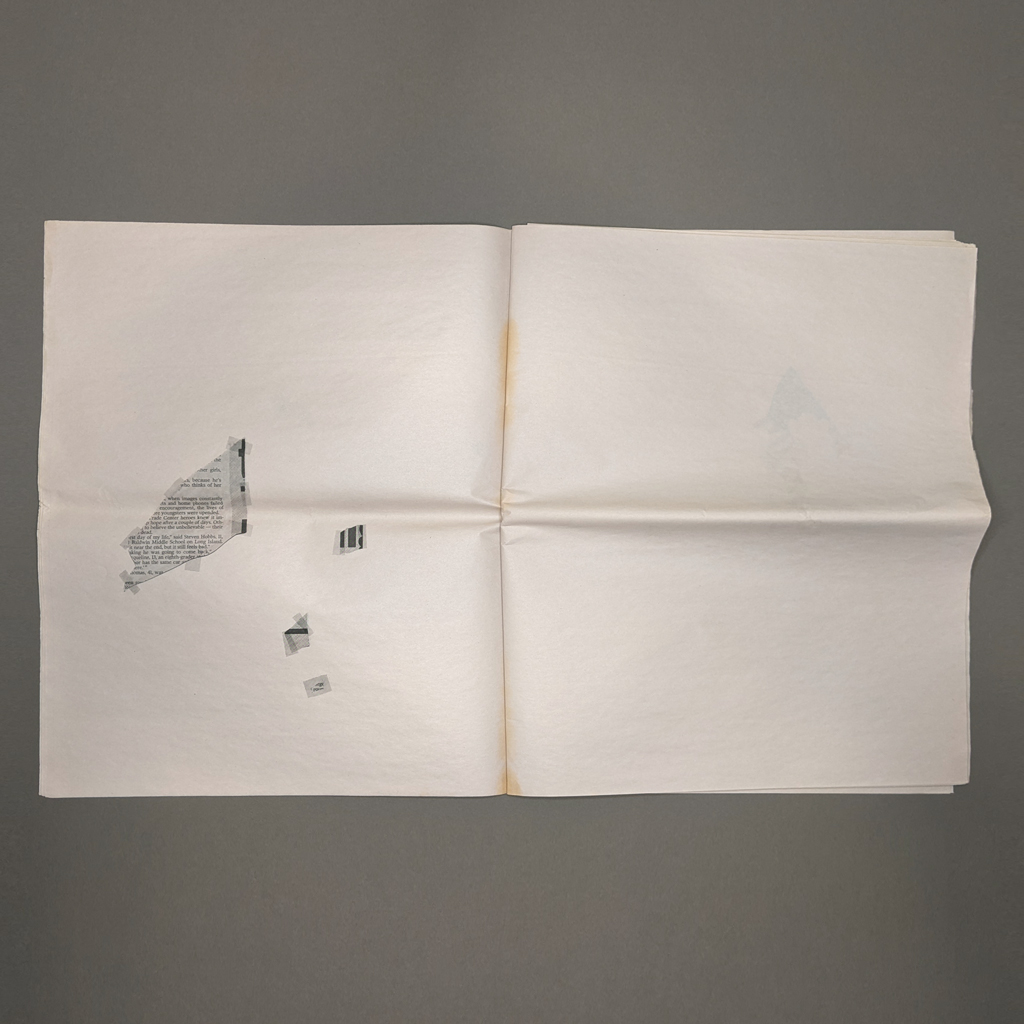
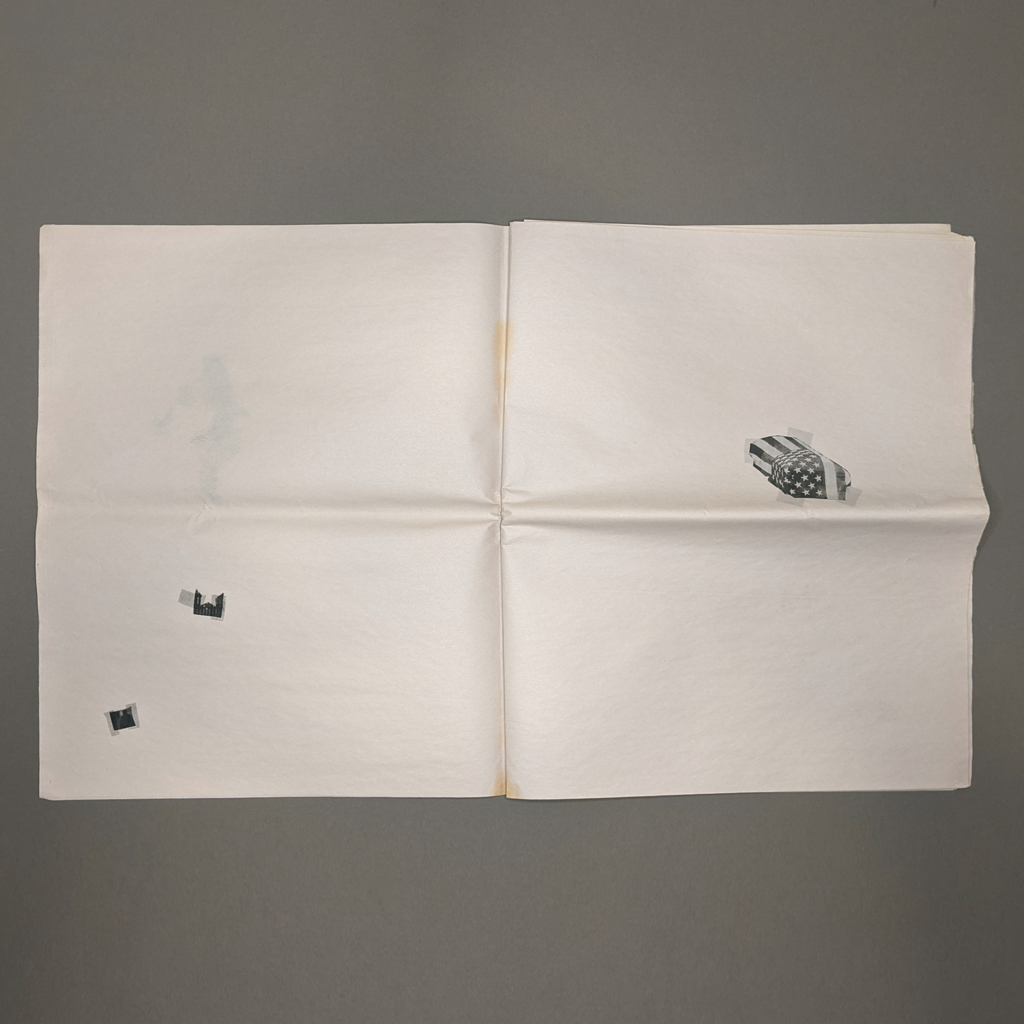
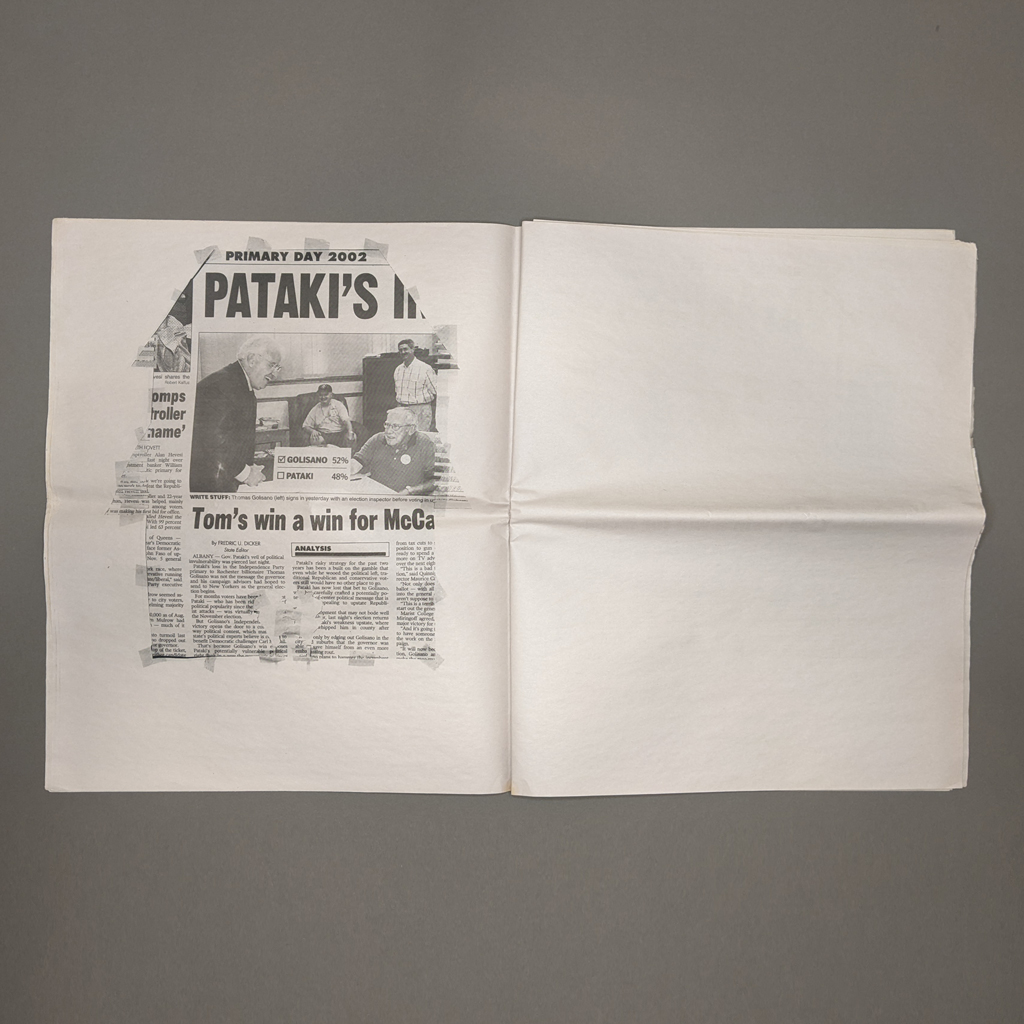
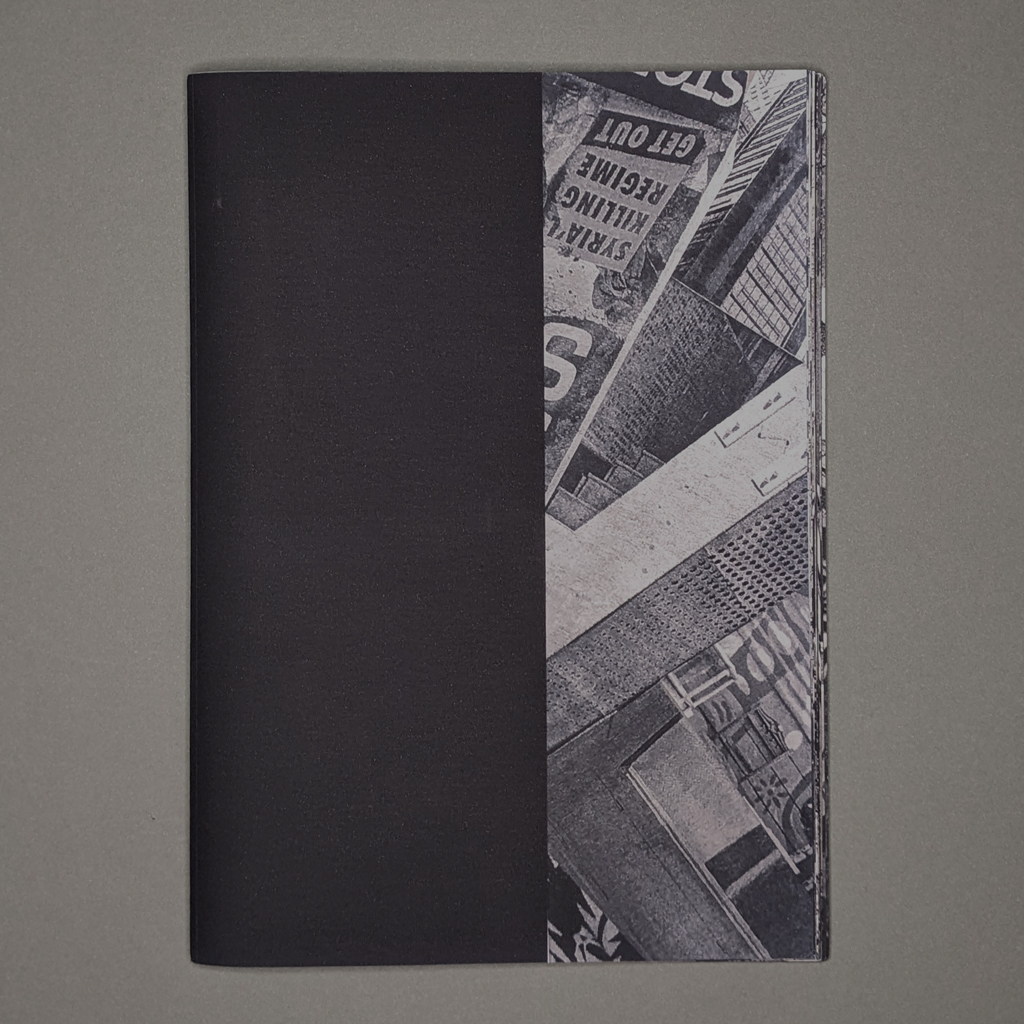
Unbound; one folded and gathered signature 6 × 8.25 in. closed 48 pages Ink jet Edition of 10
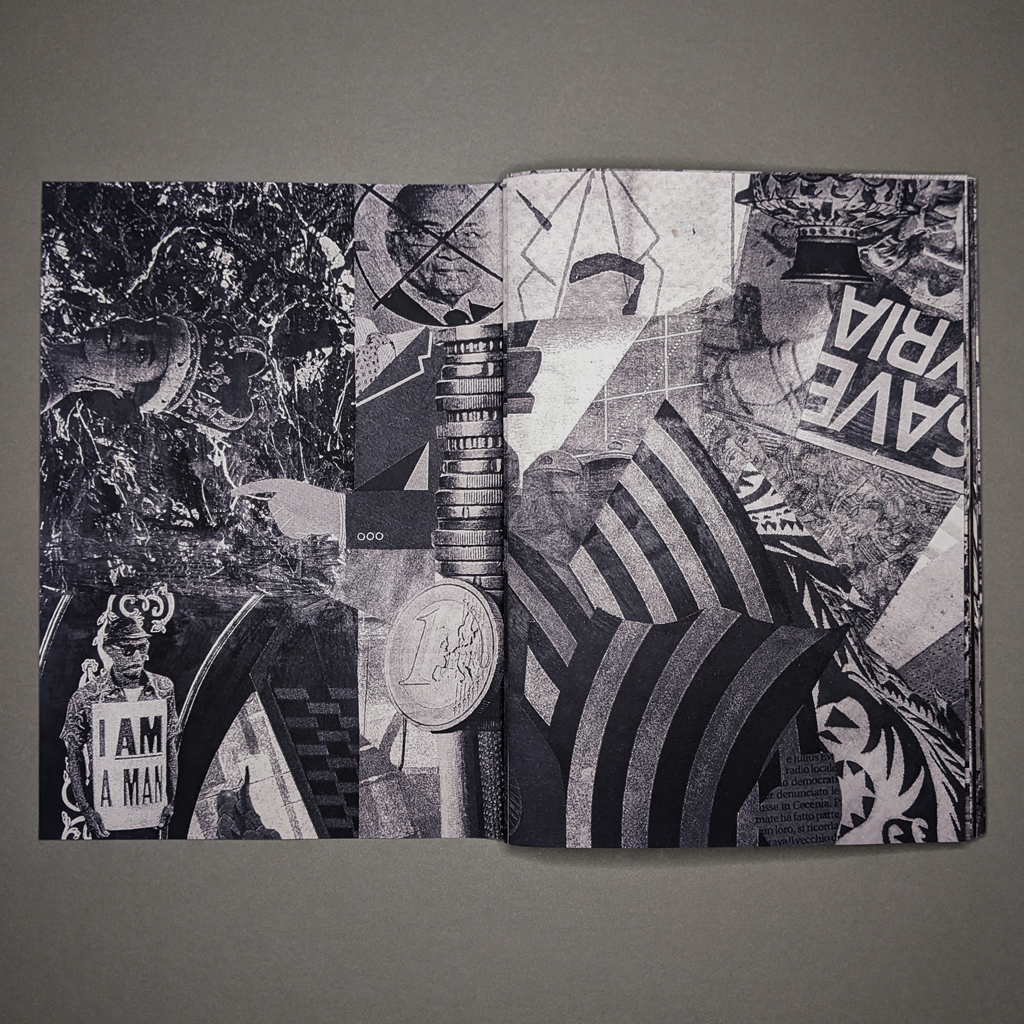
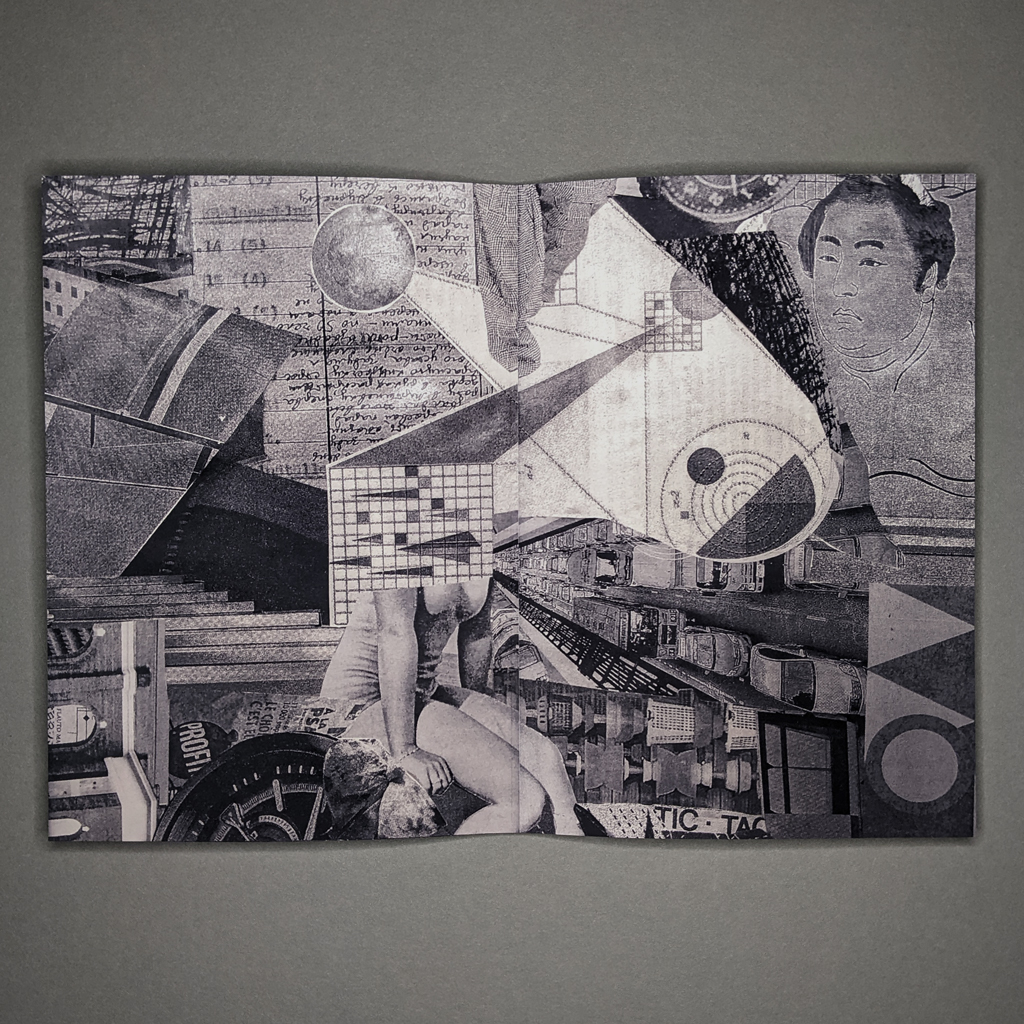
Angelo Ricciardi’s Senza Titolo (Untitled) is a busy book of fragmented collages, printed full-bleed in black and white. The whites are toned down to a light gray, lending the book the appearance of newsprint. And, like a newspaper, the book’s 48 pages are folded and gathered but left unbound. Ricciardi shares his longstanding interest in newspapers with many collage artists, and Senza Titolo recalls avant-garde movements of the early twentieth century: Cubism, Dada, and Futurism. The collages teem with images but also contain text, and it seems another of Ricciardi’s interests is the interaction of text and image. In Senza Titolo, text and image clash as often as they concur. Amid controlled chaos, the reader must make their own meaning.
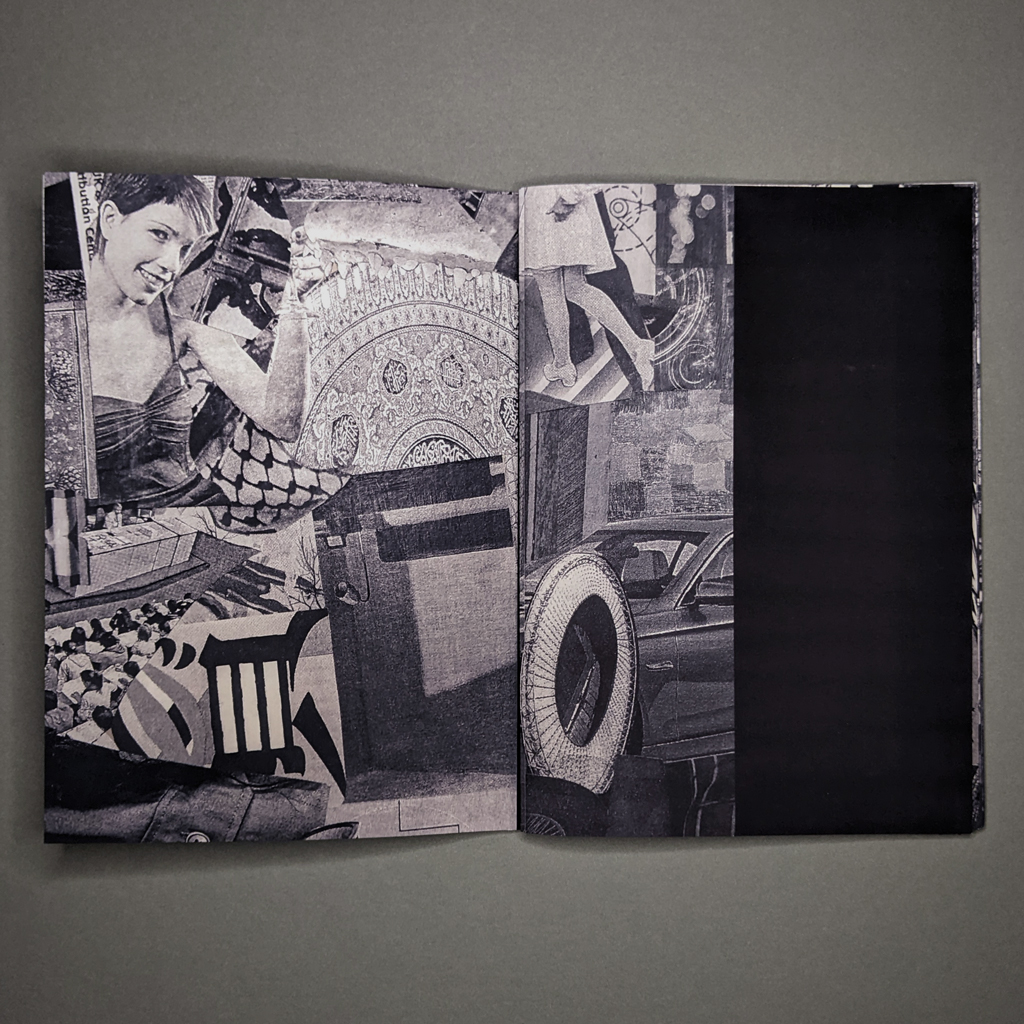
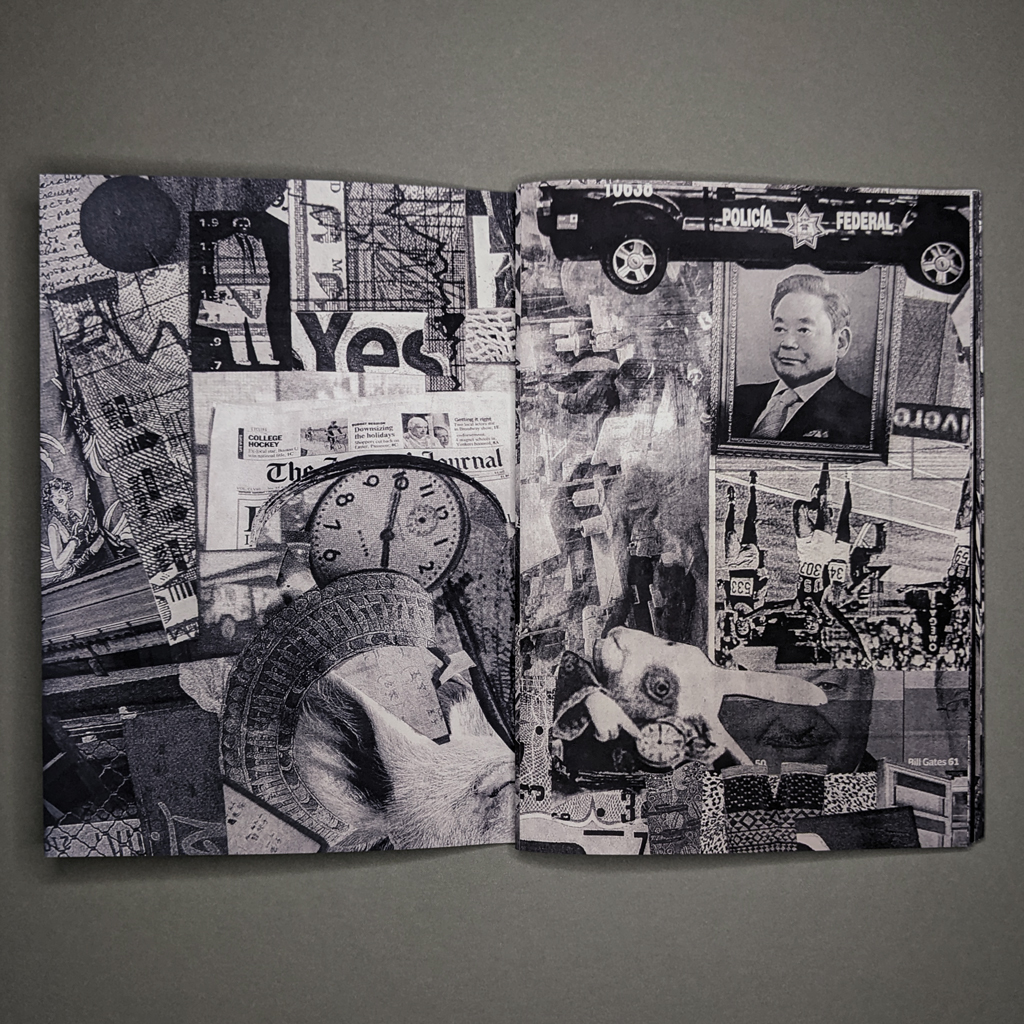
The imagery speaks to both tasks: controlling chaos and making meaning. There are police and protestors, old master artworks and cartoon characters. The grayscale rendering helps unify these incongruous images, itself a trade-off between information and order. Furthermore, the relatively low contrast — few bright whites and a full spectrum of grays — slows the reader down as they parse the boundaries of fragmented objects. Their values may be subtle, but the forms are expertly assembled; each page has a strong composition. Ricciardi guides the reader’s eye, and the mind hurries to catch up.
Composition also reveals the structural complexity of Senza Titolo. Each folded sheet has a complete college on each side, but these are only visible if the sheets are removed from the gathered signature. When gathered into a pamphlet, the verso and recto are from different collages. Despite the chaos, the pairings are not entirely random; Ricciardi uses visual devices to call across the gutter. Portraits of people are especially effective in this regard, but the echo of a geometric form is all it takes to connect the composition of the two-page spread. (If, in fact, the paired pages are random, it goes to show how naturally readers seek patterns and construct meaning.) In an unbound book — read as pages, spreads, and sheets — possible meanings multiply, and then multiply further as they accumulate in what is ultimately a time-based experience.
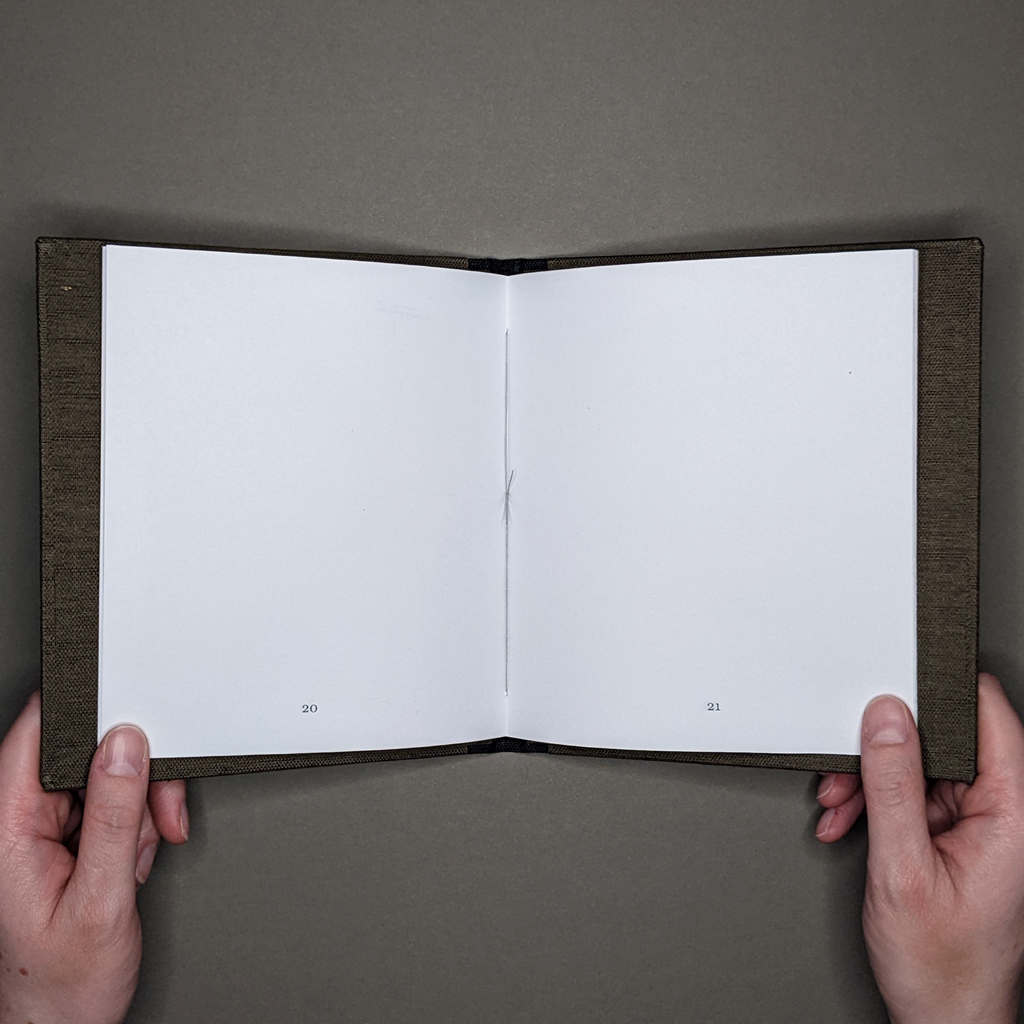
In some ways, composition and time are in conflict. The immersive, all-over design of each collage pulls the reader inward instead of propelling them to turn the page. Fortunately, this is balanced by the book’s game-like quality, which invites readers to recognize references and decode symbols. Ricciardi introduces a sense of rhythm and pacing by interspersing vertical bands of solid black, which cover half a page and split the book into several sections. Even without obvious themes or through lines, these sections break the book into manageable units for the reader and offer signposts in the absence of page numbers.
The passage — and stoppage — of time is not just a feature of the book’s reading experience but also its content. Clocks and watches appear throughout, and the mash-up of historical references and recent events is another form of temporal play. But while the source images span centuries, Ricciardi’s visual strategies are of a particular moment. There are elements of Dada, particularly Hannah Höch’s political commentary, which is in no way random or resigned. The fragmentation of space and perspective, of course echoes Cubism, which is credited with first incorporating newspaper into art. And there is an overall sense of a decadent present burdened by history, which features in Futurism. In other words, Senza Titolo seems like a work from the turn of the twentieth century. So why does it still succeed?
If the political stakes of collage, montage, and fragmentation have changed since Walter Benjamin theorized them in the 1920s, Ricciardi uses the structure of the book, as well as its content, to reach today’s reader. The unbound book makes tangible the battle between chaos and control: one must physically disorder the book by ungathering its pages to gain visual mastery of the complete compositions. Today’s reader may be less shocked by collage, but order and chaos are as salient now as a hundred years ago, and so is the related search for meaning and purpose. Senza Titolo’s absurd juxtapositions carry on a legacy of nonsense and relativism that stretches from Dada to postmodernism and beyond. And like these precedents, Ricciardi’s message is anything but meaningless.
Spiral-bound softcover 8.5 × 6.25 in. 66 pages Digital printing Edition of 500
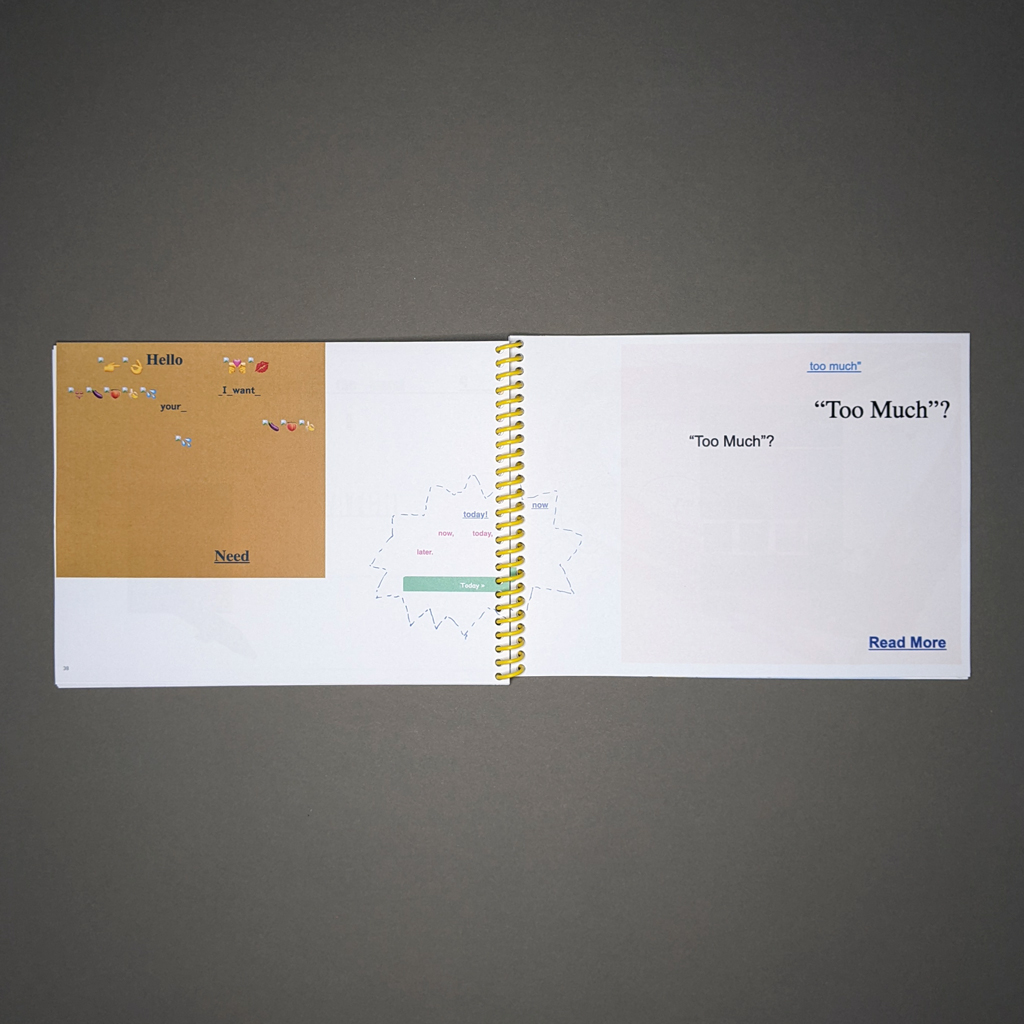
Poems Sneaking Through a Sieve combines poems from two series, one derived from spam emails and the other from CAPTCHAs, into a single, spiral-bound compendium. Riley Cavanaugh’s visual poetry and hand-drawn annotations are accompanied by a short foreword by the publishers, Lele Buonerba and Laurel Hauge, and a longer critical essay by art historian and curator Nina Wexelblatt. The book’s high-quality digital printing conveys the low quality of the source images and renders an aggressive gamut of colors from which our spam filters typically protect us. The spam filter is the most literal meaning of the titular sieve, but that symbolism carries through more broadly in Cavanaugh’s concern with attention, boundaries, and communication.
The book’s foreword gives a brief history of spam emails and CAPTCHA authentication before explaining Cavanaugh’s motivations and process. It helps attune the reader without spoiling or speaking for the poetry that follows. In contrast, it is good that Wexelblatt’s contribution comes after the poetry. I certainly enjoyed returning to the poetry after reading Wexelblatt’s essay, but I was glad I first had the opportunity to struggle on my own toward some of the same conclusions that she makes so convincingly. Likewise, the inclusion of a mind map by Cavanaugh, also after the poetry, succinctly lays out the connections between both poetry series and Cavanaugh’s artistic lines of inquiry. Readers without the unenviable task of following Wexelblatt’s essay with their own review will no doubt appreciate her analysis as well as the opportunity to peek inside Cavanaugh’s brain.
Understanding how Cavanaugh connects ideas is especially important since connectivity itself is a central theme — connections between people but also between distinct bodies of work like the spam poems and CAPTCHA poems. The spam poems, which are written by redacting real spam emails, retain the hyperbolic vocabulary that likely triggered the spam filter. Cavanaugh excavates the desperate language of desire that drives these emails. Transformed into poetry, the trademarks of low-budget marketing (attention, urgency, calls to action) are generically erotic, even if some of the original emails were not. If each distillation of urgent desire is somewhat repellant, their accumulated effect nevertheless appeals to the reader as the book progresses.
While the spam poems, with their direct address, are all about “you,” the CAPTCHA poems look inward. They reside in the pregnant pause where we question whether we are human, or at least where the seamless flow from one website to another is interrupted, and we are suddenly made aware of our own web-surfing. The earlier CAPTCHAs (distorted strings of letters) make their appearance throughout the book, but the CAPTCHA poems are based on Google’s now-ubiquitous photo CAPTCHAs, where a grid of images or a single image split into a grid asks the user to robotically identify a certain noun (e.g., “select all squares with traffic lights”). Cavanaugh responds to each CAPTCHA as if the challenge to prove one’s humanity calls for free association, word play, memory, and other acts of human creativity. Mostly, Cavanaugh adds text directly into the image grid, but they also respond with photographs of their own. For example, a CAPTCHA full of chimneys prompts a prose poem about a bird and then a photograph of two hooded crows.
Overall, the visual aesthetic is driven by the photo CAPTCHAs and spam emails. Whitespace predominates, signaling Cavanaugh’s redactions and lending a sense of movement to counteract the gridded frames of browser windows, photographs, and text fields. The space also leaves room for Cavanaugh’s playful interventions: emoji hearts float away from an email, lane lines extend a road from photograph to drawing, a fire hydrant casts a second shadow. Most importantly, the book’s negative space enacts the separation that is a precondition for Cavanaugh’s connections.
The careful attention to layout is enhanced by the book’s structure. The yellow plastic coil that binds the book is a conspicuous presence in the gutter, and even when elements cross that boundary, the spreads tend to feature two separate focal points in a dynamic relation with one another. The margins are less active than the gutter, and it is curiosity rather than any visual device that drives the reader to turn the page. The reader’s advance is evenly paced, and the book could be read rather quickly — except the whole point is to pay attention to text and imagery that is usually overlooked.
CAPTCHAs and spam are means to an end. We look and click through them on our way to a goal, whether our own or an advertiser’s. But in Poems Sneaking Through a Sieve, Cavanaugh looks at, instead of through, these communications and recovers a non-instrumental aesthetic pleasure. The book is an exercise in attention, whereas a spam filter only reduces distractions. Instead of speaking louder, it asks the reader to listen more carefully. Cavanaugh challenges binary assumptions about signal and noise, human and other, separate and connected. Between these binaries is the medium, the messy terrain where communication takes place. The sieve. The book.
As a sieve, the book also practices a certain resourcefulness, making art from the digital dustbin. Published just months before ChatGPT went mainstream, the book anticipates the need for artists to work in visual and textual economies flooded with AI-generated “content.” Cavanaugh’s prescient contribution affirms the mission of Have a Nice Day Press: to publish artists’ books informed by internet culture. It shows a deep understanding of media — print and digital, human and machine — and what happens when they collide. It also lives up to Cavanaugh’s interests in play, attention, and connection: Poems Sneaking Through a Sieve is accessible and engaging.
7 × 65 in. open Paper scroll in cardstock enclosure with leather strap Risograph Edition of 250
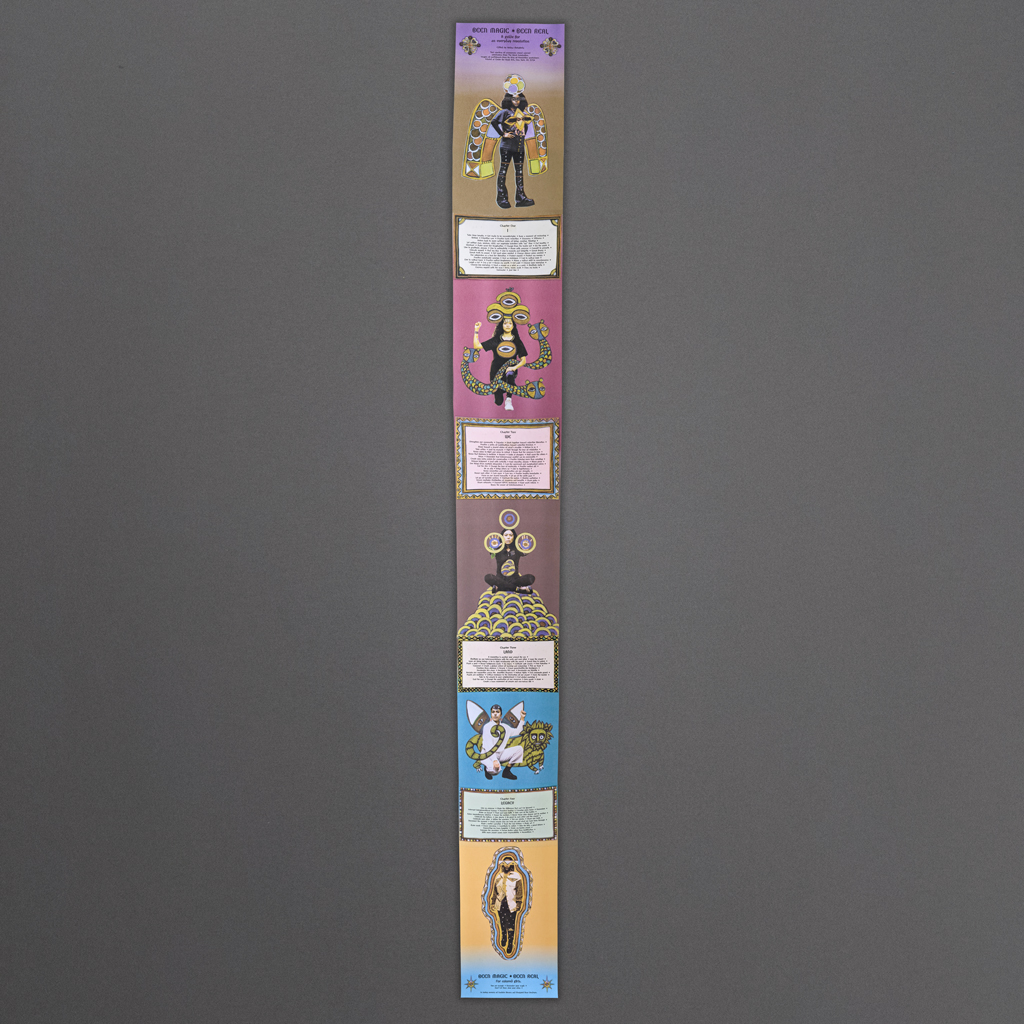
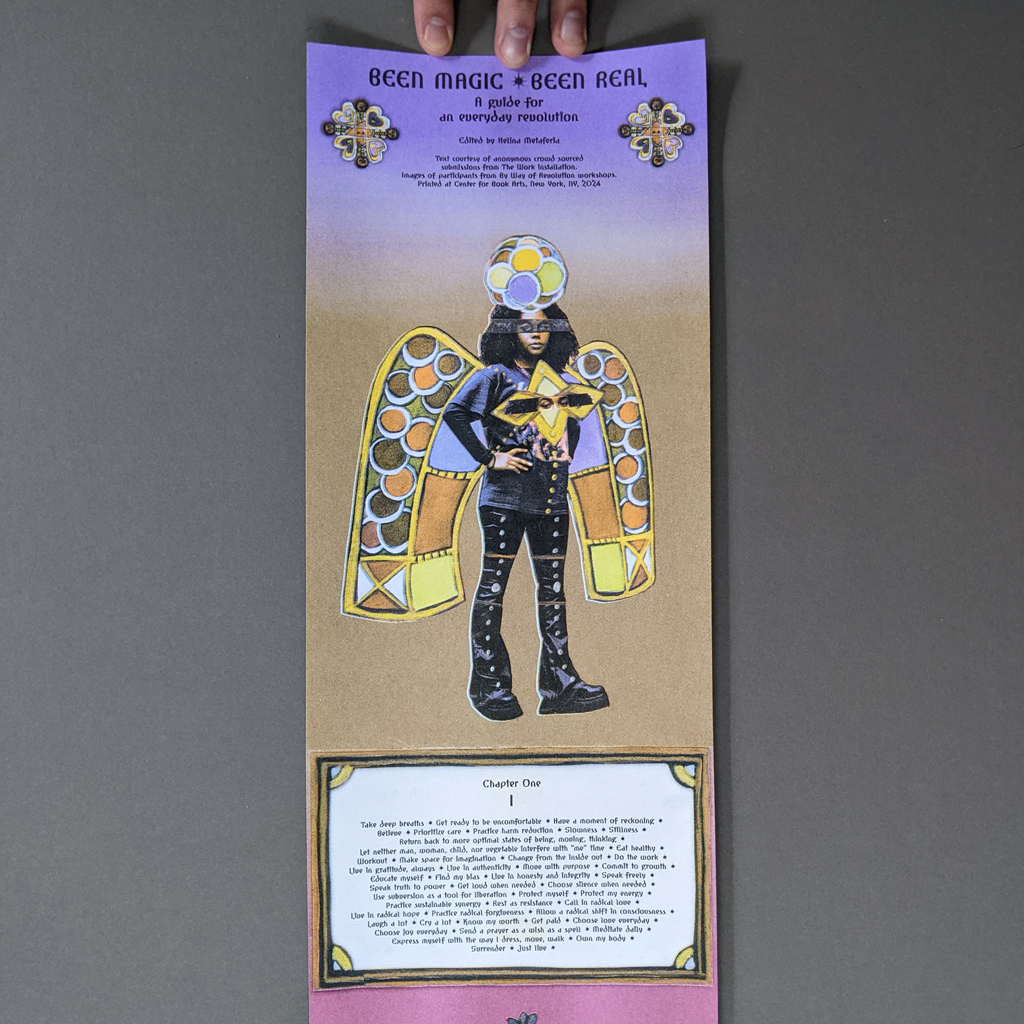
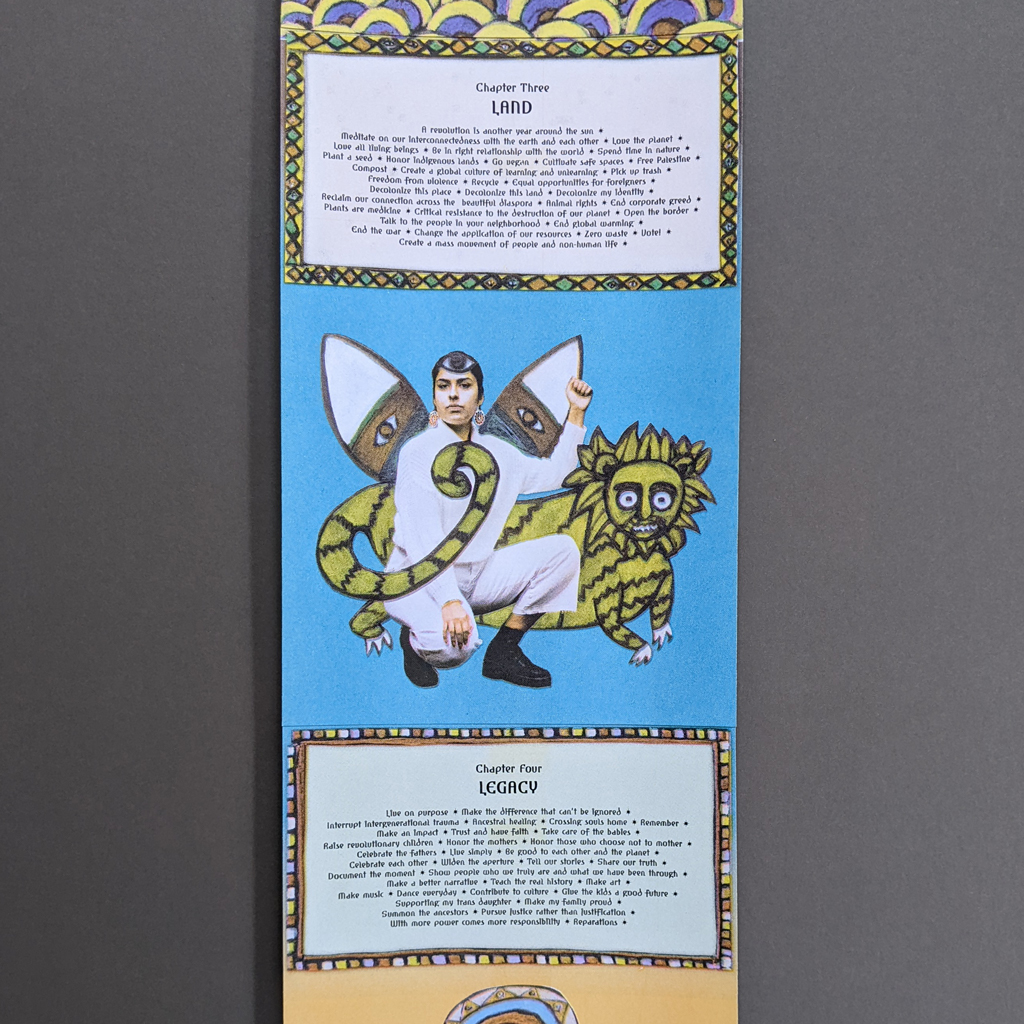
Been Magic * Been Real: A Guide for an Everyday Revolution is inspired by centuries-old Ethiopian healing scrolls. The 65-inch, vertical scroll combines text and image, the latter which cleverly updates traditional iconography through vibrant photo-collages. Drawing on African art and culture is central to Ethiopian-American artist Helina Metaferia’s practice, but Been Magic * Been Real is not about her; it is a record of collaboration and community. The text comes from Metaferia’s interactive installations and social practice projects, and the images are portraits of BIPOC women who participate in her workshop, The Meeting Place. If Been Magic * Been Real is “visual medicine,” it may be the process and not the final publication that has the power to heal.
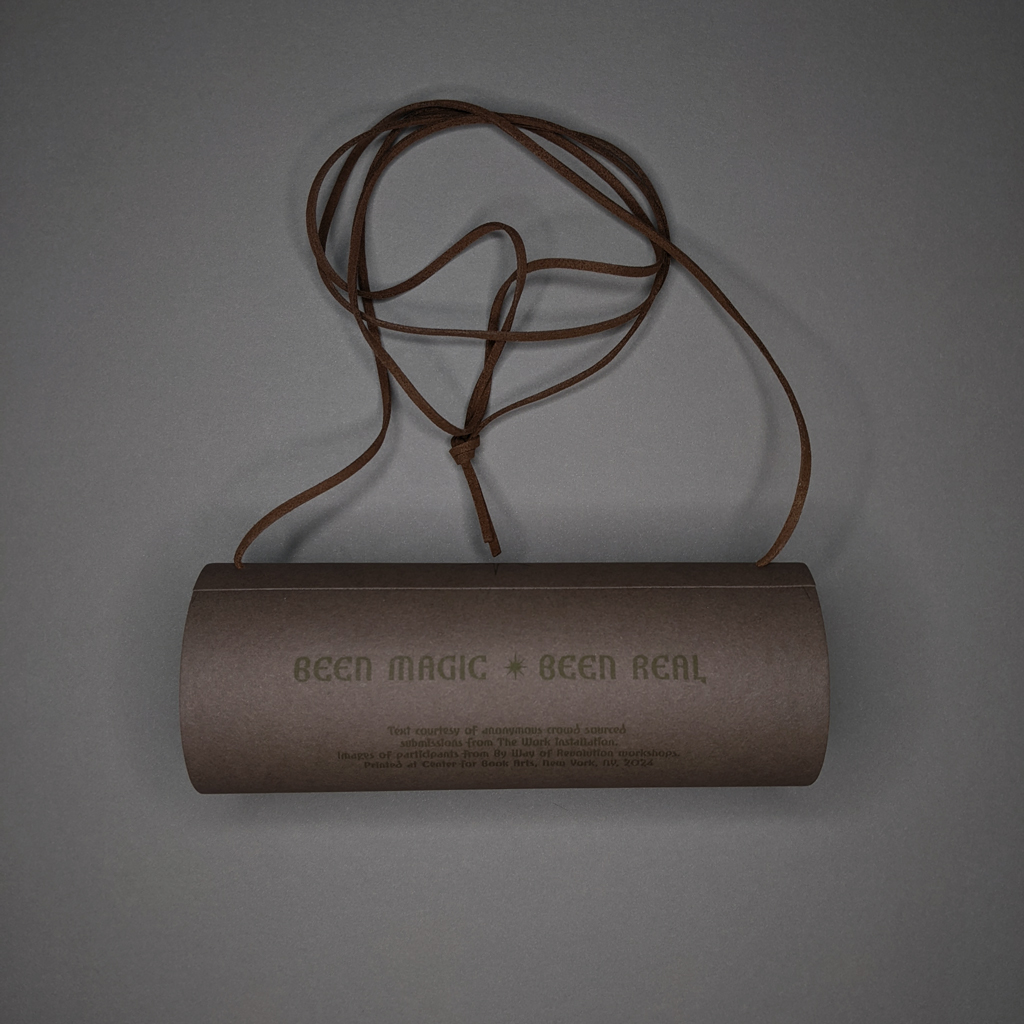
The scroll is enclosed in an open paper tube with a printed title and a leather cord. (Traditionally, healing scrolls were carried or worn on the body, and many that survive have a leather cord.) The scroll is easily removed from, and returned to, the tube, but readers who don’t plan to hang their scroll may want a rectangular box for long-term storage. At seven inches wide, the scroll itself can be managed on a lap or tabletop. It has four blocks of text divided by five images, and a reader can comfortably keep these pairs of text and image open together. To see the entire scroll at once, a reader needs a partner, a paperweight, or some way to display it on a wall.
Each block of text is a separate chapter — I, We, Land, and Legacy — and contains a litany of short phrases offered in response to the question “What is your everyday revolution?” These range from pithy sayings you might find on Instagram (activist slogans, self-help affirmations, and so on) to more individual expressions. The phrases are sequenced with an ear for rhythm and variety, giving the overall effect of a poem or a prayer rather than a word cloud at a team-building retreat. If the most meme-ready responses elicit a shrug or an eye roll, others contextualize, supplement, or even contradict these. The point is that each participant has their own revolutionary practices, and there is no one right way. This multiplicity is baked into the syntax of the first two chapters, where the titular pronoun can be appended to the beginning of each phrase: “I…prepare to be uncomfortable” or “we…work together toward collective liberation.” Instead of telling the reader what to do, the scroll offers dozens of examples that people already practice, some concrete and others more abstract.
Just as the text is stitched together from many sources, the imagery is digitally collaged. The iconography hews closely to traditional healing scrolls: eye motifs abound, and the boxes of text are framed by geometric patterns. However, instead of angels or saints, the portraits are of ordinary people posed like heroic, revolutionary figures. And, instead of a limited color palette, often only black and red, Metaferia’s scroll is Risograph printed in ten colors, enabling an aesthetic somewhere between vernacular religious posters and internet art. The images are detailed enough to be read alongside the text but retain a graphic quality that works well as wall art. Likewise, each chapter has a distinct color scheme and visual vocabulary, but they coalesce into an attractive overall design when the scroll is fully opened.
If I am projecting an internet art aesthetic onto the illustrations (and social media sloganeering onto the text), it is because the vertical scroll format now invokes the internet as much as any ancient tradition, and I think it is worth exploring, even stretching, these parallels. On one hand, social media is emblematic of the gaze that Metaferia seeks to counter: the heteropatriarchal male gaze, the colonial gaze, the glazed over, disengaged doomscrolling of the attention economy. Let’s call this the evil eye. The eye motif, which traditional talismanic scrolls use to return the gaze of the reader and banish the demon that has afflicted them, is found throughout Metaferia’s version. So, on the other hand, there is the reciprocal gaze, the healing power of being seen. Social media too often falls short of this, but it is the sort of mutual recognition that Metaferia’s workshops aim for, and which resounds in the book’s portraits.
To continue the comparison, just as traditional healing scrolls relied on ritual, Been Magic * Been Real is incomplete without its social context. It is an interesting artists’ book in its own right, but its power comes from the trust and hope that motivate Metaferia’s interlocutors. Even as the text’s direct address absorbs the reader in their individual experience, the portraits make present the contributors who collaborated on the text. This dialectic of I and we, of consciousness-raising and collective action, is just one of the tensions sustained throughout the book, showing the complexity of healing and revolution. Is it time for reflection or action? Do we act locally or globally? Do we listen or lead? Been Magic * Been Real doesn’t offer answers; it invites the reader to look, and it looks back. Its gaze affirms, encourages, and obligates the reader.
4.25 × 4.25 in. folded Single cut and folded sheet in a paper slipcase Ink jet inside with letterpress and screen printed slipcase Edition of 250
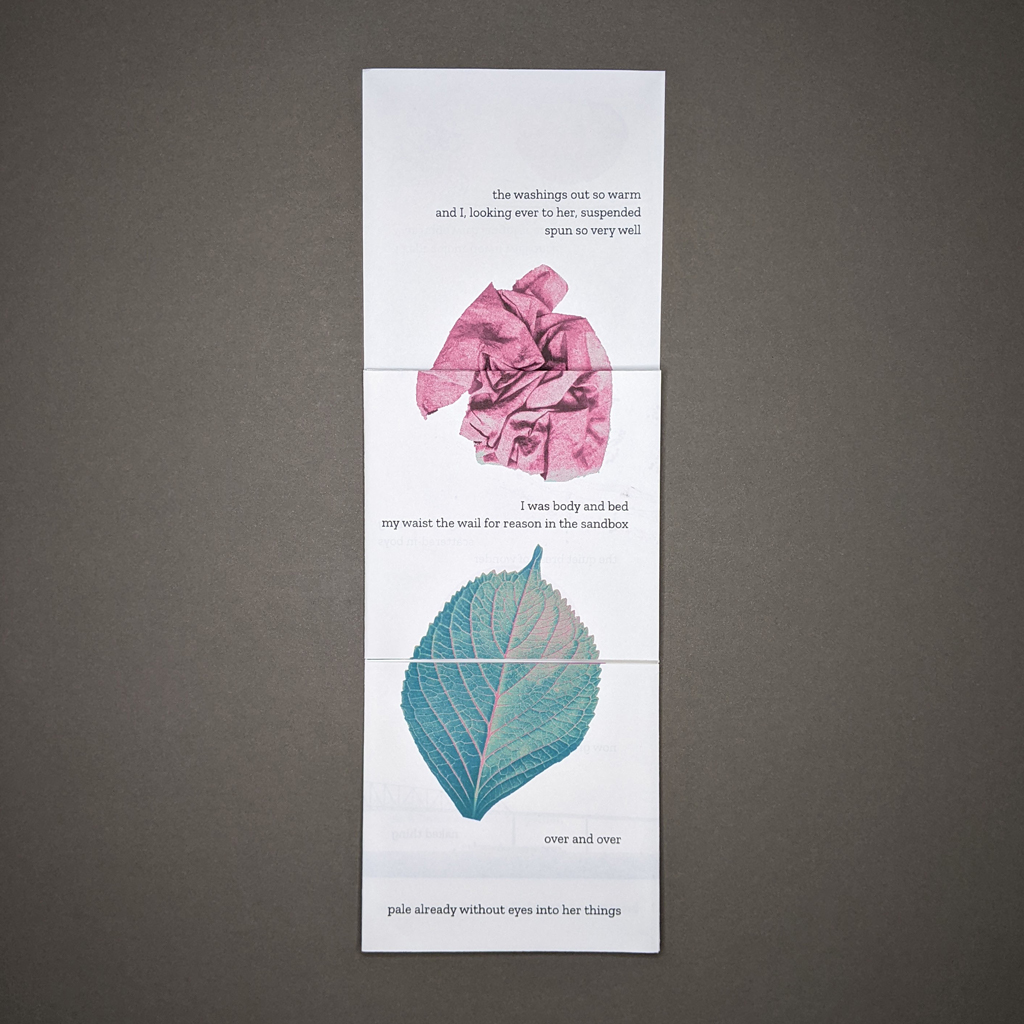
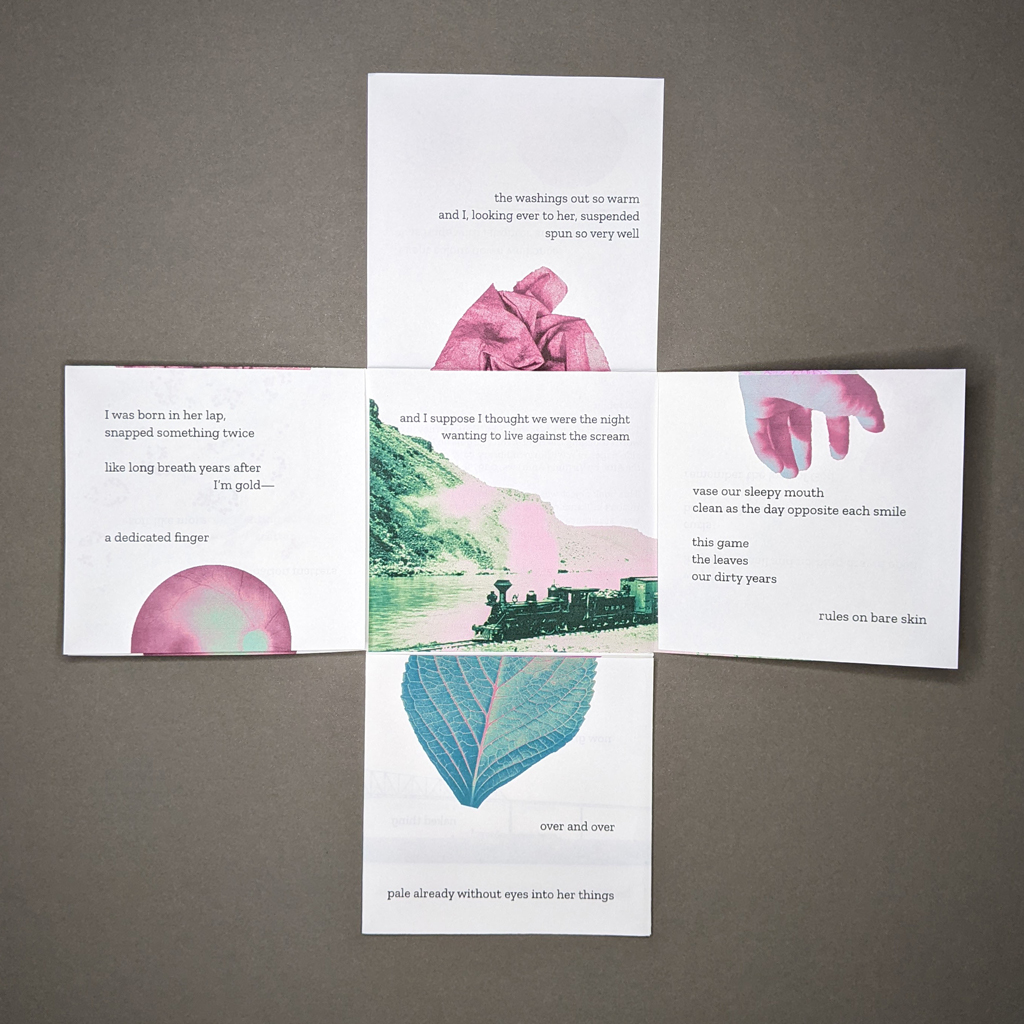
The Usual Arteries is a single illustrated poem on a single sheet of paper that nevertheless unfolds into a captivating reading experience that thoughtfully engages the book as a physical object and cultural touchstone. Dorney, both a poet and visual artist, draws the text exclusively from words set against the right-hand margins of a copy of Flowers in the Attic by V. C. Andrews, a controversial but wildly popular gothic novel first published in 1979. This interest in the physical space of the page extends to The Usual Arteries, whose eighteen square pages (the book is a two-sided, three-by-three grid with cuts that separate the pages but leave the sheet intact) allow the text to be read in more than one order. Without page numbers, the reader’s unfolding and refolding are guided by the book’s duotone illustrations, which are split across pages and can thus be matched up to form complete images. Because unfolding and refolding take concentration, and because the full poem is never visible all at once, the book would warrant repeated readings even without the multiple horizontal and vertical sequences permitted by its grid format.
Readers won’t need to have read Flowers in the Atticto enjoy The Usual Arteries. I haven’t read Flowers in the Attic, but a summary of the plot makes me think readers familiar with it will have a different experience with The Usual Arteries. (In fact, I’m glad I read The Usual Arteries a few times before investigating the source text.) The salacious story of incest, inheritance, and murder seems to stick with people. For her part, Dorney retains the original text’s first-person perspective and oblique references to a few characters, but these breadcrumbs in no way overdetermine the poem. If a certain darkness lingers beneath the surface, the credit must go to Dorney, not Andrews. The mood is fitting but not dependent on the original. Dorney alludes to past events without offering the clarity of narrative, unsettling but not upsetting the reader. Dorney has a knack for choosing words that are loaded but still open to recontextualization, and the way The Usual Arteries unfolds — sequential and combinatorial — allows for those changes in meaning no matter what background knowledge the reader brings with them.
The book’s photographic imagery adds another layer of open-ended associations, and while the text sometimes anticipates the imagery, the former is more than a caption, and the latter is more than an illustration. The images begin as single objects against the white background: a garment, a leaf, a flower. As the book progresses, larger images are collaged together, filling the page with lurid magenta-mint duotones that further the psychedelic effect of the content. Or perhaps the surrealist game exquisite corpse is a better comparison for the grid of interrupted images where a hand rises from a mountain amid the fragments of previous pages: the top of a garment, the bottom of a leaf. This interactive, ludic quality, where text-image relationships are activated by the reader, is central to The Usual Arteries’ achievement.
In this regard, the book’s production value is well matched to its form and content. The format maintains a connection between the artist’s process and the reader’s action, which is essentially unfolding the book back into a press sheet. This playful informality does not come at the expense of craftsmanship. The cut pages seem subtly tapered to fold without catching, and the book is easily retrieved from its simple but sturdy slipcase. Despite this manual labor, Illuminated Press has managed 250 copies and kept the price low enough (a sliding scale from $10–15) to compete with conventional chapbooks and zines, offering a model for accessible opuscula that might expand the readership of artists’ books.
The Usual Arteries is also a successful synthesis of Dorney’s visual and literary practices. Her erasure of Flowers in the Attic may be especially apt given the book’s themes of concealing, revealing, loss, and constraint, but it is not Dorney’s first; her previous books include a redacted treatment of Stephen King’s Pet Sematary and another taken from interviews with Shia LaBeouf. At the same time, The Usual Arteries draws on Dorney’s understanding of materiality and interactivity, which is more evident in her installation art and experimental videos. All erasure poetry blurs the line between reading and writing, but The Usual Arteries makes the reader especially aware of their role in co-producing the experience. As a multidisciplinary artist, Dorney is an accomplished bookmaker who also knows when a project is better suited to a different medium; she only makes books that need to be books. And The Usual Arteries, with its economy of text and image, fine-tuned pacing, and balance of simplicity and interactivity, also shows how much Dorney has learned from those other allied arts.
Tender to Empress is a collection of visual poems by poet, artist, and psychologist, Maureen Alsop. These digital collage-poems began as a gallery installation, but the book has its own dynamics, thoughtfully pairing pages into spreads and sequencing the poems toward something like a climax. Something like, because Alsop’s écriture féminine is not so linear or goal directed. It is better to say the book’s layers of meaning accumulate, amplifying and feeding back on one another as the reader progresses. If écriture féminine is meant to escape masculinist literary traditions, Alsop has chosen a challenging subject — Tender to Empress arose from a longer manuscript on warfare, from the crusades to the second world war. But the topic is hardly obvious, and there is rarely only one topic in Alsop’s poetry. Part of the pleasure of Tender to Empress is re-reading to see how meanings change through new juxtapositions and associations, a reading experience that is well supported by the book’s pacing, design, and mix of text and image. Returning and remaking meaning gives the reader a taste of Alsop’s process, in which words become visual art and even interactive objects, which then inspire new writing.
The book is separated into sections by numbered prose poems, which are conventionally typeset across a single spread without illustration. The visual poems that follow each of these spreads borrow fragments from that longer text or otherwise build off it. Each page is a self-contained collage-poem surrounded by a white margin, but the verso and recto visually relate to one another, often with coordinated colors. Likewise, each set of collages between the numbered prose poems seem to form a coherent movement with related colors and motifs. This coherence may simply result from the recursive repetition of themes as layers of meaning accumulate. Regardless, as the book progresses, the visual movements between numbered prose poems are shorter, quickening the overall pace.
The short texts flow from one page to the next and thus propel the reader more than the imagery. At that speed, the images offer impressions and set the tone more than they illustrate the text. Visual motifs repeat and sink in slowly, as if arising from the reader’s subconscious. Yet each collage is imaginative and well designed, warranting a closer look upon subsequent readings. Alsop also uses design tactics to slow the reader, like setting grids of vertical text or turning elements so the book must be rotated. However, even when the reader is challenged, the text remains readable.
If the reader returns to the collages, they will find that the text also merits repeated reading. Alsop’s poetry is perfectly polished at the sentence level, and some collages have only a single sentence or phrase. At the same time, the paragraphs are richly textured and unpredictable. The poetry’s refinement, and the depth and strangeness of its vocabulary, are at odds with its immediacy and momentum, but in a way that is surprising, not unconvincing. Plant species roll off Alsop’s tongue, conjuring specific geographic and cultural associations — or the exotic absence of such associations — as if they come up in daily conversation: pin-oak, glasswort, hyssop, alder. If, intellectually, the reader understands the steps Alsop must take between drafting the text, rendering it in collage, and editing it into a book, the overall effect is nevertheless spontaneous. Moments of introspection feel like real revelations.
If the topic, or topics, are never entirely clear, it is not because Alsop’s language is vague. It is, in fact, precise. Alsop is, however, interested in signification and encoding, in the erotics and ethics of communication and miscommunication. This doesn’t preclude the drive for self-understanding that is central to écriture féminine; in Tender to Empress, the self and the other cannot be disentangled. Interiors and exteriors, of people and environments alike, merge and interpenetrate.
Collage is the perfect medium for entanglement and shapeshifting; things are constantly becoming other things, or at least combining with them. These strange combinations contrast with the familiarity of their source images, a mix of eighteenth- and nineteenth-century art, scientific diagrams, and vernacular visual culture — familiar but rarely recognizable. Alsop’s collages belong to a lineage stretching from surrealism to net.art. They are unapologetically digital without being about software or the internet. Like the visual culture Alsop appropriates, the recognizable traces of digital tools speak to the limits of signification and communication. Familiarity helps the reader access the work, but it also comes freighted with history. Therefore, collage is Alsop’s medium in a second sense: it calls forth ghosts from the hall of battles, where her writing project began.
The weight of history, of war and trauma, seems to grow more explicit as the book progresses, although, again, this awareness may just result from accumulation. What first passes as metaphor becomes, slowly but insistently, history. After all, we are quick to use the language of war in other contexts, and Alsop, in turn, says a great deal about other topics. Or perhaps she says little but mediates effectively. Each reader brings their own ghosts, and Alsop trusts the reader a great deal. Which is not to say Tender to Empress is a blank screen for projection. On the contrary, Alsop provides a richly detailed, endlessly surprising environment in which to immerse oneself. This invitation to the reader doubles the achievement of Alsop’s écriture féminine on a prototypically masculine subject — she convincingly works toward a less alienated self and enables the reader to do the same.
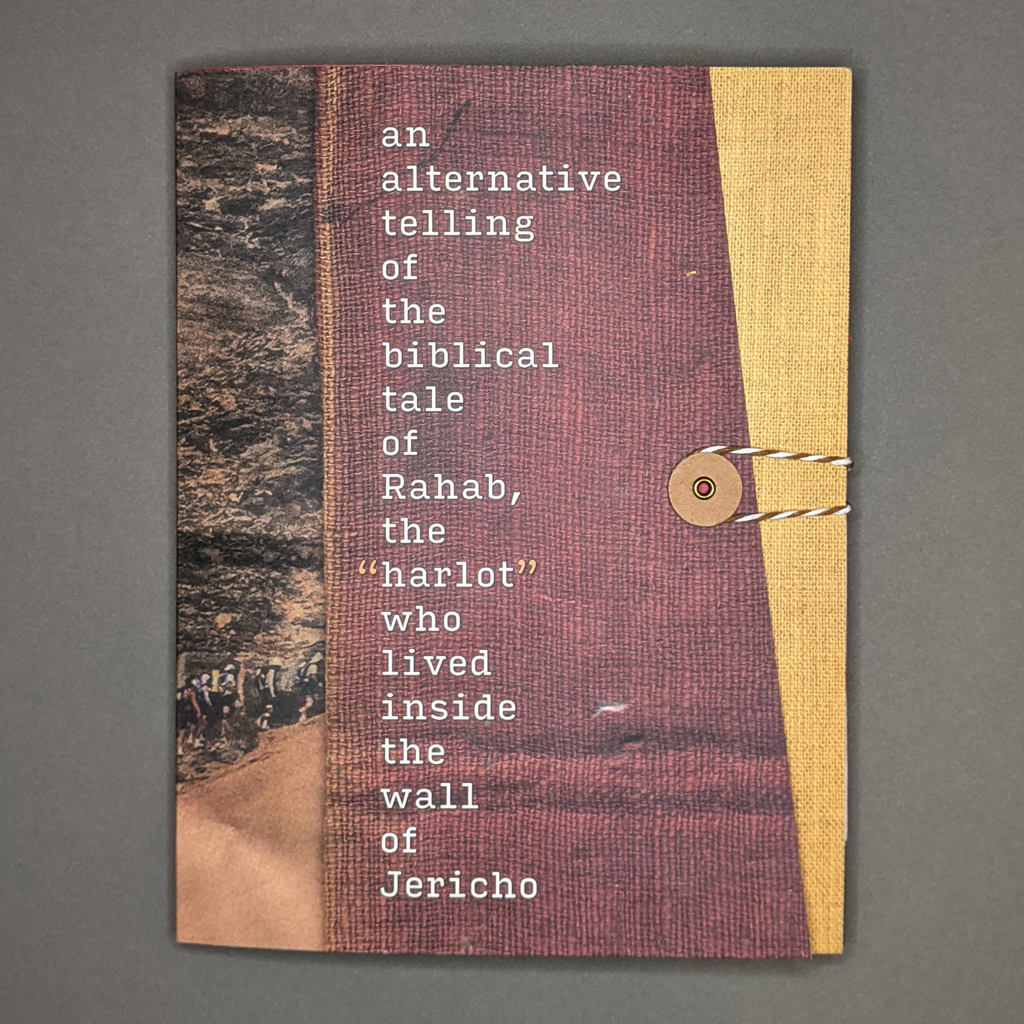
6.75 × 9 in. closed 50 pages Softcover dos-á-dos with wraparound cover and string and button enclosure HP Indigo
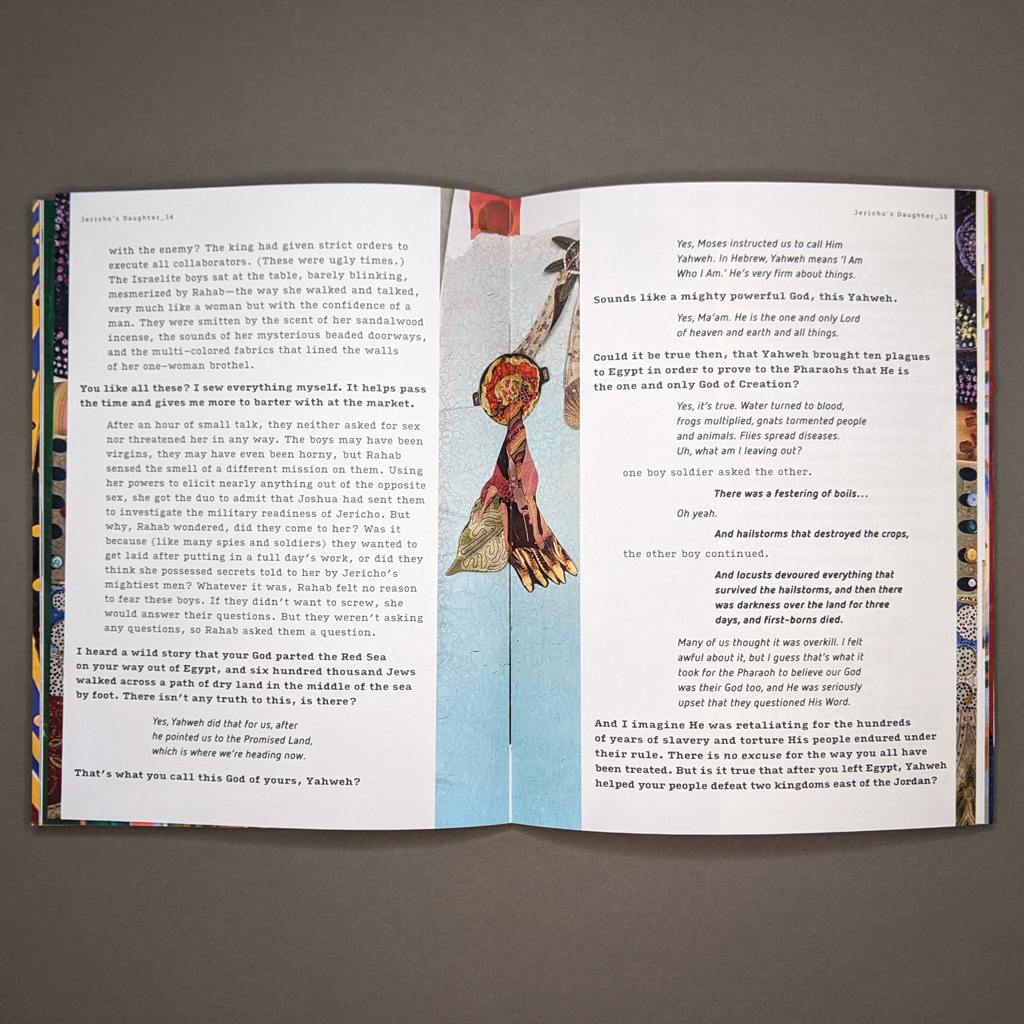
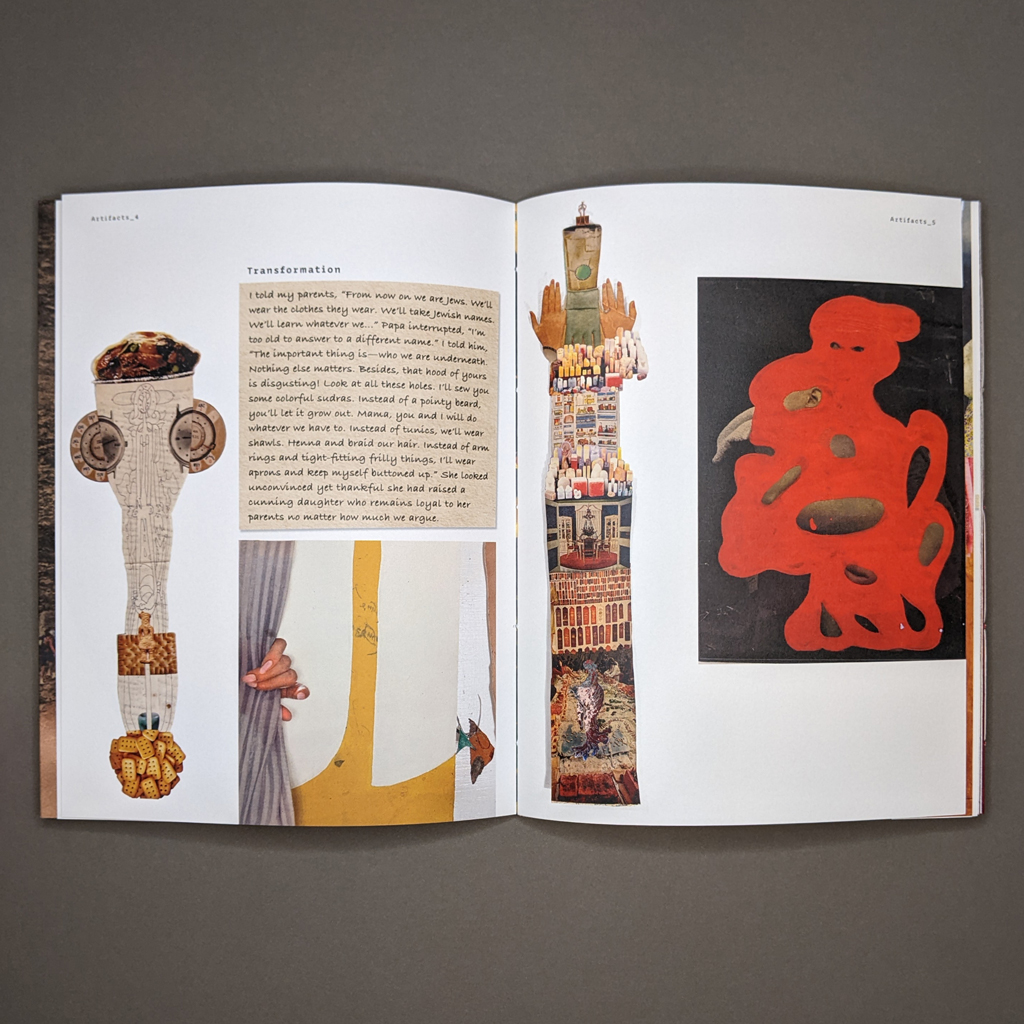
Jericho’s Daughter reimagines the biblical story of Jericho, this time told from the perspective of Rahab, the Canaanite prostitute who is spared by Joshua when the Israelites raze Jericho and who, having converted and married an Israelite, becomes an important Jewish matriarch. As a work of visual literature, Jericho’s Daughter epitomizes Warren Lehrer’s style, which is partly to say it generously accommodates the aesthetic of his collaborator, Sharon Horvath, whose mixed-media collages and assemblages contribute much of the book’s visual appeal. The book’s structure is a dos-á-dos, which compartmentalizes two storytelling strategies. The first side is a linear, narrative retelling of the usual story in a wry voice. The second side imagines what came next through “found” fragments: excerpts from Rahab’s diary (by Lehrer) and Horvath’s unclassifiable art (simultaneously image and object, figurative and abstract). Jericho’s Daughter is not a facsimile of Rahab’s diary, but with its string and button closure, the slim paperback feels more like reading a diary than a bible.
Though the book can be read in one sitting, the experience is surprisingly immersive. Instead of sequestering the publication’s technical details to a colophon or insert, Lehrer integrates the front matter into a filmic sequence of title pages that ease the reader into the visual environment. Furthering the immersive quality, the first side of the book slips seamlessly between narrative and dialogue without character names or even quotation marks. The book is not a script; it is a complete work of visual literature, and the reading is the performance. Each character is identified by typeface, the size and style of which also express qualities of their speech, but the typography is understated compared to other works by Lehrer, especially his visualizations of poetry.
The toned-down typography makes the book’s imagery even more vibrant. Fortunately, the high-quality HP Indigo printing conveys much of the texture in Horvath’s work, which mixes materials like sand and ash with paint and ceramic. The materiality of the images, which literally frame the written dialogue, brings to life the setting where much of the narrative plays out — Rahab’s home, which the narrator tells us is lined with colorful fabrics and permeated with incense. Or perhaps the setting is Rahab’s mind, where the vivid but fragmented imagery evokes memory.
Some of Horvath’s works are presented in full, but many pages are adorned with fragmented close-ups. Like the book itself then, the imagery is both archival (pieced together from fragments) and narrative. Horvath’s sculptural works, cut out and arrayed in the white space of the margins, look like archaeological finds in a museum case or catalogue. Her collages, though also assembled from separate objects, have a more integrated, narrative quality. In an interesting chiasmus, the continuous collages predominate in the book’s diary section, where the text is fragmentary and archival, whereas the individuated, archaeological objects are mostly in the book’s more linear, narrative section. Text and image reinforce one another through complementary strategies.
Lehrer’s handling of the narrator and protagonist also helps ease the reader into the narrative. With plainspoken prose in short sentences and plenty of dialogue, the voice recalls a children’s bible (Haggadah, etc.) even as the text offers frank descriptions of Rahab’s life as a sex worker. The narrator also blurs biblical time with the present day, as though the story could be contemporary. References to pants cuffs mingle with tunics and sudras, and “red alert” with candles and papyrus. The temporalities never completely collapse, but the book strains their separation.
The blurred time periods help Jericho’s Daughter operate allegorically. In Lehrer’s revision, the biblical matriarch is all too relatable. Rahab is inundated with misinformation and fearmongering by elites and disenfranchised from politics. Her dreams of running a textile business are put on hold while she scrapes by with dangerous, demeaning work. She is street-smart, but her horizons are limited. The two Israelite scouts she saves are even less worldly, boys not men, who might nevertheless fit in at the front lines of any armed conflict today.
If the narrative blurs biblical and contemporary time, the dos-á-dos book structure would seem to sharpen such divides. The conventional telling of Rahab’s story indeed follows a two-part structure: before and after conversion, before and after marriage. But the critical revision in Jericho’s Daughter is to refuse such binaries. The book separates the accepted biblical story (side one) from the speculative addition of Rahab’s diary (side two) only to attenuate the difference. In a motif repeated throughout the first side of the book, the narrative text is framed — or forced to the spread’s margins — by Horvath’s organic, ovular forms. Echoing the archived objects that accompany Rahab’s diary in the book’s second half, these forms act as portals or windows that connect the accepted narrative with the revision. The window, of course, plays a key role in the narrative (Rahab saves the Israelite scouts by letting them escape through her window) and is central to a feminist reading of Rahab as a redeemable character whose agency influences the story. It complicates a recurring biblical motif, the “woman in the window,” a liminal, transformational space where women connected to powerful men watch the world but hardly act in it.
As a feminist revision, Jericho’s Daughter goes even further. It is not enough for Rahab’s agency to catalyze her transformation from whore to mother. Rather, the binary itself must be deconstructed. Instead of symbolizing faithful conversion, Rahab’s diary reveals the ambivalence, grief, and trauma — as well as resilience and hope — that one might expect from someone whose entire community was annihilated and who survived by joining the perpetrators. The scenario is unimaginable, yet this revision is more plausible than the biblical version. Jericho’s Daughter therefore complicates the usual truth claims of narrative and archive by pitting the authority of the primary source (Rahab’s fictionalized diary) against the authority of the biblical text (perhaps no less fictional, and endlessly open to interpretation).
Rahab’s plight may be unimaginable, but it is still an effective allegory. After all, war is unimaginable, even if it continues to occur. Incidentally, Jericho’s Daughter was begun before the most recent bloodshed in Israel and Gaza. It deals with millennia-long metanarratives and cycles of violence. That Horvath’s artworks seem simultaneously contemporary and archaic speaks to the universal themes she and Lehrer address.
One of those universal themes, perhaps what resonated most with me, is the unknowability of our parents’ lives. Only Rahab’s diary betrays her true feelings. Outwardly she is the very picture of conversion, marriage, and motherhood. She masks and manipulates with the skills she honed as a “harlot.” But her children are faithful Jews whose offspring include the prophets Jeremiah and Ezekiel. How could they possibly understand what she went through? No child knows their parents as they were before parenthood, but the generational divide is especially poignant for Jews of Lehrer’s generation. Marianne Hirsch coined the term postmemory to describe the experience of the generation whose parents survived a cultural trauma, such as the Holocaust — an experience characterized by memory, but a memory of projection and imagination rather than recollection.
Just as no child can truly understand what their parents went through, no parent can fully protect their child from its effects. By revising the story of Joshua, Jericho’s Daughter offers a better understanding of intergenerational trauma. The surreal juxtapositions and glimpses of narrative that haunt Horvath’s visuals — and rupture the firewall between archive and narrative, memory and history — give lie to the tidy two-part narrative we have inherited. This improved model of trauma is badly needed in a world with so much conflict. Would there be fewer wars if the story of Jericho had been told from Rahab’s perspective instead of Joshua’s? Perhaps that is wishful thinking, but surely we can treat survivors and refugees and disenfranchised people everywhere with greater empathy.
8.5 × 5.5 in. closed 200 pages Perfect-bound softcover Digital printing
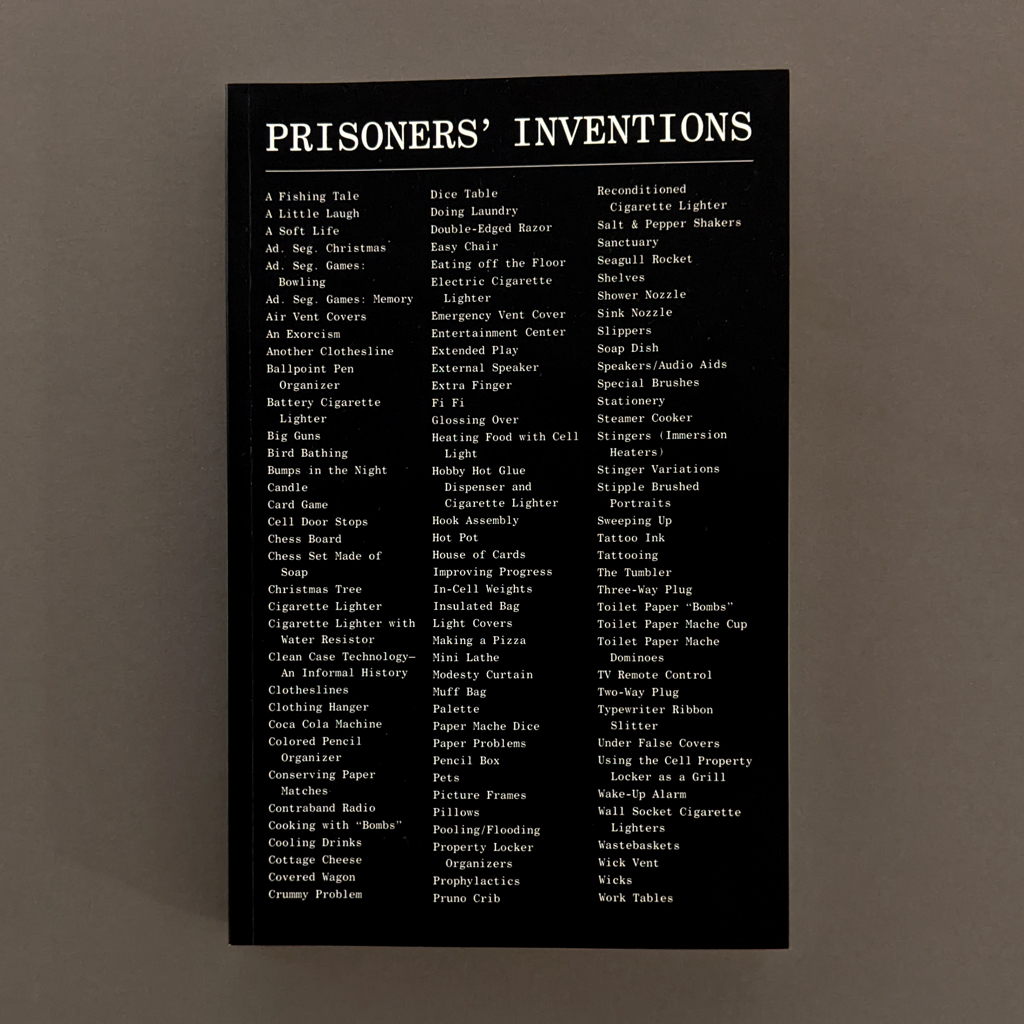
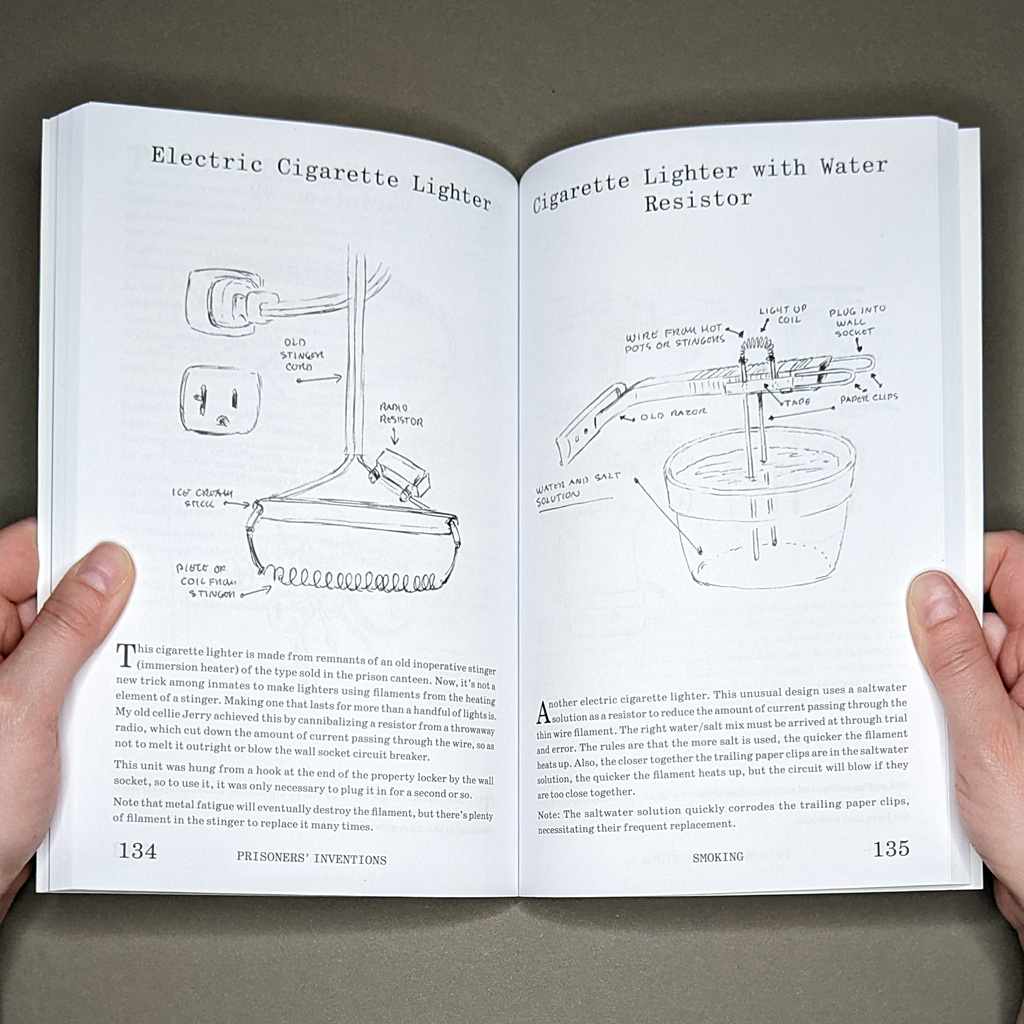
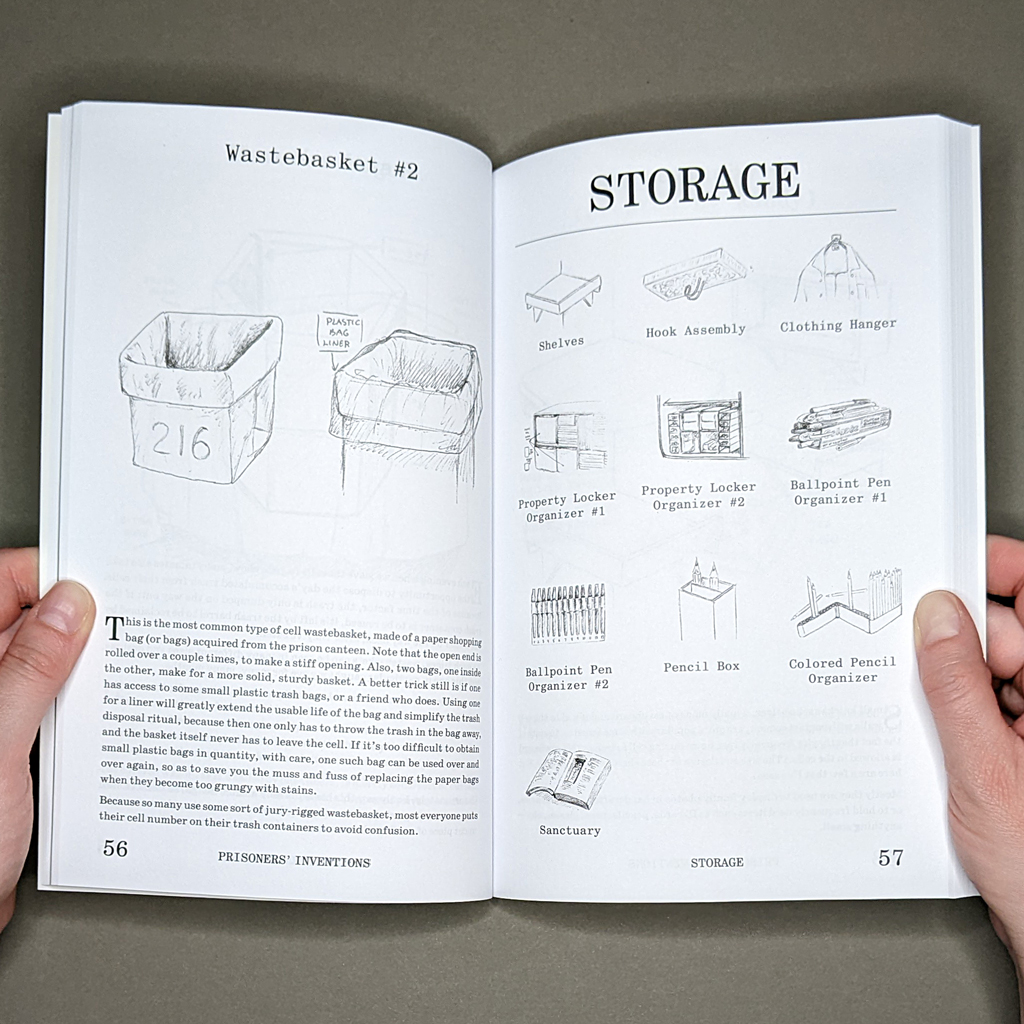
Prisoners’ Inventions is what the title suggests: a compendium of devices designed, built, and used by people incarcerated in US prisons. First published in 2003 with WhiteWalls, this 2020 edition is significantly expanded from its original 132 pages, and has just been reprinted (with minor edits) in 2024. The project’s full history is helpfully detailed in a foreword by Temporary Services. There is also an introduction by Temporary Services’ collaborator, Angelo, who was then incarcerated in California. It is Angelo who provides the prisoners’ inventions, which he renders in extraordinarily detailed ball point pen drawings and lively prose. Some of the texts are short and instructional, but more often Angelo pairs his drawings with a one- or two-page narrative. The inventions are categorized (storage, cooking, etc.) inside the book, but presented in a single alphabetized list on the front cover. With its uneven mix of prison slang, household objects, and familiar words made strange by their context, the cover effectively previews the reading experience.
Angelo is not only the author and illustrator but also the one who aggregates the inventions. Most are things he has used (and often things he has made), but a few have only been described to him by other inmates. In either case, Angelo emphasizes the way knowledge is shared among incarcerated individuals. He is quick to credit a cellmate who taught him a particular technique or namecheck an inmate whose handiwork was renowned. In other words, oral tradition and storytelling are at the heart of this paper book of printed text and image. Though less visible, written correspondence is also a constant presence. Indeed, one could argue the entire project is a work of mail art since the collaboration unfolded (without state permission) via post.
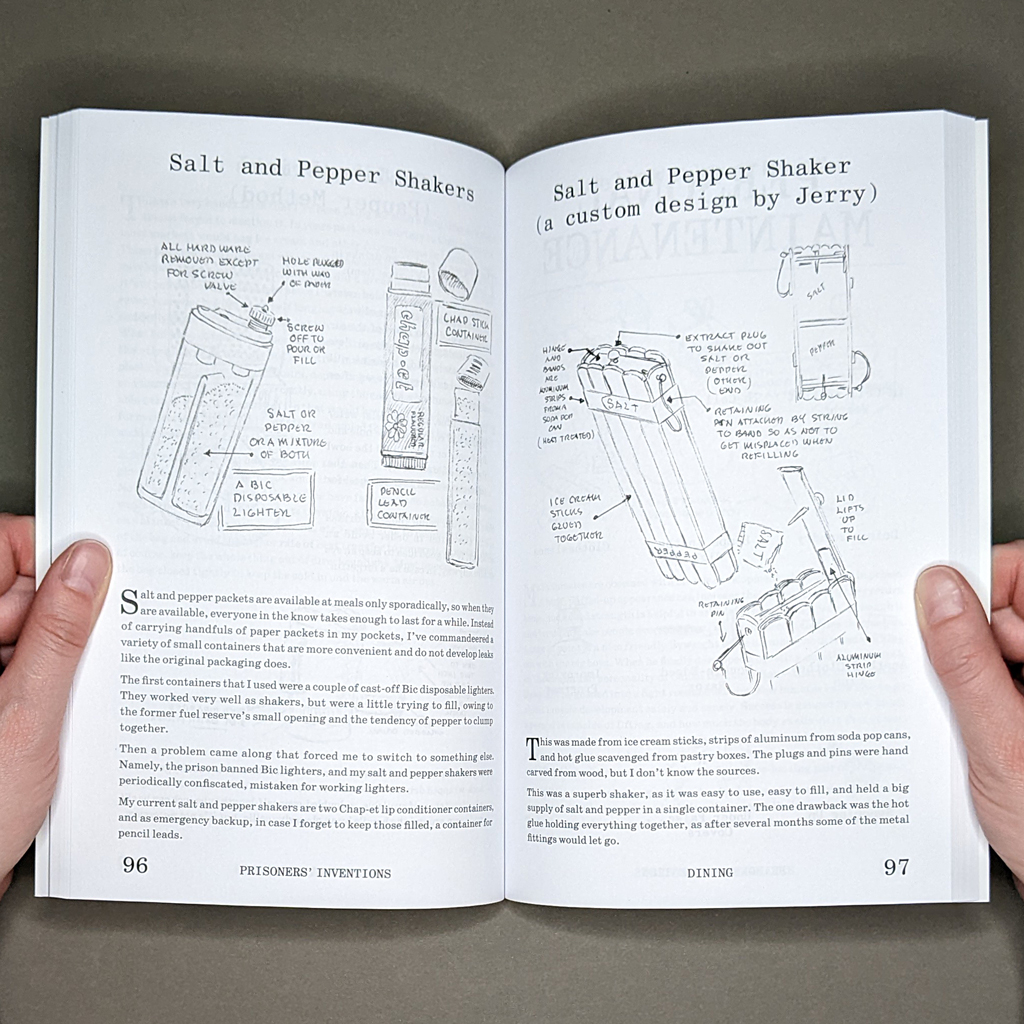
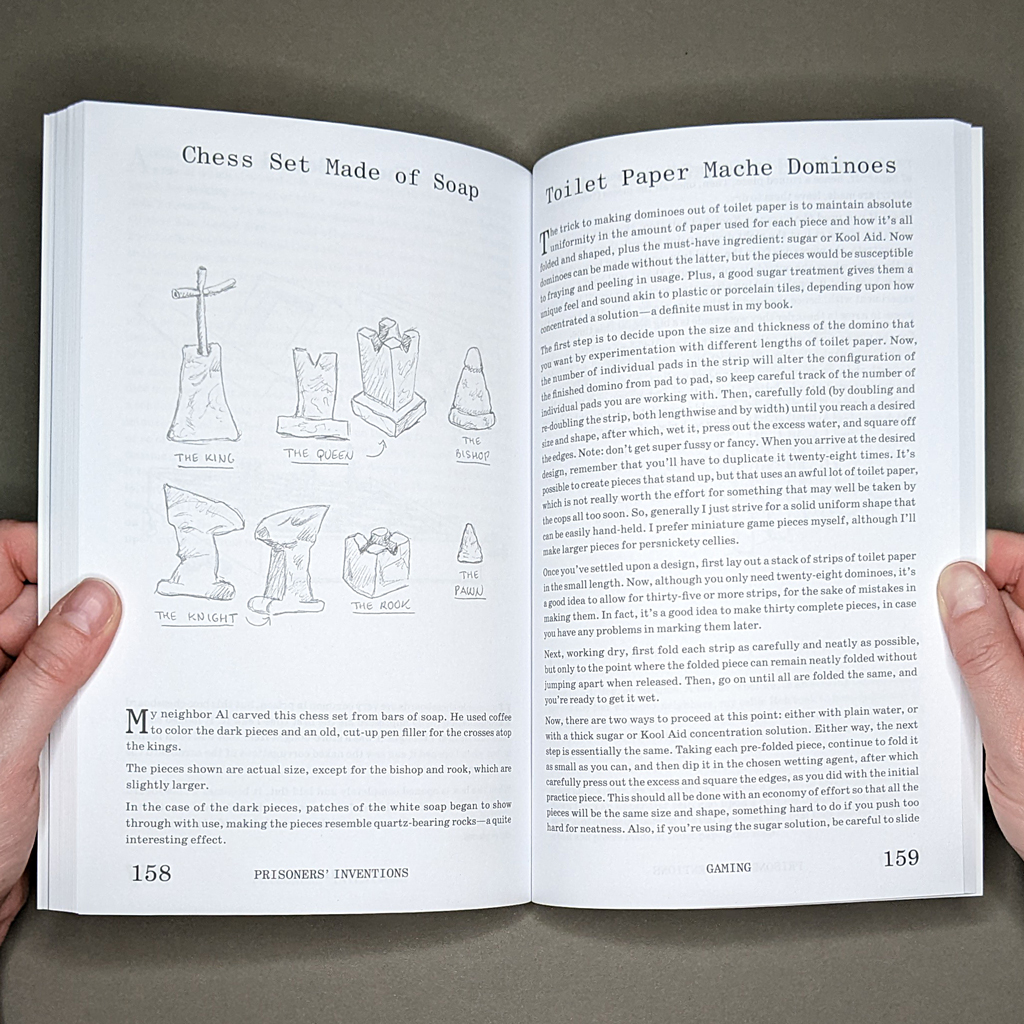
The mutual dependence of text and image, and the combination of straightforward instructions with personal anecdotes, reminded me of my conversation with Chantal Zakari about her own book with incarcerated collaborators, Pictures From the Outside. No matter how evocative, each medium is ultimately inadequate on its own. Even if Angelo’s drawings can explain how an invention might be used, they cannot capture its lore. In fact, what the drawings can and can’t convey drives the reader’s experience (at least the reader who has limited first-hand experience with such inventions). On the one hand, ball point pen enables Angelo’s meticulous detail, which gives a sense of scale, mechanics, and ergonomics. On the other, the medium gives little sense of material or texture. The result is that the outlines of something might look familiar, only to have its textual description wrench away its relatability. What looks like plastic or metal may be toilet-paper-mache or carved soap.
The tactile experience of such materials will be foreign to many readers, although Angelo admirably describes, for example, the sticky process of working Kool-Aid and toilet paper into a set of dominoes as well as the satisfying clack of the finished pieces. Angelo gives a sense of the time it takes to make things by hand, to painstakingly stockpile materials (and hope they aren’t confiscated), to plan, prototype, and produce. Incarcerated for a quarter century, Angelo presents this sense of time with stubborn equanimity. An inmate creates something, a guard confiscates it, and so the cycle continues. For the reader, though, the inventions — and their fabrication — remain almost incomprehensible, situated as the reader is outside the flow of carceral time, the deprivations of prison, and the whims of corrections officers.
Whether an invention is introduced with a humorous anecdote or an explanation of the hardship that motivated its creation, Angelo’s testimony is moving. But the book is more than a series of vignettes; its structure and presentation contribute to the message. Perhaps the most overt editorial interventions are the categories: home furnishings; storage; cooking; dining; personal maintenance; bathing; smoking; recreation; gaming; arts & crafts; little extras. The categories sound disarmingly domestic, as if taken from a catalogue or lifestyle magazine. They also speak to basic human needs. The gulf between the inside and the outside is made all the more poignant by this shared vocabulary. Unsurprisingly, the inventions fit uneasily into such familiar categories, and that illustrates another of the book’s major themes: the tension between order and chaos. Even the most anodyne invention, including one meant to maintain order — a clothes hanger or pencil organizer — is considered contraband in prison. However, where prison guards struggle to control these inventions, the book logs them in a table of contents, neatly typologized.
This is not to say that the book arrests the inventions’ unruly creativity. For one thing, the reader can use the book as an instruction manual (Temporary Services did just that for the 2003–2004 exhibition Fantastic! at MASS MoCA). Not every reader will make their own dumbbells or cottage cheese, but Prisoners’ Inventions is an instructional manual in another sense: it shows us how to see the small acts of creativity all around us. (In this regard, Prisoners’ Inventions fits perfectly alongside Temporary Service’s Public Phenomena series and Marc Fischer’s Public Collectors series.) In his introduction, Angelo says that, at first, he didn’t think there would be anything interesting to depict. The subsequent outpouring shows what a change in perspective can achieve.
Some of the book’s details, and certainly the characters, situate Prisoners’ Inventions in a particular place and time. As a celebration of innovation, though, it speaks to something more universal. The deeply human urge to solve problems and express oneself accounts for much of the book’s continued relevance, but two decades after its first publishing, we must also acknowledge how little has changed regarding mass incarceration. As I read, I kept wondering what these men — Angelo, Billy, Victor, Randy, Ron, and Little John — might invent in a different system.
136 pages 5.875 × 8.25 in. closed Offset printing Edition of 500
For Pictures From the Outside, Chantal Zakari asked her incarcerated adult students if there was a significant place they would like to see photographed, and then attempted to make the photographs they requested. The premise seems simple, but the vicissitudes of memory and the logistics of teaching a class in a prison conspire with the slippage between words and pictures to challenge the artist. The resulting book is complex and defies categorization. Its procedural approach, relinquishing of authorship, and play between text, image, and imagination echo Conceptual art. It makes visible the material and practical constraints of the prison system in nuanced ways akin to Institutional Critique. And its exploration of social relations and interpersonal communication resonate with various forms of social practice. However, these categories of contemporary art don’t fully convey the content created by the thirteen incarcerated contributors, whose reference points are further from the art world. Nor do they capture the combined effect of Zakari’s finished photographs, her written reflections on the process, the students’ writing (from plainspoken memoir to fantastic allegory), and documentation of the process, including hand-drawn maps and diagrams instructing Zakari’s photography and laser prints annotated with art direction.
Given all this, Pictures From the Outside is not a quick read, although it can be read in a single sitting. The weight of the subject matter is matched by the heft of the book, whose 136 pages are supported by thick binder’s board covers (uncovered but with printing and in-lay) and an exposed but durable smyth-sewn binding. Physically, its dimensions and relatively thick coated paper make the reader feel comfortable handling the book, including its two gatefold spreads that open to a panoramic 23.5 inches. Visually, unobtrusive page numbers and other thoughtful design elements help the reader navigate among the thirteen contributors without disrupting the unified statement of the book. In other words, Pictures From the Outside is a successful synthesis of form, content, and structure.
Indeed, the project exemplifies the book as medium in more than one sense. Yes, the book offers a moving, thought-provoking, and informative reading experience. But as Zakari explained in our interview, the reader of the finished book is a secondary audience. First, the book was created as a medium of exchange among Zakari and her students. In documenting its own creation, Pictures From the Outside records complex negotiations between people, between media, between times — between inside and outside.
Instead of saying more, I will let the interview below show why I think Pictures From the Outside is an excellent and important artists’ book.
[Chantal Zakari and I spoke via Zoom in November 2023. The transcript below has been edited for length and clarity.]
Levi Sherman: Was the project conceived as a book or did it evolve that way?
Chantal Zakari: Yes. I consider myself a book artist. I have a little bit of a problem with the term, I have to say — and I hate to start with the negative, but when people think of book arts, they think of handmade books. Whereas I’m always thinking of offset-printed multiples in editions of 500–1,000. That’s partially because I was trained as a designer, and offset is really what excites me. If I have an exhibit, it is usually a translation of the book. I love redesigning and re-organizing the same material in a three dimensional space.
I’m primarily interested in combining text and image and often the text is not me speaking. I either collaborate or interview. It’s not always a full collaboration. But, as you know, when you interview there can be collaborative editing, trying to get the text right requires some back and forth. I am mostly interested in making connections with people, often with subcultures.
LS: When did all this content start to cohere for you? When did you get the sense it would be successful?
CZ: I don’t know how to measure its success yet. I don’t have enough distance from it. What I could say is that it’s an honest book. I tried to stay close to my collaborators’ requests. I made the photos, brought them back to prison so that the students could make choices.
In fact, the reason why I started thinking about this project was because I wanted to talk about photography, and editing, as part of a class project. But the limitation of teaching inside is that students have no access to photography equipment. So, I decided that I would be the one to make the photos for them, and they could be my art directors and edit the images I bring back. It started as an excuse to teach about photography and text/image relationships.
LS: The role of art director raises questions about authorship and control.
CZ: Yes, from the development of concept, to the design of the book, authorship and control keeps shifting in this project. It originated with my idea, but then, their requests, their diagrams, my interpretation of their diagrams into photographs, their editing and comments, to finally, my design of the book. The book’s design is one hundred percent me, because by the time we had the content finalized, it was pretty much the end of the semester, and I couldn’t see them any more.
Except for one student who got out while I was designing. I was able to interview him in person outside the prison, as a free man, and we were able to have a more casual discussion. He saw the book while in progress and was able to give me feedback on the design.
Authorship in this project is layered. I’m not just the designer; I’m also participating, my voice is part of the book. My collaborators were editing the photos, but then there are some photos that are purely my creation. As I was photographing the requests, I also discovered other things I wanted to photograph. I included them in the book because they provide a greater context, for example the photo of the restaurant patio, or the bulletin board near the masjid… But as a designer, I was really interested in the connection between the diagrams, the photographs and the writings, and the overall sequencing of those three elements. The concept starts with the diagram which is a different way of thinking about space and a different way of reorganizing your memory of that space.
LS: You as the artist have the generative constraint of making a good photograph based on art direction from people who maybe haven’t seen the place in a long time. But that’s a very different type of constraint than incarceration. How do those different types of agency play out?
CZ: On many levels. First of all, my collaborators had control as to where I had to go and how I would photograph the place. Some of them kept it very simple, the back door of the courthouse, for example. Others asked for something more open ended, the night sky filled with stars.
But the diagrams are meticulously designed. One has even a little star that says, Stand here, and then underneath — I love it because he says, I trust your judgment. I loved that level of control and also trust.
I think for them the appeal was to be able to place a request for a picture and try to visualize how it would look. Whereas, for me it was the excitement of bringing back a photo of a place they had not seen in years. So it was important that I follow directions as closely as I could.
One good example is where K.W. is drawing a map of his neighborhood playground, and he’s got all the street names. Everything is written down clearly, but once I got there, I realized it’s not as accurate as it looks. K.W. had been inside for more than fifteen years at that point. He went in when he was sixteen. So, you know, there is no way he could have remembered all the street names accurately. And then, he wrote, stand here and photograph looking this way, it was completely the wrong orientation, it didn’t face the playground.
In photography, we talk about the connotation and denotation of an image. In this case, the students assigned me with the denotation of the photograph. This particular building, or the basketball court, or the night sky… But the connotation is in how a photograph is made, how it can be evocative, beyond the subject. It’s not just a picture of a building; it’s a picture of a building under a particular kind of weather. Or as N.M requests a picture of the night sky, but I chose to leave some light from the house right underneath the sky — and that’s my choice on how to frame the picture.
Once I brought back the photos we had discussions on how to edit them: why is this picture formally interesting, or why is that picture more meaningful? But even after they made some choices I traveled back to the sites to rephotograph. I had shot all the images in July, and I realized that I didn’t want some of the pictures to be shot on a bright sunny day, I wanted a cloudy day or a snowy day. So I revisited most spots later in the winter as well.
LS: Were people ever surprised by the photographs you made?
CZ: Well, K.W.’s example is a good one, because right from the onset he told me that the public housing where he grew up was demolished, and would I be able to find a picture of those buildings on the internet. I was only able to find two images. He said, yeah, I grew up in one of these buildings, but there were so many of them — who knows if it was that particular one or not? So K.W.s photographs are also about urban renovation and how our vision for public housing has changed, hopefully for the better.
The photographs I made show things as they existed a year or two ago, but the memories of my students are from fifteen, twenty years ago, they’re of the past. And the moment I made that picture it was frozen in time. Today, two years later, those places don’t look the same anymore. And by the time some of the students come out of prison, it’s not going to look like the photograph I made at all.
LS: Right, there’s photographic time. And the book is a time based medium with its own temporality, but there is also the duration of the physical book’s survival — which is different from the laser prints your students marked up (some of which are shown in the book). And then, of course, there is carceral time, which has a long history with photographic time, as Allan Sekula has shown.
CZ: Time when you are incarcerated is often thought of as empty time. That is not often true — incarcerated people have jobs, and my students were taking two classes, they were very busy. So, the time is not as empty as we tend to think.
LS: I wonder how that temporal complexity translates to the reading experience. I’m thinking of structural concerns like sequence and pacing, but also how to keep the reader invested even as they are kept outside or separate in some ways.
CZ: While designing the book I was thinking a lot about sequencing. The sequencing is based on connections I make between each story and photographs. I start with the idea of the home. C.V. asked me to go to his childhood home. He wanted me to photograph the house from a lower angle, from down the hill, the way he would have seen it when he came back from school. To me, there is the symbolic power of this image. It’s about a time when life is simpler, you look at the house from a bright sunny perspective, it’s a safe place, and a time of innocence.
From there, I move to K.W., who asked for a picture of his neighborhood; the bus stop, and the basketball court. Again, it has to do with childhood. R.G. asked for the bodega or S.A. for the Masjid. These are community spaces, what sociologists would call a third space. Several asked for a photo of their schools. A few of them were really good students at school, but for the most part many did not have fond memories of being at school.
The conceptual climax of the book, for me, builds in two places. One is C.M., who asked me for the back entrance of the courthouse — which is also the cover image. That is a key image, because, for him, this is really the place where he was transformed from an ordinary citizen into an incarcerated person. R.G. also asked for the image of the building, as he puts it “I caught my case,” that was very powerful to me. Not only because he trusted me with this information, but also because he was willing to confront his worst moment.
And then the second climax for me is the street alley of stairs that M.O. requested. It’s a place where he and his friends would find some privacy when they were teenagers. He talks about kissing girls. The text is full of emotions in that sense. His grandparents would take him up the stairs to go to church. You climb up the stairs to reach a church, a symbolic heaven… And what I really love is that when you turn the page, and you see his handwritten text, he says, the image is about him becoming a better person. M.O. asked for the picture to be made at night so there is a magical glow, and a certain amount of spirituality. The photograph, to me, becomes about redemption.
LS: The reader immediately recognizes that image of the back door to the courthouse from the front cover, which retroactively complicates whether you are inside or outside. The book draws the reader in, but also keeps them at arm’s length. For example, the contributors’ initials anonymize the person, but also serve as a thumb index, which helps the reader navigate and offers a place of physical contact between the reader and the writer.
CZ: I wanted you to be very aware of the change in voice from one person to another. They are each individuals with unique stories that merit their own space in the book. I hate that I had to reduce them to initials and keep them anonymous. I wish I could use their names, because their names are their identity, and it also would have given the reader a much more concrete description of their ethnic and racial identity — majority persons of color.
But, on the other hand, I also wanted to think of the book as one continuous piece, not just separate thoughts and separate experiences. In some cases, the stories connect pretty well. There are a lot of parallels.
There is one other thing worth mentioning about the design of the book: I started designing a horizontal book, because many of the photographs were horizontal. It allows for more space and more opportunities to juxtapose; I could literally have the diagram on one side and the photograph on the other side, which was very appealing to me. But eventually, when I made a prototype, I just didn’t like that it looked like a photo album. I wanted a smaller object that was a little bit more intimate. And the book was not thick enough. I wanted something that had more of a body to it. It didn’t feel right when I held it in my hands.
A smaller, vertical book, this version, really restricted some of the juxtapositions I was making. Instead these connections were translated into the turning of the page. It kept images separate from each other but the narrative became more dependent on the sequencing of elements.
LS: The page turning strengthens the continuity among the contributors, because they aren’t each isolated onto a single spread. The reader understands that the story continues even as the pages are turned.
That cohesion brings me back to the issue of text, image, and diagram. And not just text, but type and handwriting. So, there are different degrees of indexicality.
CZ: Because I couldn’t include their names, I had to include their handwriting. That’s the connection to their individuality. Also, because many were new to the computer, they were more comfortable writing by hand. On the outside, we have lost our connection to handwriting mostly because of technology, but in prison, they mostly use handwriting. And many of them have a beautiful handwriting. I saw it as a form of personal expression.
On the other hand, I couldn’t use their handwritten pages for the longer narratives. There needed to be some editing, so translating it into typography was more appropriate. Typography also gives the stories a certain amount of authority, less casual. Whereas when they’re giving me a personal note, saying, photograph the starry night, that, to me, had to be handwritten.
As for the connection between diagrams, photographs, and text, what interests me as an artist are indirect connections, more open ended and abstract links. New meanings come out of that, and the relationships are more interesting. So, for example, there is a photograph of a basketball court and swings in a playground which is coupled with the text of K.W. describing gang culture in his neighborhood. You know, you might associate those swings with childhood, but K.W. was at the playground and part of a gang at the same time. He lost both of his brothers to gang violence, and he himself was incarcerated because of gang violence. In his narrative he talks about neighborhood gangs identifying themselves through sports team logos. There are levels of meaning; the text does not become a caption to the image, and the image isn’t an illustration to the text. That’s really important for me. I am interested in creating new meanings through these combinations, and not simply captioning the photographs.
LS: To whatever degree it’s useful to distinguish between a photobook and an artists’ book, I think these complex relations between text and image are what makes Pictures from the Outside an artists’ book that uses photography, not a photobook. Even disregarding the conceptual way you use photography as a service and as a way of relating to people, which goes beyond a straightforward photobook, those new meanings come through at the semiotic level, between text and image.
CZ: That’s an interesting observation, I hadn’t made that distinction. There are instances where the photograph is not enough, right? J.S. made a diagram, which is also on the cover. It is of a seemingly very straight street — midway a parking lot, and at the end of the street there is a church — but when I made the photograph it just didn’t all fit into the frame. He’s got a much more diagrammatic way of understanding the space that didn’t translate into my photograph. I wasn’t able to make that work. That’s why I created a photomontage for him, because in this instance I couldn’t capture the distortion of the space and fit everything he wanted to see.
LS: It was thinking about the inadequacy of any of these modes of communication on their own that made me wonder when the book resolved successfully. If photography alone is not enough, and verbal communication is not enough, then the book can combine them. But if it’s about bearing witness to incarceration, or to any one of these individual lives, is even the book adequate? Can text, image, and diagram do that?
CZ: For me, it was important that the photograph, as an object, was the gift. I was able to bring back the photographs into the prison. One book that I really loved — I read it a long time ago — Lewis Hyde’s TheGift. He talks about the art object as a gift that can be disseminated. Art is often part of the money system, right? We need to be able to make a living just as much as any other professional. As a result, you’ve got the gallery system, the fairs, the portfolios, the framing costs, you know — it’s expensive, we are part of an industry. But it’s nice to be able to just simply make an image and give it away.
The photo may or may not be good, but it’s the act of creating that photograph that was more important for me. I had the freedom to move freely; but my students didn’t, so that was my gift to them.
LS: It’s worth saying, though, that these are successful photographic images. Still, there are different materialities with different purposes and audiences. The grayscale laser prints that are shown in facsimile are different from the high-quality full-color printing in the rest of the book. The reader can see how those grayscale prints have been handled and annotated; the exchange is physically present. The finished book has its own tactile quality, which is important to the overall experience. The different materialities seem related to their respective audiences and the type of exchange that you, as the artist, have with each.
CZ: The laser prints are not precious, as objects. But the image is still very significant, because this is the first time that the students saw these places. Like C.M. — that was really the first time he had seen his childhood home in years, and that day he had tears in his eyes, even though I was giving him these shitty laser prints. He had tears in his eyes because those few dots were able to revive a memory from his past life. That laser print was also a way for him to connect to his peers, and share his past. My students had known each other through prison, but now there was a way to say, look, this is where I grew up. This is my home, my bodega, my elementary school, this is where I played football.
It’s just regular office paper. The beauty of it is that you can make notes on it and not feel like you’re destroying it. A lot of what I collected was in writing, because my time with them was very limited. So I used a lot of sticky notes to write down my comments, and they would respond back. The writing between us was very important. These objects are just bridges between us. In art, we give too much importance to the precious object. The laser prints worked just as well.
LS: I was glad you included the laser prints. They distill the idea of publishing, of using print media and text and image to communicate between people. It’s not just the information that’s being conveyed, but there is a negotiation of trust and agency.
Those different levels of communication might be a good segue to my last question, which is about your hopes for the project, and maybe the line between art and activism.
CZ: I have very strong feelings about art and activism. Thirty years ago, when I was in art school, I was interested in connecting my art to activism — partially because in art school I was taught to work in a studio in isolation of the outside world. And I was very uncomfortable with becoming an artist working in a bubble. I wanted to connect to a community, to make art that is relevant. My design skills helped me accomplish projects that would do that, and that’s how I ended up working in the book form. I also wanted to make cheap and accessible art objects, the multiple, that could be distributed and reach an audience outside the art world. I was very committed to that idea.
To some degree I’m still committed to that idea, but as the art world has turned toward political art, I have discovered that I am not interested in making didactic pieces. I don’t think I have any answers to these big problems, so I would never try to make art that says, you know, something direct like, stop smoking cigarettes. Maybe because as a kid, whenever somebody told me not to do something, instead, I would react negatively and do it. That strategy is doomed to fail.
Not knowing the answer is what excites me when I’m making art. If I don’t know the answer, then art becomes a process of discovery.
I have really strong feelings and many, many thoughts about incarceration and the prison system, but I don’t see this book trying to change anybody’s mind about that. Increasingly, I have very strong feelings about education in prison, and its power and limitations. But this book is not about that either. For me, the book is about the process of collaborating with these incarcerated men, to connect with them on a human level, to talk about photography and art, to make a connection to their past. To give them a voice to be creative. And if I could give you a sliver of what it means to be incarcerated, that’s great.
I am not on a crusade. I can do that through different means, not with my art. All art is political, but I don’t believe in didactic art.
LS: The distinction between political art and activist art is important, but sometimes gets lost.
CZ: Persuasive art, to me, parallels advertising, and that’s a complete turn off. So I am very cautious about making that distinction.
LS: Which is related to that aspect of unknowing or discovery. So, I’m wondering if there are ways you learned or evolved or came to understand things differently through this project?
CZ: Many things. From a formal point of view, trying to make twenty to twenty-five unique photographs about buildings, avoiding people, is a challenge, you try to be inventive and photograph them differently. I am not an architectural photographer, so I was focusing more on the environments. And as a book designer, I tried things that I had never tried before. So you’re always evolving in that way.
It’s not just the book; it was the whole experience of collaborating that probably transformed me. It would be too presumptuous for me to know exactly how I changed, but if you are open, you allow yourself to change all the time.
As an artist I have a hard time committing to making art about one issue. The next project I will do is probably something I have never done before. That’s not how the art world works, curators and gallerists want to know that you have a focused voice. I have similar approaches in many of my projects, but I like exploring a lot of ideas.
LS: Collaborating with students seems like an especially good way to learn through the process, to put yourself in the beginner’s mindset. I found myself thinking about photography and its limitations, how images are constructed and how they work on the viewer, and making connections with the visual literacy I teach as an art historian. What better way of “seeing seeing” than translating someone’s verbal description of a mental image through the mediation of a camera, print production, and the book? The project captures so much of what we try to do when we teach visual literacy.
CZ: When we teach, we assign projects, for example, go photograph a building. But the real teaching happens when we critique the work and discuss the nuances. How did you photograph the building? Or are you photographing when the light condition is very low? There are so many other elements that contribute to the meaning of a photograph, and how one reads it emotionally.
That’s what this book taught me. I went back many times to photograph these places. The class took place in June, the majority of the photographs were done in July, and I was back in class in August to bring back the images. That was the last time I saw my students. Later I went back to the sites in the winter to take more pictures under different weather conditions. Then I got a new camera, so I rephotographed the next spring and summer again. If you look at the photographs in the book the seasons keep changing.
I’m growing as an artist, but I don’t know if that’s the focus of the book. It’s not about showcasing my growth — that’s what happens internally when you’re working on a project.
LS: What’s next for the project?
CZ: I guess I would like to place these books in libraries. That’s what’s so great about a book. I could make a show, and it disappears within a month or two. But a book stays.
O meu coração bate sem mim Alexandra Agostinho Design by Rita Oliveira and production by Isabel Baraona 2019
23.25 × 6 in. open Single sheet (6 accordion-folded pages) 4.3125 × 6.25 in. bi-fold paper enclosure with ribbon tie Digital offset printing
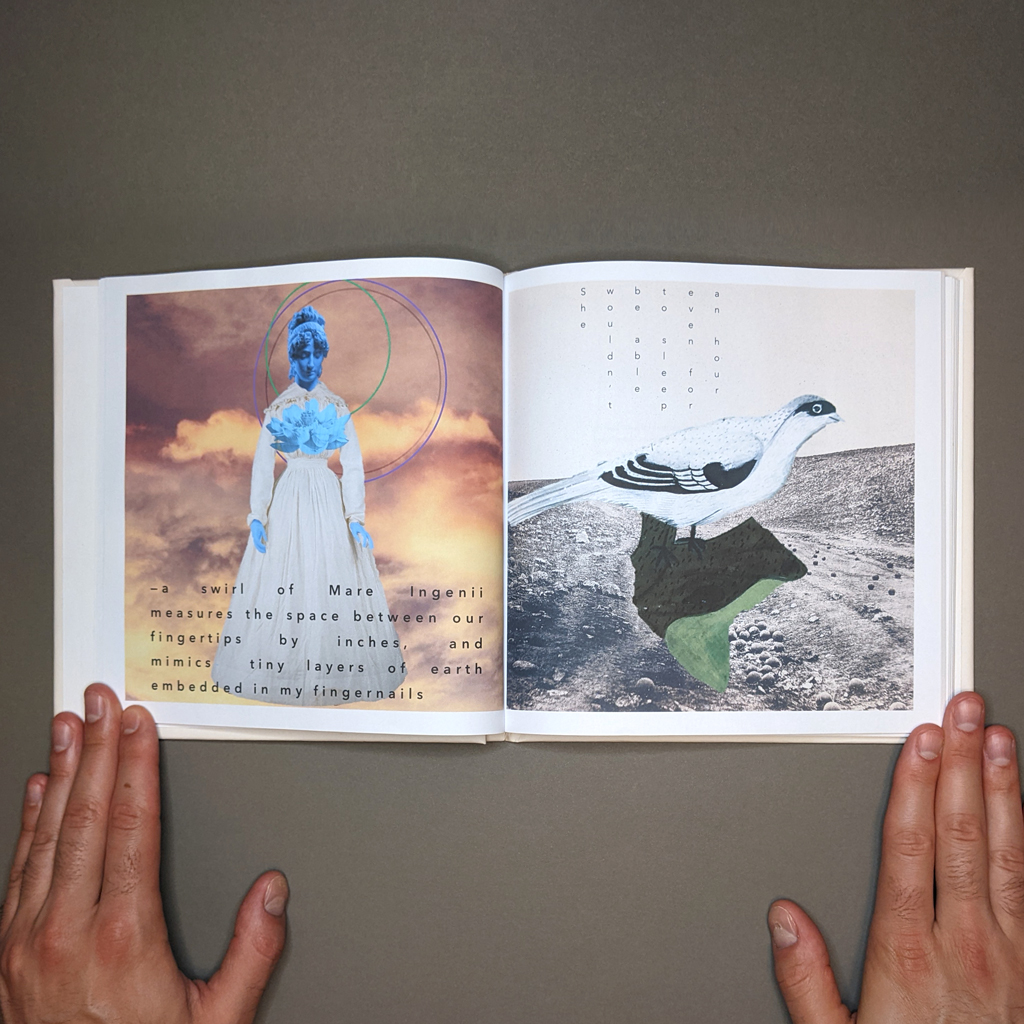
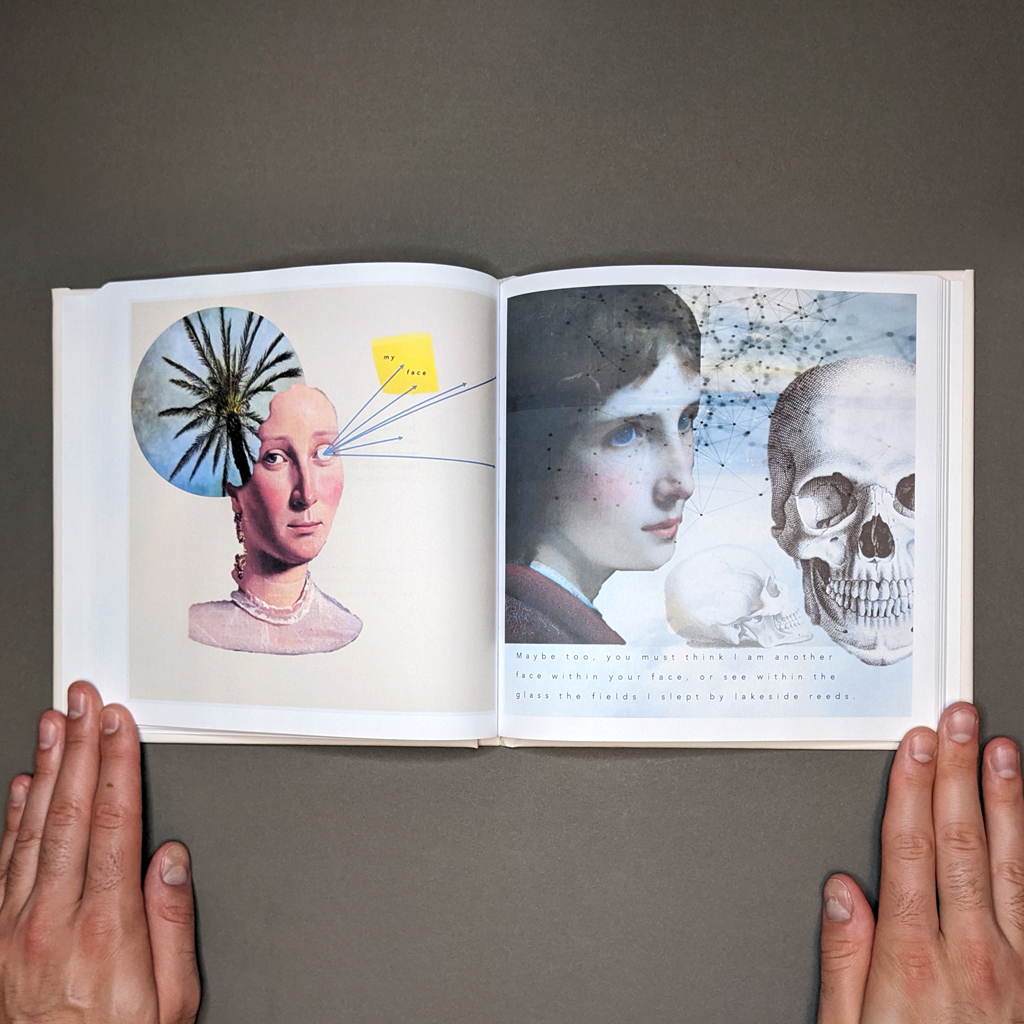
Alexandra Agostinho’s O meu coração bate sem mim is an instance of genderqueer expression that makes gender both a performance and an innate aspect of the person. The book is presented as a wrapped gift, complete with a bright red bow with matching paper as the cover, and the words (translated from the Portuguese), “My heart beats without me. What I am is not a choice, because who lives with the heart does not choose.” Inside the covers is a set of accordion-folded postcards with a series of six photographs of the artist, Alexandra Agostinho, taking their hair out of a bun and letting it settle on their shoulder while staring defiantly into the camera. Unlike other books of postcards, these have no perforation to separate them, and taking them apart would not only disrupt the order of the action in the images, but it would also tear apart the text that runs across the back of them, which is a repetition of the title.
When I first opened this book, already excited by the joyful and passionate red of the cover, I audibly gasped. What I saw was a fellow gender non-conforming artist, complete with long hair and a colorful skirt, and with eyes locked into the camera, they also saw me. Using the common LGBTQ+ pronouncement that love is not a choice, Agostinho takes it further: their entire being, skirt and facial hair and all, is not a chosen mode of expression, but a natural occurrence of letting their heart beat. At a time when queer bodies are heavily politicized and even demonized, O meu coração bate sem mim is a powerful statement of self that refuses to back down.
For a time, I sat with this book trying to impose a performance vs. internal reality dichotomy onto it. Is this performed gender? Is this innate gender? Is it both or neither? I reached out to Agostinho for some background information that would help me read and talk about this work. They were inspired by a work by Ana Mendieta while taking a class about self-representation. During a staged photography session, this series of photos “happened” and they knew they “had to do something with them.” In Agostinho’s words, “The ‘self’ represented is an extent of a ‘self’ I know that exists within me, but I’m not acquainted with yet.” I was surprised that Agostinho expressed any uncertainty about this represented self, as the confidence exuded by their stance stood out to me immediately. Perhaps it’s the eye contact, or maybe the put-togetherness of the bow tie and crisp shirt juxtaposed against the well-loved shoes and bold skirt. I can’t help but read a knowledge of, and comfort with, the self in this book. That may be a deliberate performance, but the statement that the series “happened” implies that this is instead a captured moment of the heart beating without Agostinho’s control.
But in trying to impose the question of performance vs. internal reality that I too struggle against onto this book, I think I’d missed the point. Almost every aspect of this book is non-binary. As an artists’ book in postcards, it is neither in book nor postcard form. The text (which is also the title) along the back doesn’t fit into the boundaries imposed by the postcard setting. Because this series was taken during a planned photoshoot with planned feminine- and masculine-coded aspects, there is necessarily an aspect of performance on top of the natural expression of self. The masculine and the feminine are used together in the photographs in order to render each detail “none of both,” and the change we witness in Agostinho occurs in a single fluid motion.
This fluidity of the self is reflected in Agostinho’s thoughts on gender, which stuck with me as a direct reflection of my own experience: “Gender is a concept I can’t quite wrap my head around. I’m a being that goes through womanhood and is [supposed] to ‘be’ one and is seen as one, but that’s not how I see myself. But I’m still figuring that part out.” As readers, we are also left figuring things out. With very few words and even fewer images, Agostinho has created a nesting doll of themself. Upon opening and removing layers, we are met with that aspect of Agostinho that even they aren’t familiar with. What keeps me returning to this book is not just that feeling of learning a secret about someone or witnessing their vulnerabilities. I am drawn to reopen O meu coração bate sem mim to both see and be seen.
本の本の本is a conceptual photographic artists’ book stemming from Antoine Lefebvre’s travels to Japan. Each duplex-printed page in the perfect-bound paperback has nine square photographs of the character 本 arranged in a 3 × 3 grid, forming spreads of eighteen images. The sheer variety of snapshots and their context — the materials and spaces where the character 本 appear — slows the reader, who must adjust to each ideogram’s weight, texture, and design. The character 本 is the lens Lefebvre provides the audience to view the idea of a book (which is one meaning of 本). Lefebvre’s thoughtfully crafted experience conveys to the reader that their mentally conceived book may be closer to its material counterpart than initially imagined.
Across a range of media, Lefebvre’s artistic practice constitutes research into our physical relationship with geography. For 本の本の本, Lefebvre’s photographic research began during his initial 2016 residency at the Palais des Paris in Takasaki, Japan. The first one hundred photographs come from this initial work and were first published in a small brochure upon Lefebvre’s return to Paris, while the later series of photographs are from his return to Japan in 2019.
Lefebvre’s photographs are as much about the ideogram and the unseen environment just outside the digital border as they are about their actual content. Their arrangement in a grid is inspired by Sol LeWitt’s Photogrids, who presented the grid’s ubiquity in unexpected contexts. The grid binds Lefebvre’s photographs together but also designates a space for each photograph, like the plots of urban space physically inhabited by the signs and objects Lefebvre has photographed. The quilt-like pattern of each page demonstrates Lefebvre’s skillful layout design, and the multiple, modular use of the 本form makes its perception and reception immediately available to the reader.
The viewer is aware that each 本 is unique in its color, surface, texture, and materiality; however, the photographs’ uniform, square format eliminates the reader’s sense of each character’s scale. As conceptual art, the photographs are meant to engage with the reader’s thoughts on what a book is as much as appeal to their emotional or visual enjoyment of the photographs. The work’s meaning is found in this conversation between artist, audience, and artwork.
Meaning — and language — are also deeply rooted in culture, and the project statement included in the book does provide helpful context on the multiple meanings of Japanese characters, Kanji, for those who may not be familiar with the language. I have practiced Japanese for a decade, and though I do not claim native proficiency with Japanese, this exposure offers insights into the linguistic and cultural nuances of the characters. By itself, the character 本 means “book,” but it holds numerous additional readings when associated with other Kanji. The interpretation of characters is derived from the context of the sentence. The book’s title playfully engages with this multiplicity of meaning, lightheartedly obfuscating interpretations, and pitting nuance against precise lexical meaning. Read as “Hon no hon no hon,” the title could be translated as “Books of books of books.” However, when we consider one of the alternative interpretations of 本 as the “origin,” the title becomes “The origin of the book of books,” or more concisely, “Origin of books book.” (Admittedly, considering the context, reading the title in any other way aside from “books of books of books” would be an imaginative stretch.)
Inside the book, I do worry that Lefebvre’s cropping of the images to focus on 本 may force the artist’s view onto the reader. By cropping the character out of its larger environment, Lefebvre can change the character 本 to mean “book” when originally it did not. For example, one images pairs 日 with本 to form the word for Japan, while in another the character appears on the side of a drink can. However, Lefebvre’s photographs are not intended as a fixed catalog of the character 本. The book’s images and ideas remain susceptible to temporal evolution, mirroring the dynamic interplay between the audience’s interpretation and Lefebvre’s own developing comprehension of his research method. Throughout the book, Lefebvre offers momentary peaks into his process via handwritten notes and photographs of earlier exhibitions.
Lefebvre’s repetitive photographic works diverge from iconography’s conventional commitment to signification. Meaning is simultaneously distinctly multiple and conspicuously absent. Certain depictions of the character 本, especially those characterized by bold geometric forms, assertive graphics, or vibrant colors, invite interpretation through their immediate and visceral impact. Conversely, images that are visually and conceptually more opaque pose greater challenges for viewers to seamlessly correlate geographical space with personal conceptualizations of what constitutes “book.” In these moments, the artist steps back and the reader can wander through these pictorial spaces guided by their interests. Each viewer’s introspection is built from a lifetime of interacting with books, with each viewpoint and inquiry as unique as Lefebvre’s many photographs of 本.
My initial reading of the book was emotionally dry, interested more in the spectacle of each photograph’s logical execution than in uncovering a more subjective meaning just beneath the surface. Over subsequent readings, I considered how Lefebvre’s project readily shifts the audience between reading text and viewing image. Likewise, the book foregrounds two modes of inscription: writing and photography. Then I found myself looking at my bookshelves several times, considering the types of books I have collected, their textures, and how they are a curated library of my personality and current interests.
本の本の本 encourages the reader to consider the cultural complexities of the book — an embodiment of power dynamics, societal structures, and ideological conflicts — through the lens of the character 本. Its exploration of language, culture, and the nuanced meanings of Kanji adds depth to the interplay of text and image, making it a thought-provoking contribution to contemporary artists’ books and Conceptual art. 本の本の本 carries forward the spirit of Conceptual art as an origin in its own right, questioning the essence of the book and offering a profound reevaluation of the familiar.