Artists’ Book Reviews

Artists’ Book Reviews

Monthly reviews and occasional interviews

  • Reviews
  • Interviews
  • Submissions
    • Subsidized Submissions
  • About
    • FAQ
  • Contact
  • Email Newsletter
  • Browse Books
    • Title
    • Author / Contributor
    • Editor
    • Date Published
    • Publisher
    • Publication Format
      • Monograph
      • Periodical
    • Genre
    • Print / Production
    • Medium
    • Binding
    • Container
      • Belly Band
      • Envelope
      • Slipcase
      • Tube
    • Structure
  • Pamphlets

    Pamphlets
    Andrew Shaw
    June 2019–March 2020
    The Silent Academy

    11 × 8.5 in. open
    1 sheet each (12 total)
    Trifold cardstock pamphlets

    12 pamphlets arranged in 2 rows of 6. Each is a vertical trifold with black title text on white cardstock.

    In his 2019–2020 series of twelve pamphlets, Andrew Shaw conceals extravagantly magical ideas in a plain package.

    Simultaneously evocative and mystifying titles like Items of Inconsequential Dysfunction & Beauty or Items of Color & Reach appear in black Times New Roman on a cream cardstock only slightly richer in color than ordinary printer paper. The interior of each pamphlet and its accompanying “artifact detail,” a small sheet briefly explaining its contents, are similarly unobtrusive and understated.

    At first the form may not feel significantly different from the default settings in a word processing program, but it is an intentional and vital part of the reading experience. Shaw’s design choices take the minimalist aesthetic of much of the silent academy’s work to its greatest extreme, forgoing the perfect binding of the press’s books or the hand-stitching and illustrations of their field guides. More than that, it consciously reflects the history of the medium, drawing on the simple aesthetic of both the philosophical or political pamphlets of past centuries and zines produced in the recent past and present day.

    Pamphlet no. 9, “Items of Salt & Sacred Geometry,” closed, accompanied by its single-sheet “artifact detail” paper to the right.

    The publisher’s description of Items of Gentle Revolt, first in the series, specifically references this historical context: “Pamphlets have played a part in overthrowing dictatorships. Helped tourists understand the most elegant route through an art museum. Codified noodles into a number 42. This pamphlet does none of those things.”

    As much as they participate in the history of the pamphlet, then, they also stand outside it. Rather than trying to disrupt a political or cultural system directly, the texts in Shaw’s series are more concerned with changing individual thought patterns. This is not to say they are apolitical, only that they are more concerned with inner change than outer, choosing to address the apathy and casual selfishness that capitalism creates, and is created by, rather than capitalism itself.

    To this end, the text consists of strange, wonderful instructions. “Instructions” is an inadequate descriptor, but the only word I’ve found that covers the breadth of experiences on offer.

    Pamphlet no. 2, “Items of Natural Chaos & Wonder,” partially open to display “On the Nature of Dust” on the left and “On the Acceleration of Gravity” on the right.

    Many are literal directions for producing a work of poetry or art (some similar to those Shaw created in his other works, couplets and questions). Others feel more like ethical or metaphysical musings in verse, which we could perhaps call instructions for living. Still others take the reader on a much less literal and concrete journey into the surreal — but while the destinations are unexpected, the trip is very much guided.

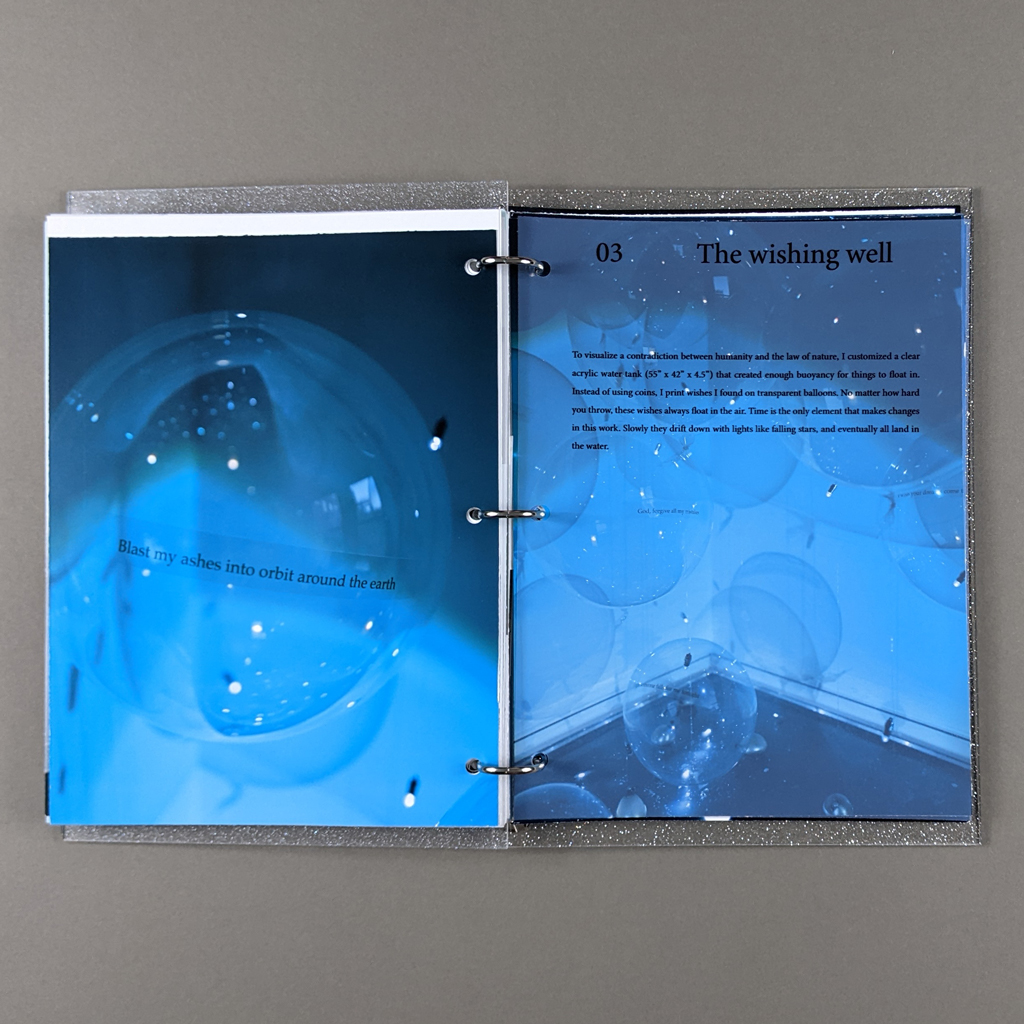
    Shaw might ask the reader to “call a friend you’ve not spoken with in forever” (as in Items of Joy and Unrest) or to imagine impossibilities like wrapping arms around the moon to pull it down from the sky — a sky that sometimes contains a gargantuan floating whale.

    Each pamphlet is divided into four sections: four sets of “instructions” for four different projects. Each of these can be appreciated individually, but they complement one another in various ways; images recur, the same themes are explored from slightly different perspectives. This double existence as single pieces and parts of a larger project extends throughout the series. The individual pamphlets were produced in four batches, each created in a particular season and reflecting that season’s aesthetic and emotional associations. The same image or idea (such as the aforementioned flying whale) often occurs in multiple contexts throughout the “year” represented by the twelve pamphlets.

    Pamphlet 12, “Items of Subtle Disclosure,” fully open  to display “On the Nature of Linguistics” (left), “ On the Nature of Purpose” (center), and “On the Nature of Motifs” (right)

    The straightforward, colloquial language Shaw uses to explore these heady, conceptual experiences is a natural complement to the pamphlets’ physical plainness, and a part of the project’s intentional accessibility. Pamphlets is a series intended for everyone, not exclusively those with formal academic or artistic training.

    Shaw instructs readers to do things virtually anyone could do easily enough (“Scribble a list of every lie, / untruth, and manipulation / that you can remember telling”) or things almost no one could (“Go to the mountains. / Sit motionless for three days. / Move only to drink, eat, shit & piss. … Walk twelve hours a day for ten days”). Rather than being taken literally, the latter are experiences meant to be had internally: what would it be like to do this impossible thing, and how would it affect me?

    Many of the projects also seek an audience beyond the individual reader, encouraging and guiding encounters with others through small bursts of public art or conversations with friends and strangers.

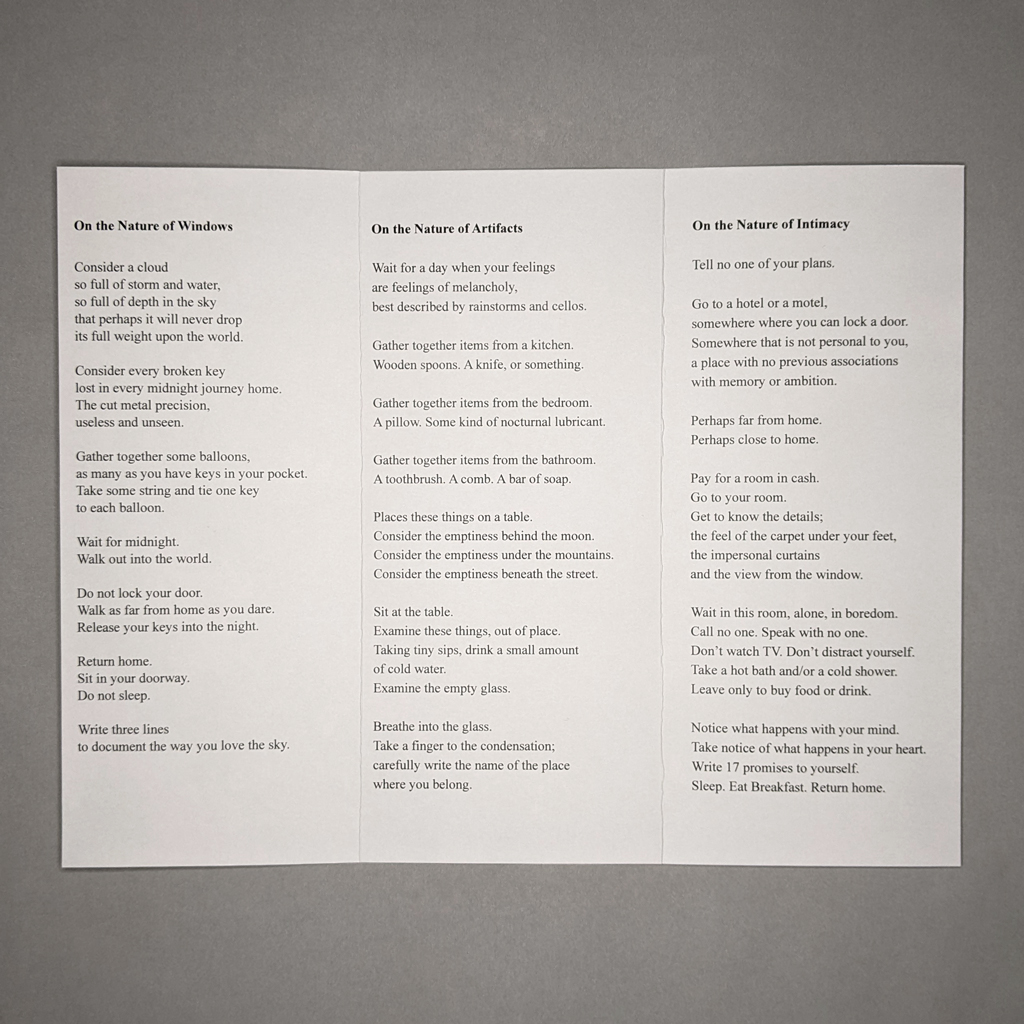
    Pamphlet no. 10, “Items of Inconsequential Dysfunction & Beauty,” fully open to display “On the Nature of Windows” (left), “On the Nature of Artifacts” (center), and “On the Nature of Intimacy” (right)

    The series’ accessible and public nature further reflects the history of the pamphlet. Just as  early mass literacy allowed for various forms of political change and enhanced the common understanding of science and philosophy, Shaw’s pamphlets hope to foster greater understanding of oneself and other people. However much they reflect his personal ideas and understanding of the world, they are necessarily and consciously dialogic.

    Like the history and ideas it explores, Pamphlets is neither static nor conclusive. After a considerable break, the series has continued, with new author Brittany V Wilder taking over in March 2022. Exploring a changed world through a new perspective seems a natural extension of the series so far, both a throwback to and evolution of the idea of the pamphlet itself. The project as a whole reflects the focus on collaboration so vital to its text, the dialogue it creates continuing to expand.

    Eric Morris-Pusey

    June 18, 2023
    Review
    2019, 2020, Andrew Shaw, Folded, Laser, Pamphlet, Performance, Periodical, Text, The Silent Academy
  • The Chiliagon Locket: A Mental Exercise from My Childhood

    Neil Majeski
    The Chiliagon Locket: A Mental Exercise from My Childhood
    From the series: The Last State or the Penultimate
    2019

    4.5 × 7 in. closed
    12 pages
    Saddle-stitched, softcover pamphlet
    Inkjet and laser

    [In a departure from the usual Artists’ Book Reviews format, this mini review is part of a series on Neil Majeski’s pamphlet series, The Last State or the Penultimate. The first of these mini reviews covered Majeski’s series as a whole.]

    Front cover of "The Chiliagon Locket: A Mental Exercise from My Childhood". Purple cover paper with black title text below an inset reproduction of a painting.

    Like Depictions of a Developing Lampshade, the core of Neil Majeski’s The Chiliagon Locket: A Mental Exercise from My Childhood is a single object which is both real and imagined and which evolves throughout the short pamphlet via visual and verbal mediation. The title references a chiliagon, a thousand-sided shape, which can be conceived of mentally, but not imagined the same way as, say, a triangle, whose three sides cohere into a stable mental image. Majeski borrows this thought experiment from William Goldbloom Bloch’s book, The Unimaginable Mathematics of Borges’ Library of Babel, but only to explain his own mental exercise: a locket that opens over and over until some inexplicable mental friction turns its infinite unfolding into an unimaginable mess of imaginary lockets.

    The Chiliagon Locket, pp 2-3. Blank verso. Recto has a compound photo of a locket tipped in between two paragraphs of text.

    Majeski introduces the pamphlet, and the perplexing mental image of an endlessly unfurling locket, with a photograph of the actual locket. Tipped in between paragraphs on the first page, a compound image shows the locket closed (left) and open (right) on a wooden tabletop. The photography is unpretentious, evidentiary even. In the righthand image, we see that the open locket is empty. The image — the only photograph in the pamphlet — is thus a photograph of a missing photograph. The parallels between the compound image, split down the middle, the hinged locket, and the pamphlet itself are unavoidable. Is a locket a photobook? Is his endlessly unfurling locket more like Borges’ library than even Majeski realized?

    The photograph signals the reality of the object, but the text on the page blurs the line between real and speculative. (Of course, the value of photography’s ostensible objectivity is already limited as an illustration of a mental image.) Majeski uses phrases like “so to speak” and “that might sound a tad strange” to reinforce the verbal mediation that guides the reader through the pamphlet; something will be lost in translation from mental exercise to verbo-visual account.

    The rest of the illustrations are painted, offering Majeski a halfway point between the rigid mimesis of photography and the freedom of imagination. The sparse, surrealist style lends itself to the mental manipulation of an object and maintains a porous boundary between real and imagined. The painted environments could represent a mysterious mindscape or simply a dimly lit tabletop. The empty locket transforms into a velvety void, as though much more than a photograph is missing.

    The Chiliagon Locket, pp 4-5. Verso has a tipped in reproduction of a painting depicting a row of lockets. Recto has a paragraph of text.

    The first two paintings, which depict the orderly unfolding of the locket, appear to form a diptych. However, they are split apart on successive versos, which emphasizes both the temporal and spatial aspects of this infinity; the scene transcends any single canvas or moment in time. It is an ongoing process.

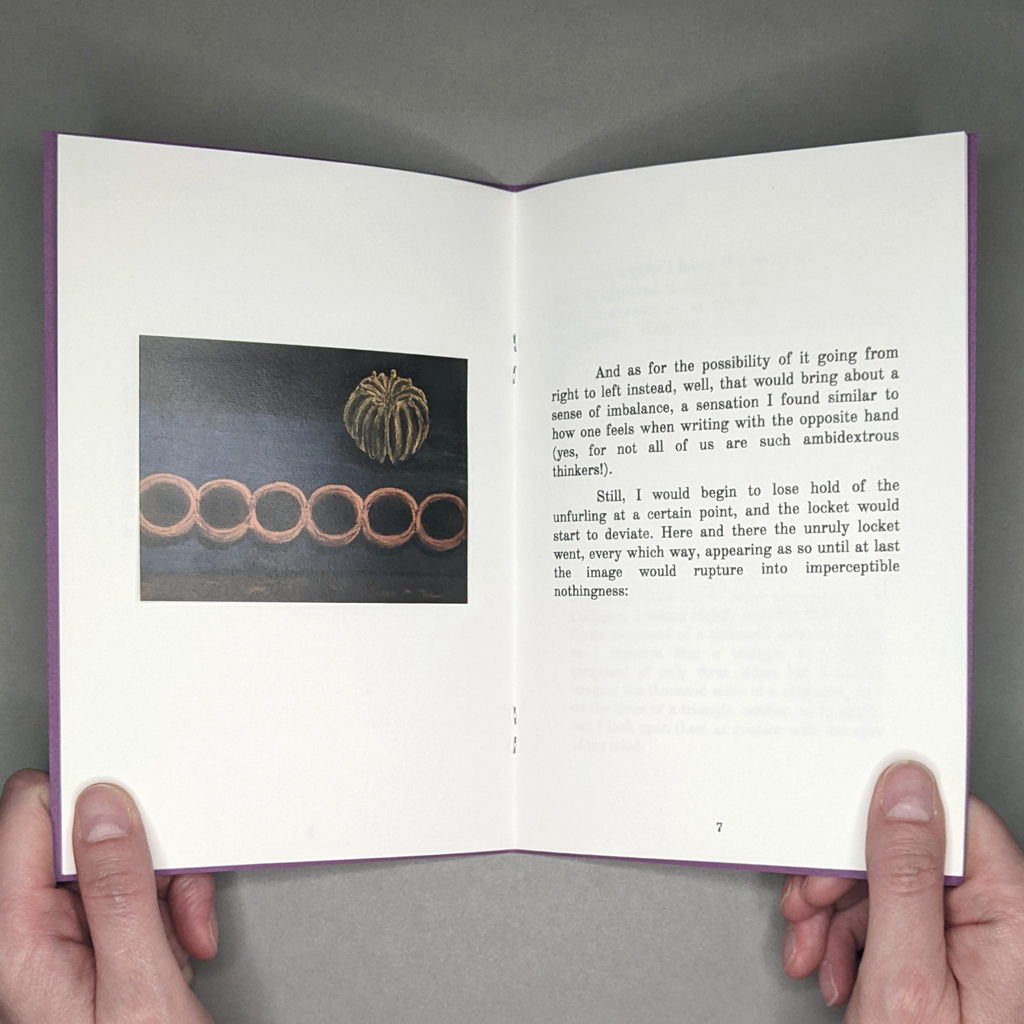
    The Chiliagon Locket, pp 6-7. Verso has a tipped in reproduction of a painting depicting a row of lockets, a continuation of the previous image. Recto has two paragraphs of text.

    Elsewhere, Majeski uses the book form to punctuate the pamphlet’s verbal and visual content. The orderly unfolding of the locket breaks down in the center spread. The image on the verso still shows the locket’s linear march, but the text on the recto describes the moment Majeski loses control: “Here and there the unruly locket went, every which way appearing as so until at last the image would rupture into imperceptible nothingness:” The colon and the phrase “as so” refer to the illustration on the following page, but they first seem to point to the vast blank space at the bottom of the page — imperceptible nothingness.

    The Chiliagon Locket, pp 8-9. Verso has a tipped in reproduction of a painting depicting a scrambled pile of lockets. Recto has two paragraphs of text.

    The Chiliagon Locket explores fundamental questions about the book as a communication tool: how does an idea get from an artist/author to a viewer/reader? Majeski shows that the process is not linear. Ideas, images, and objects are always fluid and never transparent. Even a short book, like a twelve-page pamphlet — or a locket, leaves its mark on the ideas it conveys, whether visual or verbal, spatial or temporal. Majeski has a knack for reminding us of how books work without detracting from the central object or anecdote. The Chiliagon Locket is an earnest exploration of a childhood experience, one that is as unique as it is relatable.

    Levi Sherman

    May 19, 2023
    Review
    2019, Inkjet, Laser, Memoir, Neil Majeski, Nonfiction, Paint, Periodical, Saddle Stitch, Softcover, Text
  • Interview with Tiffany Gholar — Part 2 of 2

    This is part two of a two-part interview. Read part one here.

    Portrait of Tiffany Gholar wearing a colorful patterned blouse and hair wrap in front of a shelf with patterned containers
    Tiffany Gholar. Image courtesy of the artist.

    Levi Sherman: What lessons have you learned as you become a more experienced book maker? And what are you eager to try out in your next book(s)?

    Tiffany Gholar: With every book I publish, I am becoming more comfortable with experimenting. For The Sum of its Parts, I designed a two-page spread for the title page, something I had never considered for my previous books. I took advantage of the format of the ebook edition of The Unforeseeable Future and included links where readers can find out more about the podcasters I mentioned in my acknowledgements. I also decided to link to some of the blog posts that I didn’t include in the book because I thought they worked better online instead of in print. 

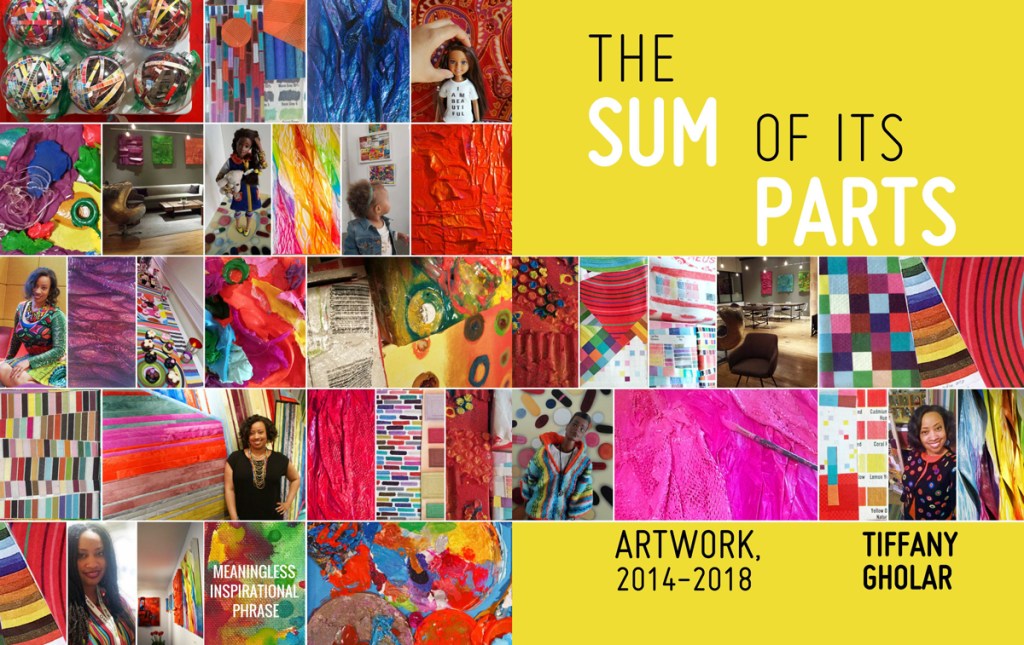
    2-page spread view of "The Sum of its Parts" cover. Artwork details and images of the artist with her work are tiled in a saturated, busy grid.
    Tiffany Gholar, The Sum of its Parts, self-published, 2019.

    LS: Can you talk about what an ebook can do that a blog or website can’t? You seem very thoughtful about the degrees and types of interactivity in the forms you choose.

    TG: I actually feel like it’s the other way around, that there are things that blogs can do that ebooks can’t. For example, updating a blog post or a website is a much simpler process than updating an ebook because you have to upload it again to every bookstore that’s selling it. 

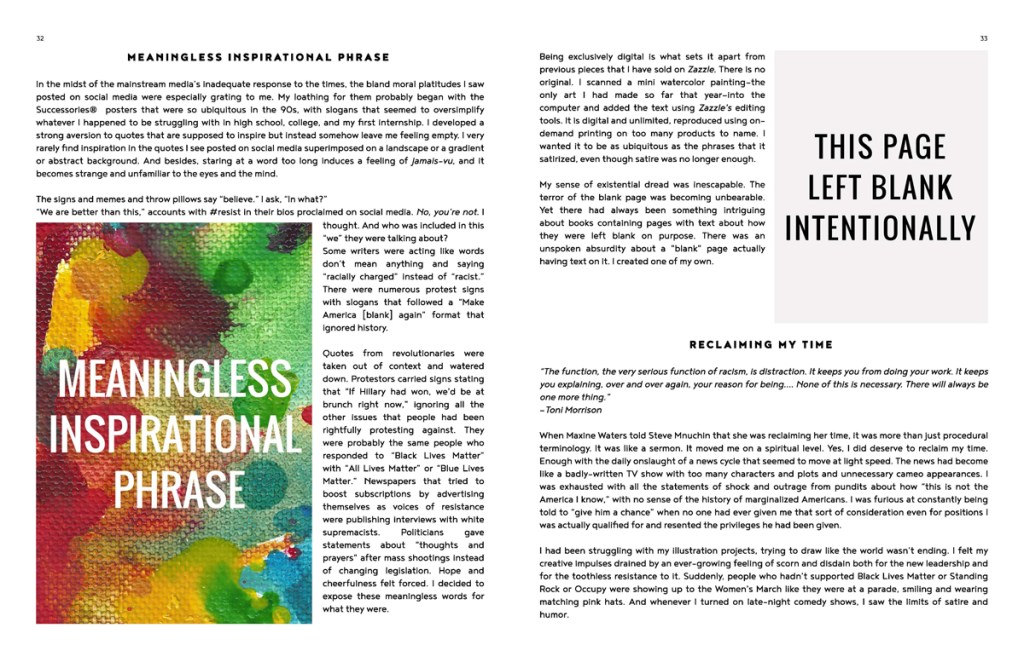
    2-page spread from "The Sum of its Parts" with text-based artworks and a running text explaining the series. A piece on the verso reads: "meaningless inspirational phrase." A piece on the recto reads: "This page intentionally left blank"
    From: The Sum of its Parts, 2019.

    LS: Which seems related to that question of closure versus ongoing work. Do you think the expectations of your blog readers differ from those of your ebook readers? 

    TG: Probably. Readers don’t expect blog posts to be as polished as books.

    LS: Do you see those expectations evolving in the future? Will we expect books to be more flexible like blogs? Or perhaps readers will lean into the fixity of print as more things become digital and fluid?

    TG: With all the synthetic digital media that we’re constantly exposed to, I think that print books might become more appealing to readers.

    LS: Does that same instinct play into your studio work, which seems to revel in materiality?

    TG: Absolutely. The more the world becomes virtual and digital, the more I want to work with my hands.

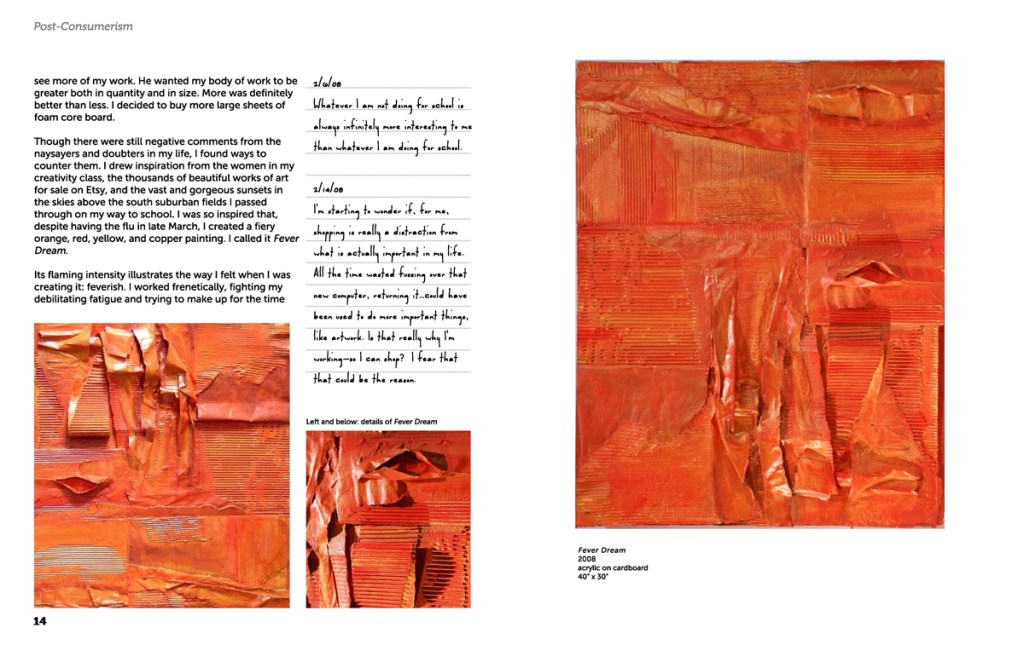
    2-page spread from "Post-Consumerism" with a large reproduction of an artwork on the recto and details shots plus facsimile journal writings, and a running, typeset text on the verso
    From: Post-Consumerism, 2012.

    LS: What about your own reading habits — do you read more in print or digitally? And are there artists or authors who particularly influence your work?

    TG: I have been reading more digitally lately. I like the convenience of the format. In an effort to prevent myself from acquiring too many books that I’m never going to read, for over a decade I’ve been trying to check books out of the library first and only purchase them if I find myself wanting to check them out more than once. I love being able to read ebooks through the library. Not having to worry about late fees is such a relief. I also like the privacy that reading books digitally can afford. I often read when I’m not at home, and it’s nice to be able to enjoy books without other people asking about them.

    I feel like I’ve been influenced by other writers and artists on a subconscious level most of the time. Often I don’t realize their work influenced mine until later. I don’t set out to create anything in anyone else’s style. In terms of art, I think pretty much anyone working with found objects and bright colors has inspired me. 

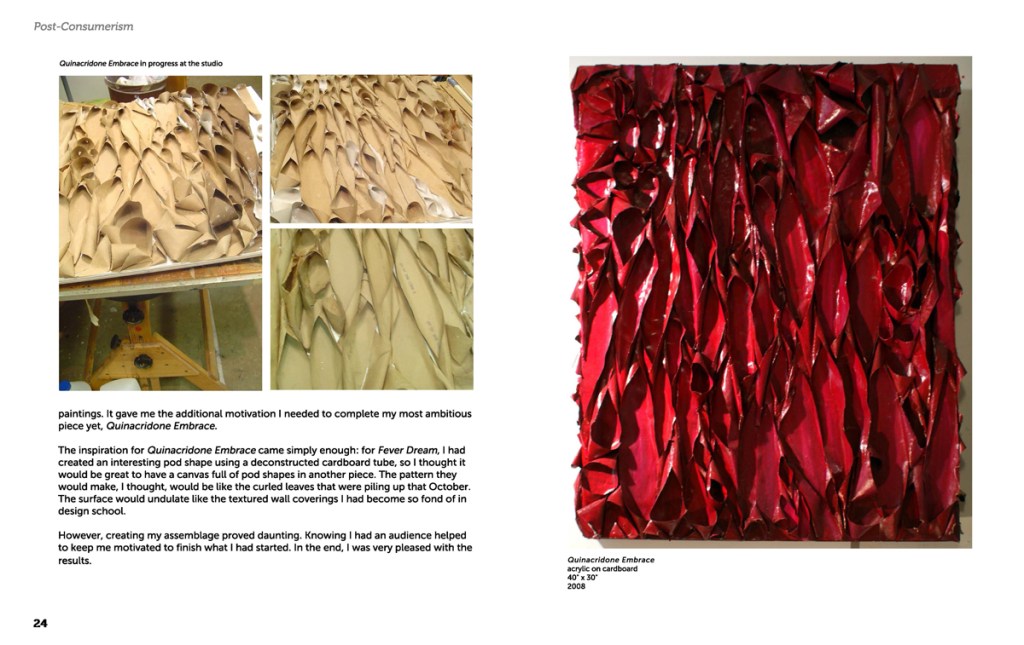
    2-page spread from "Post-Consumerism" with a a finished artwork on the recto and process documentation on the verso
    From: Post-Consumerism, 2012.

    LS: What project(s) are you working on now? Do you have a book-in-progress?

    TG: I’m working on a few new pieces for my Post-Consumerism series. I’m also working on my next art book. My goal is to publish it in 2025.

    Artists’ Book Reviews

    May 15, 2023
    Interview
  • Interview with Tiffany Gholar — Part 1 of 2

    Tiffany Gholar is a Chicago-based multimedia artist and freelance interior designer. She studied art at the University of Chicago, interior design at Harrington College of Design, fiction at Columbia College Chicago, and painting at Governors State University, where she received her Master’s degree. In distinct but related bodies of work, Tiffany explores the economics and aesthetics of our single-use, consumer culture and the social (and medical) ills it engenders. That doesn’t mean, however, that the work isn’t fun. Super saturated colors and irresistible textures transform everyday materials — even “trash” — into compelling compositions that question values like beauty, utility, and permanence.

    However, I was most excited to talk to Tiffany about the role — or rather, roles — played by books in her practice.

    The following interview took place via email beginning February 2023.

    Selfie of Tiffany Gholar, smiling with braided hair, in front of a mural
    Tiffany Gholar. Image courtesy of the artist.

    Levi Sherman: Books are clearly important to you. They are part of your art practice and a way for you to share your non-book art with viewers — plus you’ve written a novel! So how did your relationship with books begin? Were you initially attracted to art or writing — or is that division too simple?

    Tiffany Gholar: My relationship with books began as it did for so many of us, with picture books. I suppose the division really is too simple because you start reading and all the books have interesting illustrations in them; very appealing if you’re also interested in art. 

    LS: When did you realize that you could make books in addition to reading them?

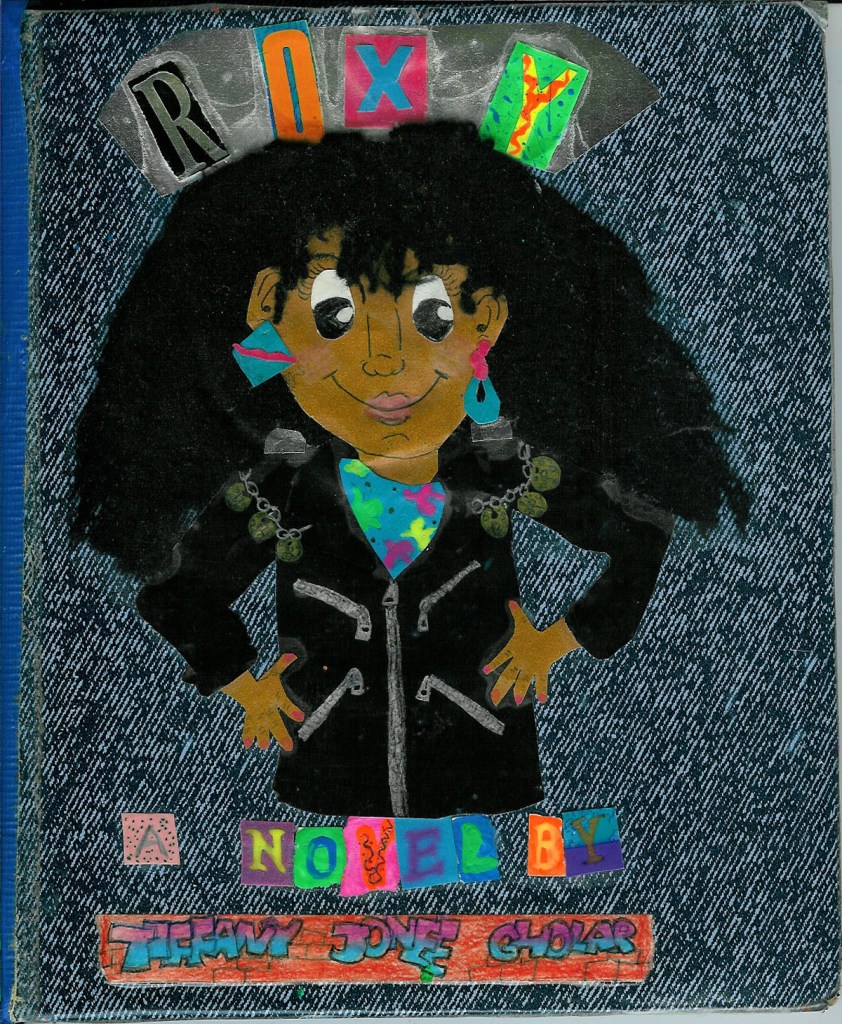
    TG: I realized that I could make books at an early age, in kindergarten. Our school system had the Young Authors Contest and I was very excited when I first learned about it. From kindergarten through eighth grade, I wrote and illustrated my own books. One of my art teachers, Mrs. Mollison-Douglas, taught us how to make books by hand using Con-Tact paper, cardboard, and duct tape, and sewing the folded pages together. I wrote my first few books by hand, then enlisted my dad’s help to type them up for me on his typewriter. I think my eighth grade book of poetry, the only one without illustrations, was the first one that I typed up myself on our computer.

    Book cover with a collage illustration of a smiling Black girl and colorful ransom-note-style lettering: "Roxy: A Novel by Tiffany Jonee Gholar"
    Tiffany Gholar, Roxy, collage on Con-Tact paper and cardboard, 1991.

    LS: I wish I’d had a program like that in school! When did you know you wanted to seriously pursue art and design?

    TG: I’m really grateful that we learned how to do so much in our art classes. I always knew that I wanted to be an artist, though I was often encouraged to do other things instead of art. My interest in interior design started with selecting and building furniture for my dollhouse when I was eleven. But it wasn’t until I moved out after college that I realized it might be something I would want to pursue a career in.

    LS: The dollhouse is a great segue into your book The Doll Project, but I hadn’t yet made the connection with your interior design practice. The Doll Project addresses negative pressures that children, especially girls, face from the adult world, but it sounds like your dollhouse was also a place to grow into your professional and creative pursuits.

    TG: Oh yes, it definitely was. I learned so many things from the process of building my dollhouse and making and buying miniatures to furnish it. It taught me about architectural scales. I’m pretty sure that the first floor plans I ever drew were for the rooms in my dollhouse.

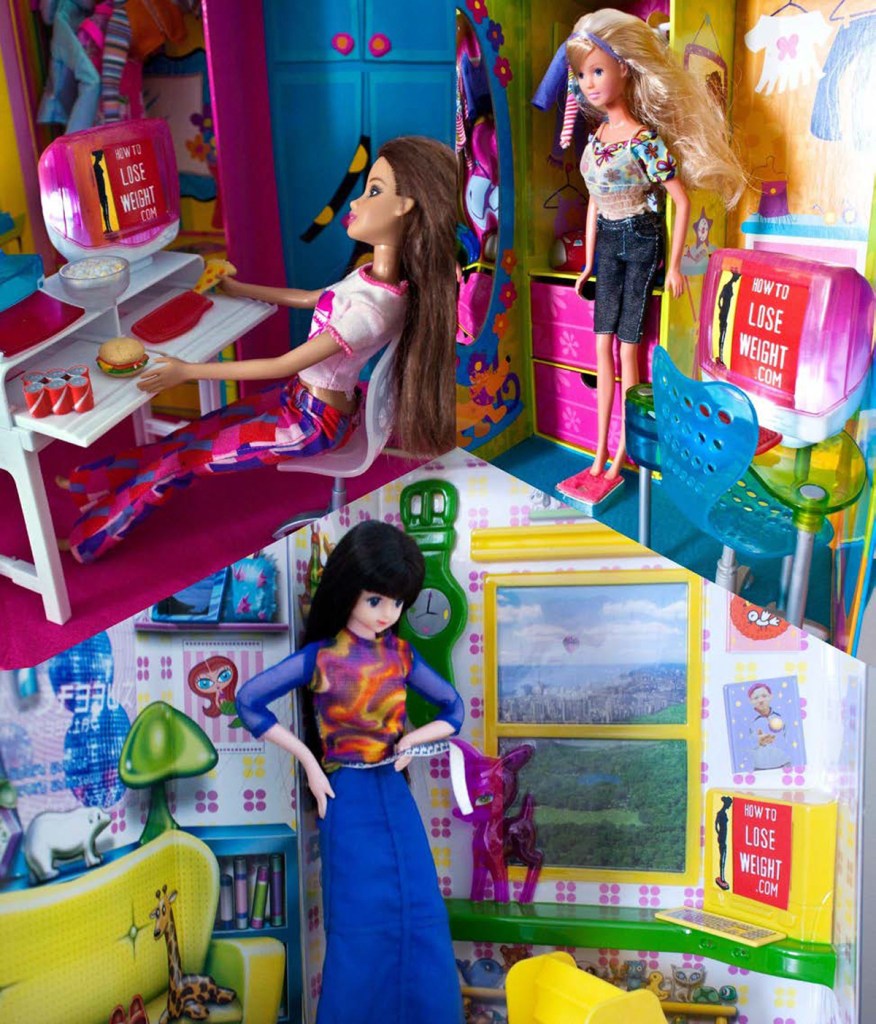
    Page from The Doll Project: 3 scenes of young women viewing "howtoloseweight.com" on their computer, created using doll photography
    From: The Doll Project, 2014.

    LS: The Doll Project combines narrative doll photography with diverse texts on diet culture, body image, family, and media. So, my first question is whether you knew the project would become a book, or did you think it would stay online as a blog?

    TG: When I first started, I wasn’t planning on making a book. I didn’t expect to have so much material. But as the ideas kept flowing, I realized that I wanted to at least show the series in public. I think I probably decided to publish my Doll Project photos as a book while working on my first art book, Post-Consumerism, which I published in 2012.

    Image from The Doll Project: doll photography scene of a young woman reading "How to Lose Weight" at a kitchen table, with an empty bowl of cereal.
    From: The Doll Project, 2014.

    LS: That’s so interesting, because a book plays a starring role in The Doll Project — as the antagonist. Does How to Lose Weight suggest an ambivalent relationship with books?

    TG: No, I’ve always loved books and reading. I chose to use the How to Lose Weight book as a recurring prop in my photos because it was easy to replicate. Something that I realized when I had my first dollhouse was that the easiest miniatures to make were of printed matter, whether books or household goods in boxes. Rather than buy it vintage from eBay, I could print as many copies of it as I wanted. The book appears in most of the photos in The Doll Project and then, in one of the photos that I set in the Y2K era, it becomes a website, too.

    LS: That evolution from book to website seems important since your own work shifts between media. Books like Post-Consumerism present distinct lines of inquiry in your studio practice. Do those lines become clear in retrospect, or are you working toward that goal all along?

    TG: I think my art books are highly retrospective. Most of the text in them comes from blog posts and journal entries and as I combine them into a narrative, they help me to notice themes and patterns that I may not have been aware of at the time when I wrote them.

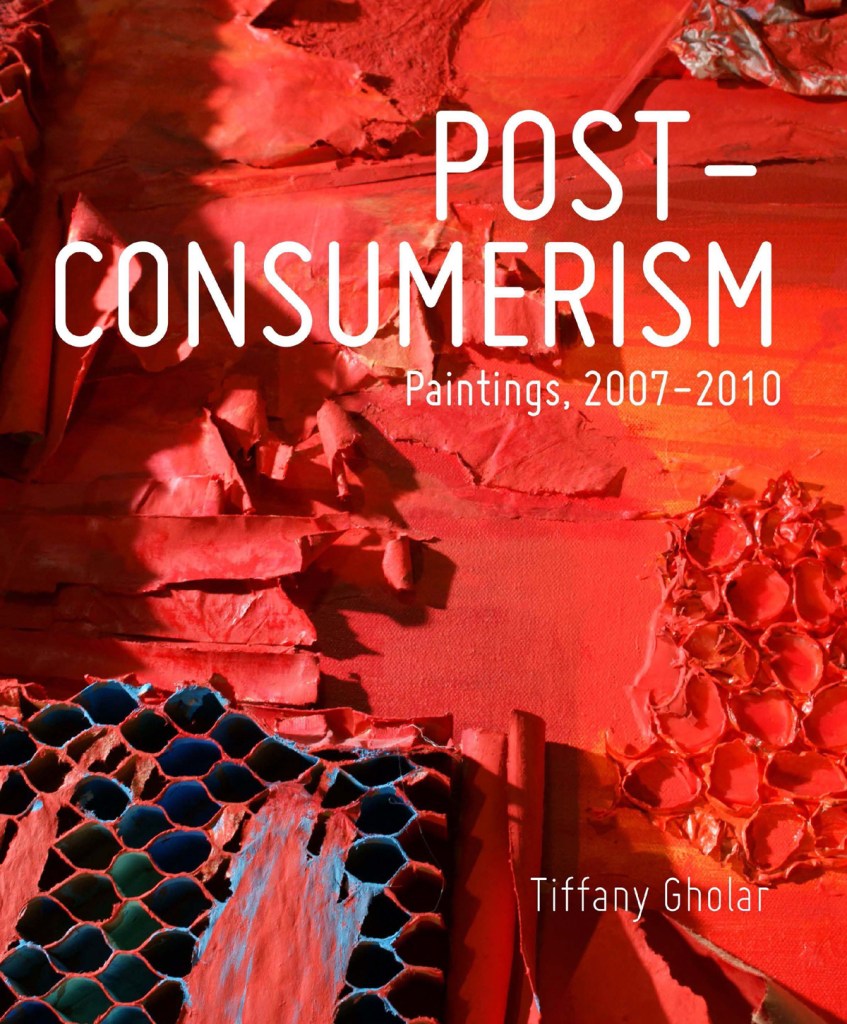
    Book cover of "Post-Consumerism" with white title text on a close-up of a red abstract artwork made from recycled materials
    Tiffany Gholar, Post-Consumerism, self-published, 2012.

    LS: Does the book provide closure for a series or project? Or do you circle back to your studio once those themes and patterns emerge?

    TG: The only book that has provided closure for a series has been The Doll Project. My abstract work is an ongoing project and my goal is to release new art books every three years.

    LS: From a more practical standpoint, how do the books serve your abstract practice? Are they an alternative to the gallery system or a supplement to it? And has the role of these books evolved as artists turn to social media to share their work?

    TG: I offer signed copies of my art books as a gift to my collectors when they purchase my larger artwork. They are a supplement to the gallery system. They’re a tool to connect with audiences at shows and I like being able to display them alongside my art at solo shows and art fairs. I like that I can sell them for less than the rest of my art, except my mini paintings. It gives people another way to engage with my art without purchasing a painting, especially if they can’t afford one or have run out of wall space. I also like being able to tell my story as an artist from my own first-person perspective instead of having it filtered through the words of curators and gallerists.

    2-page spread from "Post-Consumerism" with a reproductions of artworks, facsimile journal writings, and a running, typeset text
    From: Post-Consumerism, self-published, 2012.

    I was already pretty active on social media when I published my first art book. What I like about writing a book is that it allows more time for reflection, as opposed to the reflexive hot takes the world of social media expects us to churn out on a regular basis. Another thing I appreciate is that I can say what I have to say without getting annoying comments from reply guys and people who want to debate every little thing. Books give me enough space to fully express my thoughts without worrying about character limits. They are also not subject to the whims of tech bros. It’s nice to be able to give my words and images a more permanent format than a social media post.

    LS: This answer really shows the complexity of how books mediate relationships between artists and readers! It sounds like these books are empowering and effective — so why don’t more artists do this?

    TG: I’m not sure why more artists don’t do this, but I think they should! I would encourage all my fellow artists to publish books about their work. It’s pretty easy to do it now with print on demand companies. All you need is an InDesign subscription.

    Artists’ Book Reviews

    May 12, 2023
    Interview
  • Depictions of a Developing Lampshade

    Neil Majeski
    Depictions of a Developing Lampshade
    From the series: The Last State or the Penultimate
    2019

    4.5 × 7 in. closed
    8 pages
    Saddle-stitched, softcover pamphlet
    Inkjet and laser

    [In a departure from the usual Artists’ Book Reviews format, this mini review is part of a series on Neil Majeski’s pamphlet series, The Last State or the Penultimate. The first of these mini reviews covered Majeski’s series as a whole.]
    Depictions of a Developing Lampshade, front cover. Painted image of a pleated lampshade inlaid on a green paper cover with black title text below.

    “I once made a study of a table lamp which I acquired from an estate sale not long ago,” Neil Majeski announces on page one of Depictions of a Developing Lampshade. The strange temporality of this statement, straddling the remote and recent past, contributes to the overall sense that time works differently in Majeski’s series, The Last State or the Penultimate. It is hard to pin things down; they are always in a process of becoming. In Depictions of a Developing Lampshade, it is the lampshade that is becoming. Images on the recto document each new state of being while accompanying text on the verso explains how it was brought into existence.

    Depictions of a Developing Lampshade, opening 1: paragraph of text on the verso and a color reproduction of a painting of a lamp tipped in on the recto.

    I use the passive voice to describe this because, even as Majeski details precisely how he creates each rendering, he also conveys the agency exercised by the object and each subsequent depiction of it. This agency seems to work through the transformation of ideas into images, images into objects, and objects and images back into ideas. No sooner does Majeski turn an object into an image — say, a lamp into a study — than the image asserts its materiality. The reproductions are conspicuously tipped into the pamphlet like old-school color plates and the text revels in the material of each image, emphasizing the many layers of media, like titanium buff and charcoal.

    Depictions of a Developing Lampshade, opening 2: paragraph of text on the verso and a color reproduction of an uncanny painting of a growing lampshade (the same as the cover image) tipped in on the recto.

    The boundary between material forms, whether image or object, and immaterial ideas is as unstable as that between image and object. Majeski is motivated by his own curiosity, which is to say he renders ideas. Yet, once material, the image-objects he creates elude him. Furthermore, we should take seriously the possibility that the original object, the lamp, is being altered through Majeski’s mental and artistic activity. After all, these are “depictions of a developing lampshade” and not “developing depictions of a lampshade.” And if Majeski’s mental activity can alter the object, why not the reader’s?

    Depictions of a Developing Lampshade, opening 3: paragraph of text on the verso and a color reproduction of a painting of a lamp-shaped lampshade-like object tipped in on the recto.

    Therefore, we should resist the temptation to see Depictions of a Developing Lampshade as a form of documentation that offers closure for the endless circulation of ideas, images, and objects. Majeski certainly uses the book form to neatly frame a small idea (and, likewise, uses the series format to connect these small ideas into larger ones). However, the book is an opening as much as a closure. Alongside the particularities of his estate sale lamp and the quirks of his curiosity, Majeski leaves plenty of room for the reader.

    Depictions of a Developing Lampshade, opening 4: colophon on the verso, recto is the green back inside cover.

    Levi Sherman

    April 26, 2023
    Review
    2019, Charcoal, Inkjet, Laser, Memoir, Neil Majeski, Nonfiction, Paint, Periodical, Saddle Stitch, Softcover, Text
  • The Last State or the Penultimate

    Neil Majeski
    The Last State or the Penultimate
    2019–2021

    4.5 × 7 in. closed
    Varied page counts
    Saddle-stitched softcover pamphlets
    Inkjet and laser

    Depictions of a Developing Lampshade
    The Chiliagon Locket: A Mental Exercise from My Childhood
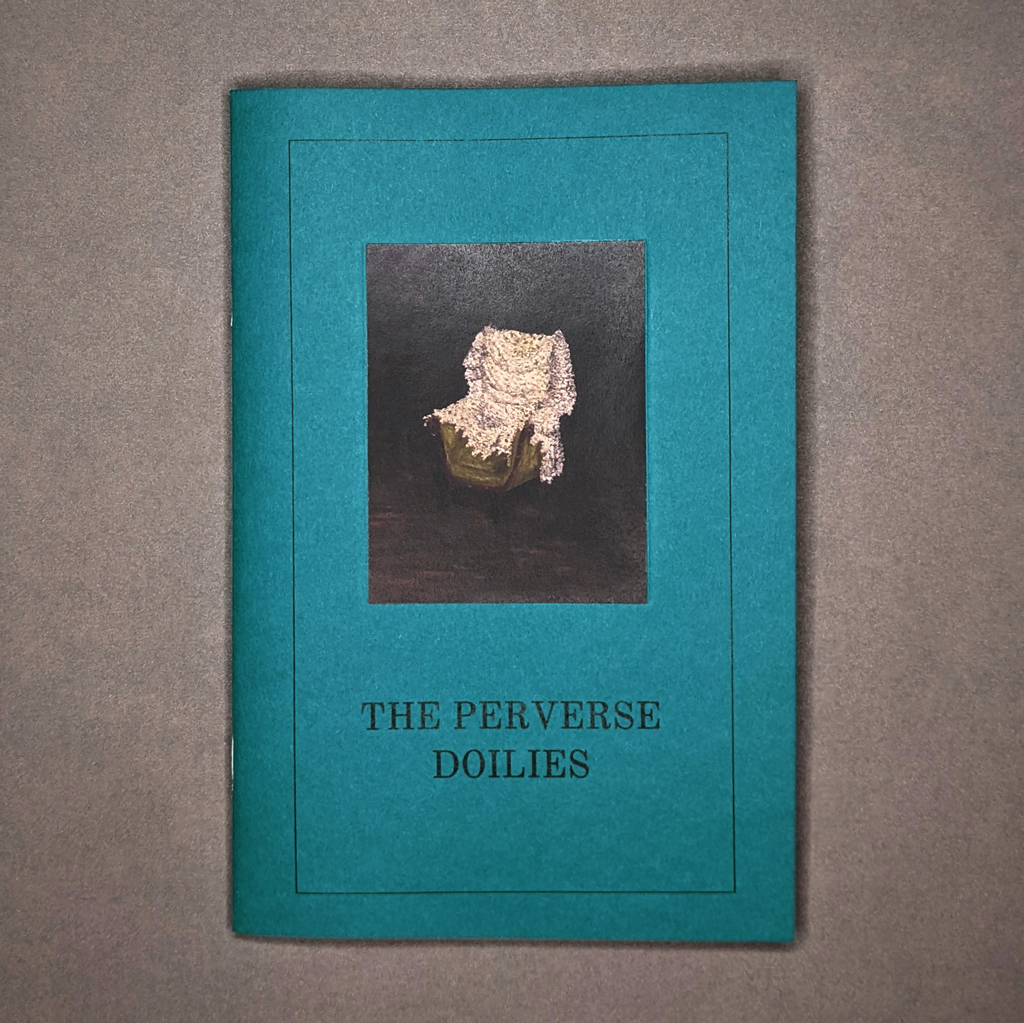
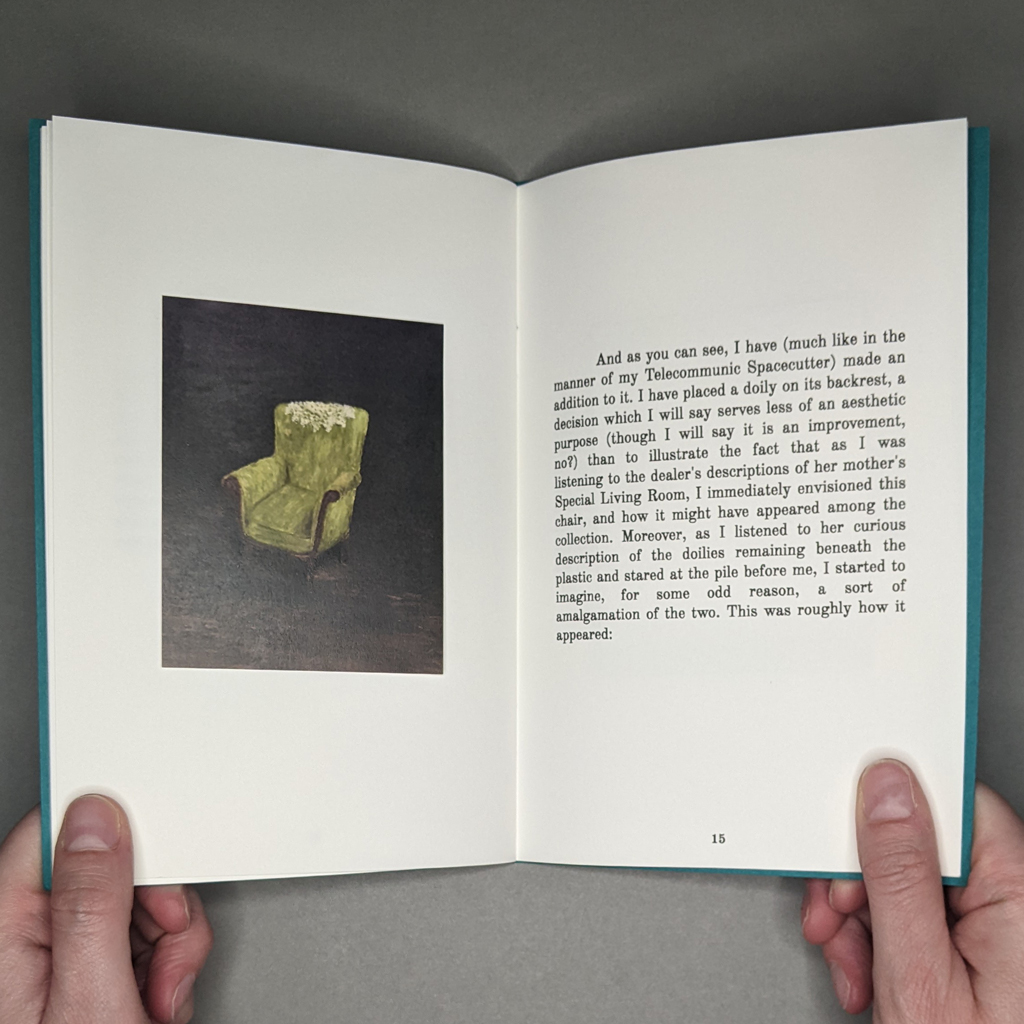
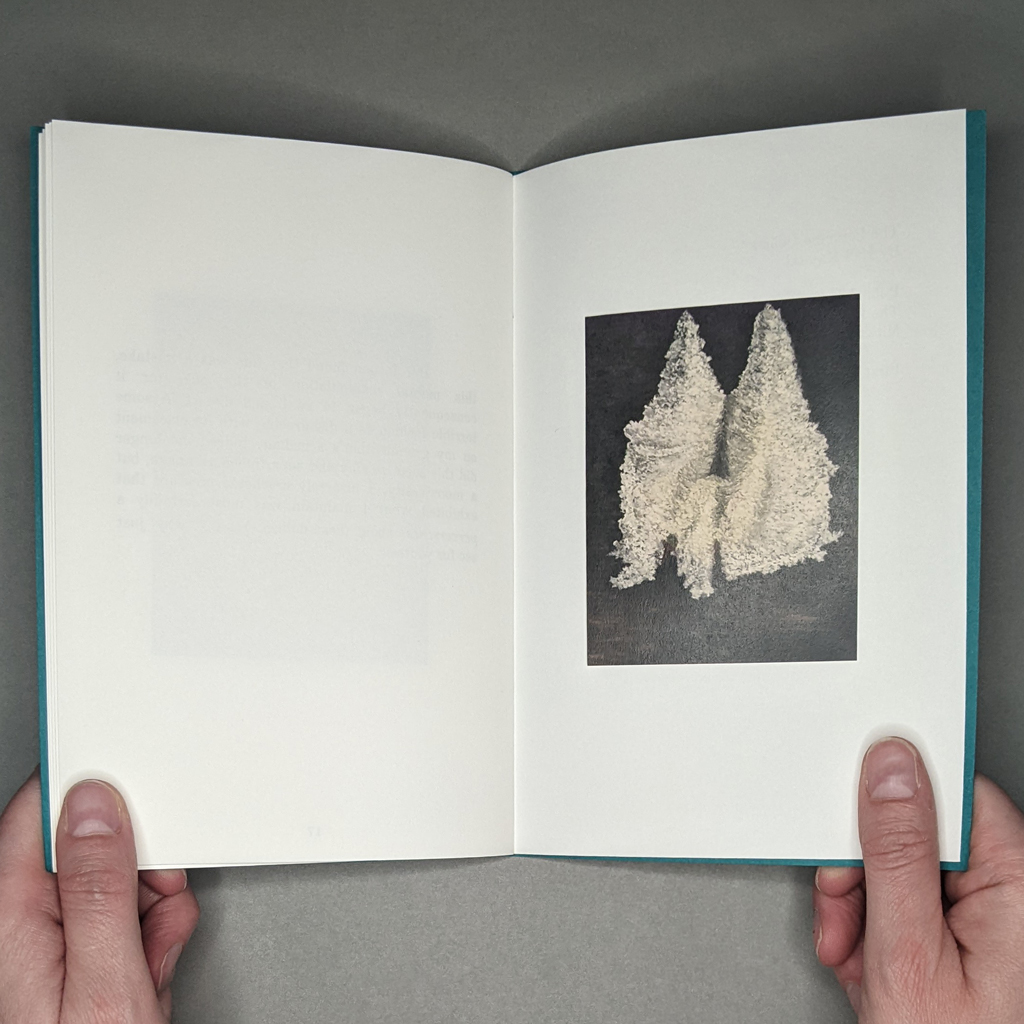
    The Perverse Doilies
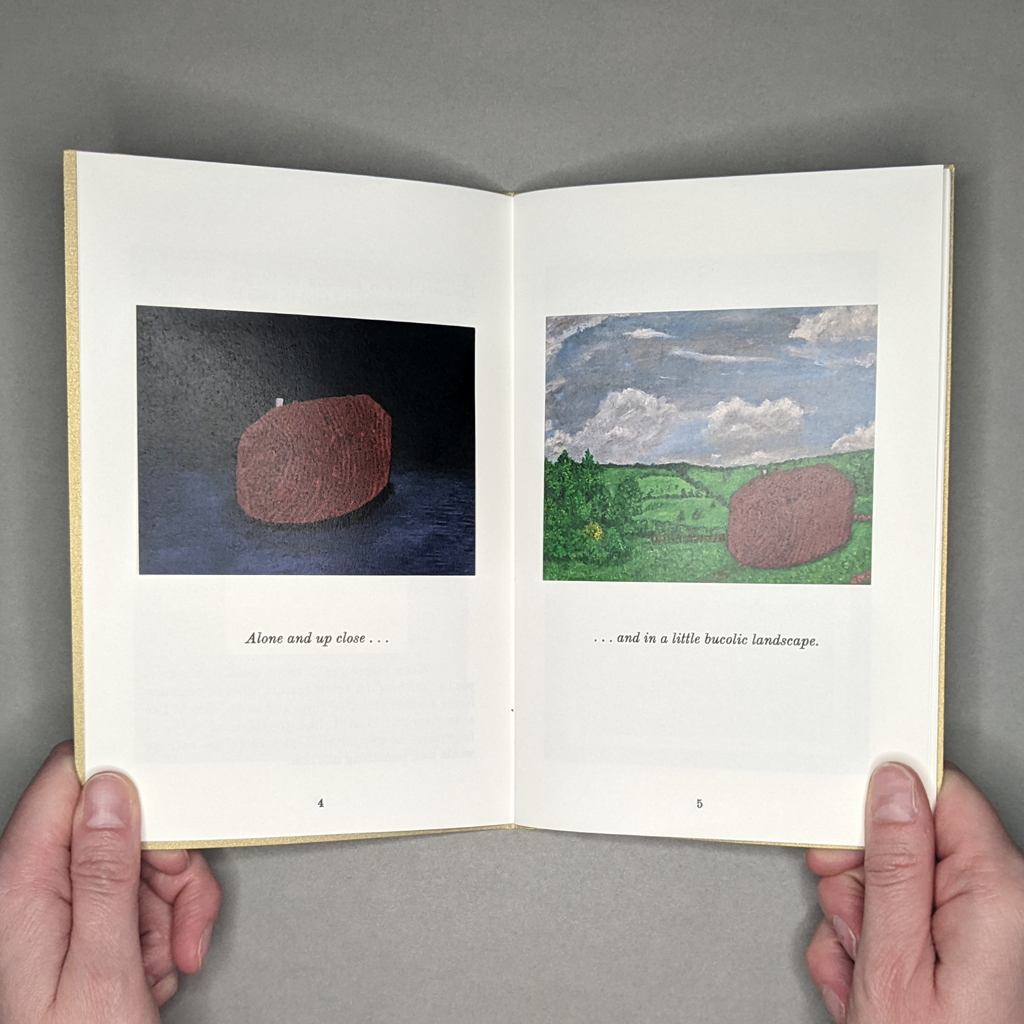
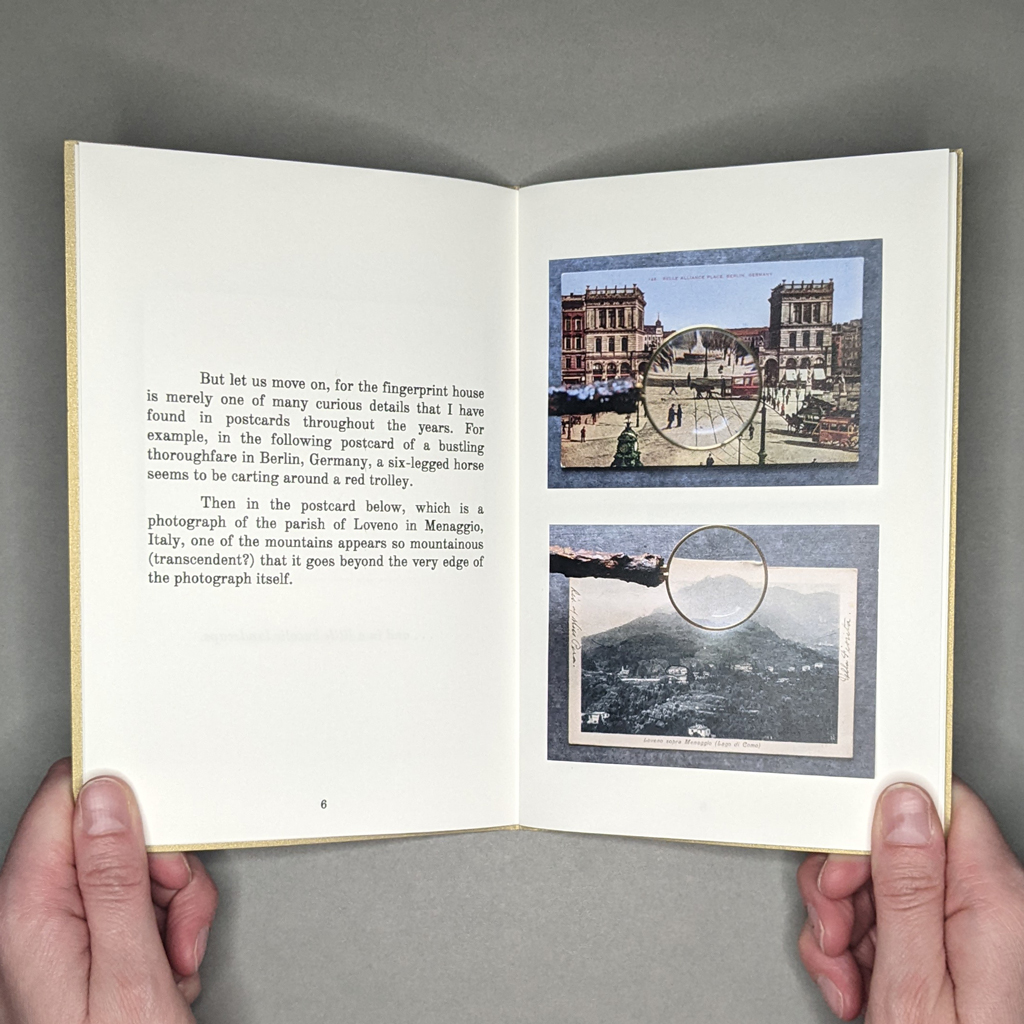
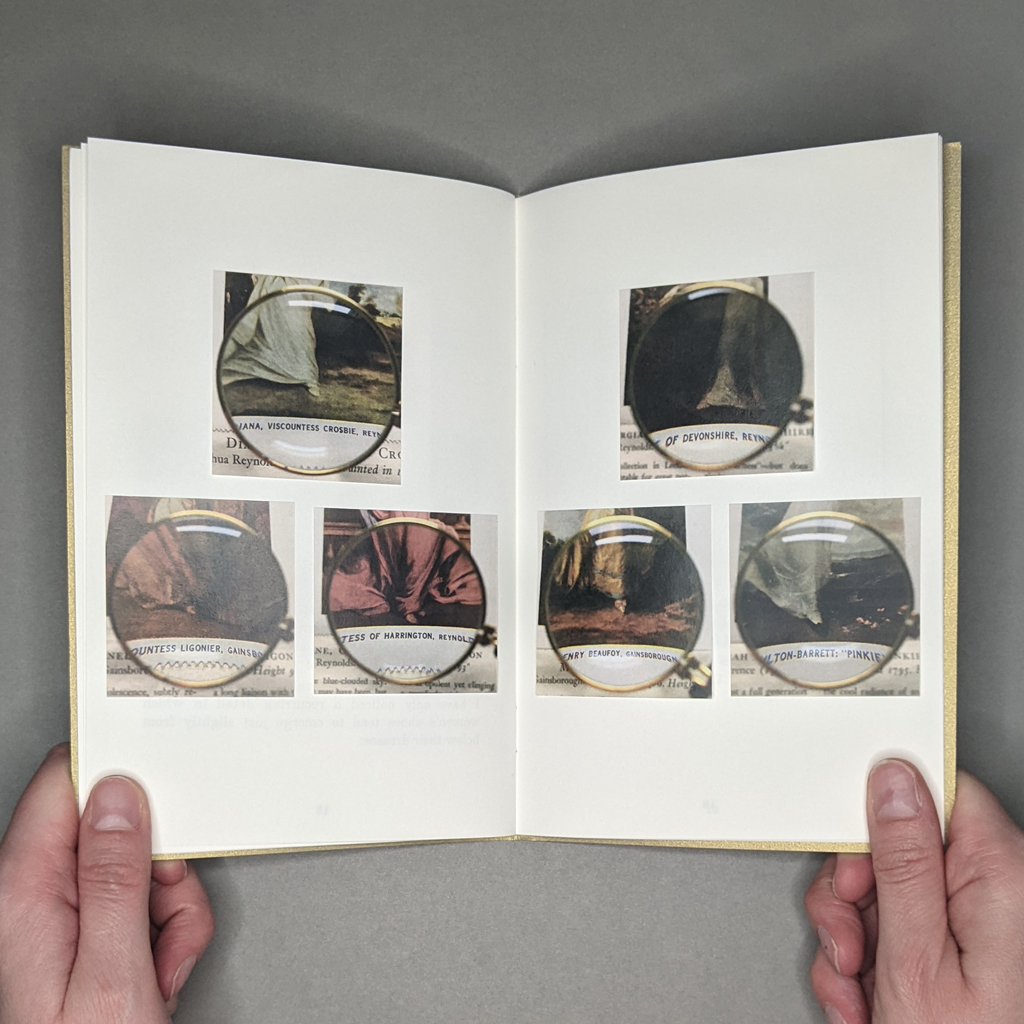
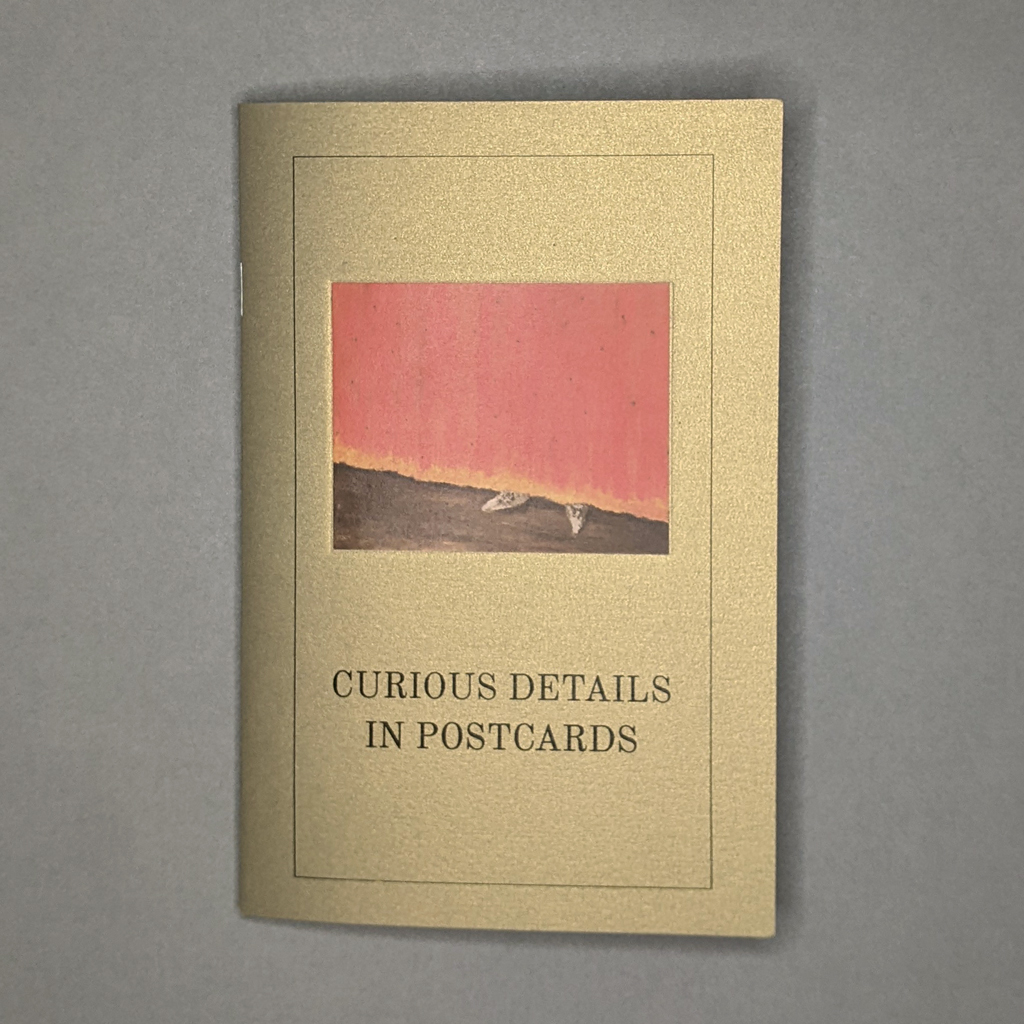
    Curious Details in Postcards
    Music of the Uncanny Soundscapes

    5 pamphlets in 2 rows. From top left: Depictions of a Developing Lampshade; The Chiliagon Locket: A Mental Exercise from My Childhood;
The Perverse Doilies; Curious Details in Postcards; Music of the Uncanny Soundscapes

    To review Neil Majeski’s The Last State or the Penultimate, a series of five interrelated publications, I will depart from the Artists’ Book Reviews format. After this overview, which will introduce the overall themes and shared elements of the five pamphlets, I will publish brief reviews of each work. (This format may also allow me to review future additions to this ongoing series, for which Majeski has planned two more publications.)

    Depictions of a Developing Lampshade, pp.2–3. Text on verso, reproduction of a painting of a lamp tipped in on recto.
    Depictions of a Developing Lampshade (2019)

    The pamphlets in The Last State or the Penultimate share a consistent look and feel. The page counts differ, but their size is the same, their saddle-stitch binding is the same, and their inside paper is the same. Each has a different cover paper, but the titles are set in the same face. The colophons are similarly consistent, and the typography and layout overall lend a sense of cohesion to the series. Perhaps the most notable feature is that the illustrations are tipped in like color plates in a vintage book, adhered along the top with three unfixed edges. This, and the typography, give the series a decidedly antiquarian feel that suits the subject matter, which often originates in estate sales, antique stores, or other, older books.

    Music of the Uncanny Soundscapes, pp. 12–13. Progressive paintings of an accordion tipped in on verso and recto, with text set beneath each image.
    Music of the Uncanny Soundscapes (2020)

    The physicality of tipped-in images also reminds the reader that images are also objects — and objects are of central importance to Majeski. Throughout the series, Majeski plays with the relationship between objects, images, and imagination. Objects are never fixed, and it is through their own agency as well as the agency of the viewer that they change. Objects change when they are put in dialogue with one another or set in new contexts, when we attend specific aspects of them or mentally will them into new configurations. So too does the entire series, The Last State or the Penultimate, change with each new pamphlet. Majeski suggests a reading order, but the pamphlets are unnumbered and develop as much through accumulation as sequence.  

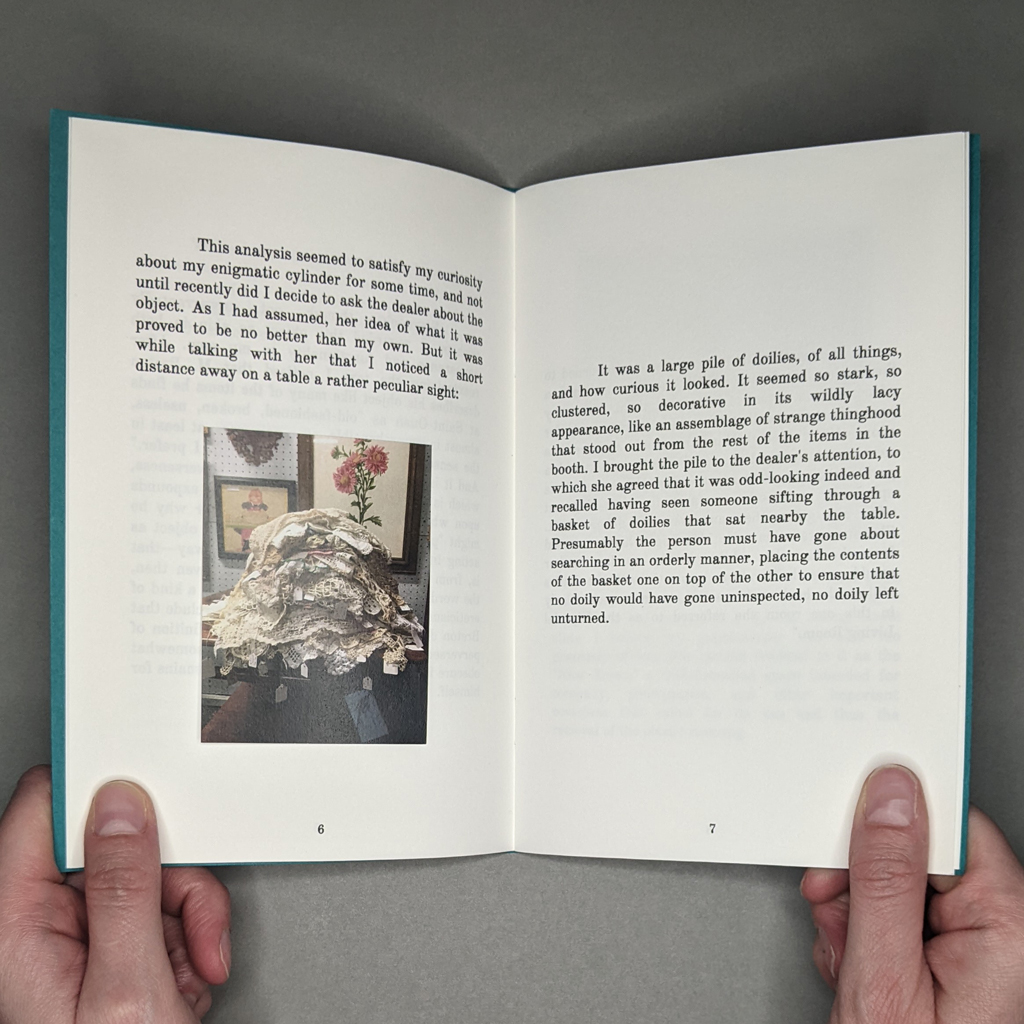
    The Perverse Doilies, pp. 2–3 Photos of a mysterious antique device tipped in on verso and recto, with text set beneath each image.
    The Perverse Doilies (2019)

    This, too, suits the subject matter of the individual publications, where Majeski explores sequence and seriality, changes over time, and the progression of time itself. While this is most obvious in illustrations, where the same object might morph from image to image, Majeski also subtly distorts time through his writing. The first- and second-person narration is emphatically present with deictic references to corresponding illustrations as if the pamphlet transcribes a slide lecture, but references to recent and distant past events push and pull the reader into other times, sometimes within the same sentence. The pamphlets also manipulate time through their pacing. All five are relatively short, but the length and pacing of each is tailored to its content. Text and image are carefully meted for the unit of the page and two-page spread to maximize the impact of a reveal or a text-image relationship. Despite their simple structure, these are thoughtful space-time sequences, not interchangeable containers of content.

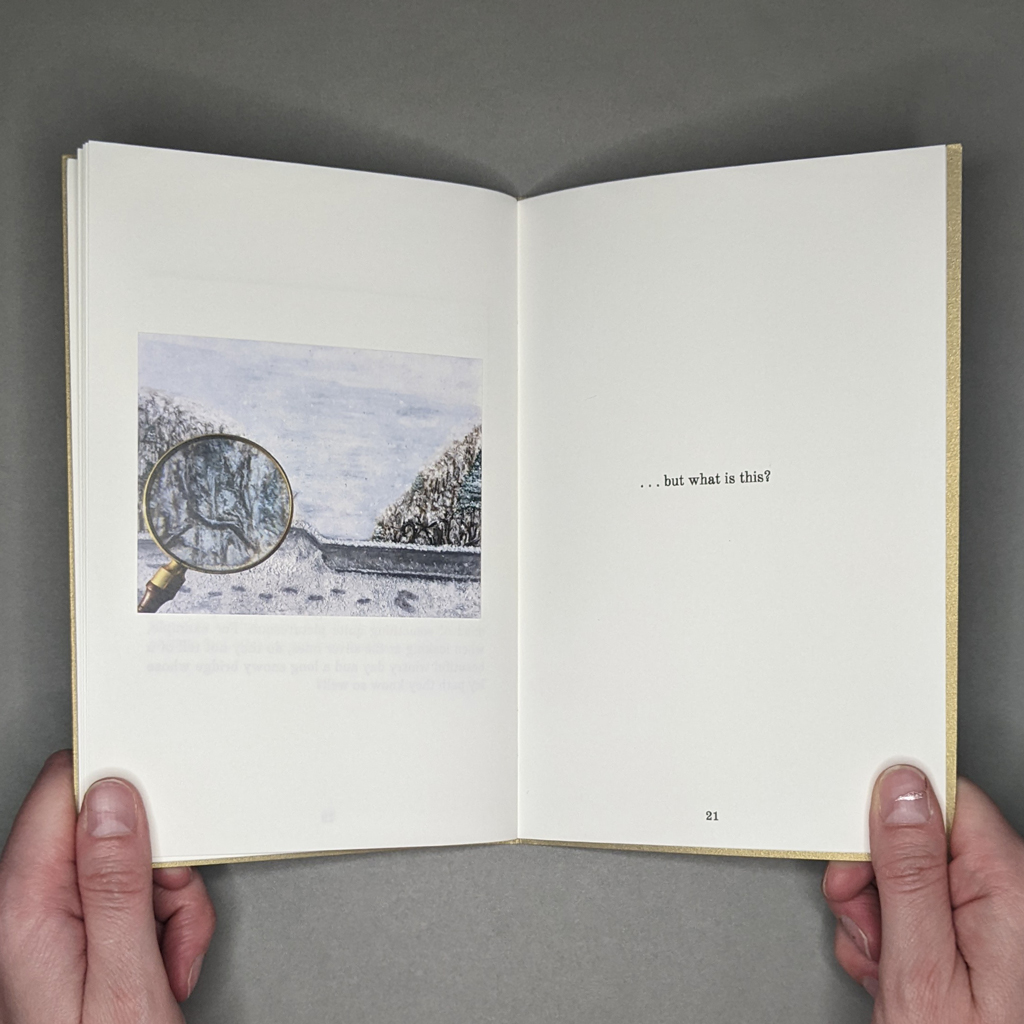
    Curious Details in Postcards, pp. 20–21. Photo of a postcard seen through a magnifying glass on verso, sing line of text on recto.
    Curious Details in Postcards (2019, 2021)

    In this way, the pamphlet format emphasizes the material presence of the text in the same way the tipped-in illustrations emphasize the physicality of images. Thus, just as Majeski’s objects act and are acted upon, the physical structure of the pamphlet co-determines the reading experience along with the reader. What could be better than a book to think through the ways objects change time and change over time, give form to experience, and invite and resist interaction and meaning?

    Levi Sherman

    March 30, 2023
    Review
    2019, 2020, 2021, Charcoal, Ink Jet, Laser, Memoir, Neil Majeski, Nonfiction, Pastel, Periodical, Photography, Saddle Stitch, Text
  • Stock Pile

    Stock Pile
    Areca Roe
    Design by Kelly Munson
    Foreword by Sheila Dickinson
    2021
    Self-published, printed by Edition One

    8.5 × 11 in. closed
    90 pages
    Perfect-bound softcover with French folds
    Laser

    Stock Pile front cover. Title text set in the upper right corner, over a staged photo of sunglasses and sliced watermelons.

    Stock photography is an uncanny reflection of reality. Its sanitization and anonymization of familiar settings function as a trick mirror, an almost-real representation that subtly but indelibly differs from what we encounter in everyday life.

    Stock Pile serves as a distorted reflection of that distorted reflection, highlighting the surreality of stock photography and more accurately — in an emotional and intellectual sense, if not a physical one — reflecting reality. Areca Roe, a multidisciplinary visual artist and member of TITLE Collective, both satirizes and reinvents the language of stock photo marketplaces and the aesthetic values of the genre.

    Her process is relatively simple, but results in a wide variety of works. Each image (a photograph or video still) is based on a prompt from one of three major stock photo marketplaces. Normally, these prompts serve as suggestions for photographers attempting to make and sell stock photos, predictions as to what types of content and style will sell well next quarter. Roe, however, deliberately misinterprets or over-interprets the prompts to create pieces thatsurprise and provoke emotion in a way stock photos rarely, if ever, do. The text of the prompt that inspired the image is included, sometimes helping the viewer to interpret the work and sometimes sharply contrasting with it.

    Most images are given an entire page or two-page spread, accompanied only by the brief text of the prompt. Occasionally, multiple images responding to the same prompt share a page. The large size of the images allows the reader to easily take in the finer details, while also imitating the appearance of magazine advertisements or billboards. The size and shape of the book and feel of the paper call to mind both the aforementioned magazines and exhibition catalogs—simultaneously placing stock photography in its expected context and asking us to view it as fine art.

    Stock Pile, pp. 28-29. Verso shows a photo of a girl holding a large teddy bear outdoors. Recto has text on a white background; the headline reads "solo outdoor activities."

    Roe uses herself, her husband, and her children as the models in images containing human figures. While this may have been as much a practical decision as an aesthetic one — much of this work was produced during the height of COVID-19 pandemic restrictions — it also fosters a sense of intimacy and personality. In most stock photography, the artist is totally unknown; credit is usually given to a company rather than the individual or team that actually produced the work. Here, the artist is often quite literally on display.

    This is only one of the ways in which Roe skewers stock photography as a quintessential product of late capitalism: a usually meaningless visual produced by someone not paid enough for their labor, most often used as advertising to sell equally meaningless products whose makers were paid even less.

    Stock Pile, pp. 44-45. Four portraits span verso and recto, showing parents and children eating junkfood made from household objects and craft supplies. Text on the verso has the headline: "junk food is comfort food"

    The content of the images pokes fun at the assumptions stock photos have primed the audience to make. In one set of video stills, she presents two well-plated meals exactly like what we would see on a cooking show or Instagram — except that the salad appears to be made mostly of veggie fries and the plate smeared with sriracha and yellow mustard. Another image consists of a woman practicing “self-care,” cucumbers over her eyes and a soothing mask on her face. Reflected in her hand mirror is a burning forest.

    While it is perhaps the most obvious interpretation of many of Stock Pile’s images, this satirical impulse does not overshadow the other main thrust of Roe’s work, which is more documentary: an examination of the way people live — and try to live normally — in unsettled times.

    An obvious and important inspiration for most of Stock Pile’s images is the ongoing COVID-19 pandemic. In her artist’s statement, Roe indicates she had been interested in making work about or imitating stock photography for some time, but it was in part the pandemic and its associated feelings and changes to daily life that made the project a reality.

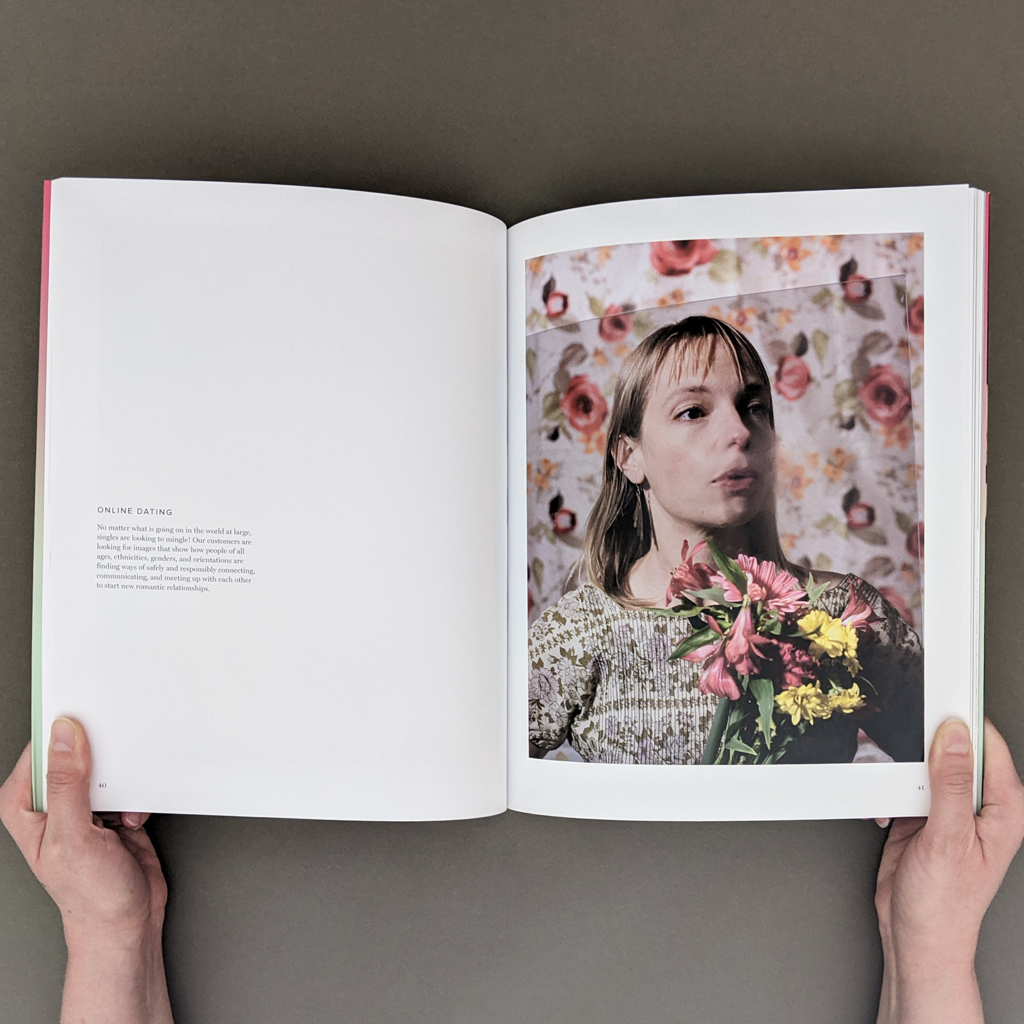
    Stock Pile, pp. 40-41. Recto shows a photo of a woman (the artist) with a bouquet behind a plastic screen or shield. Verso has text on a white background; the headline reads "online dating."

    The markers of COVID, and particularly those most uncertain and deadly early days of its spread, are everywhere in Stock Pile: face masks, empty shelves, working from home, an attempt to recreate the feeling of a dance club alone in the garage. Roe laments the devastation of the pandemic and laughs bitterly at the “solutions” advertisers offer, but also displays the more mundane feelings isolation produces: boredom, the awkwardness of masks and at-home haircuts, a longing for the familiar structure of the day.

    Tackling multiple subjects from multiple angles means the tone of the images varies greatly. In some works, this might be seen as a flaw, muddying the proverbial waters, but with regard to both stock photography and the experience of the pandemic, this nuance and willingness to hold different, sometimes contradictory feelings enhance the work.

    The wide variety of images, which jump from one tone or subject to another, mirrors the often jarring, sometimes amusing juxtapositions of radically different images in everyday media. In addition to the COVID throughline and reappearing models, this seeming disunity actually ties these images into a cohesive whole. When Roe follows an image of “the sublime” with a “fantasy, botanical, Nordic noir” book cover and a “subtle image of consumers wearing floral,” the experience is not unlike a serious piece of journalism being interrupted by a pet food ad, followed by one for a new antidepressant — except that Stock Pile’s version is a bit more fun.

    Stock Pile, pp. 84-45. Recto shows a photo of a woman (the artist) holding a pile of plastic containers and crying, with mascara running down her cheeks. Verso has text on a white background; the headline reads "emotional plastics."

    Because of its sheer ubiquity, stock photography creates reality as much as reflects it, allowing large companies to not only appeal to the way we live, but in some small way to shape it, repeatedly exposing us to their idea of normal: an idea driven more by profit and assumptions than reality or need. Stock Pile’s emotional variety and focus on surprise and humor contradict and counteract what Roe terms the genre’s “bland cheeriness” in her project statement.

    Instead of the calculated invisibility and inoffensiveness that seems the goal of much stock photography, Roe offers up a personal, messy look at human emotions and experiences. There are terrible moments and wonderful ones, and many shaded with both. Rejecting a normative, capitalistic view of the world, Stock Pile reminds the viewer not to forget the sometimes simultaneous beauty and absurdity of messy, contradictory life.

    Eric Morris-Pusey

    February 13, 2023
    Review
    2021, Areca Roe, Essay, Kelly Munson, Laser, Monograph, Perfect / Double-Fan Adhesive, Performance, Photography, Sheila Dickinson, Softcover
  • Owed to The Mountain

    Owed to The Mountain
    Diane Jacobs
    2021
    Scantron Press

    12.5 × 12.5 in. closed
    36 pages
    Single-section softcover pamphlet
    Digital inside with letterpress cover

    Front cover of Owed to the Mountain: blue letterpress printed title over an abstracted image of the surface of water

    Owed to The Mountain is a lavish tribute to Mt. Hood, which, on clear days, is still visible from Portland, where artist Diane Jacobs resides. The years-long project includes three versions of the book — an elaborate sculptural box set, a fine press edition, and a longer-run, digitally printed edition. This review will address the digitally printed version, whose exceptional production quality leaves little to be desired. Jacobs presents a kaleidoscopic view of Mt. Hood by transcribing and illustrating stories from indigenous people in the area, ranging from minimalist myths to conversational oral histories. Each story stands on its own, but together they form a longer arc about reciprocity and healing. In the title’s playful homonym, Jacobs sets a new standard for fine press publishing in the Anthropocene. She presents not just poetry, but a call to action.

    Before focusing on the digitally printed edition of Owed to The Mountain, it is worth addressing some features of the sculptural version. Inside each of the four sides of the box is a print depicting Mt. Hood from one of the four cardinal directions. The box unfolds into a square cross with these four views surrounding a cast paper model of the mountain. The mountain comprises three nested layers, representing different geological strata. The book per se — or, at least, the printed codex — slips out from beneath the model mountain. This brief description leaves out numerous features of the deluxe edition, which raises interesting (but here unanswered) questions about the ontological boundaries of “the book.” Nevertheless, the digitally printed version I am reviewing retains many of the same themes in its structure and layout.

    Owed to The Mountain, inside spread. Verso: Color print of the peak of Mount hood, echoed by a pyramidal cluster of pine trees. Recto: A creation myth about the mountain is typeset inside a square border.

    Even without a sculptural reading environment centered around a three-dimensional Mt. Hood, the book’s physical form echoes the mountain. The book is square, its four even sides referencing the four seasons, which play out within, and the four directions, each of which Jacobs renders with a different print process. While the tactile subtleties of these print techniques, ranging from relief processes to lithography and screen printing, are no doubt lost, the digital production preserves remarkable detail and visual texture. Rather than remaking the book digitally, Jacobs has created a facsimile of the fine press edition. The resolution of the scanning and printing is so high that the letterpress-printed text remains crisp and there is a discernible difference between the original book’s various papers, although the digital version is printed on the same stock throughout.

    Though simple, the book’s engineering also contributes to its success. The nine-hole pamphlet stitch keeps the book stable, and the paper drapes nicely without feeling delicate. At over two feet wide, the book is best read at a table, and fortunately lays open completely flat. Its large size makes it hard to take in the imagery at the same time as the text, lending it the feeling of a children’s book whose text is meant to be read aloud to someone who is enjoying the images. This orality seems especially well suited to the texts, which are transcribed from spoken word. The conversational, sometimes stream-of-consciousness quality of the stories emphasizes the vital present-ness of the indigenous storytellers. Though originally hand set in metal type, the stories in Owed to The Mountain are unfussy and contemporary — from a pandemic parable by a seventeen-year-old to the wide-ranging reflections of a Paiute Elder. 

    Owed to the Mountain, inside spread: An oral history is typeset in undulating columns to accommodate black and white images of a toad and snake

    Just as Jacobs approaches the mountain from all four directions and peels back the layers of its unseen history, she joins the multiple perspectives of her book’s contributors into a cohesive message about the ethics of interconnection. Of course, the bound codex format lends cohesion to the stories, as do the design constraints of hand-set metal type, but it is Jacobs’ illustrations that tie everything together. The book is just long enough to unify its wide variety of media and mark-making while maintaining a sense of variety and surprise.

    Animals, printed using solar plates, retain the fluid, transparent quality of Jacobs’ original Sumi ink drawings. Meanwhile their environments, especially the flora, are printed using sharper, more opaque processes. The animals may be rendered more softly, but their gaze is piercing, implicating the reader as an ethical subject. More than any other aspect of the book, the animals moved me to consider my impact on the environment. Yet even as they raise concrete questions about one’s actions in the world, so too does the presence of black and white animals in a color environment create a mythical or imaginary space, perhaps belonging to more than one time.

    Owed to the Mountain, center spread: A full-bleed 2-page spread in which black and white animals converge in a color meadow against a pale sunrise or sunset

    Indeed, the book’s temporality is spiral more than linear, circling the mountain as Jacobs does. Many of the indigenous stories bridge the inconceivable gap between human and geologic time, which so often stymies climate action. “All the mountains were once people,” begins a story by Myra Johnson-Orange and Átwai Geneva Charley of the Confederated Tribes of Warm Springs. At the same time, we witness the mountain change from one generation to the next, its (mis)management by the US Forest Service and grassroots efforts to encourage youth to become stewards of the land. The idea that we have reached a tipping point where humans must actively manage the environment to avoid catastrophe is not a new one — “Thousands of years ago,” Johnson-Orange reminds us, “…people took care of the earth, so that the animals and birds would have a beautiful and safe place to live and to take care of their families.”

    Owed to The Mountain, inside spread. Verso: A fluid black and white image of a wolf, turning to look back at the viewer. Recto: An endsheet covered in "nature printed" leaves from various plants.

    So, when Jacobs labels Owed to The Mountain a call to action, it is because there is still time left to act. It is an ode, not an elegy. And while I must admit that the book left me more contemplative than moved to action, that may just be the result of reading as a reviewer. For her part, Jacobs has committed 2.5 percent of proceeds to the Columbia River Institute for Indigenous Development. It is in this regard — the way Jacobs approached the project — that Owed to The Mountain is a call to action, a gauntlet thrown to other artists and publishers. Jacobs’ philanthropy is commendable, but what really matters is how she enacted the book’s ethics of reciprocity throughout its creation. The stories Jacobs presents are the result of thoughtful collaboration with members of the Warm Springs community, and she is meticulous in her acknowledgements.

    One reason I set aside my questions about where “the book” resides amid the various iterations of Owed to The Mountain is that the richness of the relationships that enabled the project, from Jacobs’ collaborations with indigenous storytellers and fellow artists to her connections with the more-than-human world around her, exceeds any book object. If I am moved to action, it is to pursue a publishing practice rooted in reciprocity, one that can only be seen from many perspectives and, even then, never completely.

    Levi Sherman

    January 23, 2023
    Review
    2021, Diane Jacobs, Fiction, HP Indigo, Letterpress, Memoir, Monograph, Nonfiction, Pamphlet Stitch, Scantron Press, Softcover
  • Copy No. 1

    Copy No. 1
    Edited by Vanessa Norton and Steven Trull
    2022
    Wasted Books

    6 × 7 in. closed
    74 pages plus a single-sheet insertion
    Perfect-bound softcover
    Digital printing

    Front cover of Copy No. 1. COPY is set over a photo of Cameron.

    Copy No. 1 is the first issue of a new periodical, a “magazine of recycled materials,” published by Wasted Books. As a celebration of plagiarism in all aspects of creative production, this debut issue includes art, poetry, music, pop culture, and profiles of notorious copycats. It concludes with a manifesto-style letter from the editors — a diagnosis of this late capitalist pandemic moment where every activity is monetized, and every object or relationship is commodified. There is no introduction; a book of copies about copies is sufficiently self-explanatory.

    In the spirit of copying, the cover of this first issue of Copy is taken from the first issue of another periodical: Semina. Editors Vanessa Norton and Steven Trull have swapped out the title text from Wallace Berman’s 1955 Semina cover, which features a photo of the artist known as Cameron (Marjorie Cameron). Berman’s 1957 arrest for obscenity seems to foreshadow Copy’s own brush with censorship — an erratum reproducing a printshop’s refusal to reproduce artist Johnny Ray Huston’s contribution, A Look at Nighthawk in Leather, is slipped between the blacked-out pages where Huston’s work should have been. Copy’s spine is taken from yet another publication, Paul Virilio’s Popular Defense & Ecological Struggles, but with “wasted” pasted over the MIT Press logo. Along with the editors’ manifesto, one can perhaps locate the politics of Copy between Popular Defense & Ecological Struggles and Semina. 

    Copy No. 1 inside spread. The recto is redacted with a black rectangle; the verso is covered by an erratum explaining the redaction.

    Visually, Copy reminds the reader that the word copy shares an origin with copious. Starting with the inside covers, it is bursting with full-bleed text and image. In a few cases, text is swallowed by the perfect-bound gutter, but most of the critical content is easily accessed. The maximalist aesthetic enhances the wide variety among the issue’s ten contributors. Amid the chaotic copiousness, each contributor is clearly announced with a name and title in black text on a white verso. A brief synopsis of each contribution is also included toward the end of the issue, which is especially helpful given the range of disciplines represented. However, the authorship is (fittingly) less clear when it comes to the profiles of forgers, copycat criminals, and other artists, which serve to expand the cultural context of copying from art per se and make connections between the issue’s contributors and other artists. Cribbed, naturally, from Wikipedia, these profiles may be key in shaping future issues of Copy to address different aspects of creative plagiarism.

    Copy No. 1 inside spread. Two artists' copies of Walker Evans' Tenant Farmer Wife mirror one another across the gutter.

    For this first issue, Norton and Trull show their commitment to unoriginality by opening with a contribution called Copy by Stewart Home. Home’s Copy is a copy of pages 62–66 from a book called Copy by Chus Martinez, a collective pseudonym adopted by numerous artists and activists. Distributed authorship, whether anonymous or attributed, is a key feature of Copy No. 1. An obvious example is Norton’s After Michael Mandiberg, which rephotographs Mandiberg’s rephotograph of Sherrie Levine’s rephotograph of Walker Evans’ Alabama Tenant Farmer Wife. If the piece elicits an eye roll, it also provokes deeper questions about appropriation and originality. A similar dynamic is at play in contributions by Derek Beaulieu and Eîlot Tuerie, both of whom appropriate turn-of-the-century composer Erik Satie’s composition Vexations, which was first published by John Cage in 1949.

    Copy No. 1 inside spread. Each page shows a mugshot of a copycat killer.

    A more surprising dynamic is introduced by the editors’ profiles of an entirely different order of copying. Forgers like Lee Israel and Mark Landis perhaps bridge the gap between artistic copycat and criminal, but we see a darker side of imitation in references to the Tylenol Murders, the Manson murders, and other so-called copycat crimes. Copying, it seems, is something done by people who are not in their right mind. The dismissive reaction that often meets uncreative works is not unrelated to this deep-seated mistrust of copying. Plagiarism is seen not only as unethical but as an affront to an entire culture that prizes originality and self-sufficiency. The artist Elaine Sturtevant, whose work is featured on the back inside cover of Copy No. 1, upset the art world as much for rejecting the avant-garde mandate for originality as for (intentionally imperfectly) imitating iconic artists who embraced that ideology.

    It is this unsettling of the usual values of the art world — originality and commodification — that drives Copy and connects its contributors with more established artists like Levine and Sturtevant. The artists seem united more by what they oppose than by any particular aesthetic program. Indeed, the letter from the editors is mostly a manifesto of what Copy will not do. Copy is not, strictly speaking, a pandemic project, but it positions itself as a diagnosis of and logical response to the various intersecting crises that characterize 2022. Copy gives an account of why plagiaristic practices arose in these cultural and economic conditions and how they contribute to contemporary art. The editors not only sidestep any futile “is it art?” debate, they remind the reader that copying remains provocative in the broader culture beyond the art world.

    Copy No. 1 inside spread. Verso: A screenshot with a closed caption "You're just copying!"; Recto an aerial view of a subdivision with a "you are here" sticker placed between two houses.

    At the same time, though, Copy No. 1 is undeniably self-reflexive. It is a work of piracy and plagiarism that explores the potential and limitations of appropriation and distributed authorship. It is no surprise that the first issue of a periodical would stake out its territory and reflect on its own methods. The future success of Copy rests in its ability to be about more than copying and more than art. If Norton and Trull continue to position their contributors within, against, and outside of the discourse of contemporary art, Copy will fill an important gap in a publishing landscape that is overly concerned with brand identity and monetization.

    This first issue shows the importance of producing and distributing such a publication, even if it only remixes existing works. The dialogue among contributions clearly illustrates the intertextuality that underpins uncreative art practices, while the spat with the printer shows that every copy introduces friction, entropy, and chance. What remains to be seen is what comes of the connections the publication will forge among its readers, contributors, and publishers.

    Levi Sherman

    December 29, 2022
    Review
    2022, Anthology, Derek Beaulieu, Eîlot Tuerie, Jake T. Webber, Johnny Ray Huston, Laser, Lydia Hounat, Melany Nugent-Noble, Perfect / Double-Fan Adhesive, Periodical, Photography, Rishi Dastidar, Softcover, Steven Trull, Stewart Home, Text, Vanessa Norton, Wasted Books, Yvonne Litschel
  • A Ghost Story: Photographs

    A Ghost Story: Photographs
    Bret Curry
    2021
    A24 Films
    Temper Books

    8 × 11.5 in. closed
    136 pages
    Smythe-sewn hardcover
    Offset inside with foil-stamped cover
    Edition of 500

    A Ghost Story: Photographs, front cover. A line drawing of a sheet ghost is foil-stamped on black bookcloth with silver glitter.

    We expect ghost stories to scare us. Whether they’re shared on screen or around a campfire, we expect our surroundings to be dark, making the eeriness even creepier. Ghost stories should leave us looking over our shoulder, keeping all the lights on. But not this one. Curry presents a passive, spectating ghost that is the embodiment of the memory of a past life and relationship. As readers, we are invited to reflect on what ghostly memories are following us, and what role we have as spectators.

    A Ghost Story: Photographs is a photobook that represents and documents the 2017 feature film A Ghost Story. In it, we get photographs of the set, crew and their equipment, cast both in and out of character, and stills from actual scenes, most of which are close-up or medium shots. The book can stand alone, but reading a short synopsis of the film provides helpful context to the characters. This tangible version of the film is heavy even for its coffee table size, but is relatively short. There is plenty of whitespace to show off the thick, semi-gloss paper. Interspersed are black pages with short quotations from Virginia Woolf’s A Haunted House. The only other text, besides a short introduction by the film’s director David Lowery, is a few single-page excerpts from the screenplay. The layouts vary, with one or two images per spread; some include a full page of whitespace and others feature images that reach over the gutter onto the second page.

    A Ghost Story: Photographs, inside spread. Verso is blank. Recto shows a black and white photo of a man playing dead on the floor, wearing a T-shirt printed with the book's cover image.

    Although the black cover is reminiscent of the darkness with which we surround ourselves to make ghost stories scarier, the playful cover image of a sheet ghost by Casey Affleck, who plays the ghost, and the glitter in the bookcloth hint at the tone of the book. Instead of jump scares and a violent backstory, this book reveals as its ghost a past companion that looks in on our protagonist with longing and love. I opened this book expecting a single ghost story. But the further I read, the more I felt myself to be the ghost, invisibly observing the contents of the photographs as if floating through the house myself alongside the protagonist’s deceased husband. Like the viewer, he watches the protagonist without being able to interact with her.

    The calm domesticity of these images recalls the opening scenes of many haunted house movies, where the family (or, in this case, a single woman) moves into a perfectly lovely house and everything is going well until it isn’t. But Bret Curry’s photographs stay softly lit, devoid of the shadowy fears we expect from the genre. Even in the darker black-and-white images, the shadows serve more to enhance the lighted subjects. The domesticity of the images is further enhanced by Curry’s use of closeups; the intimate framing puts us right in the house with our protagonist. We become ghosts who watch her. A great haunting movie typically makes me dread all the unexplained sounds in my house, turning them into ghosts and ghouls creeping around the corner. Instead, after reading this book, the ghosts I see in my apartment are the memories I’ve made here. This book is no horror story, after all, but a romance between a ghost and his widow.

    A Ghost Story: Photographs, inside spread. Verso is blank. Recto shows a warm-toned close-up photograph of a couple cuddling.

    This one-sided relationship between the ghost and the protagonist is as painful as unrequited love, as the ghost is literally invisible to the person he desires. Still, his presence in the house is light and playful. In a typical ghost story, it is often guilt, greed, and abuse that haunt a home, but this ghost is the memory of a loving, gentle husband, a manifestation of a memory wrapped up in the sheets of the former marital bed.

    The ghost itself is both serious and silly. The tone of the photographs — depicting closeups of abandoned objects and unsmiling subjects — is often serious. But the somewhat-cartoonish ghost is a fully-grown adult under a sheet with eye holes, much like the Peanuts characters out for Halloween. The death of the character is tragic, as are his forced passivity and disconnection as a ghost, but we can also see him as a person in costume, particularly when we see the film crew adjusting his sheet or otherwise interacting with the actor. Throughout the book, scenes from the movie are interrupted by scenes from its production, where equipment and crew members remind us that what we are seeing is staged.

    A Ghost Story: Photographs, inside spread. Verso and recto show horizontal photographs of broken furniture and demolition detritus in a derelict indoor space, with ample white space above and below.

    These crew members haunt the house more as poltergeists than as passive sheet ghosts. The film’s characters are fully unaware of these watchers, but they actually have control over the situation, manipulating not only their equipment, but the characters themselves. We sometimes see the crew, but more often see evidence of their presence: their equipment set up to better see and document the characters they control. The crew members’ invisibility then comes from their control over the situation instead of adding to their powerlessness. Like the sheet ghost, the crew is both serious and silly. The high value of their equipment and the detailed nature of the setup is juxtaposed against someone playing dead in a T-shirt printed with the cover drawing.

    A Ghost Story: Photographs, inside spread. Verso is blank. Recto shows a photo taken through a doorway of two crew members adjusting the sheet on a sheet ghost.

    As readers, we have only a small bit of control over our experience. We can flip back to various points in the book and decide how long to spend on each spread, but Curry dictates the book’s sequence — and its contents. In fact, we don’t even get page numbers to better orient ourselves within the book, and instead float through the pages almost timelessly.

    What we are left with at the end of the book is a glimpse into production as well as a produced work of art in itself. After spending time between these pages, I cannot help but think of the memories in my life that have become ghosts following me around in my apartment, and whose houses the memory of me haunts.

    Abigail Guidry

    November 28, 2022
    Review
    2021, Bret Curry, Documentary, Fiction, Foil Stamp, Hardcover, Monograph, Offset Lithography, Photography, Smyth Sewing, Temper Books
←Previous Page
1 2 3 4 5 6 … 10
Next Page→

    • Instagram
    • Mail
     

    Loading Comments...
     

      • Subscribe Subscribed
        • Artists’ Book Reviews
        • Join 78 other subscribers
        • Already have a WordPress.com account? Log in now.
        • Artists’ Book Reviews
        • Subscribe Subscribed
        • Sign up
        • Log in
        • Report this content
        • View site in Reader
        • Manage subscriptions
        • Collapse this bar